


You know the feeling. You finish a heavy overhead set, rack the bar, and your shoulder gives you that sneaky little twinge. Not enough to stop training. Just enough to make you wonder: is today the day this gets worse?
Yeah, we know that feeling too. At Anaconda, we hear some version of that story from lifters, CrossFitters, and contact sport athletes every single week.
Here is the thing: The shoulder joint is incredible. It offers close to 360 degrees of rotational freedom, making it the MVP for pressing, snatching, and throwing. But that same freedom is exactly why it is the most commonly dislocated joint in the human body.
A shoulder brace for prevention is not about training scared. It is about training smarter. Read on to find out how it works, who needs one, and how to get the most out of it. Protecting your shoulders starts here.
Key Takeaways
-
Over 95% of shoulder dislocations happen in an anterior direction, and a brace limits the exact range of motion that puts you there.
-
Prophylactic shoulder bracing cut injury-related time lost from 36.6 practices and games to just 8.7 in a study of 45 collegiate offensive linemen.
-
Brace compression stimulates skin receptors and measurably improves proprioception in unstable shoulders.
-
Wearing a brace for 2 to 4 hours per session can start to reduce the natural stabilizer strength. Keep it session-specific.
-
A shoulder brace works best as part of a wider system, not as a substitute for actual shoulder work.
How a Shoulder Brace Actually Protects Your Shoulder
Picture the shoulder like that fearless friend who volunteers for everything. It does the most work, takes the most hits, and somehow stays smiling. Until one day it does not.
The glenohumeral joint offers incredible range but sacrifices structural stability to achieve it. For athletes who go heavy, go overhead, or absorb contact, that trade-off is where shoulder injuries live.
So what does a shoulder brace actually do when you put it on? Here is the breakdown:
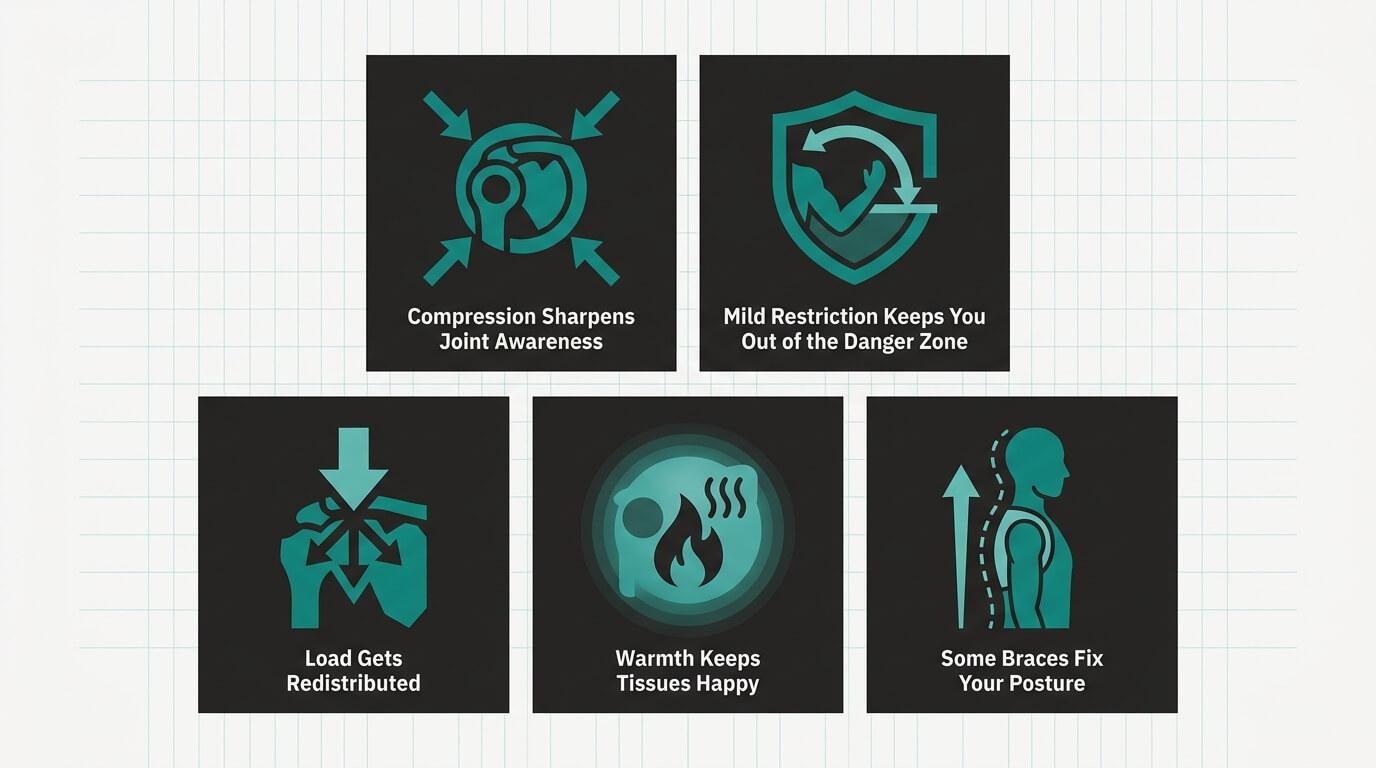
Compression sharpens your joint awareness. Gentle pressure stimulates skin receptors and improves proprioception, which is your brain's real-time read on where your arm is in space.
A study in the Journal of Athletic Training confirmed that neoprene shoulder bracing measurably improved active joint-reposition sense in unstable shoulders by increasing cutaneous input. That matters most in those last few reps, when your form starts to drift.
Mild restriction keeps you out of the danger zone. A brace applies just enough resistance to discourage the extreme external rotation and abduction that cause most shoulder dislocations.
Research confirms that over 95% of shoulder instability events occur anteriorly, triggered by those end-range positions. Your brace helps you stay just inside the safe zone.
Load gets redistributed, not dumped on the rotator cuff. A shoulder brace spreads the weight of your arm and external forces across the chest and opposite shoulder.
That means less direct strain landing on rotator cuff tendons and ligaments during heavy pressing, which is where rotator cuff injuries love to accumulate over long training blocks.
Warmth keeps your tissues happy. Neoprene retains heat and improves blood flow to superficial tendons, helping tissues stay pliable during warm-up sets when cold muscles are most at risk.
Some braces fix your posture while you lift. Certain shoulder supports guide the shoulders into a neutral, retracted position, actively preventing the forward slump that leads to chronic impingement over time.
Basically, it is a technique cue you wear. Not bad for something that fits under your T-shirt.
Benefits of Wearing a Shoulder Brace for Prevention
For the right athlete, preventive bracing does more than protect. It lets you train harder, stay consistent, and walk into heavy sessions without that background dread of blowing your shoulder up again.
Here is what it actually delivers in practice:
-
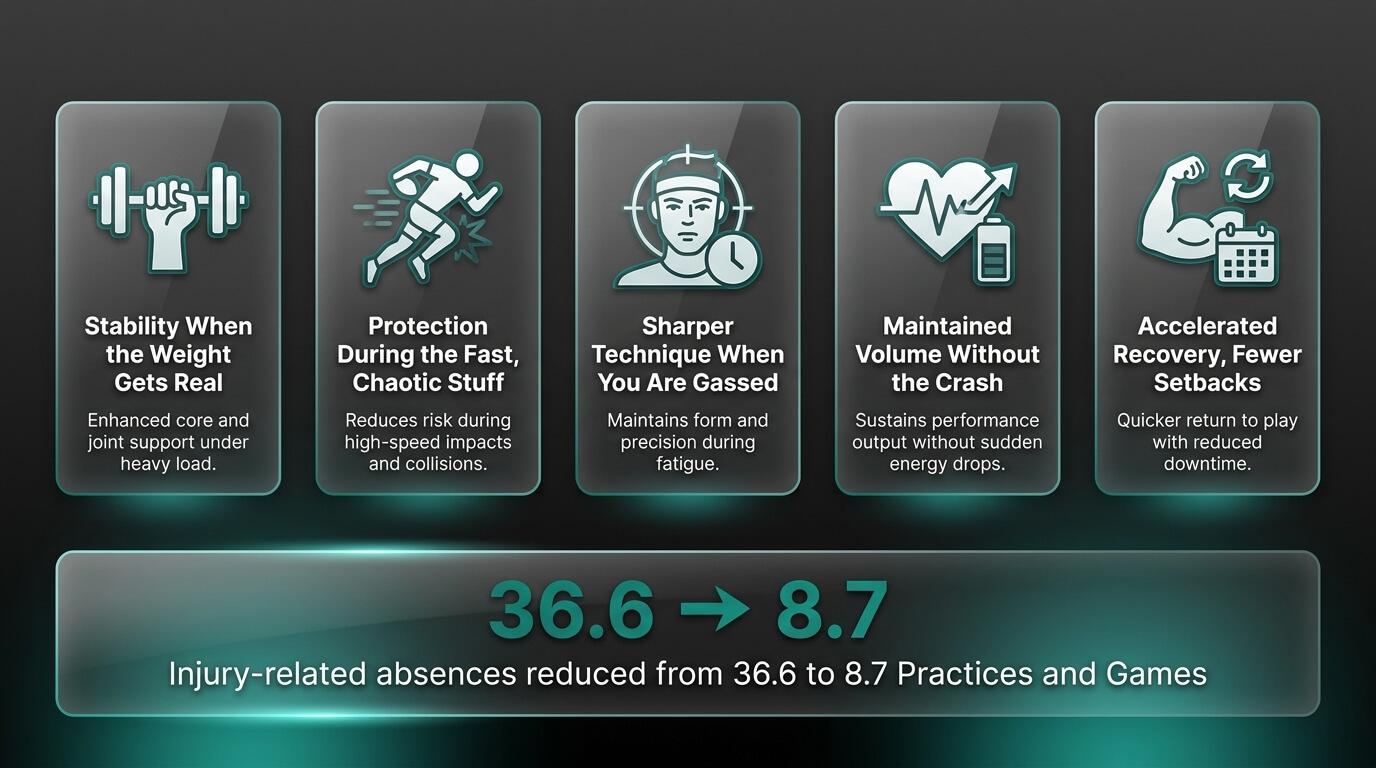
Stability when the weight gets real. A shoulder brace reduces micro-movements in the joint during bench press, overhead press, jerks, and dips. This matters most when you are pressing 1.5 to 2 times your bodyweight, and subtle joint shifting starts accumulating across working sets, loading up your cartilage and tendons rep by rep.
-
Protection during the fast, chaotic stuff. Kipping pull-ups, muscle-ups, and snatches can push the shoulder into extreme external rotation at speeds exceeding 1,000 degrees per second. A brace keeps you away from the ranges where labrum tears and sprains love to happen.
-
Sharper technique when you are gassed. Compression improves proprioception, so your brain gets clearer position feedback even when you are three rounds deep, and your mechanics are slipping. Some shoulder supports even guide you into a retracted shoulder position mid-session, turning your brace into an always-on posture coach. No extra fee required.
-
Maintained volume without the crash. Whether you are mid-season, peaking, or managing a shoulder that flares under volume, a brace offers extra support without forcing a full deload. Wearing a shoulder brace during these phases may also help speed healing from minor irritation by providing stability and protection while you keep moving.
-
Confidence that is backed by actual data. Athletes returning after a prior shoulder strain often develop protective guarding patterns that create new imbalances. A brace helps close that confidence gap. As mentioned above, prophylactic bracing cut injury-related absences from 36.6 to just 8.7 practices and games in a study of collegiate offensive linemen. That is not a placebo. That is real-time back on the platform.
One thing to keep front of mind: A shoulder brace for prevention is one layer, not the whole system. It works alongside rotator cuff strengthening, scapular stability work, and smart programming. The brace is a tool. Your discipline is the foundation.
When Does a Preventive Shoulder Brace Make Sense?
Not every athlete needs one, and wearing a brace when you genuinely do not need it is just dead weight in your gym bag. Here is how to figure out if you are in the right camp.
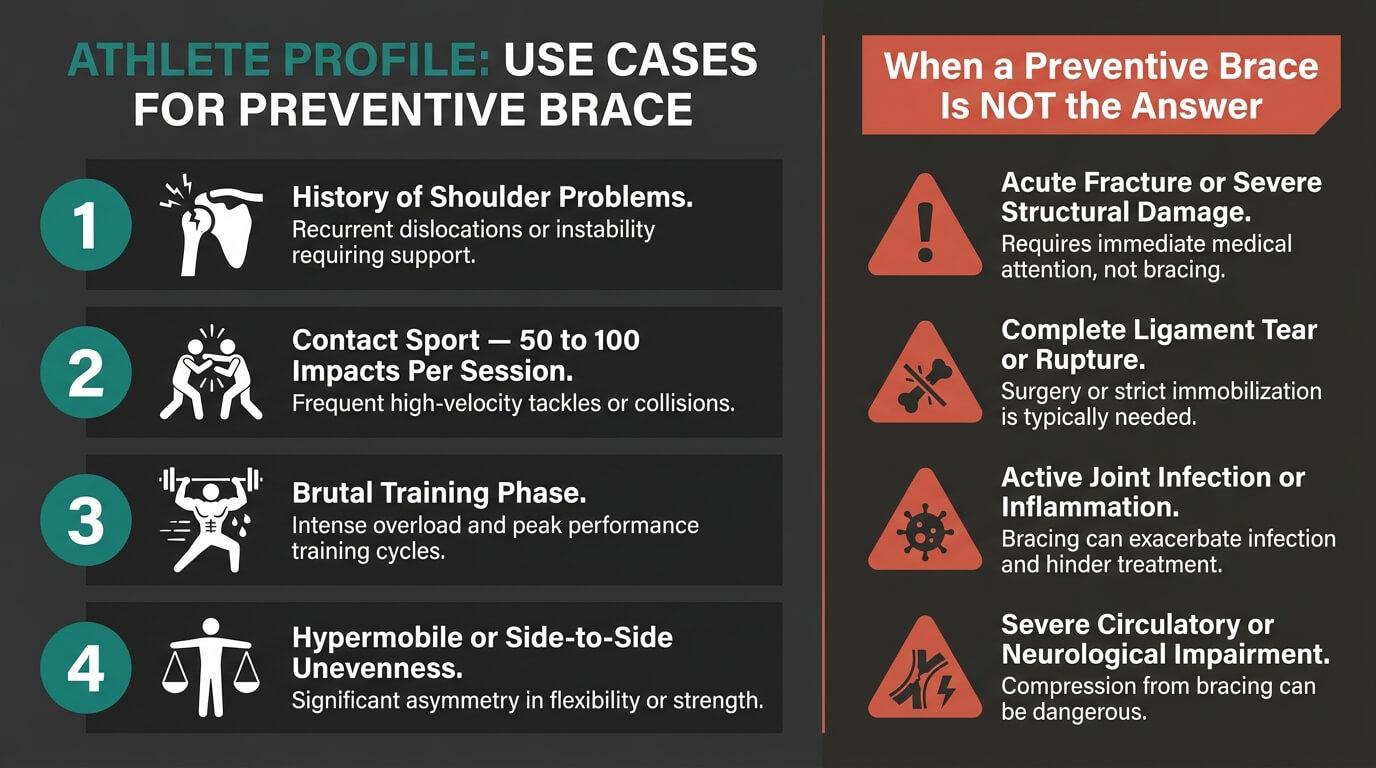
1. You have a history of shoulder problems, but feel fine right now.
If you have had prior impingement, labrum irritation, bursitis, tendonitis, or AC joint sprains that tend to flare during heavy overhead sessions, preventive bracing can help you stay consistent through demanding blocks.
Shoulder braces are commonly used for rotator cuff injuries, dislocations, shoulder instability, tendonitis, and bursitis. Moderate compression during high-risk movements helps keep borderline shoulders healthy before they become injured.
2. You play a contact sport, and getting hit is just Tuesday.
Football players, especially linebackers, running backs, and tight ends, absorb 50 to 100 contact impacts per session.
Rugby, wrestling, judo, BJJ, and overhead throwing sports all dramatically increase the risk of shoulder instability. When collisions are part of your game description, preventive bracing gives you measurable protection through every impact.
3. You are in a brutal training phase with nowhere to hide.
CrossFit Open prep, powerlifting peaking cycles, and Olympic weightlifting meet preparation push shoulders hard multiple days per week for extended periods.
When rest is limited, and volume is high, a brace helps manage cumulative strain on cartilage, tendons, and tissues across the entire block without forcing you to back off the work you have been building toward.
4. You are hypermobile or have noticeable side-to-side unevenness.
If your joints are naturally very mobile, or one side tends to collapse at end ranges more than the other, a preventive brace helps stabilize movement patterns before that asymmetry becomes further injury.
When a Preventive Brace Is NOT the Answer
If you have sudden sharp pain after a traumatic event, visible deformity, numbness down your arm, or cannot raise your arm above shoulder height, a brace is not your solution. That is a signal to stop and see a sports medicine professional.
Delayed diagnosis can increase the likelihood of needing surgery by 20 to 30 percent in some shoulder injury cases. The Anaconda shoulder brace is built for high-use, high-risk athletes who are currently training, not as a workaround for a serious injury.
Shoulder Brace for Prevention vs. Other Shoulder Supports
The term shoulder brace gets slapped on everything from a paper-thin sleeve to a full post-surgical immobilizer. They are absolutely not the same thing, and picking the wrong one means either missing the protection you need or sacrificing range you cannot afford to lose.
Here is how to tell them apart quickly:
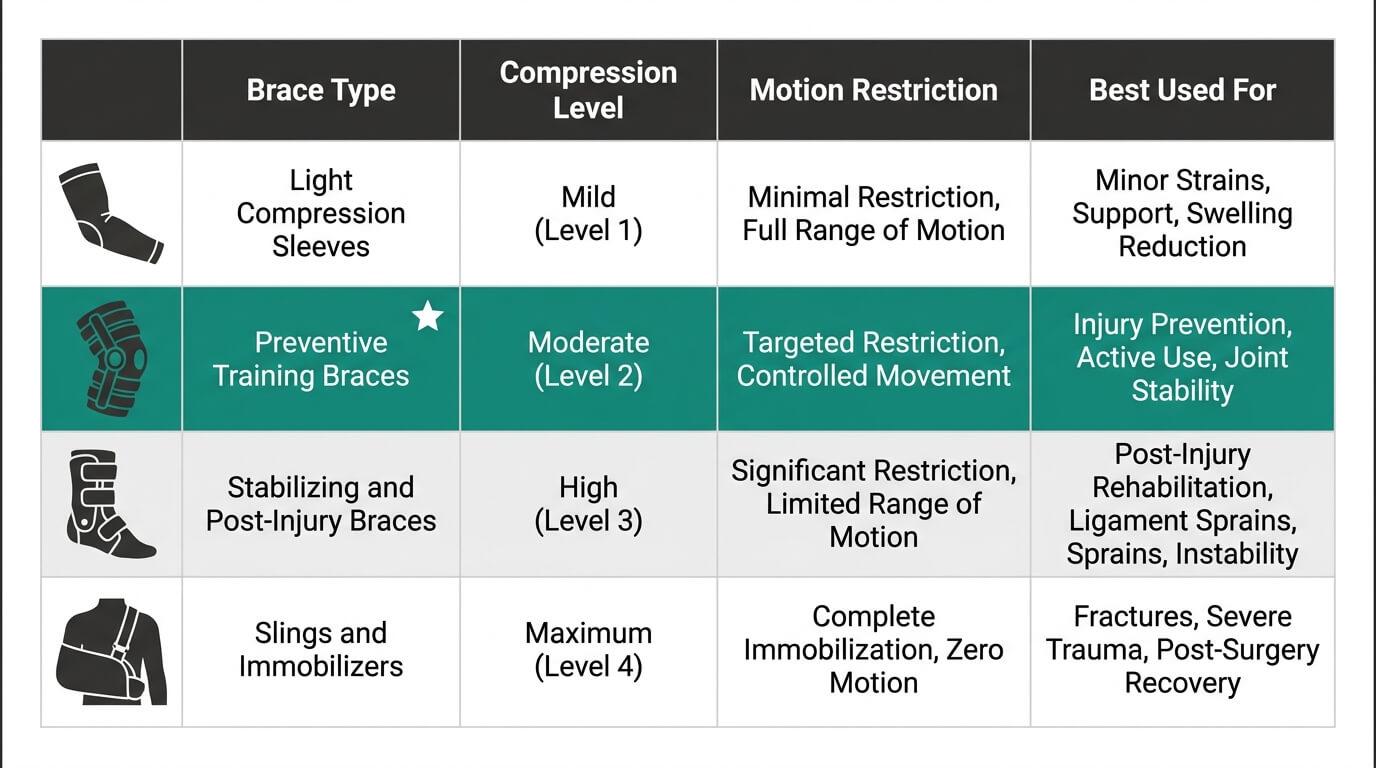
1. Light compression sleeves
Thin, flexible, minimal motion restriction. Great for mild warmth and everyday comfort. Under heavy or dynamic loads, they fail because they lack strap-enforced limits. If you are doing serious overhead work or contact drills, a sleeve alone is not enough. Think of it as the shoulder equivalent of wearing a bandana as a helmet.
2. Preventive training braces
Moderate compression plus targeted adjustable straps that limit risky end ranges while still allowing full overhead range of motion.
These are designed to be worn under clothing during high-risk sessions without restricting elbow movement or digging into the axilla during dips or snatches.
Using a shoulder brace in this category can help limit the range of motion that can lead to dislocation and enable safer rehabilitation exercises when recovering from minor irritation.
This is exactly where the Anaconda shoulder brace sits. Built specifically for athletes who press, pull, and go overhead, it delivers targeted compression with adjustable straps for a perfect fit that moves with your technique rather than fighting it.
It fits under a T-shirt or jersey without slipping during sweat-heavy sessions and delivers flawless motion that balances real protection with a full performance range. Trusted by lifters, CrossFitters, and contact sport athletes across Australia and beyond.
3. Stabilizing and post-injury braces
Bulkier designs that significantly restrict the range of motion after shoulder dislocation, labrum repair, or rotator cuff surgery.
Stabilizing shoulder supports prevent reinjury by limiting movement more aggressively. They are not built for high-intensity training without medical clearance. Immobilization is the priority, not performance.
4. Slings and immobilizers
Complete rest and maximum stability after severe rotator cuff repairs or serious dislocations.
A shoulder dislocation brace in this category has absolutely no role in active training or prevention. If you are in one of these, the gym will still be there when you are cleared.
How to Use a Shoulder Brace for Prevention Safely
Getting the brace is half the job. Wearing it correctly is what actually determines whether it protects you or just gives you a false sense of security. Let us make sure it is the former.
Getting the Right Fit and Adjusting It
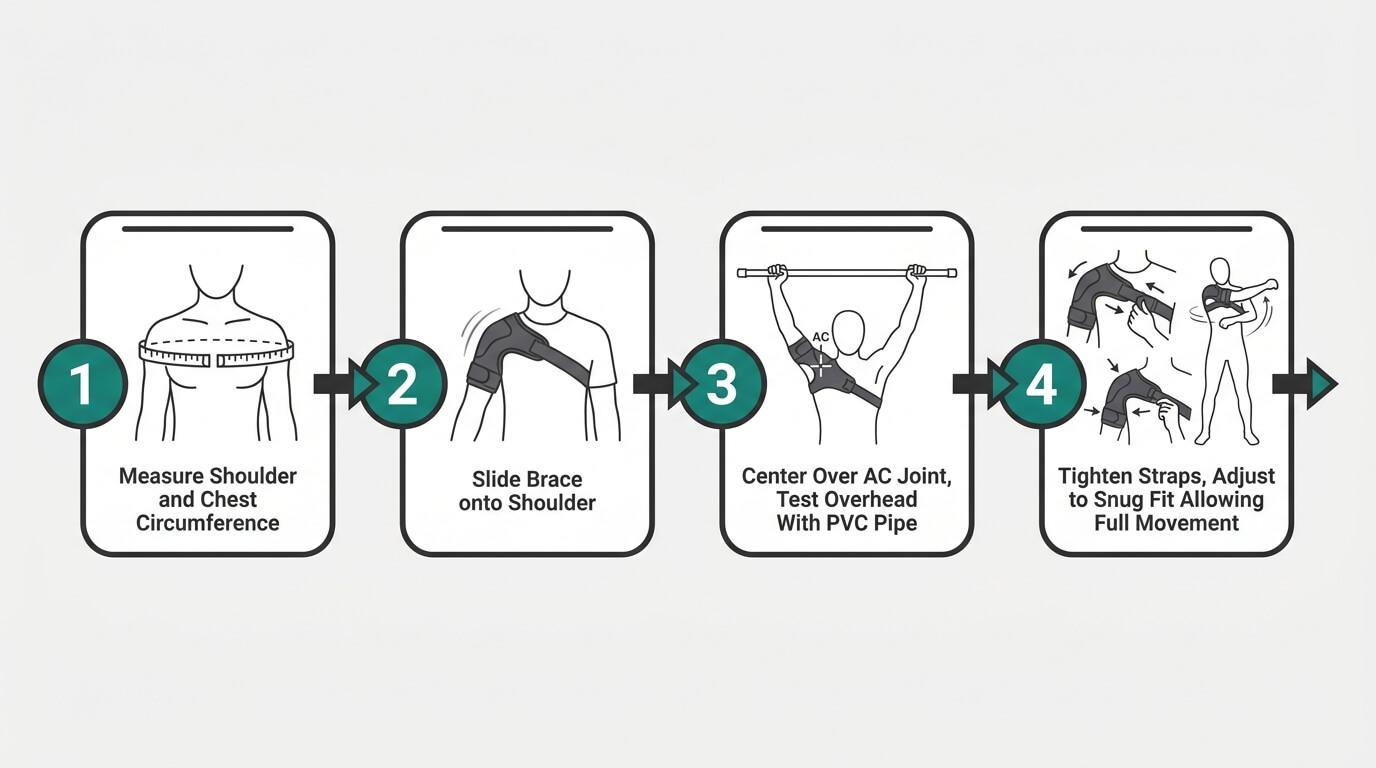
To wear a shoulder brace correctly, start by measuring your shoulder and chest circumference rather than guessing from your T-shirt size. Many braces come with adjustable straps for a customized fit, but baseline sizing determines whether those adjustments can actually achieve a good fit.
A preventive brace should feel snug and compressive without cutting off circulation or causing numbness in the arm, hand, or elbow. The straps should hold the brace firmly enough that it does not rotate during kipping movements or overhead pressing. A brace that shifts defeats its entire purpose.
Follow this quick fitting sequence:
-
Measure your shoulder and chest circumference to confirm your size.
-
Slide the brace onto the shoulder, centering it over the shoulder joint and AC joint.
-
Tighten the straps gradually while testing full overhead movement with an empty bar or PVC pipe before loading.
-
Adjust the straps to a snug fit that allows movement while still providing necessary support to the shoulder joint throughout your session.
Anaconda includes a sizing chart and fitting guide built specifically for lifters and CrossFit athletes, so you can get a perfect fit at home without guessing or wrestling with it for twenty minutes. Our founder, Luke, built the Anaconda brace with training athletes in mind.
When and How Long to Wear It
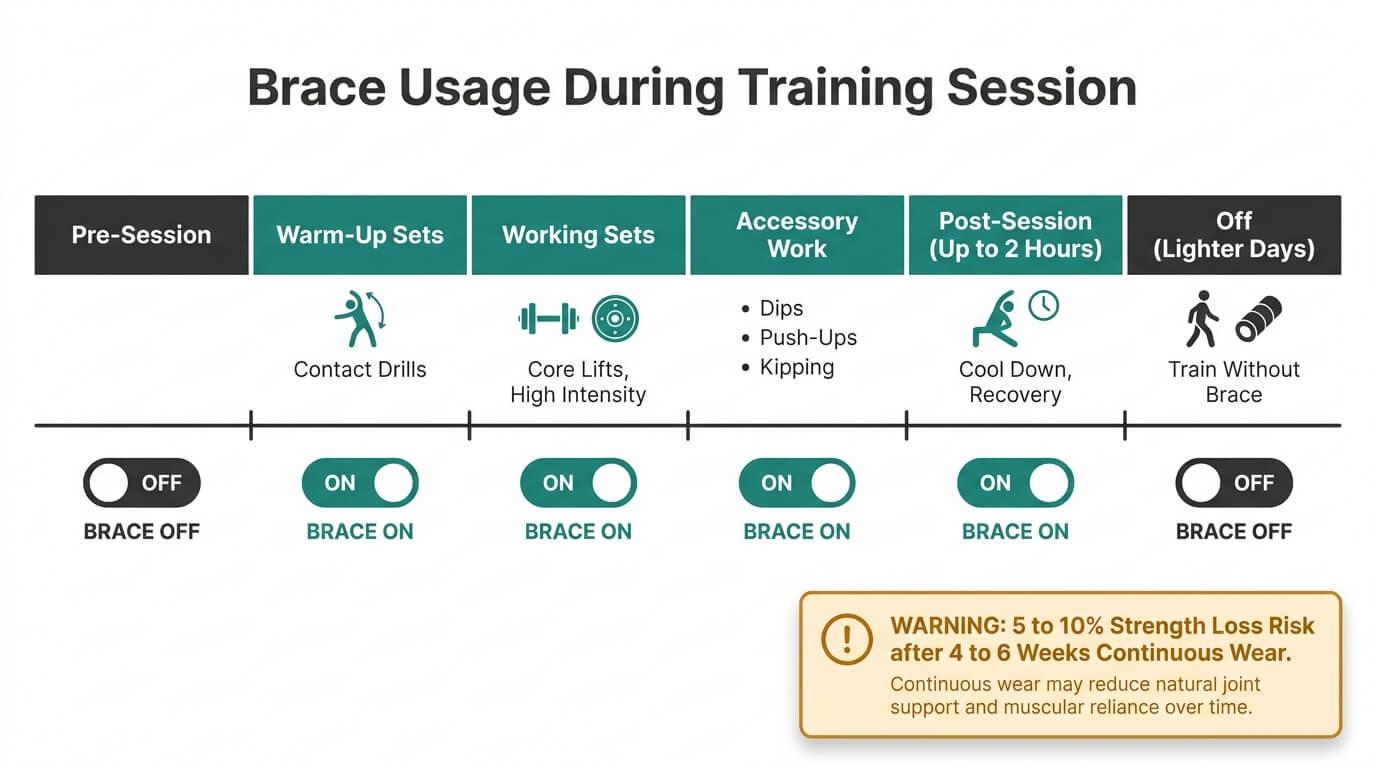
A shoulder brace for prevention is best worn during warm-up sets and working sets that stress the shoulder, during contact drills, and during high-volume accessory work like dips, push-ups, and kipping, which tend to aggravate the shoulder.
The goal is protection during vulnerable phases, not a permanent accessory. Avoid wearing a firm brace outside of training unless a doctor advises it. Studies suggest that a 5 to 10 percent loss in the strength of stabilizing muscles can occur after continuous wear for 4 to 6 weeks.
A practical rule: Wear it for the training session and briefly after, up to 2 hours total, then take it off to let normal movement and circulation do their thing. Train without the brace on lighter days to keep your shoulder naturally resilient.
For brace care: Hand-wash in cold water with mild soap, and air-dry completely before wearing again. Avoid machine washing or high heat, as both shred neoprene faster than you would like.
Combining a Brace With Strength, Mobility, and Recovery Work
The most resilient shoulder setup combines smart programming, targeted prehab, and optional bracing for high-risk sessions. A brace alone will not relieve pain or prevent injury if your training fundamentals are missing.
Strength work should include rotator cuff exercises such as external rotations, face pulls, and band pull-aparts, performed 2 to 3 times per week. These build the muscles that actually stabilize the joint and protect tendons and ligaments from strain.
Mobility drills matter just as much. Thoracic spine work on a foam roller, lat stretching, and controlled overhead range with PVC or light dumbbells maintain flexibility without compromising joint integrity.
Post-session recovery ties it all together. Ice, active recovery on rest days, sleep, and good nutrition all reduce cumulative inflammation and stress on the shoulder over time. If you want to speed up muscle recovery from strain without stopping training, the same approach applies directly to shoulder care.
Red Flags: When Not to Rely on a Preventive Brace
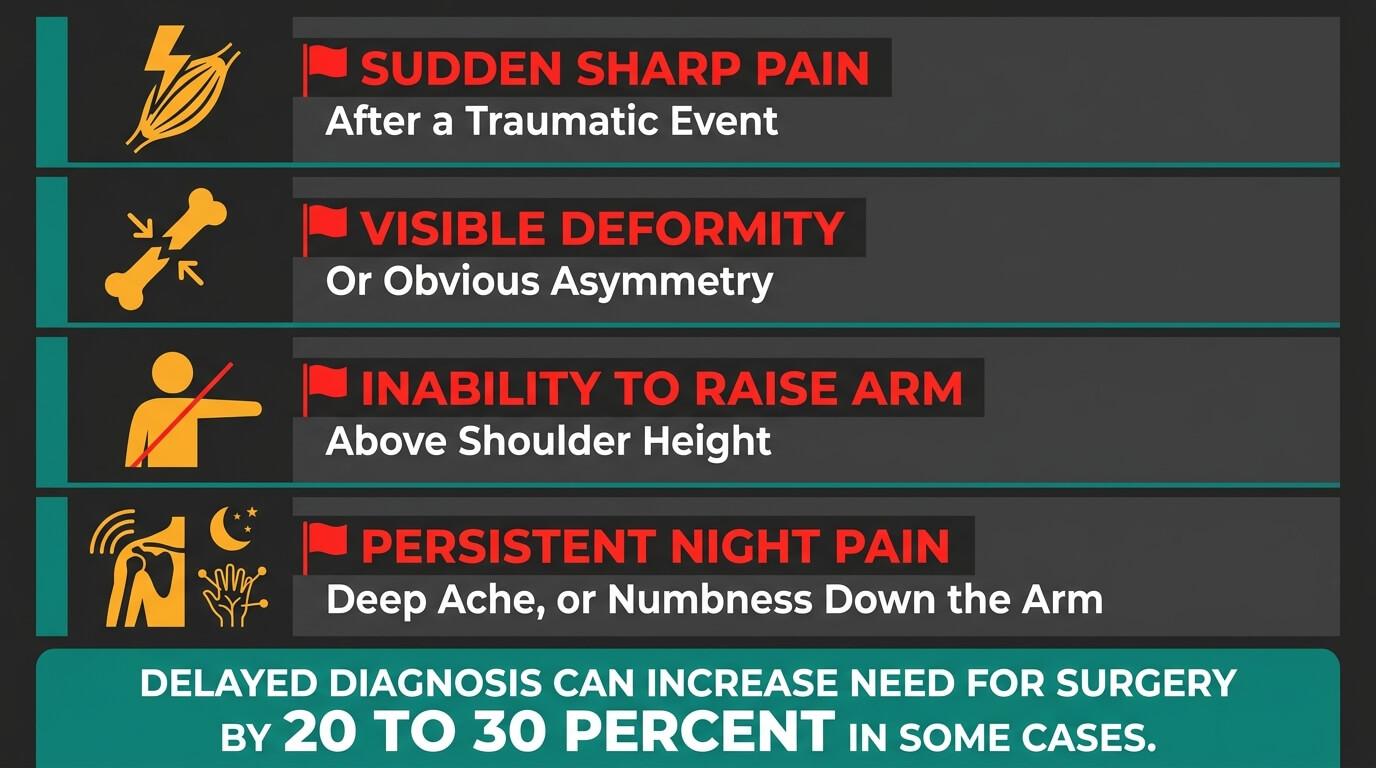
Pain is information. Using a brace to push through significant pain is not being tough. It is muting a signal your body is sending you, and that signal usually has something important to say.
Watch for these warning signs:
-
Sudden sharp pain after a traumatic event. A tackle, fall, or failed lift with an audible pop suggests labrum tears, rotator cuff tears, or a dislocated shoulder. A preventive brace cannot help here. Stop. Full stop.
-
Visible deformity or obvious asymmetry. If the shoulder looks out of place, it may indicate a dislocation or structural damage requiring immediate medical evaluation. Do not attempt to self-brace a shoulder showing these signs.
-
Inability to raise the arm above shoulder height. A significant weakness greater than 20 percent on the other side suggests potential rotator cuff pain or a full-thickness tear. These need imaging and a professional, not a brace.
-
Persistent night pain, deep ache, or numbness down the arm. These symptoms can indicate nerve compression or severe soft-tissue damage. A brace cannot address this, and wearing one may delay the diagnosis you actually need.
In any of these situations, stop training and see a sports medicine physician or physical therapist. Delayed diagnosis can increase the need for surgery by 20 to 30 percent in some cases. The Anaconda shoulder brace is built for high-use, training athletes, not as a medical device to diagnose or treat serious injury.
Final Thoughts
If you train hard or have a history of shoulder injuries, wearing a brace is a smart move. It helps with early instability, minor sprains, or limited mobility, providing support and mild pain relief during the healing process.
A brace will not replace proper training, but when combined with strength work and good technique, it adds protection and improves control. Look for designs with adjustable straps so you can customize the fit without restricting movement or feeling too limited.
It should fit comfortably under clothing or over gym clothes, allowing natural motion. Athletes facing recurring instability or limited range may benefit most. For serious cases, consult a doctor.
At Anaconda, we built our shoulder brace for athletes who press, pull, and go overhead, and who refuse to pick between protection and performance. You should not have to choose. Train hard. Stay protected.
Quick Answers About Preventive Shoulder Brace Use
Here are the questions we hear the most. Straight answers, no fluff.
Will wearing a brace weaken my shoulder muscles?
Minimal risk if you use it session-specifically and cycle off on lighter days. Continuous all-day wear over several weeks can reduce stabilizer muscle strength by 5 to 10 percent, but wearing a shoulder brace during high-risk sessions does not carry that risk.
Can I wear a brace on either shoulder?
Most preventive braces feature universal-fit designs that work on both the left and right sides. Always double-check the specific product design first, as some models wrap differently depending on which shoulder you are supporting.
Should I use heat or cold with my brace?
Neoprene braces provide inherent warmth during training, which supports tissue elasticity throughout your session. After the session, remove the brace and apply ice if you are managing inflammation or minor soreness.
How do I know if I need more support than a preventive brace offers?
If you are recovering from surgery, rehabilitation from a significant shoulder dislocation, or dealing with a torn rotator cuff, you likely need a stabilizing brace or sling under medical direction. A preventive training brace is not the right tool for those situations.
How should I care for my brace?
Hand wash in cold water with mild soap, and air-dry completely before the next session. Avoid machine washing or high heat. Both degrade neoprene and elastic materials faster than you want, and a brace that has lost its compression is a brace that has lost its point.


