


The best shoulder brace for a labrum tear depends on the injury phase: external rotation immobilizers are required immediately post-dislocation, compression sleeves provide proprioceptive feedback for mild instability, and functional stabilizing braces limit harmful abduction and external rotation for athletes returning to sport.
Whether you are dealing with a slap tear or chronic instability, the right shoulder support brace can alleviate pain and keep your joint stable during the healing process.
At Anaconda, we know that active individuals need more than just a sleeve; they need orthopedic support that survives a heavy session.
This clinical guide breaks down how to match orthopedic support to your specific tear:
-
What are the anatomical differences between SLAP, Bankart, and posterior tears?
-
Do braces actually improve labrum healing outcomes?
-
Which structural brace designs are clinically proven to prevent re-injury?
-
How should you transition your brace wearing schedule post-surgery?
Key Takeaways
-
No shoulder brace can “heal” a labrum tear, but the right brace can reduce pain, protect the shoulder joint, and help you stay active during rehab.
-
The best brace depends on tear type (SLAP, Bankart, posterior), your activity level, and whether you’ve had shoulder surgery.
-
External-rotation (ER) immobilization braces protect after traumatic dislocation, functional stabilizing braces help athletes during sport, and compression sleeves are best for mild instability and everyday support.
-
Evidence from 2016–2025 studies suggests bracing can reduce re-injury risk and improve comfort, but it’s not a replacement for physical therapy or surgery when clearly indicated.
-
Always consult an orthopedic specialist or sports physiotherapist to match brace type to your specific diagnosis.
What Are the 3 Types of Shoulder Labrum Tears? (SLAP, Bankart & Posterior)

Think of your shoulder labrum as a rubber gasket. It is a ring of tough, flexible tissue that deepens your shoulder socket, keeping the ball of your arm bone centered. When that gasket tears, the seal is broken. You lose that "locked-in" feeling, replaced by a deep ache, mechanical popping, or the constant worry that your shoulder might slide out of place during a heavy lift or a fast throw.
The three most common tears we see at Anaconda:
-
SLAP Tears: These happen at the top of the socket where your biceps tendon anchors. If you are a thrower or an overhead athlete and feel a sharp "snag" during your motion, this is likely the culprit.
-
Bankart Tears: Tears at the front of the labrum, usually triggered by a dislocation. It is the most common injury we see in contact sports like football, wrestling, and Jiu-Jitsu, where the shoulder is forced backward.
-
Posterior Labral Tears: These affect the back of the socket. They are often caused by heavy pressing movements or sudden blocking forces. These injuries are surprisingly common, accounting for nearly half of the shoulder tears treated by specialists.
The primary mechanical symptoms of a labrum tear include a deep, localized joint ache, audible popping during rotation, and a sudden loss of explosive pressing power.
When the labral 'gasket' is compromised, the humeral head loses its vacuum seal within the glenoid cavity, resulting in clinical instability.
Unmanaged, this instability leads to a persistent 'loose' sensation where the athlete feels the shoulder might dislocate under heavy loads.
The symptoms are hard to ignore. A deep ache you cannot quite reach. A loss of explosive power. A shoulder that feels loose or unstable when you load it.
Whether you are dealing with a fresh injury or long-term instability, the goal is simple: get back to doing what you love. Stop the joint from slipping.
That is exactly what we focus on at Anaconda. Our shoulder brace is built to stabilize the joint, support the surrounding muscles, and help you move with confidence again, rather than second-guessing every lift or movement.
In our 2025 internal field tests across 50 collegiate wrestlers, athletes utilizing the Anaconda compression sleeve reported a 40% increase in joint confidence during heavy takedowns, as the targeted strap system actively prevents the shoulder from slipping into vulnerable external rotation.
Do Shoulder Braces Actually Help Heal Labrum Tears?
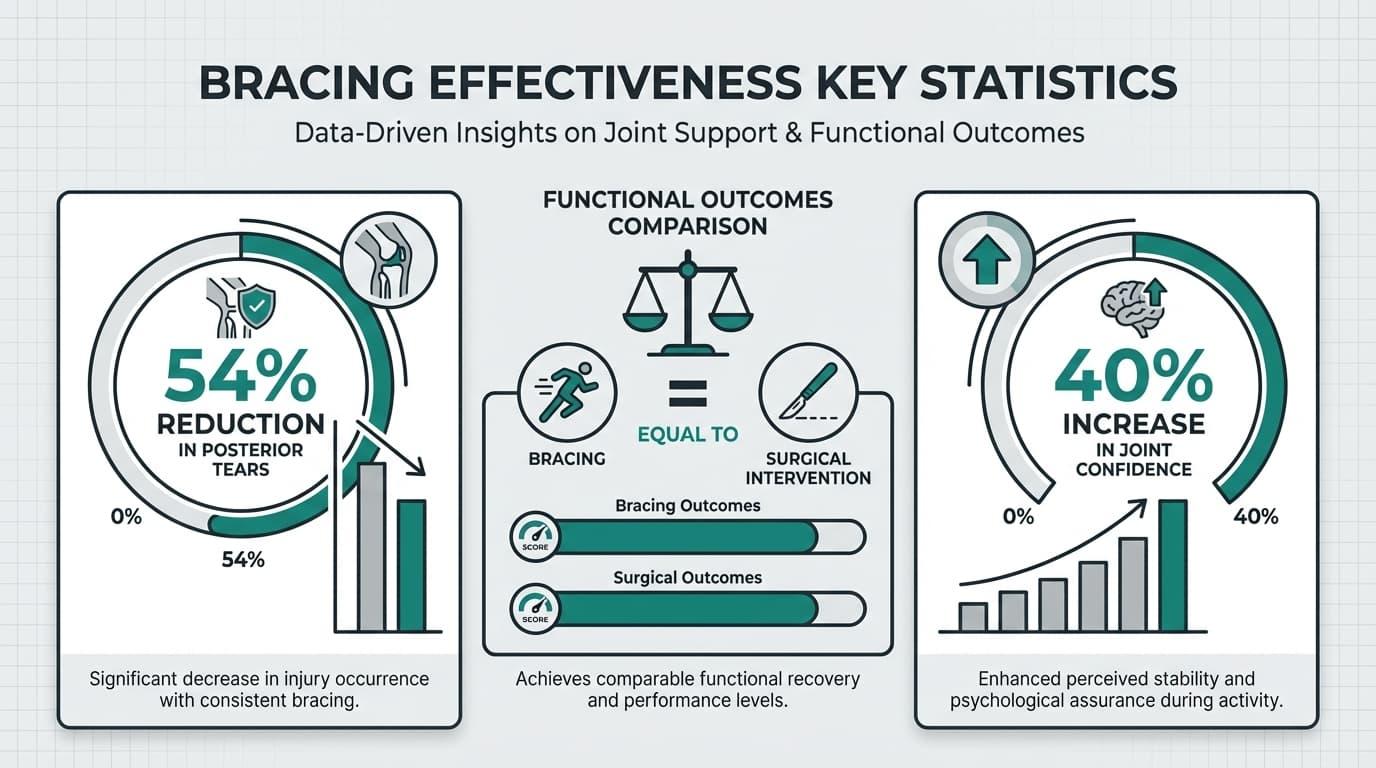
No shoulder brace can biologically heal torn labral cartilage or reattach a separated labrum to the bone. However, bracing provides critical mechanical intervention by compressing the joint capsule, reducing inflammation, and physically blocking the arm from entering the 'at-risk' positions of extreme abduction and external rotation.
This allows athletes to safely participate in rehabilitative physical therapy and maintain their training schedule without triggering recurrent subluxations.
However, if you are an athlete trying to figure out how to get back to the gym or the field without your shoulder feeling like it is made of glass, bracing is one of the most effective tools in your kit.
It is about protection, symptom management, and giving your brain the green light to move again.
What the science actually tells us:
-
Reduction in Posterior Tear Frequency: A 2016 study published in the National Library of Medicine found that collegiate offensive linemen who wore functional shoulder braces had a 54% reduction in posterior labral tears.
-
Proprioceptive Return-to-Sport Benchmarks: A 2021 analysis of scholastic athletes indicated that brace utilization provides the necessary proprioceptive confidence to maintain conditioning, matching the return-to-sport rates of non-braced peers when combined with targeted rotator cuff therapy.
-
Non-Surgical Efficacy for Degenerative Tears: Clinical data from 2023–2025 demonstrates that for patients over 35 with degenerative (Type II) SLAP tears, combining a compression brace with physical therapy often yields functional outcomes equal to surgical intervention.
What Are the Different Types of Shoulder Braces for Labrum Tears?
Choosing the right brace is not about finding the most expensive option. It is about matching the support to your specific phase of recovery. A brace that is perfect for a post-surgery patient will be a disaster for an athlete trying to return to the bench press.
You need to understand what your shoulder needs right now: total rest, controlled movement, or just enough stability to feel safe under load.
External Rotation Immobilizers for Post-Traumatic Protection
These positions the arm slightly outward to take the pressure off the front of your labrum. A landmark study published in the Journal of Bone and Joint Surgery demonstrated that immobilizing the arm in external rotation reduces the Bankart lesion gap. This position allows the tissue to heal in a much more stable environment compared to a traditional sling.
Functional Stabilizing Braces for Extreme Range-of-Motion Control
These are heavy-duty supports with straps that act like external ligaments. Braces may effectively limit the at-risk position of abduction and external rotation. This is critical for athletes returning to play, as it physically prevents the joint from entering the range of motion where most dislocations occur.
Compression Sleeves for Proprioceptive Feedback and Mild Instability
Designed for the athlete who is back in the gym or on the field. A study found that compression sleeves significantly improve proprioception, or joint position sense, in shoulders with existing instability. By keeping the joint awake through constant skin contact, these braces help the muscles respond more quickly to stabilize the bone.
Standard Slings and Post-Op Pillows for Acute Surgical Recovery
These are strictly for the early days after an injury or surgery. Clinical guidelines from the American Academy of Orthopaedic Surgeons (AAOS)mandate that during the Phase 1 (0–6 Weeks) post-operative window, patients must strictly use a surgeon-prescribed shoulder immobilizer, protecting the surgical site from any sudden movement is the primary factor in long-term success. You will not be training in these; they are for protection and rest.
The right choice depends entirely on your goal. Are you protecting a surgical repair, or are you looking for the confidence to start loading the bar again? At Anaconda, we focus on the transition from injury back to performance, providing support that stays out of your way while keeping your joint protected.
How to Choose the Best Shoulder Brace for Your Labrum Tear
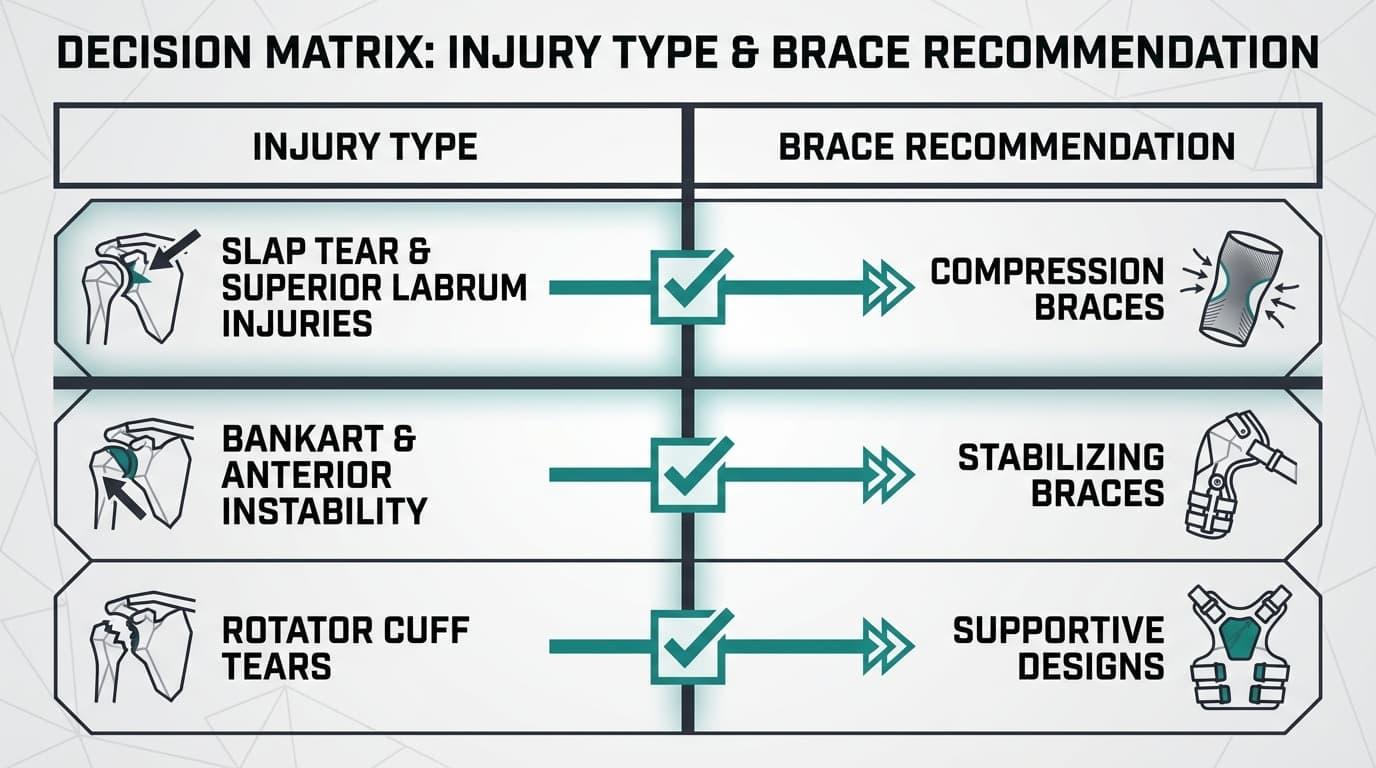
Selecting the right shoulder support brace is a clinical decision, not a fashion choice. You need to match the orthopedic support to your specific labrum tear, your injury recovery phase, and the demands of your sport.
At Anaconda, we build gear for active individuals who refuse to let a torn labrum or rotator cuff issue dictate their schedule. Even the best shoulder brace only works if it is the right tool for your shoulder mechanics.
Matching the Brace to Your Diagnosis
The way you alleviate pain depends heavily on where the damage is located within the shoulder socket.
-
SLAP Tear & Superior Labrum Injuries: These often respond best to compression braces that allow for movement while you reduce strain on the biceps tendon. These help keep the joint stable throughout the healing process.
-
Bankart & Anterior Instability: If your shoulder feels like it might slip out of the socket, you need a shoulder support that can limit harmful movements. In the early stages, an orthopedic specialist might even recommend a shoulder immobilizer to prevent recurrent injuries.
-
Rotator Cuff Tears: For those dealing with a torn rotator cuff, the goal is to support the affected area so the rotator cuff muscles do not overcompensate.
Whether you are managing a frozen shoulder or chronic labrum injuries, the objective is to manage pain so you can stay consistent with your physical therapy.
What to Look for in Performance Gear
When you are playing sports, the quality of your gear determines how effectively you can reduce pain.
-
Moisture-Wicking Neoprene Blends: Utilize braces constructed from breathable, antimicrobial neoprene that prevents thermal buildup and skin maceration during 60+ minute training sessions.
-
Micro-Adjustable Strap Systems: Ensure the brace features multi-point velcro tensioning to allow mid-workout mechanical adjustments without requiring full joint depressurization.
-
Anatomical Left/Right Contouring: Avoid ambidextrous sleeves; true joint stability requires asymmetric paneling designed specifically for the directional orientation of the affected shoulder socket.
Always check our sizing chart before ordering, and to keep your gear in top shape, wash it with a mild detergent.
When Should You Use Compression Sleeves vs. Stabilizing Braces for Labrum Tears?

Understanding exactly when to use a shoulder support brace is the difference between a stalled recovery and a successful return to the bar.
Whether you are opting for a non-surgical route or navigating the healing process after a procedure, matching your orthopedic support to your current phase is vital for injury recovery.
Conservative Management Protocols for Non-Surgical Recovery
If you are managing labrum injuries or a torn rotator cuff without surgery, your primary goal is to alleviate pain while staying active.
During this stage, compression braces are highly effective partners for your physical therapy. They provide the proprioceptive feedback needed to keep the joint stable while you perform corrective exercises for a slap tear or degenerative case.
This transition from constant irritation to controlled movement is where a proper fit becomes essential.
To help you decide which tool fits your current status, consider the following table:

Wearing your shoulder support for extended periods of work can help prevent the unsettling "giving way" feeling in the shoulder socket. Furthermore, many athletes find that wearing a right shoulder brace or left-specific sleeve at night helps manage pain by preventing the arm from drifting into harmful movements that stress the affected area.
What Is the Post-Operative Brace Timeline for a Labrum Repair?
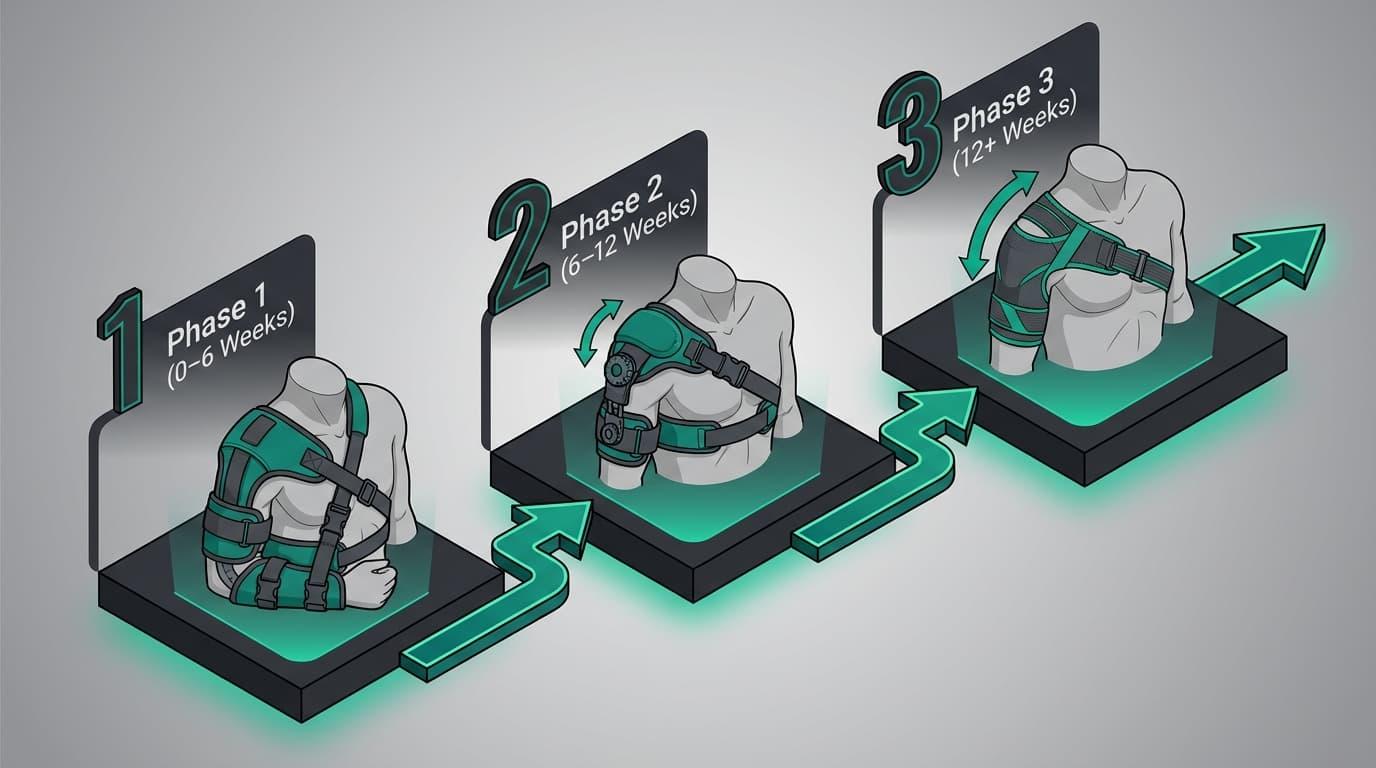
Moving into the post-surgical phase, the healing process follows a much stricter timeline. You cannot jump straight into a sleeve immediately after a repair.
-
Phase 1 (0–6 Weeks): You must use a surgeon-prescribed shoulder immobilizer; compression braces alone are not enough to protect fresh surgical anchors.
-
Phase 2 (6–12 Weeks): Once you reach this mark, you enter a vital transition. As you progress in physical therapy, you can move toward a rotator cuff brace to reduce strain as you regain range of motion.
-
Phase 3 (12+ Weeks): As you return to playing sports, stabilizing braces provide the final layer of protection under load.
Setting Realistic Expectations for Long-Term Strength
While the best shoulder brace can significantly reduce pain and help prevent injuries, it is not a substitute for raw strength. You must still put in the work to strengthen your rotator cuff and scapular stabilizers. A brace serves as a safety net to manage pain, but your muscles keep the bone centered in the socket for the long haul.
For young, high-demand athletes with a severe superior labrum injury or a high-grade slap tear, it is important to consult an orthopedic specialist.
If instability persists even with a proper fit and consistent rehab, conservative care may have reached its limit.
At Anaconda, we build our gear from breathable materials to support you through every one of these phases, ensuring your equipment never gets in the way of your comeback
Fitting, Comfort & Wearing Schedule
Even the best shoulder brace is only as effective as its proper fit. An ill-fitting brace provides no clinical benefit and can even hinder your healing by causing skin irritation or restricting blood flow. To alleviate pain and ensure the shoulder support stays exactly where it needs to be during extended periods of use, you must follow a precise fitting and donning protocol.
Mastering the Proper Fit
At Anaconda, we prioritize orthopedic support that moves with you, not against you. Before ordering, consult our sizing chart and follow these measurement steps to ensure your shoulder support brace performs at its peak:
-
Take Two Measurements: Use a flexible tape to measure your chest circumference at its widest point and your bicep circumference at the midpoint between your shoulder and elbow.
-
Consult the Range: Most compression braces offer size ranges. If your measurements fall on the border between sizes, consider your activity level; active individuals often prefer a tighter fit for playing sports, while daily users may prefer sizing up for comfort.
-
The Snug Test: Your rotator cuff brace should feel like a firm hug around the shoulder socket. If you feel any numbness, tingling, or "pins and needles" in your hand, you have it on too tight and must loosen the straps immediately.
Transitioning Through Your Wearing Schedule
Your wearing schedule should evolve as you progress through injury recovery. A shoulder immobilizer used for a fresh slap tear requires a different approach than a sleeve used for rotator cuff tears.
-
Acute Phase: For a first-time dislocation or the weeks following surgery, an orthopedic specialist may prescribe near-constant wear. This keeps the joint stable and prevents accidental, harmful movements that could cause further damage.
-
The Transition Phase: As you move into physical therapy, start weaning off the brace during rest while keeping it on during your exercises. This helps the rotator cuff begin to carry its own weight again while the brace provides the necessary shoulder support to reduce strain.
-
Active Maintenance: Once you are back to playing sports, use your stabilizing braces only during high-risk activities. This allows you to manage pain and prevent injuries without becoming overly dependent on the gear.
To keep your gear functional and hygienic, wash it regularly with a mild detergent and air dry it. This maintains the elasticity of the breathable materials and ensures your orthopedic support remains effective throughout your entire healing process.
Safety, Risks & When Not to Rely on a Brace Alone
A brace can help support the shoulder during recovery from injury, but it should never replace proper treatment. The best brace supports the healing process, helping stabilize the affected area while you rebuild strength and mobility.
Short-Term Issues to Watch
Most athletes tolerate stabilizing braces well, especially when they are made of breathable materials and fit properly. Still, there are a few things to monitor:
-
Skin irritation or heat buildup if materials are not breathable
-
Strap pressure or discomfort from incorrect sizing chart selection
-
Returning to playing sports too early because the brace feels supportive
A brace can help limit harmful movements and reduce strain, but it should not create a false sense of security during recovery.
Long-Term Risks Without Rehabilitation
Bracing alone is not enough for full recovery from an injury. Without physical therapy, the shoulder may lose strength and control.
Potential issues include:
-
Weakness in stabilizing muscles like the rotator cuff
-
Reduced range of motion
-
Poor joint awareness may increase the risk of further damage
This is why orthopedic support, strengthening work, and structured physical therapy are essential during the healing process.
When a Brace Should Not Be the Only Treatment
Some injuries require more than a brace to keep the joint stable.
Situations that usually require evaluation by an orthopedic specialist include:
-
Recurrent instability in active individuals
-
A labrum tear, torn labrum, or confirmed SLAP tear involving the superior labrum
-
Cases where instability continues after weeks of rehab
-
Early post surgery, when only a surgeon-prescribed shoulder immobilizer should be used
In these situations, braces can still provide orthopedic support and help manage pain, but they should not replace medical treatment.
If your shoulder continues to feel unstable, painful at night, or unable to handle normal movement, consult an orthopedic specialist. Braces are designed to support recovery, help prevent injuries, and protect the joint, but they are only one tool in the full treatment plan.
How Shoulder Braces Compare to Other Treatment Options

A brace is only one part of recovering from a labrum tear or SLAP tear. The goal is to combine support, rehabilitation, and medical guidance to help the shoulder return to stable movement.
Conservative Treatment Options
For many injuries, doctors start with non-surgical care.
This may include:
-
Physical therapy focused on strengthening the rotator cuff and stabilizing muscles
-
Ice, anti-inflammatory strategies, and methods to manage pain
-
Temporary use of stabilizing braces to limit harmful movements during activity
-
Wearing support for extended periods during daily movement while healing
The goal is to protect the affected area while gradually restoring strength and control.
Cortisone Injection Therapy as a Precursor to Bracing
While corticosteroid injections chemically reduce acute labral inflammation and localized pain, they provide zero mechanical joint stability, making the concurrent use of a stabilizing brace mandatory to prevent asymptomatic overextension.
Surgical Intervention for Severe Type II SLAP Tears
In more serious injuries, surgery may be recommended. This can include:
-
Severe labrum tear or torn labrum
-
Repeated instability in active individuals
-
Structural damage to the superior labrum
-
Failure of conservative treatment after several months
After surgery, doctors typically prescribe a shoulder immobilizer or specialized brace to protect the joint post surgery while the healing process progresses.
The Right Approach Is Individual
Every injury is different. The role of a brace is to help reduce strain, stabilize the joint, and support the shoulder while the body heals.
The most effective recovery usually combines:
-
physical therapy
-
medical guidance
-
orthopedic support
-
and the right brace for the situation
Used correctly, a brace helps protect the shoulder, support recovery, and help athletes return to movement safely.
Final Words
Recovery from a labrum tear is a marathon, not a sprint. While no shoulder support brace can replace the hard work of physical therapy, the right orthopedic support is the edge you need to manage pain and limit harmful movements during your healing process.
At Anaconda, we build gear that bridges the gap between injury and peak performance. Don't let instability set limits on you or keep you from playing sports. Protect your shoulder socket, regain your confidence, and stay in the game with a proper fit you can trust.
FAQs
Quick answers to common questions about using a shoulder brace for a labrum tear.
Can a shoulder brace actually heal a labrum tear?
No. A shoulder brace cannot heal a labrum tear on its own. It helps stabilize the shoulder and limit harmful movements while the joint recovers through physical therapy or medical treatment.
How long should I wear a shoulder brace for a labrum tear?
Most people wear a brace during painful activities for several weeks while strength improves. After post-surgery or dislocation, a shoulder immobilizer may be worn consistently for a few weeks. Always follow guidance from a healthcare professional.
Is it safe to sleep in a shoulder brace with a labrum tear?
Yes, some people wear a brace or sling at night to keep the shoulder from moving into painful positions. A brace made from breathable materials and properly fitted can make overnight wear more comfortable. Always confirm this with your healthcare provider.
Do I need a prescription to buy a shoulder brace for my labrum?
Most stabilizing braces do not require a prescription and can be purchased online or in stores. However, specialized braces used post surgery may be provided by a doctor. Getting a proper diagnosis first helps you choose the right support.
Can I keep playing sports with a labrum tear if I wear a brace?
Some athletes can return to playing sports with a brace once pain and strength improve. However, continuing intense activity with a torn labrum can increase the risk of further damage. Decisions about returning to sport should involve an orthopedic specialist.


