


Does this scenario sound familiar? You tweak your shoulder mid-session, or you’re coming back from one that already went sideways, and someone tells you to just tape it and push through. But is tape actually doing what you think it is?
At Anaconda, we get asked the shoulder brace vs tape question constantly, from competitive BJJ athletes and football players to lifters who just want to train without their shoulder reminding them it exists.
The real answer: Both have a place, but they work through completely different mechanisms and serve different needs depending on your injury, your sport, and how much consistent support you require.
This guide cuts through the noise and gives you the practical breakdown so you can match the right method to your situation.
Key Takeaways
-
A shoulder brace provides structural, mechanical support that stays consistent from rep one to the last set, regardless of sweat or session length.
-
Scapular taping produces earlier trapezius muscle activation onset during shoulder movements, a real neuromuscular benefit confirmed in the Journal of Athletic Training, though this effect diminishes as the adhesive degrades.
-
Kinesiology tape can lose adhesive effectiveness during high-sweat or high-movement activity, making reliable support across a full training session uncertain.
-
For acute injuries, contact sports, and shoulder instability, a brace provides the structural protection that tape cannot.
-
Both taping and bracing are tools that support rehabilitation, not substitutes for progressive strengthening and professional guidance.
-
Many athletes use both: tape for proprioceptive feedback on lighter rehab days, brace for structural protection during heavy training and competition.
Shoulder Brace vs Tape: Key Differences
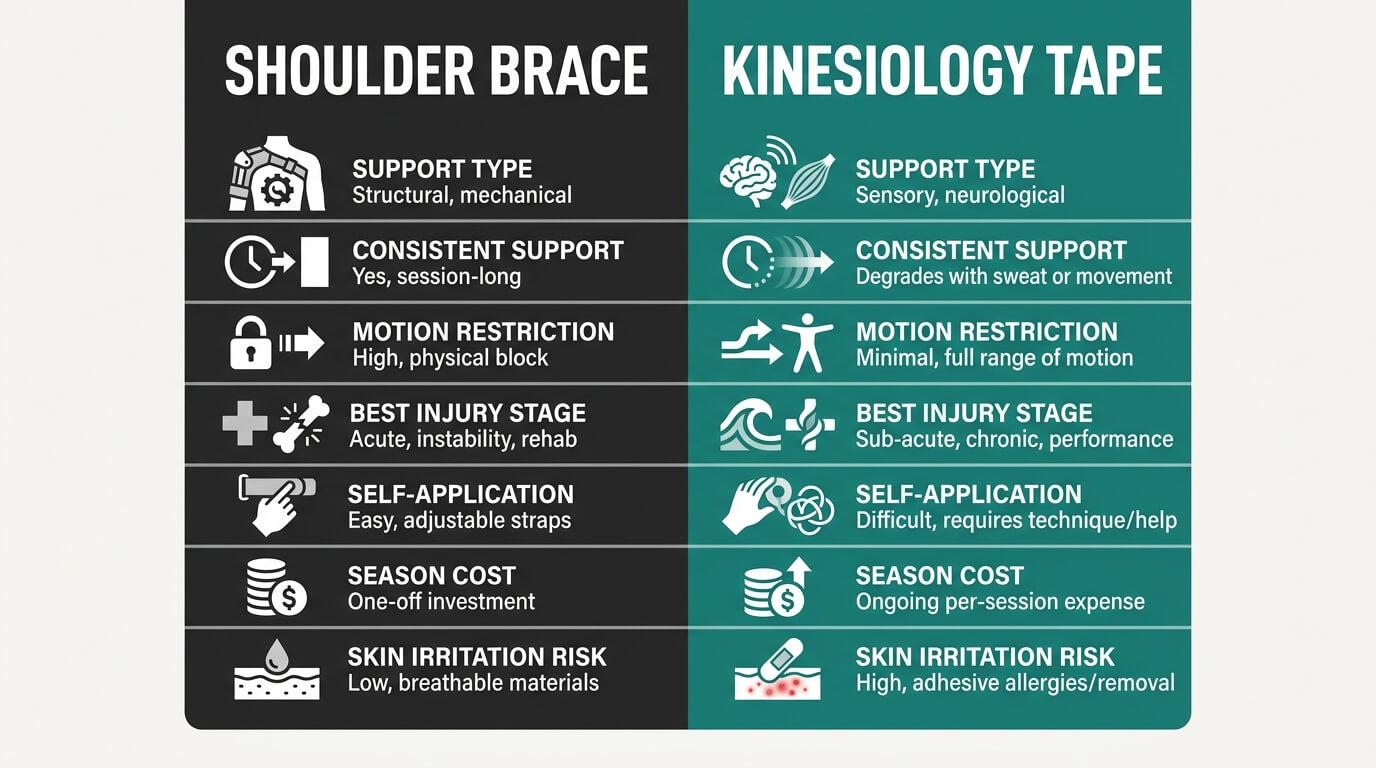
The key to understanding this comparison is knowing that a shoulder brace and tape are not just different versions of the same thing. They work through fundamentally different mechanisms.
A shoulder brace uses rigid materials or high-compression neoprene to physically hold the humerus in the socket, limit end-range motion, and provide consistent structural support regardless of sweat or session length.
Kinesiology tape is designed to lift the skin slightly, promoting improved lymphatic drainage and increased blood circulation to reduce swelling and support the healing process through sensory feedback to the nervous system.
Rigid athletic tape sits in the middle, physically restricting movement and altering neuromuscular control rather than just providing sensory cues. Understanding these differences is the foundation for making the right choice.
Here is the practical comparison side by side:

Support Mechanism and Effectiveness
This is where the real head-to-head begins. Same goal, completely different paths to get there. Understanding how each method delivers joint support tells you exactly which one you need.
How a Shoulder Brace Provides Support
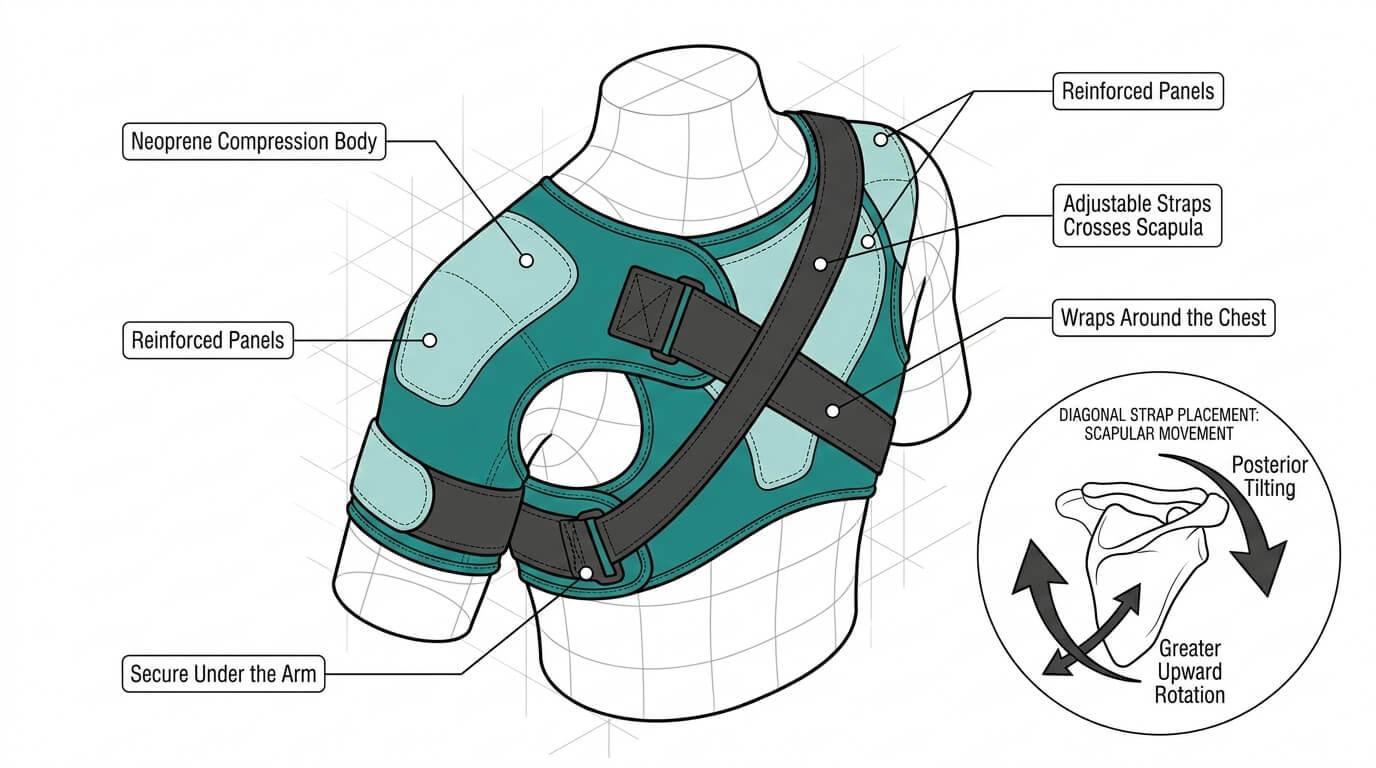
A quality shoulder brace features a neoprene or compression body, reinforced panels, and adjustable straps that cross the scapula, wrap around the chest, and secure under the arm. Every element serves a structural purpose.
Biomechanical testing of glenohumeral joint stability braces confirms that they effectively limit abduction and external rotation under load, directly reducing exposure to the high-risk positions where shoulder dislocations and labral injuries most commonly occur.
Research on brace strap configurations shows that diagonal strap placement produces greater upward rotation and posterior tilting of the scapula, thereby improving overall shoulder mechanics.
A study of Division I athletes with unstable shoulders found that wearing a neoprene stabilizer significantly improved joint angle reproduction near maximal external rotation, without restricting that rotation. That is a real proprioceptive and structural benefit from a single piece of gear.
For athletes managing shoulder instability and labrum concerns, the compression also stimulates skin receptors, improving real-time awareness of shoulder position as technique drifts under fatigue. Structural and sensory support combined.
How Taping Provides Support
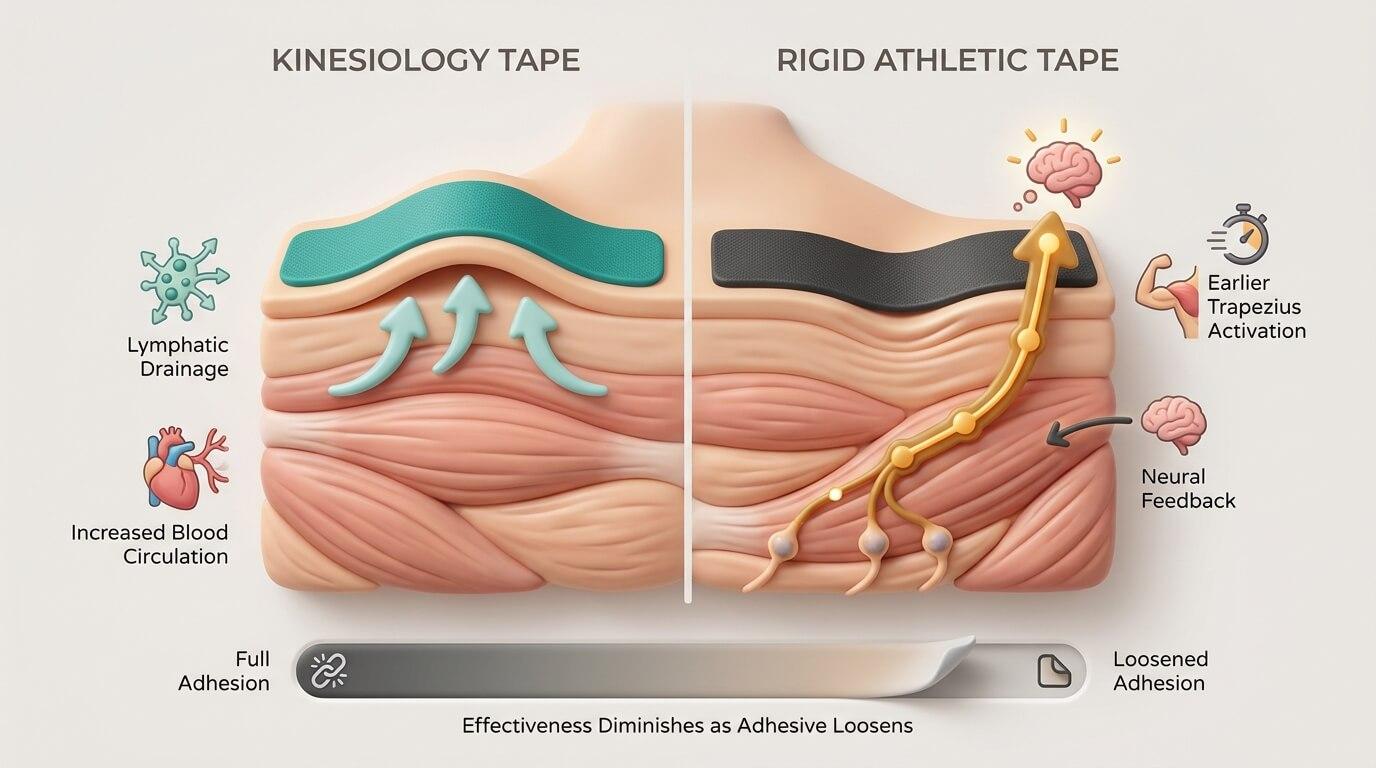
Taping is not a gimmick. When applied correctly, it delivers real and measurable benefits. But those benefits work through an entirely different mechanism than bracing.
Kinesiology tape improves blood flow and signals the brain to help stabilize the area using the body's own muscles. A study in PMC confirmed kinesiology taping stimulates lymphatic drainage and promotes circulation by lifting the skin slightly, supporting the healing process without restricting the range of motion.
A randomized controlled study in overhead athletes with shoulder impingement confirmed that kinesiology taping significantly improved scapular joint position sense and posterior tilt kinematics during arm elevation, two meaningful benefits for athletes returning to overhead training.
Rigid athletic tape goes further by physically restricting movement and altering neuromuscular control.
A study in the Journal of Athletic Training confirmed that scapular taping resulted in earlier onset of upper and lower trapezius contractions during shoulder abduction and flexion, with contraction timing shifting immediately after tape application. That’s a genuine neuromuscular finding for rehabilitation programs.
Where taping falls short, though, is consistency. Unlike a brace, which provides support throughout every rep, tape offers only limited mechanical stability, and its effectiveness diminishes as the adhesive loosens during activity.
Durability and Long-Term Support
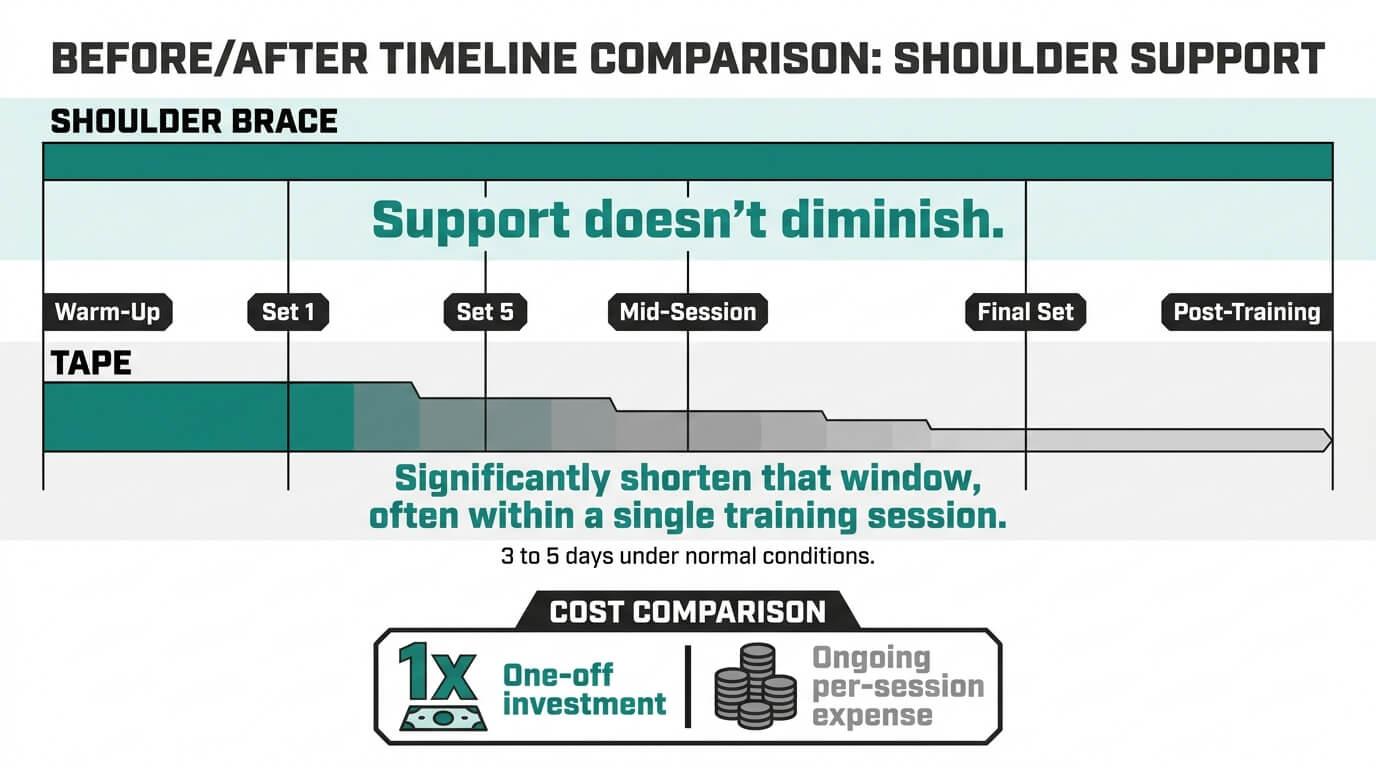
If support is the goal, the next question is how long that support actually lasts. This is where the gap between a brace and tape becomes most obvious, and most consequential for athletes training at volume.
Brace: Support That Doesn’t Quit Mid-Session
A shoulder brace doesn’t rely on adhesive properties to do its job, which means its structural support doesn’t diminish as you work through a tough session. Sweating through a heavy block doesn’t change what the brace is doing for your joint.
For athletes returning to full load after injury, that consistency matters for the entire muscle strain recovery process, not just the first cautious session. Studies confirm that braces maintain restriction of abduction and external rotation under both active and passive loading more consistently than tape, session after session.
One quality brace covers months of training at a fraction of the per-session cost of tape. That’s not a minor financial point for athletes training five or six days per week across a full season.
Tape: A Hard Ceiling on Wear Time
Kinesiology tape is designed for continuous wear of 3 to 5 days under normal conditions. But high-sweat environments and repetitive dynamic movements significantly shorten that window, often within a single training session.
Rigid athletic tape degrades even faster under load. For athletes training at high volume, the ongoing cost of supplies, pre-wrap, and athletic trainer time across a full season adds up to a meaningful recurring expense that a single brace investment eliminates entirely.
Beyond cost, there’s also the application dependency. Effective shoulder taping, particularly across the posterior deltoid and scapular regions, typically requires a physical therapist or athletic trainer. If you train five days a week and need professional retaping before each session, that barrier alone makes tape an impractical primary support strategy.
Application and Ease of Use
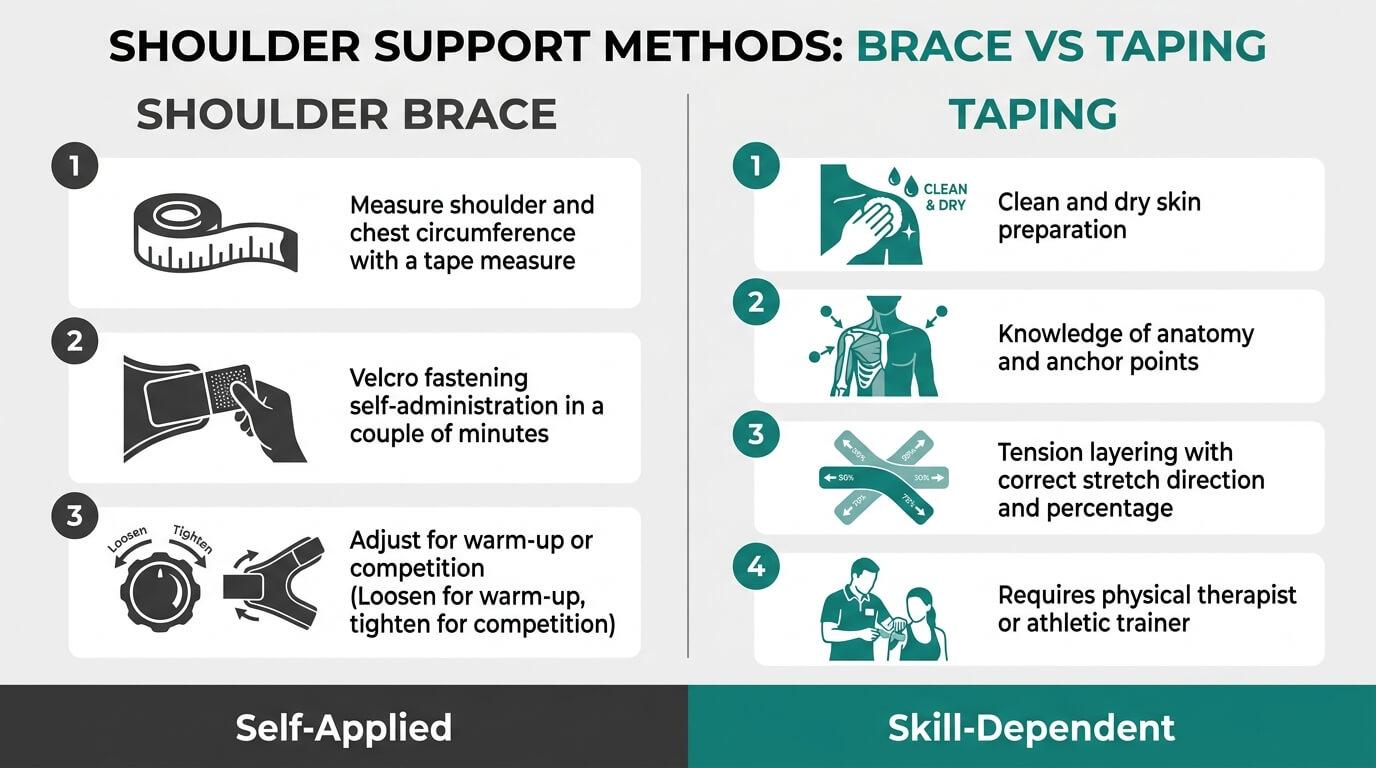
How easy each method is to apply consistently matters more than most athletes realize, especially when you’re training solo and need to be ready before every session.
Brace: Self-Applied, Instantly Adjustable
Most athletes can apply a shoulder brace independently once they understand proper sizing. Sizing involves measuring the shoulder and chest circumference. Once fitted, adjustable straps with Velcro fastening allow self-administration in a couple of minutes before each session.
Modern braces feature multiple adjustment points, allowing you to loosen for warm-up, tighten for competition, and switch strap configurations for specific movement demands, all without any assistance. That level of adaptable control is something tape can’t offer.
Shoulder braces can cause sweating under the neoprene, but they don’t irritate the skin and can be removed instantly if discomfort occurs. That quick-release flexibility matters in dynamic training environments where you need to adjust without stopping.
Tape: Skill-Dependent, Often Needs Assistance
Effective shoulder taping is technical. Rigid taping requires knowledge of anatomy, proper anchor points, tension layering, and clean skin preparation. Kinesiology taping requires understanding the stretch direction, the percentage of stretch, and the shape's placement relative to movement patterns.
The posterior deltoid and scapular regions are difficult to reach independently, so most athletes rely on physical therapists or athletic trainers to apply shoulder tape. That dependency creates a practical barrier to daily training use that a brace simply does not.
Kinesiology tape adheres directly to the skin using medical-grade glue, and while most formulations are hypoallergenic, some athletes experience skin irritation with repeated application in high-sweat zones. Applying over clean, dry skin, using a pre-wrap barrier, and incorporating rest days significantly reduces that risk.
Range of Motion and Performance Impact
The performance question is simple: How much does each method affect what you can actually do in training or competition? The answer is more nuanced than most athletes expect from either side.
Brace: Targeted Restriction, Not Total Lockdown
Modern shoulder braces are engineered to limit range in dangerous positions while still permitting most athletic movements. Research shows braces effectively prevent reaching extreme high-risk positions, specifically abduction combined with external rotation near 90 degrees, while still allowing adequate motion for competition.
Adjustable strap configurations let you dial the restriction up or down as needed. Diagonal strap setups increase scapular muscle activation and control more than parallel configurations, providing athletes meaningful performance input rather than just a restriction.
The trade-off is bulk. Braces can feel heavy under clothing and may create fitting issues under tight uniforms or shoulder pads. For athletes in sports requiring absolute maximal overhead range, that extra layer requires some adjustment in the first few sessions.
Tape: Low Profile, but Limited Mechanical Bite
Kinesiology tape is lightweight and barely noticeable under clothing, which is why overhead athletes such as swimmers, baseball players, and volleyball players often prefer it for return-to-sport phases. The elastic material stretches with skin and muscle, allowing near-natural mechanics while enhancing neuromuscular awareness.
The limitation is that tape doesn’t provide substantial mechanical stability. Its effectiveness in restricting harmful ranges depends entirely on adhesive integrity, which degrades under sweat and repetitive motion. Many athletes report psychological confidence from tape, but studies show those effects also diminish as the adhesive weakens.
For overhead athletes in rehabilitation where maximal range is essential, and the injury is minor, tape is the right tool. For athletes who need the joint physically held in a safer range during high-load or high-contact activity, tape is asking too much of its adhesive.
Which One Fits Your Sport?
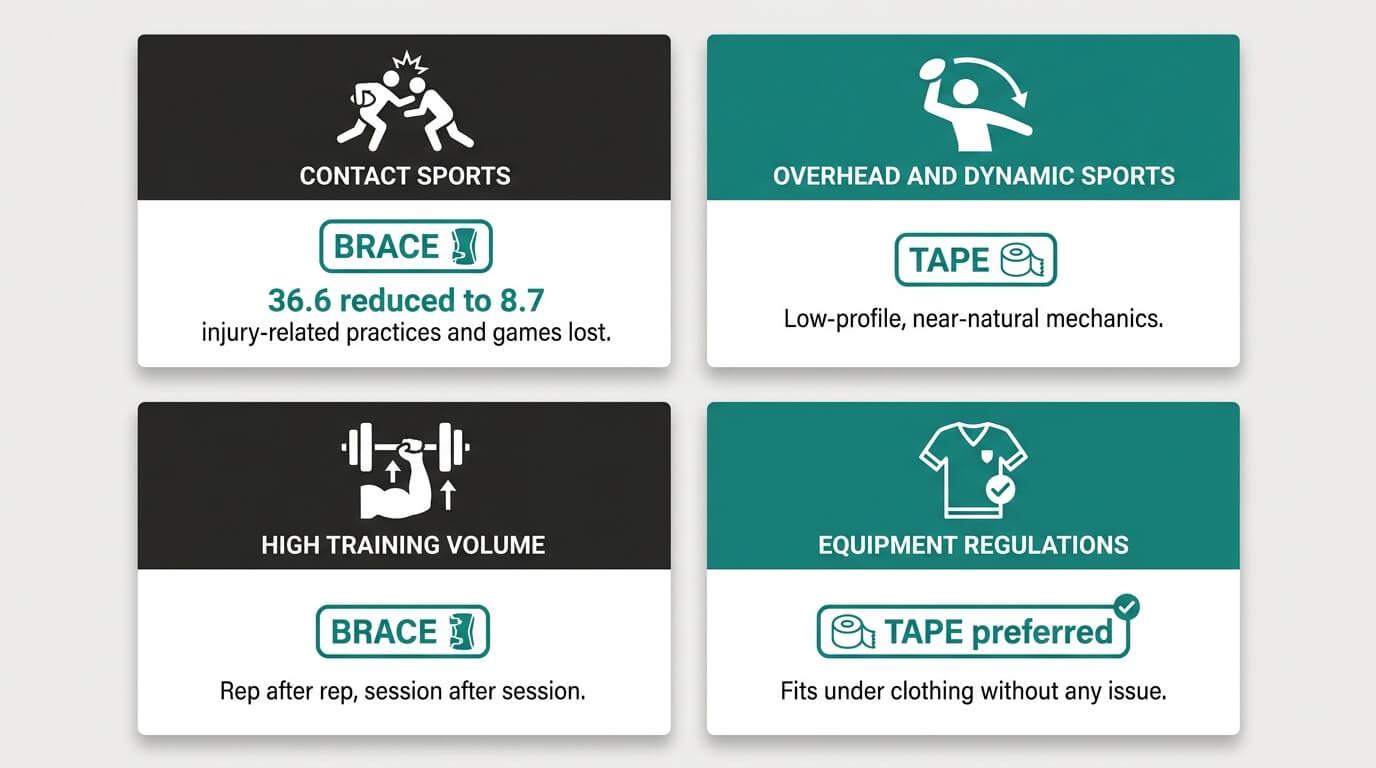
With the mechanisms and durability clear, the final filter is the sports context. Injury stage and sport demands should drive this decision, not habit or what happens to be in the physio drawer.
Contact Sports: The Brace Wins
In football, rugby, wrestling, and BJJ, a brace provides structural support and protection against external forces, collisions, and the risk of dislocation that tape simply cannot withstand. Body weight impacts the shear tape from the skin. A brace doesn’t move.
The data backs this up. Research confirms that prophylactic shoulder bracing in collegiate contact athletes reduced injury-related time lost from 36.6 practices and games to just 8.7. That’s the kind of result that comes from structural protection, not sensory feedback.
Overhead and Dynamic Sports: Where Tape Has Real Value
For swimmers, baseball players, volleyball players, and gymnasts returning from minor shoulder injuries, kinesiology tape is the better fit. It’s low-profile under clothing, allows near-natural mechanics, and enhances neuromuscular awareness without creating restriction that could compromise performance.
When a full range of motion is essential, and the injury is minor, tape works well as a return-to-sport support layer that gets out of the way and lets the athlete move freely. The moment the injury escalates to structural instability, though, tape needs to step aside for a brace.
High Training Volume: Bracing Protects the Block
Athletes pressing, pulling, and going overhead multiple times per week accumulate repetitive stress on the rotator cuff, labrum, and AC joint that builds invisibly until it becomes a real problem.
Bracing during high-load phases actively reduces that cumulative strain. Athletes dealing with shoulder instability during training benefit from consistent joint support rep after rep, session after session, without reapplying anything between sets. That’s where bracing wins on pure practicality.
Equipment Regulations: Check Before You Compete
Some sports leagues have strict uniform or profile rules, and bulky braces can create fitting issues under tight uniforms or shoulder pads. Tape typically fits under clothing without any issue.
Always check league-specific equipment rules before competition, particularly at elite or sanctioned levels. Some preventive braces, including Anaconda's, are designed to sit low-profile under a jersey specifically to address this.
If you’re protecting your shoulder, there’s a reasonable chance your knees are also absorbing extra load. This happens particularly in athletes who compensate for movement patterns across squats, lunges, and bilateral lifts during shoulder recovery phases.
The Anaconda Knee Brace applies the same athlete-first thinking as our shoulder brace: targeted compression, adjustable straps for a perfect fit, and enough structural support to train through demanding sessions without losing range of motion.
For athletes managing both joints simultaneously, the two braces work as a complete joint protection setup, keeping you on the platform and away from the physio table for longer.
Final Verdict
The right support depends on your injury stage, the demands of your sport, and the level of protection your injured joint needs.
Choose a shoulder brace for consistent, structural, and long-term support, especially for chronic conditions, instability, or contact sports. It delivers reliable external support to prevent injury and reduce the risk of reinjury without constant adjustment.
Choose athletic tape when you need additional support but still want to limit the range of motion as little as possible. It offers distinct advantages for minor strains or early recovery, though it provides less support than braces. When in doubt, an athletic trainer can guide proper use.
At Anaconda, the focus is on optimal recovery and real performance. The Anaconda Shoulder Brace is built to provide the right support for injury prevention and consistent training, similar to how ankle braces protect high-risk joints. Even used by professional athletes, this shoulder brace delivers the support you need without the bulk of other options.
If unsure, consult a physical therapist or a healthcare provider.
Quick Answers: Shoulder Brace vs Tape
Here are the questions we get most often. Direct answers, no padding.
Does using tape or a brace actually heal shoulder injuries?
Neither heals tissue directly. A shoulder brace provides structural support during the healing process for dislocations or instability, while kinesiology tape offers proprioceptive reminders for minor strains without physical restriction. Both are tools that support rehabilitation, not substitutes for progressive strengthening and professional guidance.
Can wearing a brace weaken my shoulder muscles?
Excessive reliance or all-day wear can reduce stabilizer engagement over time. Many physical therapists recommend using a brace during the initial healing phase and transitioning to lighter support as strength recovers. Session-specific use alongside active rehabilitation keeps natural stabilizers working and prevents dependency.
How long does each method last during a session?
Kinesiology tape can lose adhesive rigidity during intense activity, particularly in high-sweat conditions. A shoulder brace maintains consistent support throughout training and competition without degradation, making it the more reliable choice for extended or high-intensity sessions where support cannot fade.
Which is more cost-effective over a full season?
For athletes training multiple times per week, a brace is significantly cheaper per use. One quality shoulder brace lasts months, while tape costs accumulate with ongoing replacement, pre-wrap supplies, and potentially athletic trainer time for every application across a full season.
Can you use both a brace and tape together?
Yes, and many athletes do this strategically. Tape under the brace provides proprioceptive feedback, while the brace provides structural support during heavy training and competition. Tape alone works well for lighter rehabilitation sessions where full range of motion is the priority over restriction.
What about skin reactions to tape?
Skin irritation from kinesiology tape is most common with repeated daily application in high-sweat areas. Applying over clean, dry skin, using a pre-wrap barrier, and incorporating rest days between applications significantly reduces risk. Shoulder braces worn over a base layer carry no adhesive skin risk at all.


