


You rack the bar, set your grip, and feel it before the first rep even starts. That dull ache at the front of the shoulder is familiar enough that you've started working around it. You've adjusted your grip, warmed up longer, maybe dropped the weight, and it still comes back.
Shoulder pain during bench press isn’t random. It builds from specific mechanical patterns that repeat themselves hundreds of times per session. Rotator cuff tears account for more than 4.5 million hospital visits in the US every year, and the majority of those cases trace back to accumulated stress that could have been addressed much earlier. The five causes in this article are the ones most lifters are living with right now without realizing it.
At Anaconda, we build gear for athletes who refuse to sit out when things get uncomfortable. Whether you're pressing competitively or just trying to stay consistent in the gym, you deserve to train without pain being the price of admission.
Key Takeaways
-
Elbow flare, grip width, and missing scapular retraction are the three most common technique-driven causes of bench press shoulder pain
-
AC joint impingement and rotator cuff overload are the result of accumulated mechanical stress, not a single bad rep
-
Biomechanical research confirms that a narrower grip and scapular retraction measurably reduce rotator cuff demand during the press
-
Push-pull volume balance and a structured warm-up are the two training habits that prevent shoulder irritation from compounding
-
Sharp pain, rest pain, and arm radiation are signs to stop pressing and get a professional evaluation
-
Targeted compression and proprioceptive support help stabilize the AC joint while technique and strength improve
The Five Causes of Shoulder Pain During Bench Press
Shoulder pain during bench press rarely comes from one bad rep. It builds from a specific mechanical breakdown that repeats itself every session.
The table below maps the five most common causes to what's actually happening inside the joint and the quick cue that addresses it.
|
Issue |
What Happens |
Quick Cue |
|
Elbow flare |
The humeral head drives forward, stressing the anterior capsule |
Tuck elbows to 45 degrees on descent |
|
Wide grip |
Spikes AC joint compression at the top of every press |
Bring one thumb-width narrower |
|
No scapular retraction |
Shoulder blade shifts mid-rep, overloading the rotator cuff |
Pinch blades before unracking |
|
Full lockout |
Compresses the AC joint on every single rep |
Stop just short of a lockout |
|
Rotator cuff overload |
Cuff compensates for instability instead of assisting the press |
Balance pressing with pulling volume |
None of these requires you to stop training. They require you to train smarter. The sections ahead walk through the mechanism and the fix for everyone.
Technique Breakdowns That Load the Wrong Structures
Most bench press shoulder pain starts with a technique habit that places load on structures that weren't built to absorb it. Three problems account for the majority of cases, and correcting any one of them produces a noticeable change in how the joint feels under load.
Flared Elbows
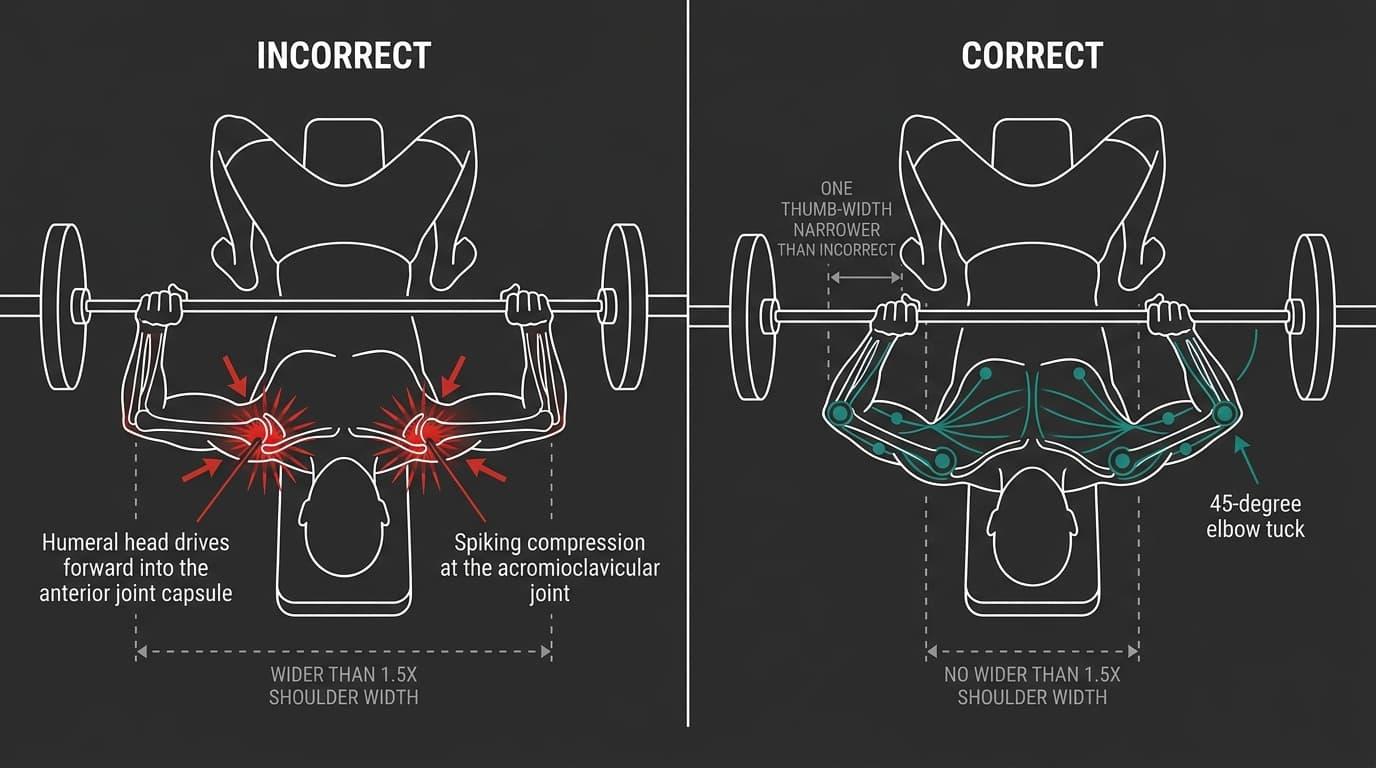
When your elbows flare wide on the descent, the glenohumeral joint rotates into a position that drives the humeral head forward into the anterior joint capsule; if the shoulders roll forward or you have rounded shoulders, that added internal rotation also reduces the space under the acromion and raises the risk of impingement.
That places direct stress on the biceps tendon on every rep. This poor technique can be causing pain by contributing to rotator cuff strain and impingement. The tendon wasn’t built to absorb that kind of repeated force.
Over time, that anterior compression becomes the ache you feel at the front of the shoulder before you’ve finished your warm-up sets. The fix is a 45-degree elbow tuck on the way down. That single adjustment redistributes load away from the anterior capsule and toward the larger pressing muscles where it belongs.
If you’ve been pressing with fully flared elbows for years, expect to drop weight temporarily. The movement pattern needs time to become automatic before you start pushing intensity again.
Grip Width
In the bench press exercise, a grip should stay no wider than 1.5 times shoulder width, even if a wider setup feels like a mechanical advantage because it shortens your range of motion. The problem shows up at the top.
At lockout, a wide grip forces the shoulder into horizontal adduction under load, spiking compression at the acromioclavicular joint. A 2024 biomechanical study found that grip widths narrower than 1.5x biacromial width measurably decreased AC joint compression forces during the bench press, reducing the risk of distal clavicular osteolysis.
Bring your grip one thumb-width narrower. Going too narrow can shift stress toward the elbows, so the goal is correct form rather than simply narrowing as much as possible.
A narrower grip reduces pec activation slightly and may drop your max load in the short term. That’s the honest trade-off. Less AC joint stress now means more productive training sessions later.
Missing Scapular Retraction
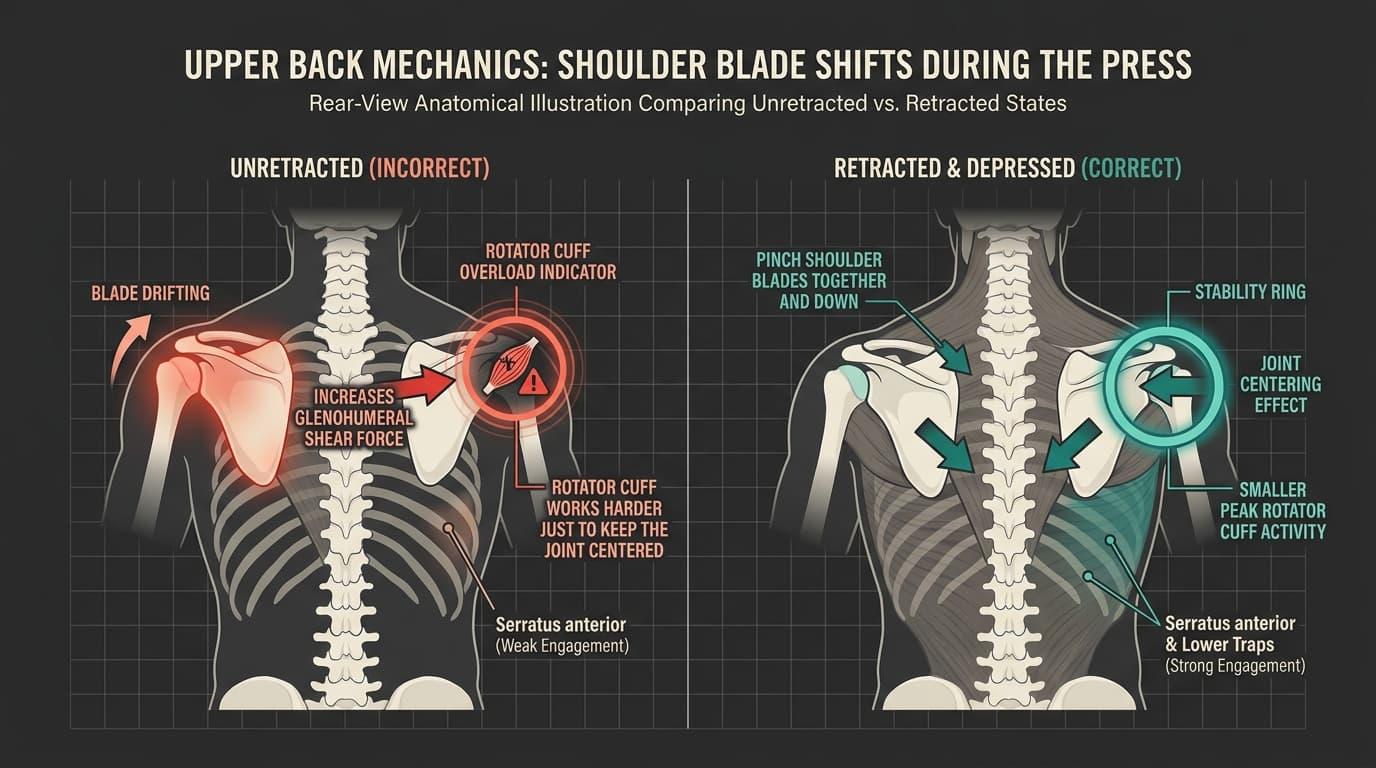
Without active scapular retraction before you unrack, the shoulder blade shifts during the press instead of staying locked as a stable base.
Retracting the scapula before the unrack creates shoulder stability by engaging the scapular stabilizers, including the serratus anterior, so the base stays set for the press. That movement increases glenohumeral shear force and forces the rotator cuff to work harder just to keep the joint centered.
The same 2024 study found retracted scapulae produced smaller peak rotator cuff activity across all bench press variations tested, meaning the cuff was assisting the press rather than compensating for instability. Stable shoulder blades also help the rotator cuff muscles and surrounding muscles keep the shoulder joint centered and reduce extra strain.
Pinch your shoulder blades together and down in the starting position before the bar leaves the rack. Hold that position through every rep of every set. Scapular control is not a warm-up cue. It’s a structural requirement that changes how the load is distributed across the joint for the entire set.
Loading Problems That Compound Over Time
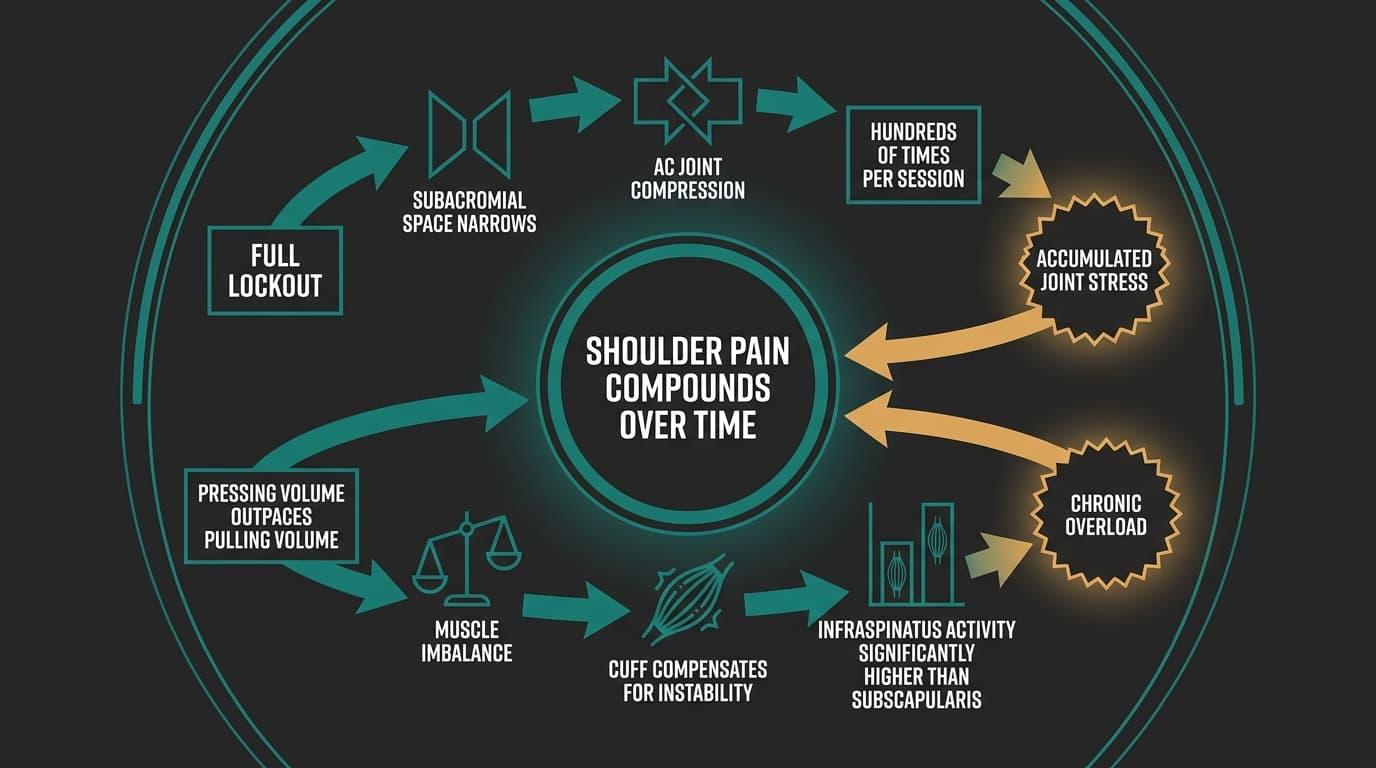
Even with solid technique, two structural loading problems can drive shoulder pain when they go unaddressed across weeks and months. These aren't caused by a single bad session. They're caused by volume and programming decisions that accumulate quietly until the joint starts pushing back.
AC Joint Impingement
At full lockout, the shoulder moves into a position that narrows the subacromial space and compresses the acromioclavicular joint directly. Lifters who press to complete lockout on every rep are loading that compressed position hundreds of times per session. It's as much a volume problem as a technique problem.
The fix is to stop the press just short of full lockout, or shift to a slight incline variation. Changing the shoulder angle by even five to 10 degrees reduces direct AC joint compression without sacrificing any meaningful pressing volume. Your working load stays the same. The joint stress at the end range doesn't.
Rotator Cuff Overload
The rotator cuff is a stabilizer, not a prime mover. When pressing volume consistently outpaces pulling volume, muscle imbalance develops, and the cuff is forced to compensate for instability on every rep. Add overtraining and poor progressive loading to that pattern, and the cuff accumulates fatigue faster than it can recover between sessions.
The research on this is clear. A 2011 EMG study found infraspinatus activity was significantly higher than subscapularis during bench press, meaning the posterior cuff is working hard on every pressing rep. When pulling volume doesn't match, that demand becomes chronic overload.
Match your pressing volume with equal pulling volume across the week. Rows and face pulls are the two movements that correct the imbalance most effectively.
Add banded external rotation to your warm-up to pre-activate the cuff before it's asked to stabilize under load. How long shoulder injuries take to recover depends heavily on whether you address the root cause or just manage symptoms.
When Shoulder Pain Means Stop, Not Push Through
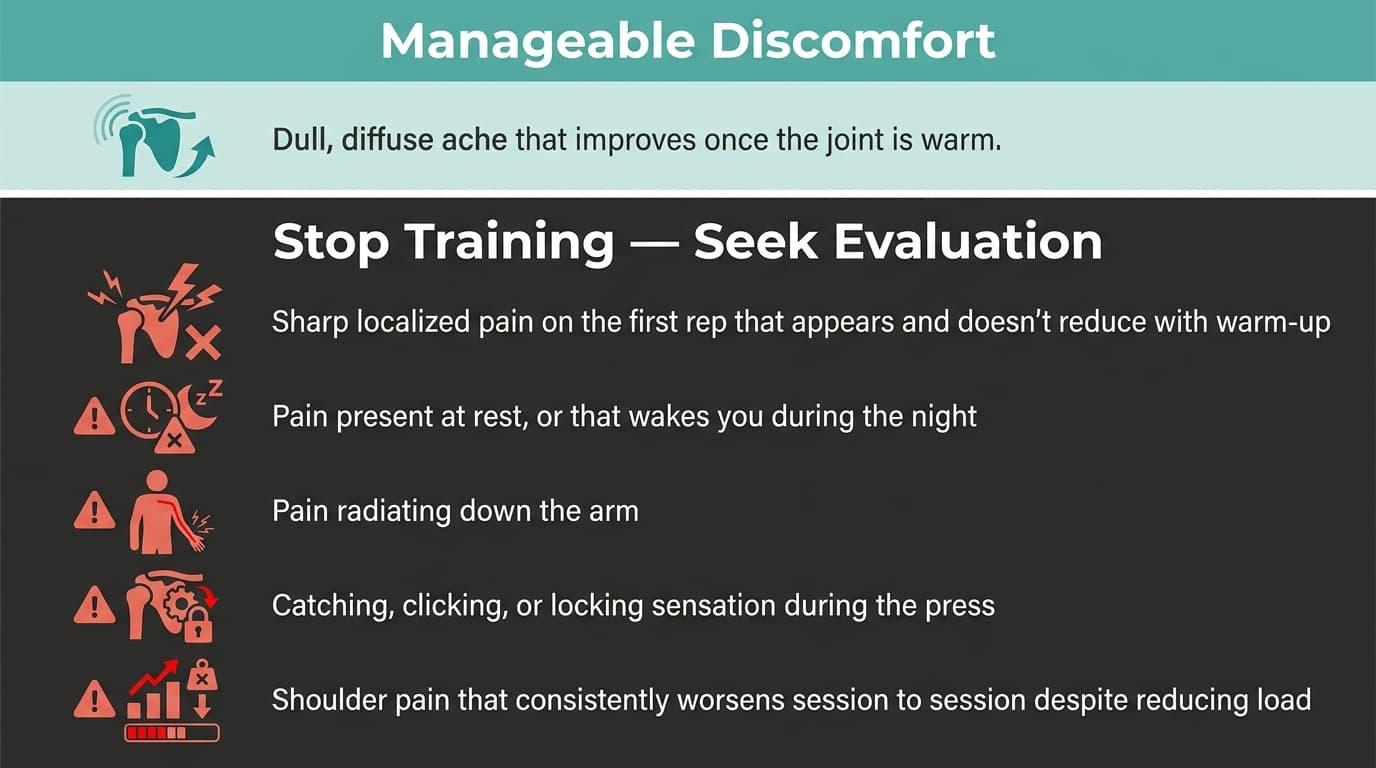
Not all shoulder discomfort signals the same thing. The difference between manageable irritation and structural damage matters because treating them the same way will cost you significant time on the platform.
How you fix shoulder pain depends on how severe the issue is, and conservative care is usually the first step before more invasive options are considered.
Manageable discomfort typically presents as a dull, diffuse ache that improves once the joint is warm and stays consistent across your working sets. That pattern usually points to muscle fatigue or minor joint irritation, not tissue damage.
The pattern that warrants real attention looks different. Rotator cuff tears can affect 30% of adults over 60, and they often develop gradually without a single traumatic event. Progressive worsening over sessions is a more reliable warning sign than waiting for a dramatic injury moment.
Common conservative options include rest, cold compresses, anti-inflammatory medication, and physical therapy to improve flexibility and strength.
Stop training and seek a professional evaluation if you notice any of the following:
-
Sharp, localized pain that appears on the first rep and doesn’t reduce with warm-up
-
Pain present at rest, or that wakes you during the night
-
Pain radiating down the arm, which may suggest nerve involvement rather than local shoulder impingement
-
A catching, clicking, or locking sensation during the press, particularly at the bottom of the range
-
Shoulder pain that consistently worsens session to session despite reducing load and improving thoracic mobility
These signs are not a diagnosis. They’re a signal that self-management has reached its limit, and a physical therapist can assess the affected side, address muscle imbalances and poor posture, and determine whether the symptoms point to joint dysfunction or something more serious.
Protecting the Joint While You Train
Compression during pressing movements does more than hold the joint together. It provides continuous proprioceptive feedback, giving the nervous system a clearer read on where the shoulder is in space.
That feedback reduces the instability perception that causes lifters to unconsciously guard, compensate, and load the rotator cuff unevenly through every rep.
For the AC joint specifically, that feedback needs to be targeted. General sleeve compression doesn’t address the localized stress that builds at the acromioclavicular joint during horizontal pressing. Lifters can also reduce stress by using dumbbells or kettlebells instead of a barbell when needed, which allows a more natural range of motion.
Gel pad technology changes that by placing direct, shock-absorbing contact at the most vulnerable point of the joint rather than spreading pressure broadly across the shoulder.
The Anaconda Shoulder Brace is built with a dedicated gel pad for AC joint protection and a 3D knit compression design made from polyester, nylon, and spandex that moves with the pressing movement rather than restricting it.
It supports the joint environment while you actively improve your technique and build the scapular control that makes pressing sustainable long-term. At $49.95 with a 30-day return guarantee and orders shipped within 24 hours from our Arizona warehouse, it’s a practical addition to any pressing session where shoulder irritation is present. Over 400,000 athletes have trusted Anaconda gear to keep them training through real shoulder issues.
Get the Anaconda Shoulder Brace Today
Training Adjustments That Let You Keep Pressing
Beyond technique corrections, how you structure your training week has a direct impact on whether shoulder irritation compounds or clears. Two areas matter most: what you do before you load the bar, and how you manage volume and intensity across sessions.
Build a Warm-Up That Actually Prepares the Joint
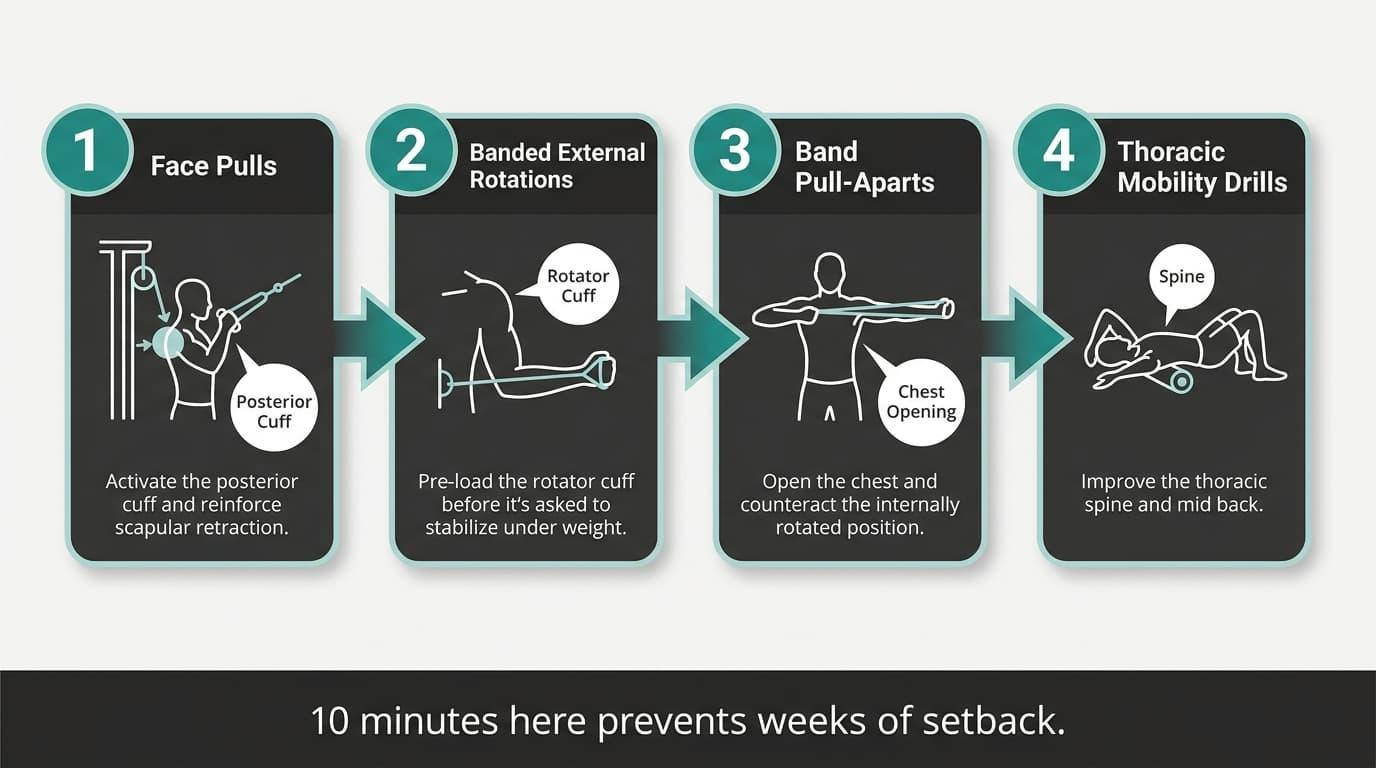
Most shoulder problems during bench press start before the first working set. Loading a cold, unactivated shoulder is how rotator cuff irritation turns into something that sidelines you for months. A proper warm-up targets the specific structures that stabilize the joint under pressing load, not just general blood flow, and should improve shoulder mobility before you start loading.
Before touching the bar, run through these movements:
-
Face pulls with a band or cable to activate the posterior cuff and reinforce scapular retraction before any pressing load goes through the joint
-
Banded external rotations to pre-load the rotator cuff before it’s asked to stabilize under weight
-
Band pull-aparts to open the chest and counteract the internally rotated position most lifters carry into the gym, which helps correct proper posture and build shoulder mobility over time
-
Thoracic mobility drills, including foam rolling and foam roller extensions, to improve the thoracic spine and mid back, which supports proper posture and the upper-back position on which effective scapular control depends
The warm-up should also set a solid upper-body start position, with the feet pressed firmly into the floor to create tension and stabilize the upper back before bench pressing pain free.
Ten minutes here prevents weeks of setback.
Manage Volume, Load, and the Push-Pull Balance
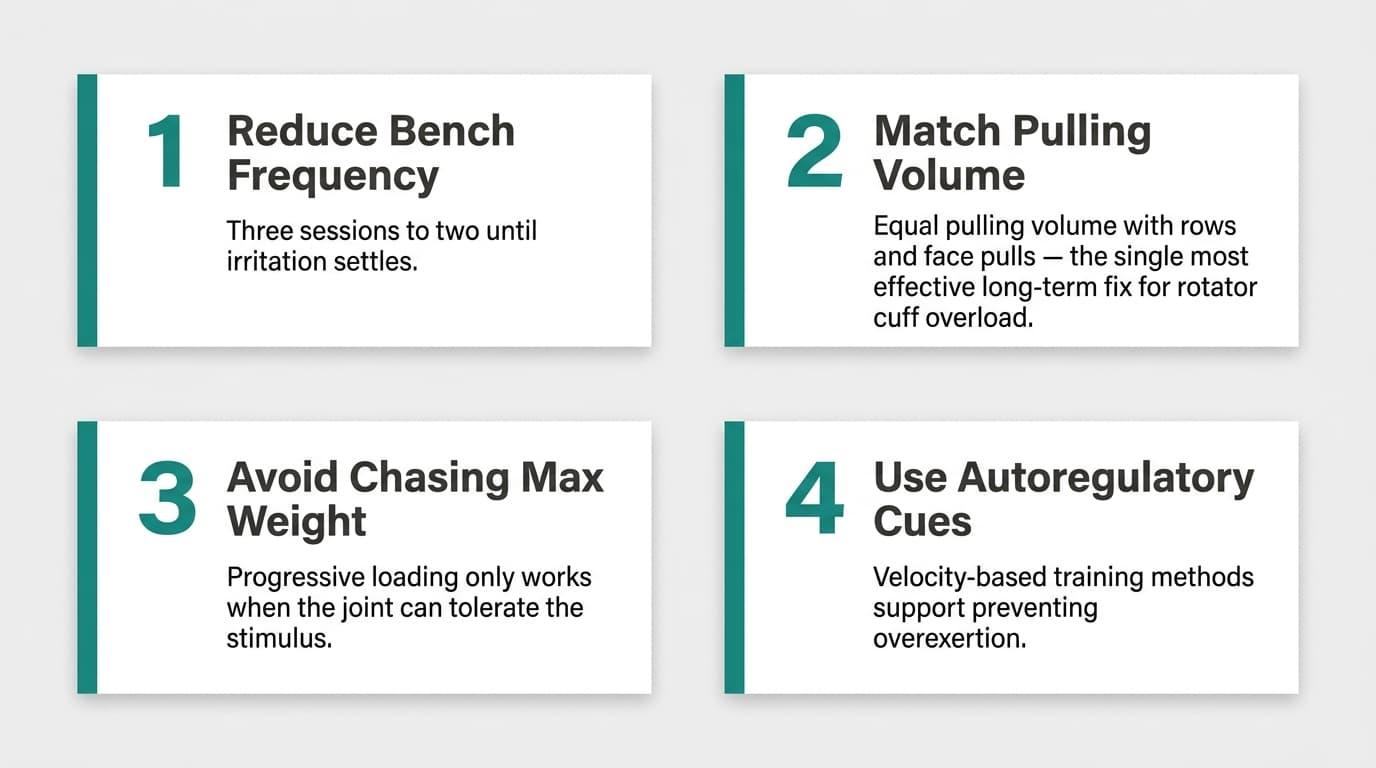
When shoulder pain is present, the instinct is to push through. The smarter move is to adjust the variables that are driving the overload. Here's what that looks like in practice:
-
Reduce bench frequency temporarily from three sessions per week to two until irritation settles. Two quality sessions with better technique beat three painful ones every time
-
Match every pressing session with equal pulling volume using rows and face pulls. This is the single most effective long-term fix for rotator cuff overload
-
Avoid chasing max weight during a flare. Progressive loading only works when the joint can tolerate the stimulus
-
Use autoregulatory cues to govern intensity. Velocity-based training methods support preventing overexertion without sacrificing training output
Final Words
Most bench press shoulder pain comes down to two things: technique gaps and ignored early signals.
Fix the elbow path, lock in scapular control, and address the push-pull imbalance before it compounds, and the majority of lifters get back to pressing without missing significant training time.
At Anaconda, we build gear for athletes who are serious about staying on the platform. Our shoulder brace gives you the joint support to keep training while you work through the adjustments that make pressing sustainable for the long haul.
Frequently Asked Questions
Here are quick answers to the most common questions lifters ask about rotator cuff pain, impingement, and recovery.
How do I know if my shoulder pain is muscle soreness or a rotator cuff injury?
Muscle soreness usually feels broad, temporary, and improves as you move throughout the day. Rotator cuff pain is often sharper, more localized, and triggered by specific movements like overhead reaching or rotating the arm. Soreness also tends to improve within a few days after training. If the pain keeps returning during pressing movements, the rotator cuff may be involved.
What are two warning signs of a rotator cuff tear?
Two major warning signs of a rotator cuff tear are noticeable shoulder weakness and pain that continues even at rest. Many people also struggle lifting the arm overhead or away from the body without discomfort. Night pain is another common symptom that separates tears from normal gym soreness. If weakness and persistent pain happen together, professional evaluation is important.
Will a rotator cuff injury heal on its own?
Some mild or partial rotator cuff injuries can improve with rest, reduced training load, and proper rehabilitation. More severe or full-thickness tears are less likely to heal fully without medical treatment.
Physical therapy is often the first step for many rotator cuff problems and may include manual therapy, stretching, and strengthening to address muscle imbalances and improve posture. Early recovery management usually improves long-term outcomes significantly. If symptoms keep getting worse instead of better, it’s important to get assessed professionally.
Can I still bench press with shoulder impingement?
Yes, many lifters dealing with shoulder pain bench issues can still bench press with shoulder impingement by modifying technique and reducing aggravating positions. Adjusting grip width, lowering training volume, and controlling elbow position often helps reduce irritation.
For bench pain free execution, lower the barbell in a controlled diagonal path toward the mid-to-lower chest. However, sharp pain or worsening symptoms should not be ignored during training. If pain continues outside the gym as well, it’s best to pause pressing temporarily and get evaluated, since these adjustments also help avoid undue stress on the shoulder complex.
How long does bench press shoulder pain take to heal?
Mild shoulder irritation from bench pressing may improve within a few weeks if training adjustments are made early.
More significant issues like impingement or partial rotator cuff injuries can take several months to fully settle down. Recovery speed depends heavily on severity, training habits, and how well the underlying cause is addressed. Continuing to push through pain usually delays healing rather than speeding it up.


