


Shoulder pain is annoying in a way that's uniquely personal. It's not the kind of injury that keeps you on the couch; it's the kind that follows you onto the mat, into the gym, and into every overhead movement you attempt for the next three months. You're not incapacitated. You're just constantly reminded that something isn't right.
And what makes it worse? Grabbing the wrong support gear. A compression sleeve and a shoulder brace are not the same tool, and using one when your shoulder actually needs the other doesn't just stall your recovery. It can quietly set it back. The sleeve that works brilliantly for tendonitis offers zero protection against instability, and the brace that's right for a partial tear is overkill for post-workout soreness.
At Anaconda, we build support gear for athletes who refuse to sit out. Our shoulder range is designed to move with you through every phase of training and recovery, not slow you down.
Key Takeaways
-
A shoulder sleeve delivers compression and proprioceptive feedback with no rigid structure and no movement restriction.
-
A shoulder brace mechanically limits joint movement and is built for more serious structural injuries.
-
Sleeves work best for tendonitis, bursitis, minor strains, and post-workout recovery.
-
Braces are the right call for partial tears, instability, AC joint separation, and labral damage.
-
Wearing a compression sleeve under most stabilizing braces is not only possible but often preferable to using a single product alone.
-
Neither product replaces a clinical diagnosis when symptoms are worsening or unclear.
What a Shoulder Sleeve Actually Does
A sleeve is often the smarter starting point for lower-severity shoulder problems, even though most athletes instinctively reach for the most structured option available.
More support feels like more protection, but for a large portion of shoulder issues, additional restriction works against the recovery rather than for it.
For a large portion of shoulder problems, that instinct works against you. More restrictions aren't always more helpful, meaning a sleeve is often the smarter, more targeted starting point.
Compression and the Proprioception Loop
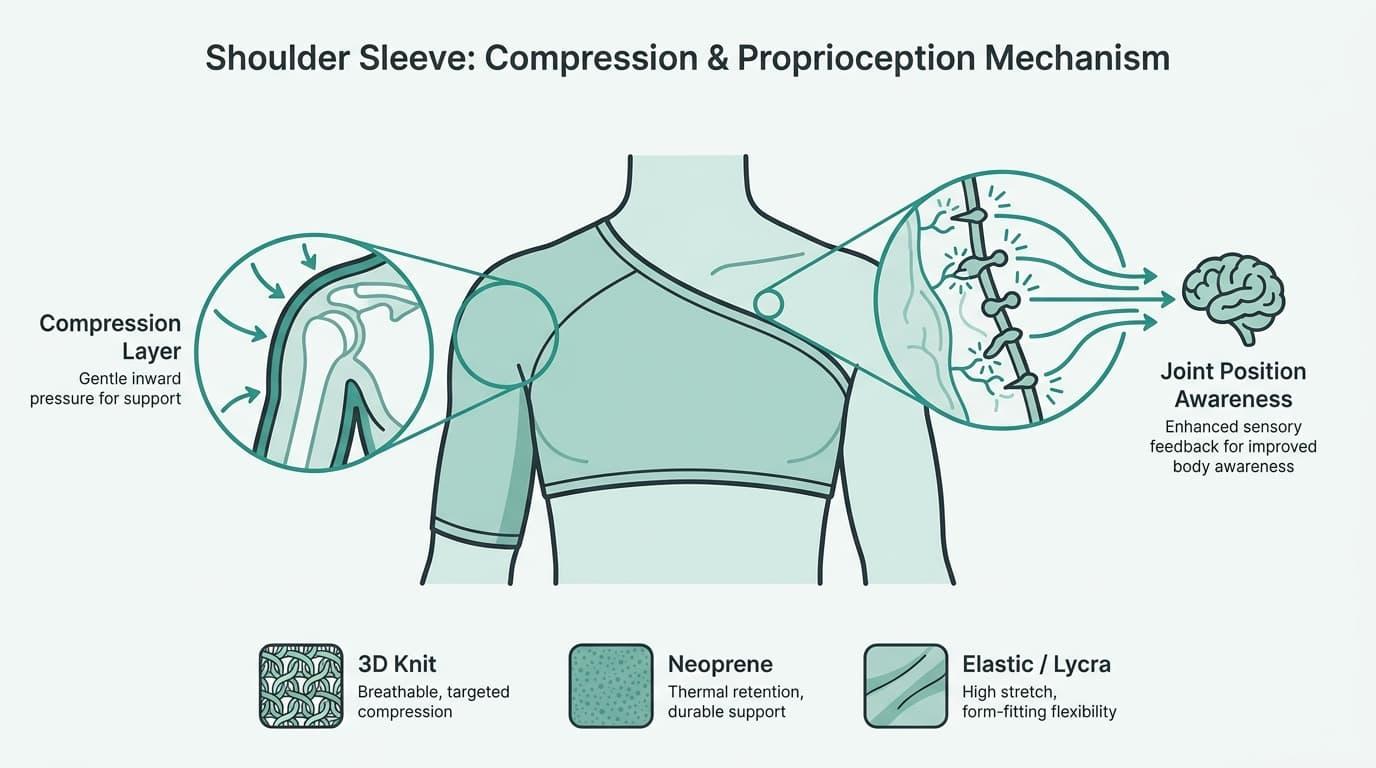
A shoulder sleeve is a stretchable compression garment: no hinges, no panels, no rigid reinforcement. What it delivers is two overlapping mechanisms that work well together for lower-severity injuries.
Compression applies consistent, gentle pressure across the joint. It supports venous return and helps the tissue manage post-training inflammation more efficiently
Proprioception is the second mechanism, and it's the one most athletes underestimate. The sleeve's constant skin contact activates sensory receptors around the shoulder, improving your brain's real-time awareness of where the joint sits in space.
A 2024 systematic review and meta-analysis found that compression garments significantly improve joint position sense, reducing repositioning errors in injured populations more than in healthy ones.
In plain terms, when your shoulder is irritated, your brain's spatial map of the joint gets fuzzy. The sleeve sharpens that map by activating cutaneous sensory receptors across the skin around the joint. That subtle shoulder hike you do during a press or a clinch without realizing it? That's what proprioceptive feedback helps you stop doing.
What Material Does and Doesn't Change
Material determines how a sleeve feels during activity. It doesn’t change the amount of structural support it provides. That distinction matters when choosing between options.
3D knit fabric is breathable and stays low-profile under gear, making it the most practical choice for active training sessions where heat buildup becomes a problem.
Neoprene retains warmth around the joint, which suits athletes dealing with chronic stiffness or tendonitis that tightens up in cold gyms or early morning sessions.
Elastic and Lycra blends are the lightest option, built for all-day wear when discretion and comfort matter more than thermal retention.
When a Sleeve Is the Right Call
A sleeve is the appropriate tool in specific, lower-severity situations. These are the scenarios where it performs best:
-
Minor rotator cuff strain: Compression supports the tissue without restricting the range of motion you need for continued light training.
-
Bursitis: Gentle pressure helps manage swelling during the subacute phase when the joint is irritated but structurally intact.
-
Tendonitis: Consistent proprioceptive feedback reduces unconscious guarding patterns that tend to prolong tendonitis recovery far longer than necessary.
-
Post-workout soreness: A compression sleeve supports circulation and recovery between sessions without adding unnecessary bulk to your kit.
-
Prevention during training: Athletes with a history of shoulder sensitivity use sleeves as a proactive tool to maintain joint awareness under load before anything goes wrong.
A sleeve is not appropriate for dislocations, full rotator cuff tears, or post-surgical recovery. Those situations require structured mechanical support. Compression alone isn’t enough.
What a Shoulder Brace Does Differently
There's a point in shoulder recovery at which compression becomes insufficient.
Your joint isn't just irritated anymore; it's genuinely unstable, or the tissue is structurally compromised.
A sleeve gives your brain useful information at that point. It doesn’t prevent the joint from moving where it shouldn't. That's the job of a brace.
Mechanical Restriction, Not Just Pressure
A shoulder brace is a structured support device that uses straps, panels, or rigid components to physically limit joint movement.
Where a sleeve influences the shoulder through pressure and sensory feedback, a brace intervenes at the structural level. Straps and panels create hard limits around the joint, preventing the movement patterns that place direct strain on damaged or unstable tissue.
Think about what happens in a scramble when your arm gets posted out wide, and your shoulder reaches that vulnerable external rotation.
A sleeve has already done everything it can. A brace stops the joint from getting there in the first place.
The Three Types of Shoulder Braces
Not all braces restrict movement equally. Understanding the different types clarifies which level of control your specific injury requires:
-
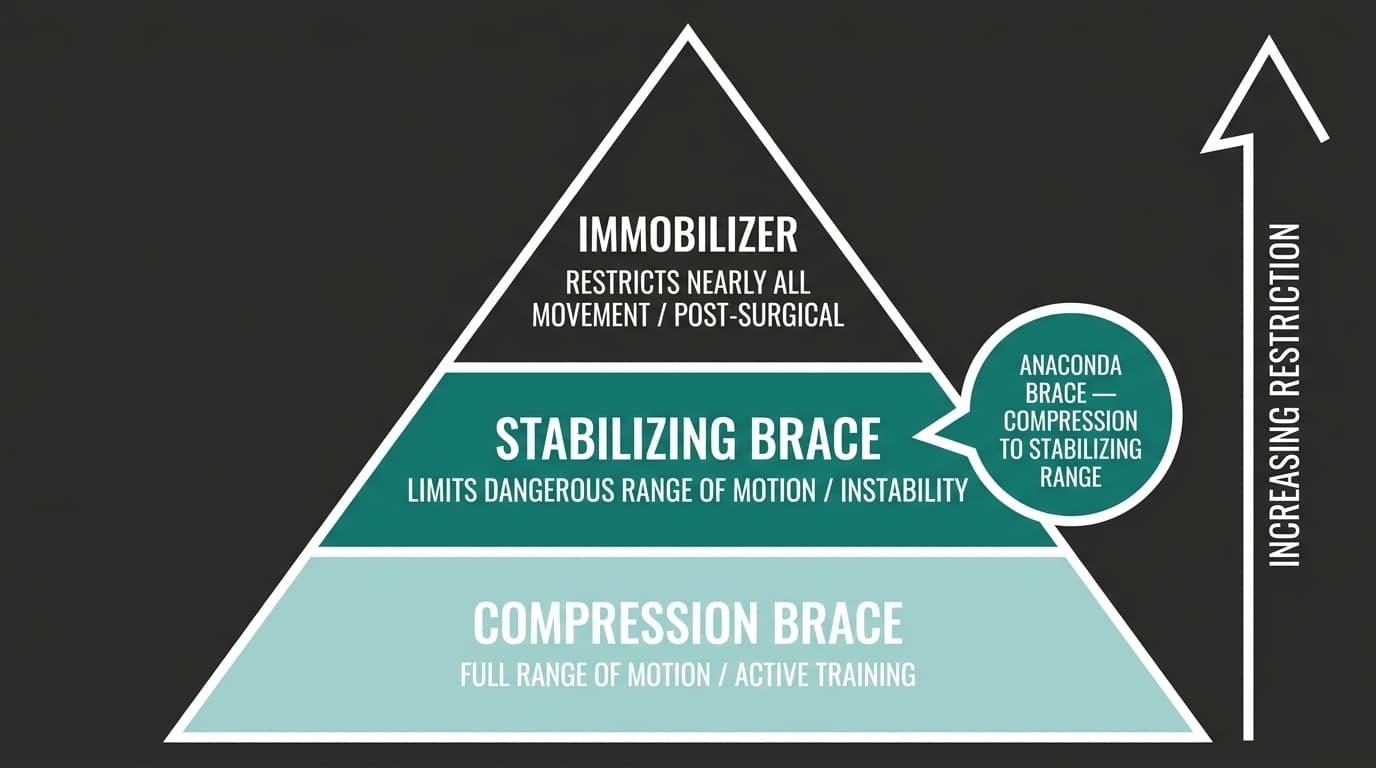
Compression brace: Allows full range of motion with added structure. Suited for mild-to-moderate injuries during active training.
-
Stabilizing brace: Uses a strap system to limit the dangerous range of motion. Designed for shoulder instability and recurrent dislocations.
-
Immobilizer: Restricts nearly all movement. Reserved for post-surgical recovery and fractures.
The Anaconda shoulder brace sits between the compression and stabilizing categories. It delivers structural reinforcement without the bulk of a rigid immobilization device, so you keep your mobility where it's safe without losing protection where it counts.
For athletes returning from a partial tear or managing instability under load, the Anaconda Shoulder Brace is built to give your joint real structural support without shutting down your training. It's constructed from polyester, nylon, and spandex using a 3D knitting process that moves with your body rather than against it, and the universal fit means no left-right confusion when you're gearing up fast. At $49.95, it sits in the sweet spot between full rest and getting back to serious training.
When a Brace Is the Right Call
Braces are suited to more serious structural situations. These are the conditions that require one:
-
Partial rotator cuff tear: Controlled range of motion reduces mechanical load on the compromised tendon during activity.
-
Full tear or post-surgical recovery: Structured immobilization is required during early healing phases. Clinical guidance should direct the choice.
-
AC joint separation: Strap-based support limits movements that aggravate the acromioclavicular joint.
-
Labral tear: Mechanical restriction prevents the shoulder positions most likely to cause re-injury.
-
Recurrent instability: A stabilizing brace limits the range of motion that triggers dislocation episodes.
-
Clavicle fracture: An immobilizer keeps the joint stationary while the bone heals.
Sleeve vs. Brace: Side-by-Side
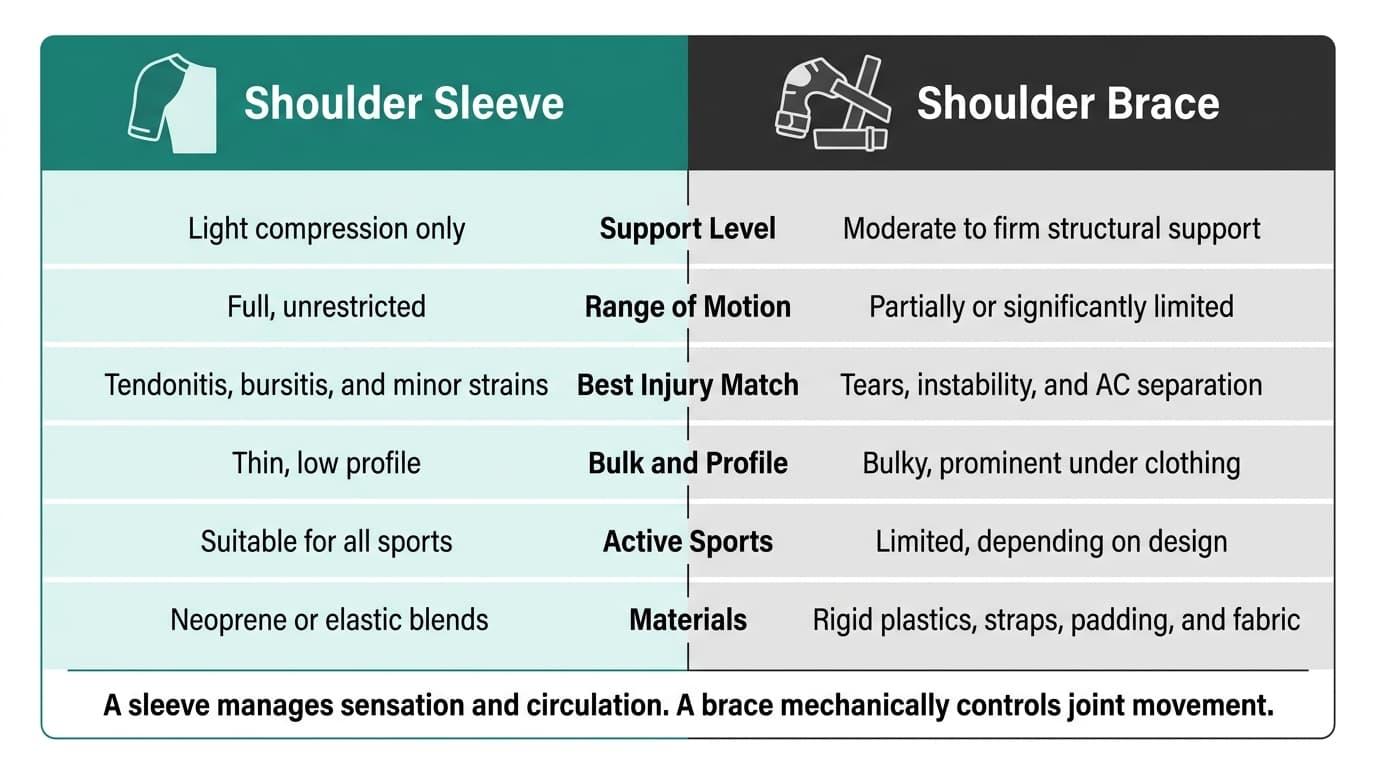
Before you commit to one or the other, seeing the differences laid out clearly makes the decision a lot faster. The table below covers the factors that matter most in the context of training and recovery.

The core difference is structural intent. A sleeve manages sensation and circulation. A brace mechanically controls joint movement. Choosing between them depends on whether your shoulder needs sensory support or physical restriction.
Where They Sit on the Support Spectrum
Shoulder supports follow a clear progression: compression sleeve, compression brace, stabilizing brace, immobilizer.
A sleeve sits at the lightest end, suited for active training with minor irritation.
A stabilizing brace sits in the middle, controlling a dangerous range of motion without full immobilization.
The Anaconda shoulder brace occupies that critical middle ground, delivering structural reinforcement with enough freedom for high-intensity training.
Which Shoulder Support Matches Your Injury?
The table above gives the broad picture. This section gets specific, mapping the most common shoulder injuries to the support type that best fits each.
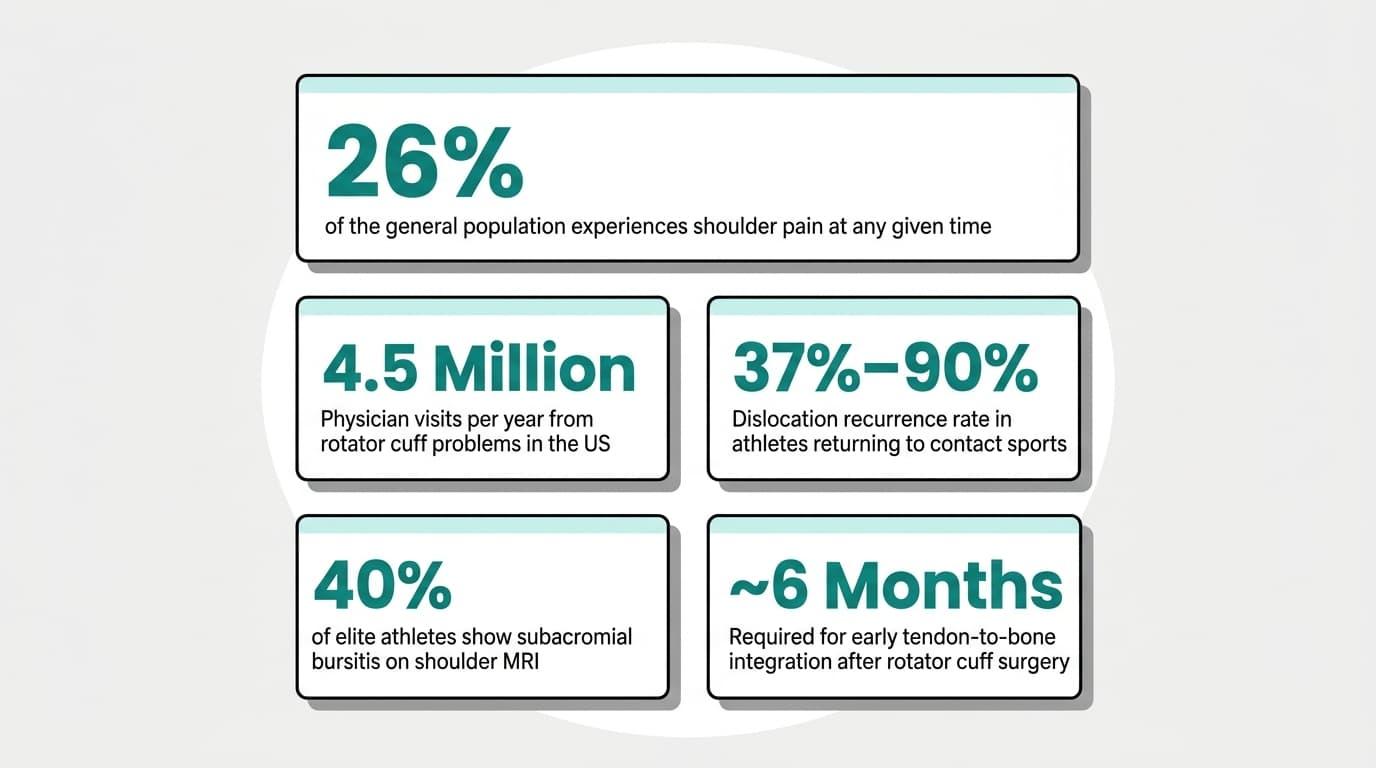
The data on shoulder pain is truly striking. Up to 26% of the general population experiences shoulder pain at any given point in time, and among active athletes, the numbers climb significantly higher.
Rotator cuff problems alone account for more than 4.5 million physician visits in the US each year. Your shoulder problem is not unique. The right support for it is well understood.
Rotator Cuff Strain or Tendinitis
You feel it most during overhead pressing or when your arm crosses the midline. The ache is persistent, but your shoulder still moves through its full range without giving way. This is a sleeve scenario.
A sleeve is sufficient when the joint remains structurally intact.
Compression supports the tissue and reduces guarding patterns, while proprioceptive feedback helps maintain cleaner movement mechanics during training.
Because there's no structural compromise, unrestricted range of motion is an asset here, not a risk.
Partial Rotator Cuff Tear
A compression or stabilizing brace is the appropriate choice for this type of injury. A sleeve alone doesn’t reduce mechanical strain on damaged tendon tissue during loaded movement. The severity of the tear determines which brace level is needed: a compression brace handles milder partial tears, while a stabilizing brace is needed for more significant ones.
If you're unsure of your tear grade, get a clinical assessment before returning to training under load. The difference between a partial and a full-thickness tear changes the entire support and treatment approach, and getting that wrong adds months to a recovery that was already frustrating.
Full-Thickness Tear or Post-Surgical Recovery
A sleeve isn’t the right tool at this stage. Full-thickness tears and post-surgical shoulders require an immobilizing brace or sling, as unrestricted movement significantly increases the risk of retear during early healing.
This phase calls for patience. The tissue needs time, not load. Rotator cuff surgery requires approximately six months for early tendon-to-bone integration, and returning too early is one of the most common reasons athletes end up right back where they started.
Shoulder Instability and Dislocation History
If you've dislocated before, you know the specific fear that comes with certain positions. The arm goes back during a clinch or a sprawl, and you feel that familiar looseness. That's not paranoia. It's a well-founded concern. Athletes returning to contact sports after a dislocation face recurrence rates ranging from 37% to 90%, with younger athletes at the higher end of that range.
A stabilizing brace with a strap system is required for shoulder instability and a history of dislocation. A sleeve provides no mechanical resistance to the abduction and external rotation positions that trigger subluxation episodes.
Compression alone offers no meaningful protection against repeat injury in a grappling or contact context.
AC Joint Sprain or Separation
A stabilizing brace is appropriate for Grade I and Grade II AC joint sprains, where the ligament is stretched or partially torn but the joint remains reducible. Grade III or higher may require immobilization, depending on clinical assessment. A shoulder sleeve does not stabilize the acromioclavicular joint mechanically, regardless of how much compression it provides.
Bursitis and Shoulder Impingement
That deep, diffuse ache that gets worse when you raise your arm past shoulder height, the one that woke you up at 2 am the night before training, is often bursitis or impingement. It's more common than most people realize. Subacromial bursitis is present in roughly 40% of elite athletes who receive shoulder MRI. No structural damage, but real and frustrating inflammation.
A sleeve is the right tool when no structural damage is present. Compression and warmth help manage inflammation during the subacute phase, and an unrestricted range of motion supports continued rehabilitation movement without aggravating the bursa.
The sleeve that seems unnecessary during a healthy training block becomes the tool that keeps the shoulder moving through a flare-up — the role shifts with the joint's state, not with the athlete's preference.
A Fast Decision Guide for Four Common Situations
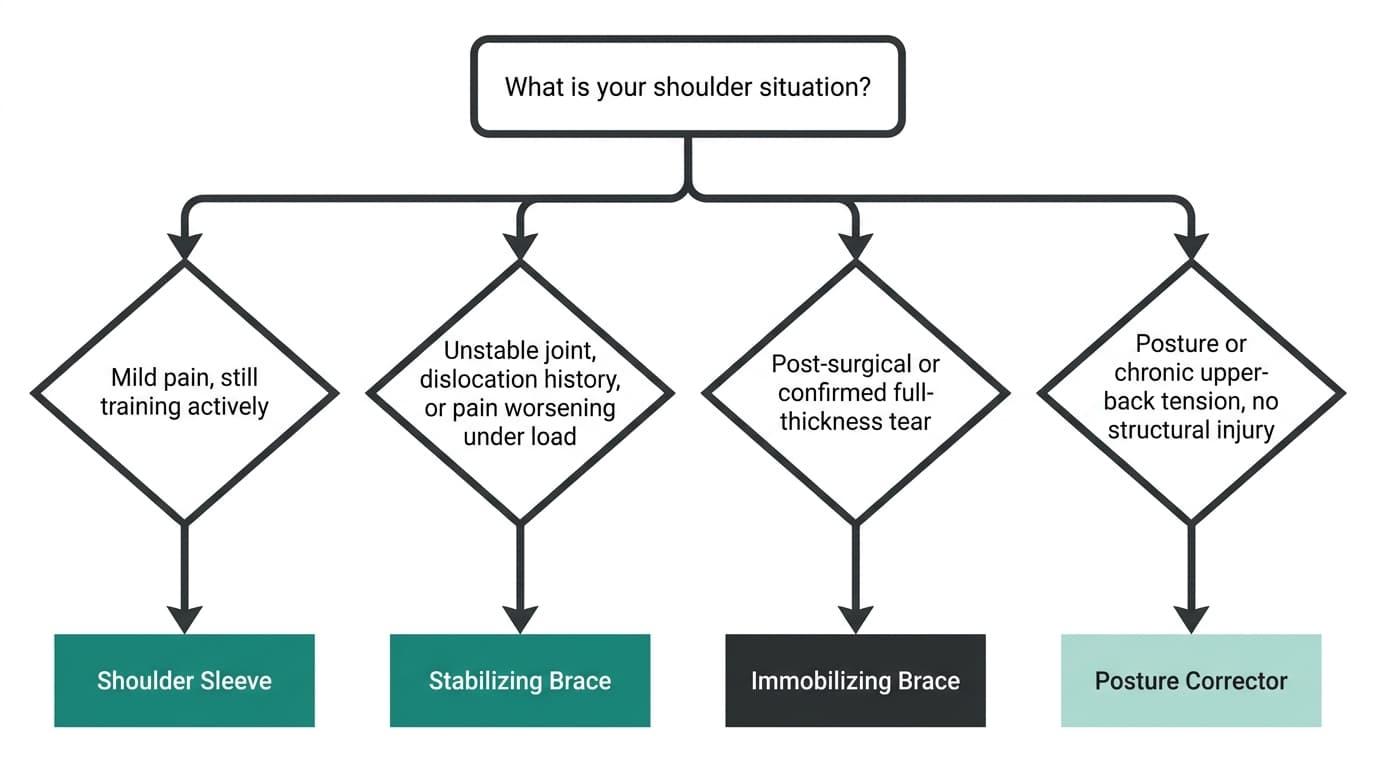
Sometimes you just need a straight answer without having to read through every clinical scenario. This framework covers the four most common situations athletes face, in plain language:
-
If you have mild pain and are still training actively: A shoulder sleeve is the right call. Compression and proprioceptive feedback support the joint without limiting the range of motion you need on the mat or under the bar.
-
If your joint feels unstable, you have a dislocation history, or pain is worsening under load: Move to a stabilizing brace. A sleeve provides no mechanical resistance to the positions that trigger subluxation.
-
If you are post-surgical or dealing with a confirmed full-thickness tear: An immobilizing brace is required. See a clinician before returning to any loaded movement.
-
If your issue is posture or chronic upper-back tension with no structural injury: A posture corrector is the option most buyers overlook entirely.
The Anaconda shoulder brace collection is built across multiple support levels so you can find the right fit for wherever you are in your recovery.
Sizing: Why Sleeves and Braces Measure Differently
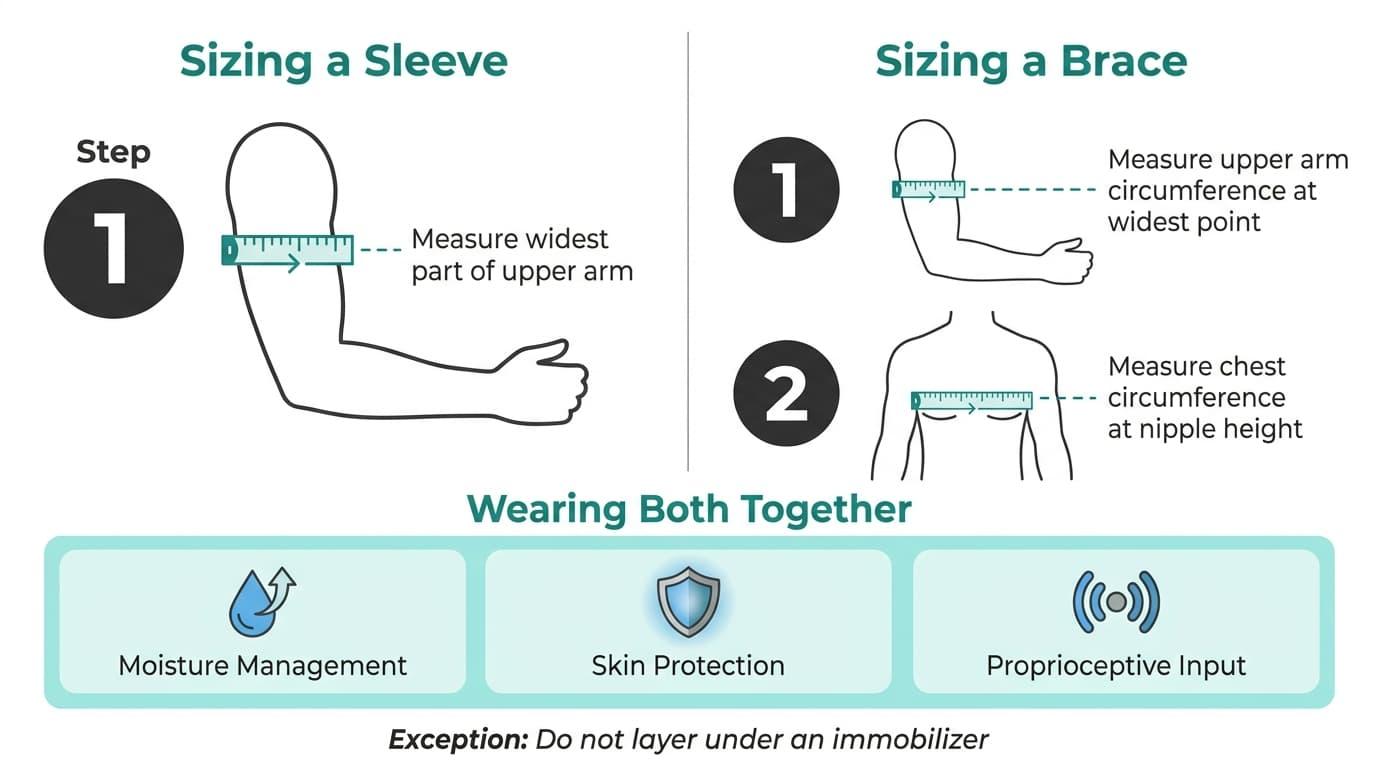
Choosing the right product is only half the job.
A sleeve that slides mid-session delivers no proprioceptive benefit.
A brace with incorrectly placed straps loses structural integrity exactly when you need it most, which is precisely when you can't afford to adjust it.
Sleeves are sized solely by arm circumference. Measure the widest part of your upper arm for an accurate fit.
Braces require both chest and arm measurements because the straps anchor across the torso, not just the limb.
For Anaconda braces specifically, measure your upper arm circumference at its widest point and your chest circumference at nipple height. Both numbers together determine your correct size.
Fit isn't just a comfort issue. Incorrect brace positioning is one of the most common reasons athletes abandon their support gear before recovery is complete. Getting it right from session one protects both your shoulder and your investment.
Can You Wear a Sleeve and a Brace Together?
Yes, and for most athletes, layering the two performs better than using a single product. Three practical reasons drive this layering approach in the field:
-
Moisture management: The sleeve wicks sweat away from the skin, preventing the brace from slipping during explosive movement.
-
Skin protection: The sleeve creates a barrier between strap contact points and bare skin, reducing chafing during long sessions.
-
Proprioceptive input: Layering adds an additional sensory layer, reinforcing joint position awareness under load.
The one exception is an immobilizer. Wearing a sleeve under a rigid immobilization device compromises the fit and reduces the mechanical control the device is designed to provide.
The Anaconda dual-strap shoulder brace is designed to accommodate a standard compression sleeve underneath. A low-profile sleeve in 3D knit or thin elastic fabric sits cleanly beneath the strap system without affecting tension or anchor point positioning. Thick neoprene sleeves are not recommended, as the added bulk can shift strap placement and reduce structural contact across the joint.
What Bracing and Compression Can and Cannot Do
Athletes sometimes put too much faith in support gear and sometimes dismiss it entirely. The reality sits somewhere more useful than either extreme. Compression and bracing each have a defined job, and each has a defined limit.
Compression supports venous return and helps the tissue manage post-training inflammation, which is why athletes feel a sleeve doing real work between sessions even though it isn't restricting movement.
A shoulder brace works differently: Mechanical restriction limits the positions that place direct strain on damaged tissue, whether that is a compromised rotator cuff or an unstable AC joint. Together, they manage load and sensation, with distinct jobs at distinct stages of recovery.
Three things worth stating plainly:
-
A brace or sleeve cannot reconnect a torn tendon.
-
Neither product replaces a clinical diagnosis when symptoms are worsening or unclear.
-
Neither substitutes for structured rehabilitation when restoring the range of motion is the actual goal.
The same sleeve serves two distinct jobs across a recovery timeline.
During the acute phase, a compression sleeve fills the C in RICE (Rest, Ice, Compression, Elevation), applying consistent pressure to limit early swelling.
Once active rehab begins, that same sleeve transitions into a training support tool, reinforcing proprioceptive feedback during loaded movement.
Final Words
Your shoulder doesn't need the most aggressive support on the market. It needs the right one for this specific stage of recovery. A sleeve is a tool for irritation and inflammation. A brace is the tool when the structure itself is compromised. Use either one incorrectly, and you're either under-supported or unnecessarily restricted, neither of which is a winning position.
At Anaconda, every product we make is built to help athletes find that balance. Our shoulder brace ships within 24 hours and comes with a 30-day return guarantee, because choosing gear mid-recovery is stressful enough without second-guessing your order. If your shoulder is ready to be supported properly, we're ready for you.
Frequently Asked Questions
Still have questions about shoulder support, injuries, or recovery? Here are a few quick answers to the most common things people ask before choosing a brace or sleeve.
Do doctors recommend shoulder braces?
Yes, doctors do recommend shoulder braces for certain injuries and recovery situations. Shoulder braces are commonly used for shoulder instability, rotator cuff injuries, AC joint sprains, and post-surgical support. The right brace depends on your condition, activity level, and how much stabilization you need. A doctor can help determine the proper type, fit, and wear duration for better recovery outcomes.
Will a shoulder brace help with a torn labrum?
Yes, a shoulder brace can help with a torn labrum by limiting movements that place stress on the shoulder joint. A stabilizing brace helps reduce the risk of re-injury during sports, training, or daily movement. While it will not heal the tear itself, it can improve shoulder stability and reduce discomfort during activity. Many athletes use shoulder braces as part of the conservative management of labrum injuries.
Should I wear a shoulder brace if I have a torn rotator cuff?
Yes, a shoulder brace may help if you have a torn rotator cuff, depending on the severity of the injury. Partial tears often benefit from added support and controlled movement during activity and recovery. More severe or full-thickness tears may require immobilization and medical supervision before returning to movement. A compression sleeve alone is usually not enough support for a serious rotator cuff tear.
When should you not wear a compression sleeve?
You should not wear a compression sleeve over open wounds, irritated skin, or untreated post-surgical areas. Compression sleeves are also not a replacement for immobilizers when stricter shoulder support is required. If your doctor recommends limited movement after surgery or injury, a sleeve may not provide enough stabilization. When in doubt, get a proper assessment before choosing between a sleeve and a brace.


