


You rack the bar after your last set and feel it immediately: That dull, insistent ache spreading through your shoulder.
Now you're standing in the locker room, wondering if you just trained too hard or if something's actually wrong. It's one of the most frustrating calls an athlete has to make, and guessing incorrectly in either direction can cost you time, progress, and confidence.
Shoulder pain after workout sessions doesn't come with a label.
Overuse, poor mechanics, and real structural problems can all produce the same ache. The difference between soreness you can train through and an injury you need to respect isn't always obvious in the first 24 hours.
At Anaconda, we built our shoulder support range for athletes who refuse to sit on the sidelines, trying to figure it out alone. Our braces are designed to keep you training, not second-guessing every press.
Key Takeaways
-
Most post-workout shoulder pain comes from overuse, poor form, or muscle imbalances, and all three are correctable.
-
Normal soreness (DOMS) is dull, diffuse, and clears within 72 hours. Injury pain is sharp, localized, and persistent.
-
Complete rest is rarely the right call. Structured movement and progressive loading outperform passive recovery.
-
Seven specific red flags should prompt you to stop training and seek professional evaluation right away.
-
Compression support helps manage swelling, sharpen proprioception, and keep you mechanically sound through recovery.
Why Your Shoulder Hurts After Training
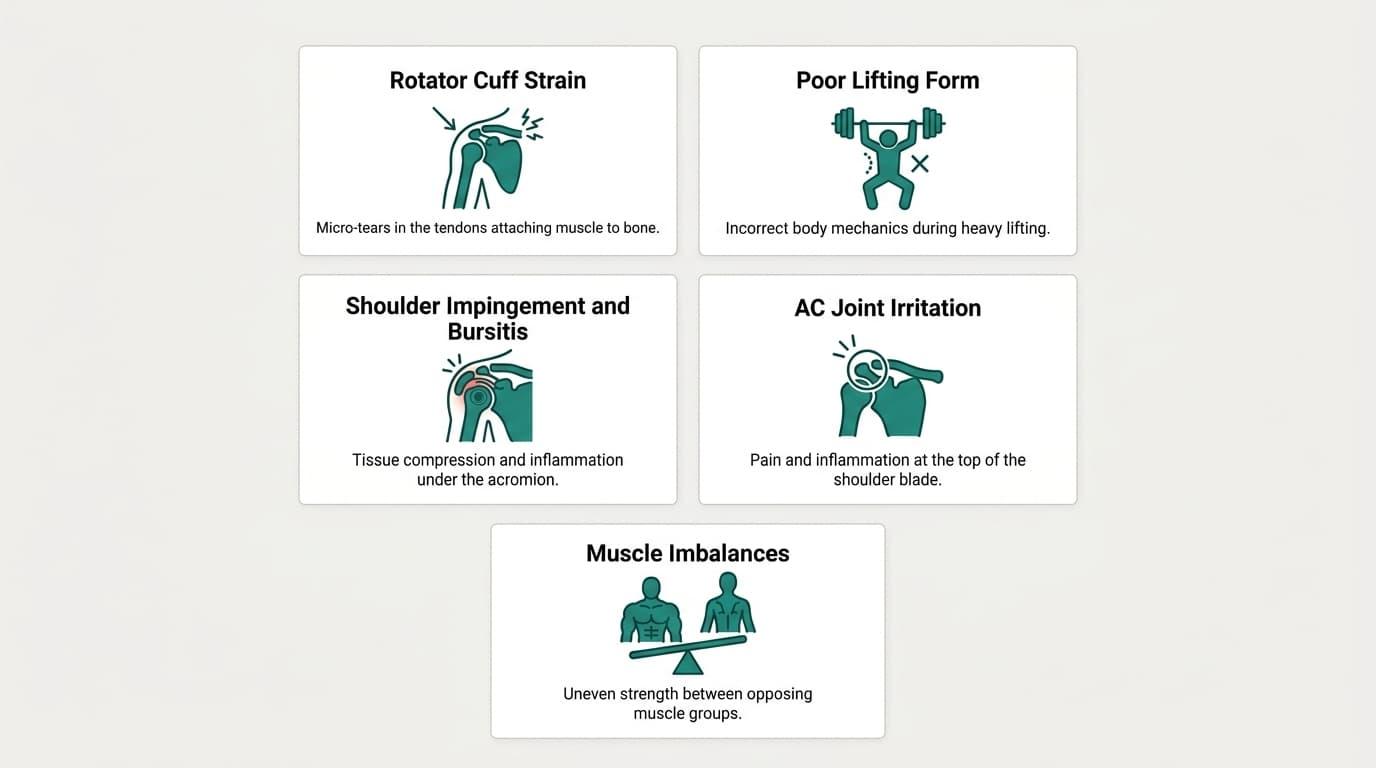
Post-workout shoulder pain usually traces back to a handful of recurring culprits.
Research on risk factors for new onset shoulder pain confirms that overuse, mechanical load, and structural imbalances drive the vast majority of cases across athletic populations.
Knowing which one's affecting you changes everything about how you respond.
Rotator Cuff Strain
The rotator cuff is a group of four muscles and tendons that stabilize the shoulder joint throughout pressing, pulling, and overhead movement. A rotator cuff tendon can become irritated from repetitive strain or overhead exercises, which is essentially tendonitis. Overuse is almost always the root cause, and rotator cuff tears can also develop from repetitive overhead movements when load and volume outpace recovery.
Quick fixes to try:
-
Reduce pressing volume temporarily and avoid overhead movements that reproduce pain.
-
Add external rotation work with a light resistance band to restore tendon load tolerance.
-
Sleep on the unaffected side to reduce overnight compression on the irritated tendon.
Poor Lifting Form and Overhead Load
Incorrect technique during overhead pressing or pulling shifts the load onto the shoulder capsule instead of distributing it through the surrounding musculature, and poor form becomes even riskier when lifting weights, especially when repetitive movements continue without enough recovery.
Flared elbows, a forward head position, and excessive arching all increase joint stress significantly, so bad mechanics combined with repetitive stress can lead to overuse injuries that arise from repeated motion without adequate recovery.
Quick fixes to try:
-
Film your overhead press from the side to check the elbow path and bar position.
-
Cue packed shoulders by actively pulling your shoulder blades down and back before initiating any press.
-
Reduce load until the correct technique is consistent across every rep.
Shoulder Impingement and Bursitis
Shoulder impingement occurs when tendons get pinched in the subacromial space during movement. Bursitis often develops alongside it, as the bursa becomes inflamed from repeated pinching. Both conditions worsen with high-rep overhead work and poor scapular control.
Quick fixes to try:
-
Temporarily avoid movements above shoulder height.
-
Prioritize scapular upward rotation exercises like wall slides and serratus activation drills.
-
Apply ice for 10 to 15 minutes post-training to manage acute inflammation. After the first 48 hours, heat can also help relieve pain and reduce stiffness.
AC Joint Irritation
The AC joint sits at the top of the shoulder where the collarbone meets the shoulder blade. Heavy bench pressing, dips, and loaded crossover movements compress this joint directly. Athletes who train their chest frequently without adequate recovery are especially vulnerable, and the pain is often mistaken for general shoulder soreness until it becomes persistent.
Quick fixes to try:
-
Limit deep dips and wide-grip pressing temporarily.
-
Narrow your grip slightly on pressing movements to reduce AC joint compression.
-
Prioritize shoulder pain recovery protocols that include joint offloading.
Muscle Imbalances
Muscle imbalances develop when pushing muscles are trained far more than pulling muscles. Over time, the anterior shoulder becomes dominant, pulling the joint forward and creating stress during shoulder movement, especially during repeated lifting patterns.
It's one of the most underappreciated causes of chronic shoulder pain in gym-goers who train consistently but program poorly.
Quick fixes to try:
-
Match every pressing set with an equal or greater volume of rowing or pulling work.
-
Add face pulls and band pull-aparts to your warm-up routine, or do shoulder rolls as a simple activation option.
-
Audit your weekly training split for push-to-pull ratio before adding more volume.
Soreness or Injury? Here's How to Tell
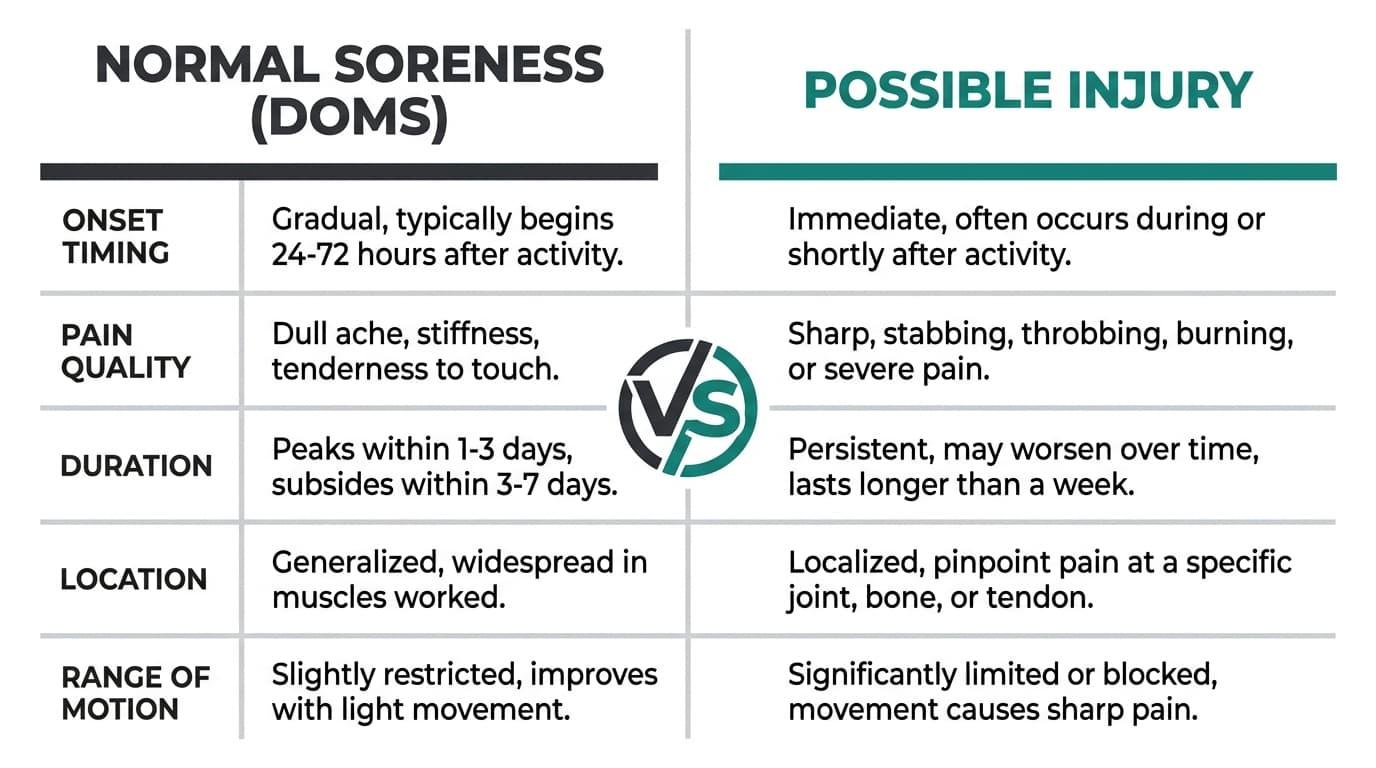
Not every ache after a hard session means something is wrong.
Soreness and injury can feel deceptively similar in the first 24 hours, and misreading that signal leads to either unnecessary panic or a real injury getting worse.
What Normal Post-Workout Soreness Feels Like
Delayed onset muscle soreness is a normal response to training stress. Research on managing DOMS (Delayed Onset Muscle Soreness) shows it typically appears about 24 to 72 hours post-workout.
The sensation is dull, diffuse, and often bilateral, meaning both shoulders may feel it after a heavy pressing day. It resolves within 72 hours and doesn't worsen with gentle movement.
Light activity, gentle stretching, and rest can help sore muscles settle by improving flexibility and reducing muscle tightness.
Signs That Point to an Actual Injury
Injury pain behaves differently. It tends to feel like a sharp pinch, sharp, pinching, or localized to one specific spot. It often appears immediately during training or intensifies in the days following rather than fading.
A rotator cuff tear or tendonitis will frequently limit your range of motion in ways normal soreness won't. Labral tears occur in the cartilage that stabilizes the shoulder joint and can also cause localized pain or instability. You may notice pain when reaching overhead, behind your back, or across your body.
Use the table below to compare what you're feeling against the key markers:
|
What to Check |
Normal Soreness (DOMS) |
Possible Injury |
|---|---|---|
|
Onset timing |
12 to 48 hours post-training |
Immediate or progressively worsening |
|
Pain quality |
Dull, achy, diffuse |
Sharp, pinching, or burning |
|
Duration |
Resolves within 72 hours |
Persists beyond 5 to 7 days |
|
Location |
Broad, bilateral, hard to pinpoint |
Localized to one specific spot |
|
Range of motion |
Mildly stiff but functional |
Noticeably restricted or painful |
If your symptoms sit consistently in the right column, treat it as an injury signal, not a recovery inconvenience.
Red Flags That Mean You Should Stop Training Now
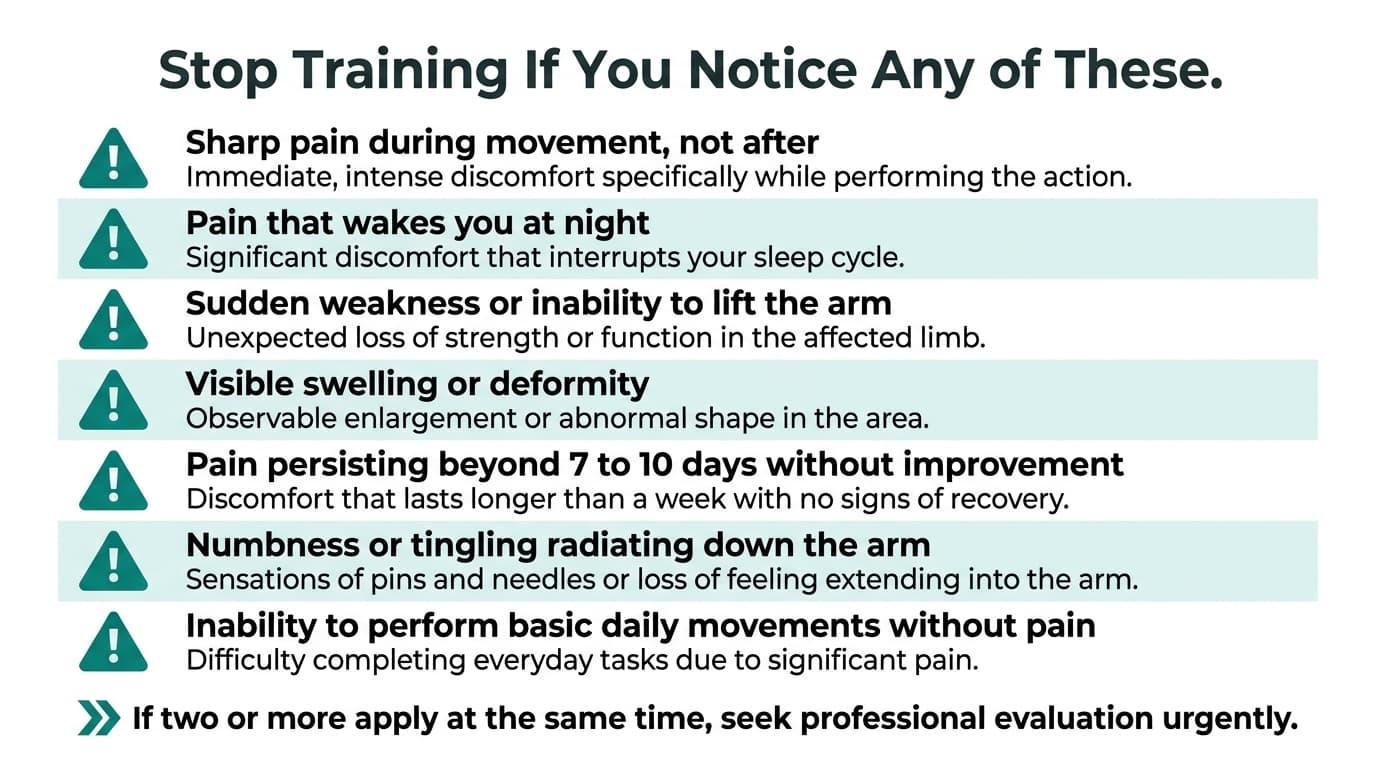
Most shoulder pain after training is manageable. Some signals, however, are telling you to stop, not push through. Ignoring these flags doesn't shorten your time out of the gym; it extends it.
The 2025 clinical practice guidelines for rotator cuff tendinopathy are clear: Early identification of serious symptoms is critical to preventing long-term damage. If you have severe pain or lasting symptoms, that requires medical evaluation before your next session.
Stop training and get evaluated if you notice:
-
Sharp pain during movement, not after: Pain that spikes mid-rep during pressing or overhead work isn't soreness. It signals something is being loaded past its limit.
-
Pain that wakes you at night: Shoulder pain that disrupts sleep, especially when lying on the affected side, is a consistent marker of tissue-level irritation that rest alone won't resolve.
-
Sudden weakness or inability to lift the arm: Losing the ability to raise your arm against resistance is one of the primary warning signs of a rotator cuff tear. Visit a healthcare professional for severe pain or weakness.
-
Visible swelling or deformity: Any structural change in the shoulder's appearance after training, including swelling or redness, needs a doctor rather than a wait-and-see approach.
-
Pain persisting beyond 7 to 10 days without improvement: Tendonitis and minor strains typically show some improvement within this window. If pain persists, seek earlier care as needed, and if it continues beyond three weeks, get medical help because it requires medical evaluation.
-
Numbness or tingling radiating down the arm: This pattern suggests nerve involvement, so numbness or tingling in the arm needs prompt medical evaluation.
-
Inability to perform basic daily movements without pain: If reaching a shelf or putting on a shirt has become painful, consult a doctor, especially if limited arm movement is affecting daily tasks.
If two or more of these apply at the same time, the case for professional evaluation becomes urgent.
What to Do When Your Shoulder Hurts After the Gym
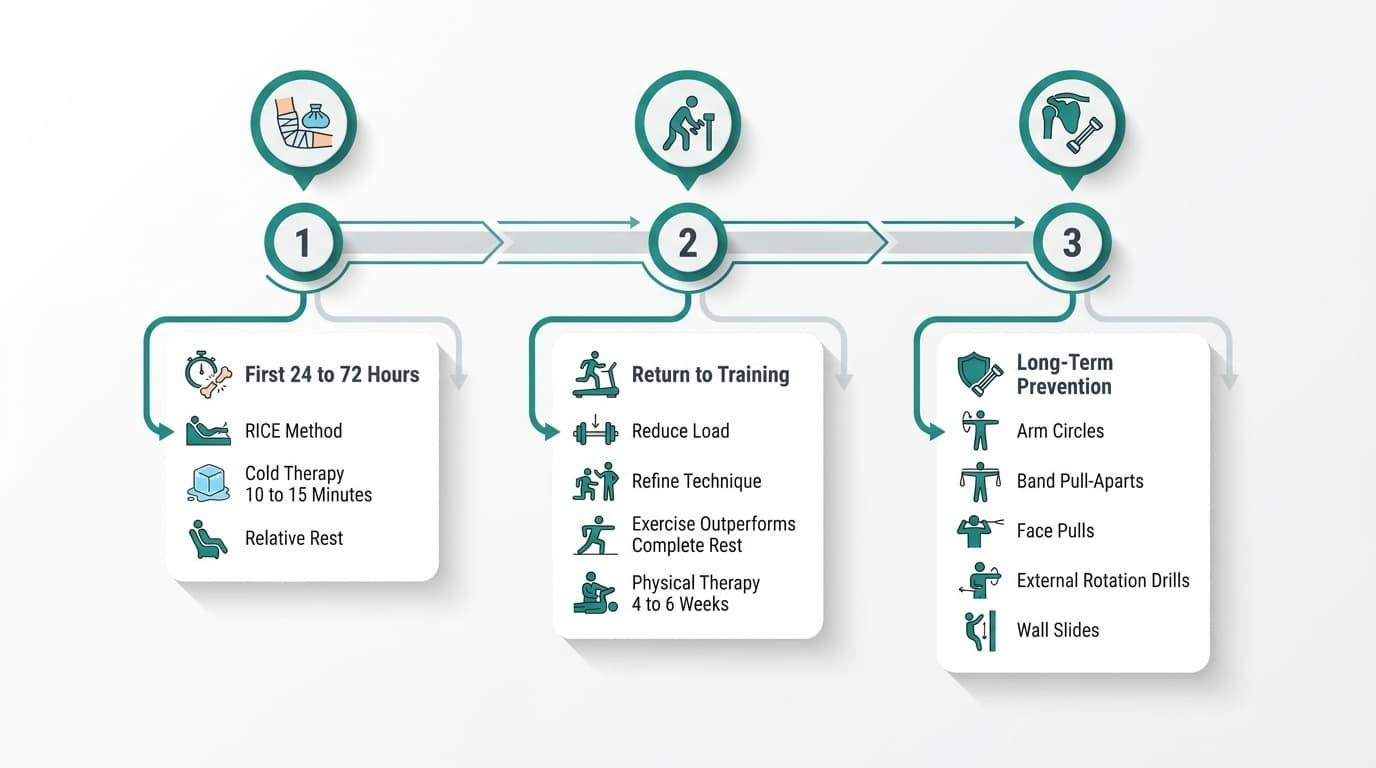
Knowing what you're dealing with is half the battle. The other half is responding correctly. Your approach should shift depending on where you are in the recovery timeline.
The First 24 to 72 Hours: Reduce Irritation Without Shutting Down
Your first priority is managing shoulder pain and lowering irritation to reduce inflammation without stopping movement entirely. The RICE method gives you a practical starting point: Rest (relative, not total), Ice, Compression, and Elevation.
For athletes, relative rest means swapping the movements that provoked pain for ones that don't, not lying on the couch for a week. Apply cold therapy for 10 to 15 minutes post-session to manage acute inflammation. Over-the-counter NSAIDs can help in the short term if appropriate for you, but they're a tool, not a strategy. Hydration supports the recovery process by helping flush out post-exercise shoulder soreness.
Getting Back to Training: Exercise Beats Rest
Here's where most gym-goers go wrong: total rest is not the answer.
Current rotator cuff guidelines are unambiguous on this point. Exercise therapy outperforms complete rest for shoulder pain recovery, with structured movement restoring tissue capacity faster than passive approaches. The goal is to find the training you can do and build from there.
Reduce load, refine your technique, and stay in the gym. Pulling movements, lower body work, and controlled range-of-motion drills keep you active without aggravating the shoulder.
If symptoms persist or arm movement stays limited, consult a doctor or physical therapist, who can create a personalized treatment plan to improve mobility and structure your return. A typical physical therapy plan may involve weekly visits for four to six weeks.
Don't spike volume the moment pain eases. Respect the acute-to-chronic workload ratio and build back gradually. Pacing your training load during shoulder recovery is one of the most important variables athletes tend to overlook.
Long-Term Prevention Through Load Management
Prevention comes down to preparation and smart progression. Research on exercise management for rotator cuff shoulder pain confirms that structured loading reduces recurrence significantly. Build these movements into every session before you load the shoulder:
-
Gentle arm circles to improve mobility, increase blood flow, and help the nervous system prepare the joint before loading.
-
Band pull-aparts to activate scapular retractors.
-
Face pulls to reinforce posterior shoulder balance before overhead work.
-
External rotation drills with a light band to load the rotator cuff stabilizers.
-
Wall slides to train scapular upward rotation under control.
Chest stretches and rotator cuff strengthening also support long-term shoulder health.
A proper warm-up isn't optional. Prioritizing shoulder health with warm-up work and smart progression matters, because skipping a warm-up increases the risk of shoulder pain during gym workouts.
How Compression Support Helps You Train Through Recovery
Returning to training after shoulder pain isn't just a physical challenge. For many athletes, the fear of re-injury is the bigger obstacle. That hesitation changes how you move, how you load, and how confidently you perform. Compression support works on both fronts.
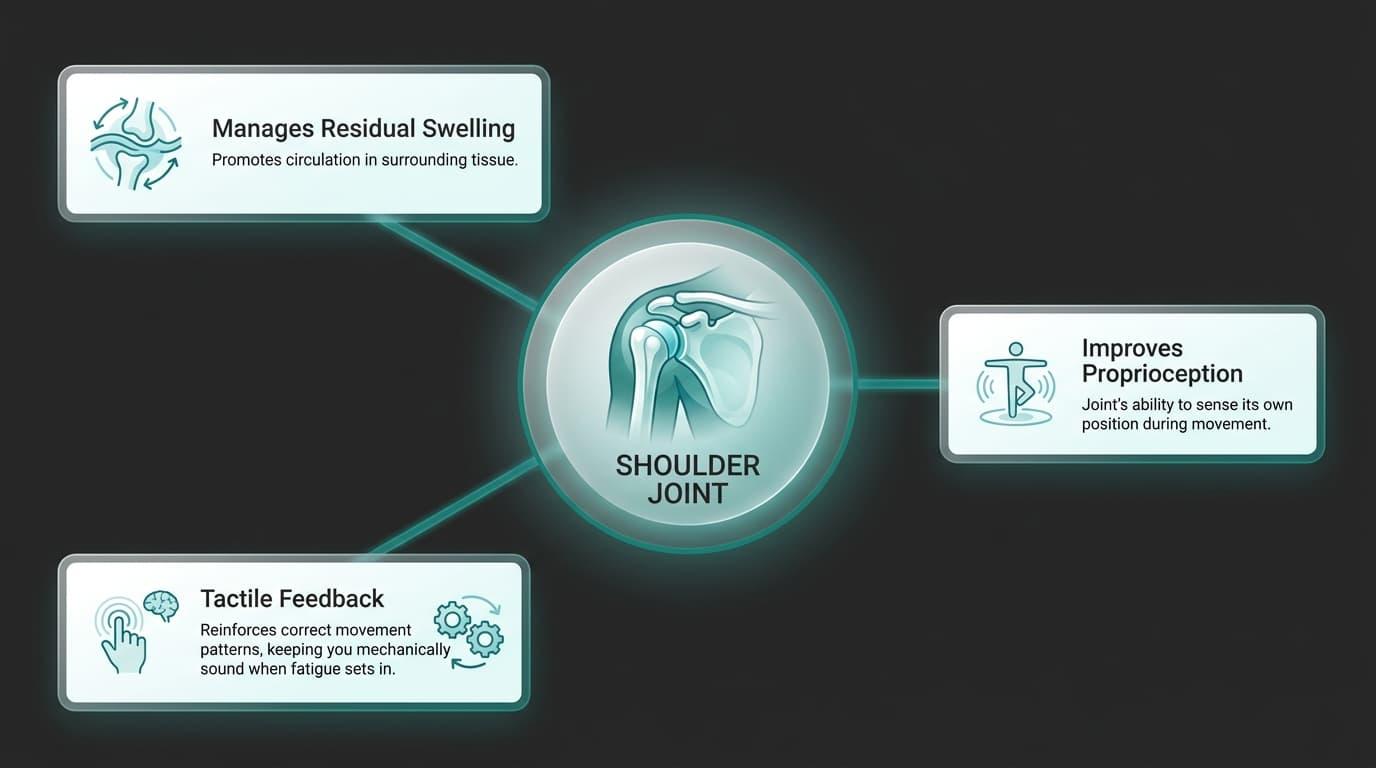
Compression around the shoulder joint accomplishes three practical things. It helps manage residual swelling by promoting circulation in the surrounding tissue. It improves proprioception, which is the joint's ability to sense its own position during movement.
That's especially relevant when recovering from rotator cuff irritation or bursitis. It also provides tactile feedback that reinforces correct movement patterns, keeping you mechanically sound when fatigue sets in.
Athletes who feel unstable in a recovering shoulder tend to compensate, shifting load onto other structures and creating secondary problems. External support reduces the compensation reflex by giving the joint a clear sensory signal that it's stable and held.
The Anaconda Shoulder Brace delivers 3D knit compression and joint stabilization while preserving the full range of motion you need to train. Built from polyester, nylon, and spandex, it moves with your body instead of working against it. Think of it as a return-to-training tool, not a permanent fix.
Wearing our shoulder brace makes sense in these specific situations:
-
Returning to overhead pressing after shoulder impingement or rotator cuff strain, when the joint still needs load management support.
-
During high-volume pulling sessions, cumulative fatigue raises the risk of mechanical breakdown.
-
In competition or high-intensity training, psychological confidence directly affects performance output.
-
When transitioning back to full training loads after a period of modified activity.
More than 400,000 athletes have come to us after trying generic alternatives that restricted their movement instead of supporting it. Our brace was built specifically to solve that problem. Orders ship within 24 hours, and every purchase comes with a 30-day return and exchange guarantee.
Final Words
Shoulder pain after training is rarely a reason to stop. It's a reason to be smarter about how you continue. Learn to read the difference between soreness and injury, act on red flags before they become setbacks, and choose progressive movement over passive rest.
At Anaconda, our shoulder support range was built for athletes who won't let a setback define their training. Physical therapy builds the foundation. The right compression support keeps you in the gym while it does.
Frequently Asked Questions
Not sure whether your shoulder pain is normal soreness or something more serious? Here are quick answers to the most common questions athletes ask about post-workout shoulder pain and recovery.
Should I skip the gym if my shoulder hurts after a workout?
Not necessarily. Mild soreness after training is common and doesn't always mean you need to stop exercising completely. In many cases, modifying exercises and avoiding painful movements is more productive than full rest. However, sharp pain, swelling, or significant weakness should be evaluated before continuing training.
How do I tell if shoulder pain is muscular or coming from the joint?
Muscular pain usually feels dull, achy, and spreads across a larger area, while joint-related shoulder discomfort tends to feel sharper, more localized, and may explain why your shoulder hurt during specific movements. You may also notice clicking, pinching, or restricted motion when the joint is involved. If symptoms persist or worsen, professional assessment can help identify the source, especially if it seems joint-related or may involve pinched nerves, since nerve compression can also cause muscle pain.
What are two warning signs of a rotator cuff tear?
Two common warning signs of a rotator cuff tear are significant weakness and sharp shoulder pain during movement. Many people struggle to lift their arms overhead or perform normal activities without compensation. In cases of severe tears, conservative care may not be enough, especially when weakness is substantial and function is limited. Unlike normal soreness, the weakness often remains even after warming up. Persistent pain or weakness should be evaluated for possible rotator cuff injuries, including rotator cuff tears.
Is it okay to train through shoulder impingement?
Yes, some people can continue training with mild shoulder impingement, but common shoulder injuries can worsen with repetitive overhead activities, so modifying exercises and reducing aggravating movements matters. Avoiding painful overhead positions and focusing on proper mechanics can help reduce pain and improve mobility while the shoulder calms down. However, pushing through increasing pain can make the condition worse. A physical therapist can help create a safer training plan.
How long does post-workout shoulder soreness typically last?
Normal post-workout shoulder soreness after a hard block in your workout routine usually peaks within 24 to 48 hours and improves within a few days. This type of soreness is commonly known as delayed onset muscle soreness (DOMS). If pain lasts longer than five days or becomes more severe over time, it may indicate an underlying injury rather than normal recovery. Persistent pain should not be ignored, and ongoing shoulder pain that lasts more than three weeks should be medically assessed.


