


You went to bed feeling fine, but when you woke up, your shoulder was screaming. There was no fall, and no heavy workout session the night before. Just sleep, and somehow that was enough to wreck your morning.
Most people blame the pillow. Sometimes that’s fair, but the athletes we work with at Anaconda know that morning shoulder pain often goes deeper than a bad sleep position. The right fix depends entirely on understanding what’s actually happening inside the joint while you sleep and what you can do, starting tonight, to stop it.
At Anaconda, we build recovery and support gear for athletes who refuse to sit on the sidelines. Whether you’re dealing with a rotator cuff flare, managing shoulder impingement, or just waking up sore after hard training, our shoulder support is designed to protect the joint while your body does the real work of healing.
Key Takeaways
-
Nighttime shoulder pain is often driven by inflammation, pooling, and compression, not just a bad sleep position.
-
The four most common causes are rotator cuff tendinopathy, bursitis, shoulder impingement, and frozen shoulder, and they behave differently.
-
Back sleeping with arm elevation is the most shoulder-neutral position available.
-
A short pre-sleep wind-down and morning mobility routine significantly reduces overnight stiffness and morning soreness.
-
Persistent night pain that wakes you regardless of position is a clinical red flag that deserves professional evaluation.
-
A compressive shoulder brace can reduce uncontrolled overnight movement and support faster recovery between sessions.
Why Your Shoulder Hurts More at Night and After Sleeping
Sleep is supposed to be recovery time. So why does the joint feel worse by morning? The answer comes down to two things working against you at the same time: compression and inflammation pooling.
The Role of Compression
During the day, your muscles work continuously to stabilize the shoulder joint. They absorb impact, distribute force, and keep the humeral head centered in the socket, while the scapula, or shoulder blade, helps connect the humerus and clavicle and serves as a key muscle-attachment site. When you fall asleep, that active muscular support shuts off entirely. The rotator cuff tendons and surrounding soft tissue are left without their usual buffer.
If you sleep on the affected side, your body weight presses directly into the bursa, a small fluid-filled sac that sits between the rotator cuff tendons and the acromion bone. Its job is to reduce friction. Under sustained pressure for seven or eight hours, it becomes irritated, swollen, and painful. That’s the inflammation you feel when the alarm goes off.
The Role of Inflammatory Pooling in Shoulder Anatomy
Movement helps flush inflammatory fluid away from the joint through circulation. At rest, that process slows dramatically. By the time you wake up, the joint has been sitting in a concentrated pool of inflammation that has built up through the night.
Tendons already have a limited blood supply. Gravity and sustained arm position restrict it further during sleep, which slows the tissue repair that should be happening during those same hours. Research on sleep position and shoulder pain confirms that night pain is a clinically distinct pattern. It’s not general soreness, but an active inflammatory process inside the joint.
The Four Most Common Causes of Morning Shoulder Pain
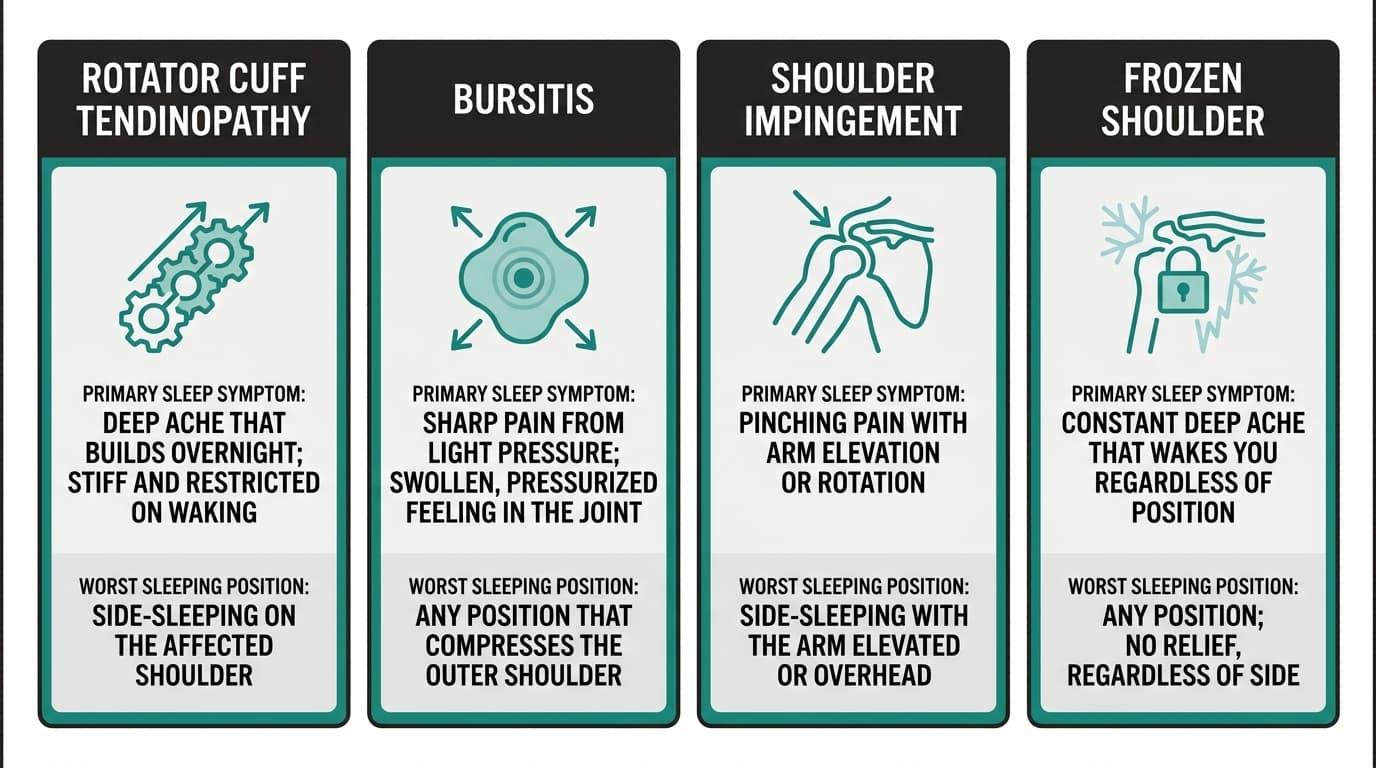
Not all shoulder pain after sleeping comes from the same structure.
The condition driving the pain determines how it behaves, when it peaks, and which positions make it worse.
These are the four most common culprits.
Rotator Cuff Tendinopathy
The rotator cuff is made up of four muscles—supraspinatus, infraspinatus, teres minor, and subscapularis—whose tendons provide stability and mobility to the shoulder joint. When those tendons are inflamed or partially torn, hours of sleep remove the muscular buffer that normally protects them. The result is a deep, aching pain that builds gradually through the night.
Overhead reach is painful in the morning, and the range of motion feels locked until the joint warms up. Side-sleeping directly on the affected shoulder is typically the worst position.
Shoulder Bursitis
Bursitis involves inflammation of the bursa sac, and its defining feature is sensitivity to compression. You don’t need to sleep directly on the shoulder for it to flare.
Lying on your back with the arm slightly rotated inward can be enough to aggravate an inflamed bursa for an entire night.
Even light pressure from a mattress can spike pain significantly when bursitis is active.
Shoulder Impingement
Impingement occurs when the rotator cuff tendons are pinched between the ball of the humerus and the acromion bone above it. Side-sleeping worsens this because the joint space narrows further under body weight. Impingement frequently underlies both rotator cuff and bursitis symptoms, which is why treating only one may not resolve the pain.
Frozen Shoulder (Adhesive Capsulitis)
Frozen shoulder produces a deep, achy night pain that is position-independent. Unlike the other conditions listed here, it wakes the sleeper regardless of which side they’re on.
The joint capsule thickens and tightens, severely limiting the range of motion and generating constant low-grade pain that intensifies through the night.
The table below shows how these four conditions compare during sleep, so you can better identify which one may be driving your symptoms.
|
Condition |
Primary Sleep Symptom |
Worst Sleeping Position |
|
Rotator Cuff Tendinopathy |
Deep ache that builds overnight; stiff and restricted on waking |
Side-sleeping on the affected shoulder |
|
Bursitis |
Sharp pain from light pressure; swollen, pressurized feeling in the joint |
Any position that compresses the outer shoulder |
|
Shoulder Impingement |
Pinching pain with arm elevation or rotation |
Side-sleeping with the arm elevated or overhead |
|
Frozen Shoulder |
Constant deep ache that wakes you regardless of position |
Any position; no relief, regardless of side |
Best Sleeping Positions for Shoulder Pain
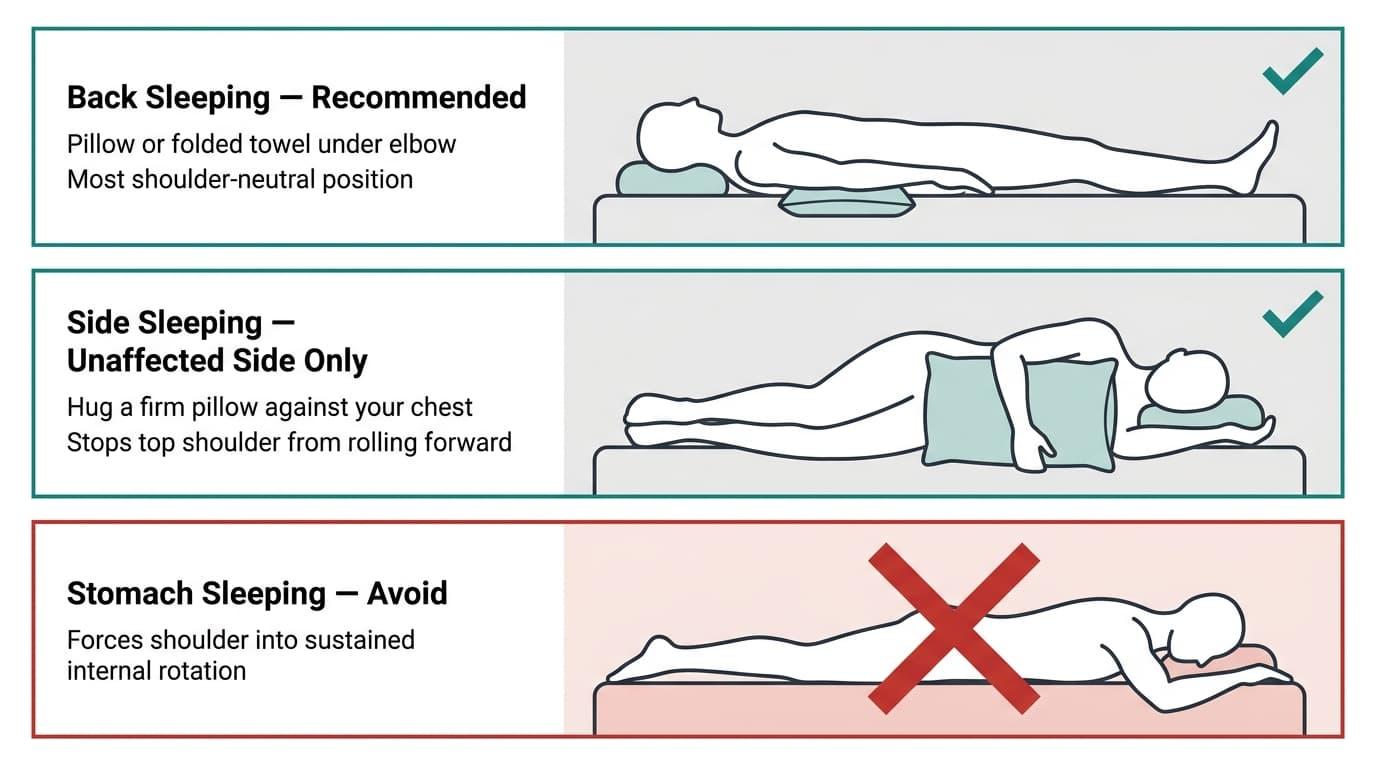
The way you position your body for seven or eight hours has a direct impact on how inflamed and compressed the shoulder becomes overnight. Small adjustments, specifically in arm placement and surface support, can meaningfully cut down on morning shoulder pain before it becomes a recurring pattern.
Back Sleeping With Arm Elevation
Back sleeping is the most shoulder-neutral position available. It distributes body weight evenly and removes direct pressure from the joint entirely. The key variable is arm placement.
Letting the arm fall flat at your side still pulls the shoulder into mild internal rotation overnight. Instead, use arm elevation. This involves placing a small pillow or folded towel under the elbow of the affected arm to keep it slightly raised and supported. This reduces tension on the rotator cuff tendons and limits inflammatory pooling in the joint.
Side Sleeping on the Unaffected Side
If side sleeping is your default, move to the unaffected side only. Use the pillow tuck technique: Hug a firm pillow against your chest. This stops the top shoulder from rolling forward into internal rotation, which is a primary driver of overnight compression and inflammation.
Stomach sleeping should be avoided entirely. It forces the shoulder into sustained internal rotation for hours and is one of the most reliable ways to guarantee morning shoulder pain.
Mattress Firmness
The surface you sleep on matters more than most athletes account for. A mattress that’s too soft allows the shoulder to sink and compress against the underlying joint structures. Research suggests medium-firm mattresses reduce pressure point buildup compared to soft surfaces, a practical consideration for anyone managing shoulder compression during sleep.
Here’s a quick reference for overnight positioning:
-
Sleep on your back with a pillow supporting the affected arm at elbow level
-
Side sleep only on the unaffected shoulder, never on the painful one
-
Hug a firm pillow to stop the top shoulder from rolling forward
-
Avoid stomach sleeping in any variation
-
Keep the affected arm below shoulder height to reduce rotator cuff tension overnight
Should You Sleep With a Shoulder Brace?
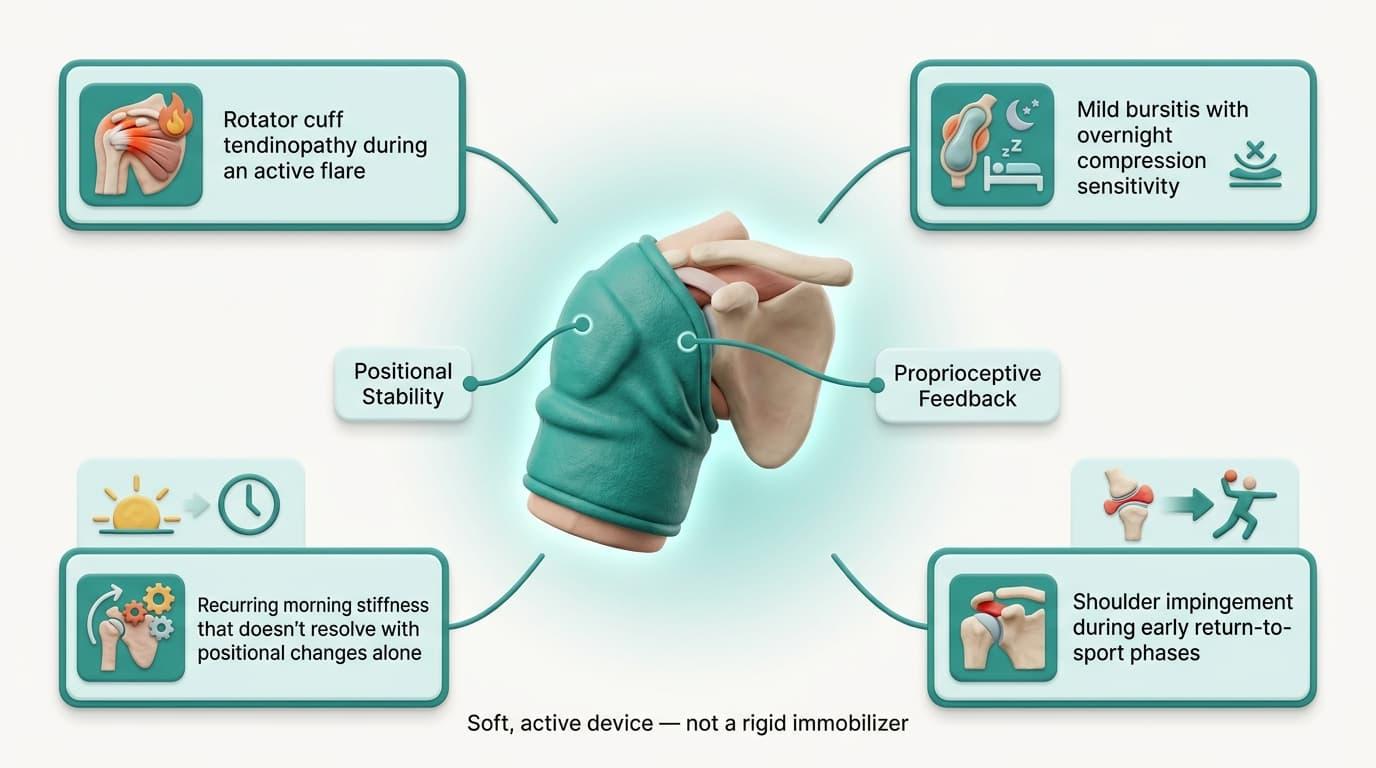
For athletes managing active rotator cuff tendinopathy, bursitis, or shoulder impingement, a compressive shoulder brace worn during sleep can make a meaningful difference. Here’s why it works and when to use one.
How a Brace Helps Overnight
The biggest overnight problem with shoulder injuries isn’t always position; sometimes it’s uncontrolled movement. You shift without realizing it, the shoulder rolls into compression, and inflammation spikes before you wake up.
A compressive support brace reduces that unintended movement without locking the joint down completely.
A well-fitted brace also provides proprioceptive feedback, which keeps the nervous system partially aware of shoulder position even during sleep. Athletes returning to training after a flare regularly tell us this is the reason they stopped waking up at midnight. The shoulder stays out of the positions that trigger pain without full immobilization.
This isn’t the same as a rigid post-surgical immobilizer. A compressive support brace is a soft, active device that provides positional stability and compression. It doesn’t replicate post-operative hardware and should not replace physical therapy or medical care.
Who Benefits Most From Overnight Bracing
Overnight bracing is most useful for specific recovery scenarios. The best candidates are athletes managing one of the following:
-
Rotator cuff tendinopathy during an active flare
-
Mild bursitis with overnight compression sensitivity
-
Shoulder impingement during early return-to-sport phases
-
Recurring morning stiffness that doesn’t resolve with positional changes alone
One non-negotiable rule: If the brace feels tight enough to restrict circulation or causes tingling, remove it immediately. Compression support and vascular restriction aren’t the same thing.
The Anaconda Shoulder Brace uses a 3D knit compression design engineered specifically for overnight use and active recovery. It moves with the shoulder rather than against it, providing stability and proprioceptive feedback without limiting the natural movement your body needs during sleep.
Over 400,000 athletes trust Anaconda gear through training and recovery and this is one of the most consistently recommended tools in their routine. Available at $49.95 with free shipping and a 30-day return guarantee.
Pre-Sleep and Morning Routines That Actually Help
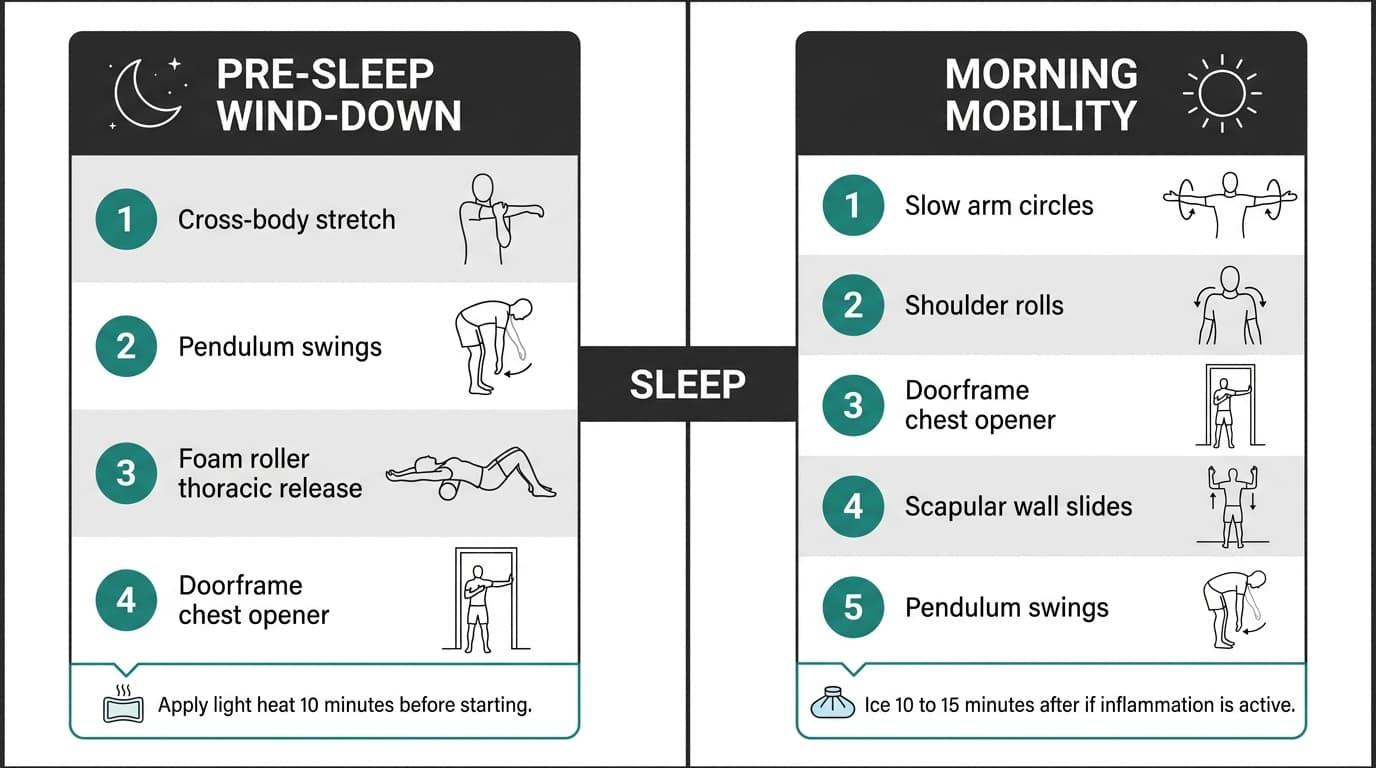
Positional adjustments handle the structural side of overnight recovery. Movement routines handle the physiological side.
A short sequence before bed reduces tension before hours of stillness, and a morning routine eases the joint back into function before any real load hits it.
Pre-Sleep Shoulder Wind-Down
Aggressive stretching before bed on an inflamed shoulder is a mistake. The goal at night is tension reduction, not flexibility gains. Gentle movement helps clear some of the inflammatory buildup that accumulates during stillness and prepares the joint for hours of immobility.
Run through these movements slowly with no forcing. Apply light heat for 10 minutes before starting to improve tissue response:
-
Cross-body stretch: Draw the affected arm across your chest with light support from the opposite hand. Hold 20 to 30 seconds.
-
Pendulum swings: Lean forward, let the arm hang, and make small controlled circles using gravity, not muscle effort.
-
Foam roller thoracic release: Lie over a foam roller placed across the mid-back. This opens the chest and reduces the forward rounding that compresses the shoulder joint overnight.
-
Doorframe chest opener: Place your forearm on a doorframe and gently rotate away. This keeps the anterior shoulder from tightening during sleep.
Morning Mobility to Ease Post-Sleep Stiffness
Morning shoulder pain peaks when stiff tissue meets sudden demand. A short mobility sequence before any loading helps restore range of motion gradually and can fit into a broader exercise routine. Work through these before training or physical therapy:
-
Slow arm circles: Small to large, forward and backward. Warms the joint without loading it.
-
Shoulder rolls: Forward and backward, 10 repetitions in every direction.
-
Doorframe chest opener: Repeated from the night before to counter overnight tightening.
-
Scapular wall slides: Stand against a wall with arms at 90 degrees and slide upward slowly.
-
Pendulum swings: Same as the pre-sleep version, with a slightly larger range as the joint loosens.
Physical therapy is often recommended as a first-line treatment for shoulder pain because it uses exercises to improve strength and flexibility. Ice the shoulder for 10 to 15 minutes after morning movement if inflammation is active.
When Sleep Pain Is Telling You Something Serious
Not all morning shoulder pain is mechanical. Some of it is signaling something structural, and knowing the difference matters.
Persistent night pain that wakes you regardless of which side you sleep on is a clinical red flag.
It often points to rotator cuff pathology, bursitis, or a frozen shoulder rather than a positional problem. In rarer cases, referred pain from the cervical spine, inflammatory arthritis, or visceral referred pain can all present as shoulder pain. Shoulder instability can also follow a sudden injury, when the head of the upper arm bone is forced out of the shoulder socket, and it may lead to chronic pain.
Another reason a proper evaluation matters is when symptoms don’t resolve.
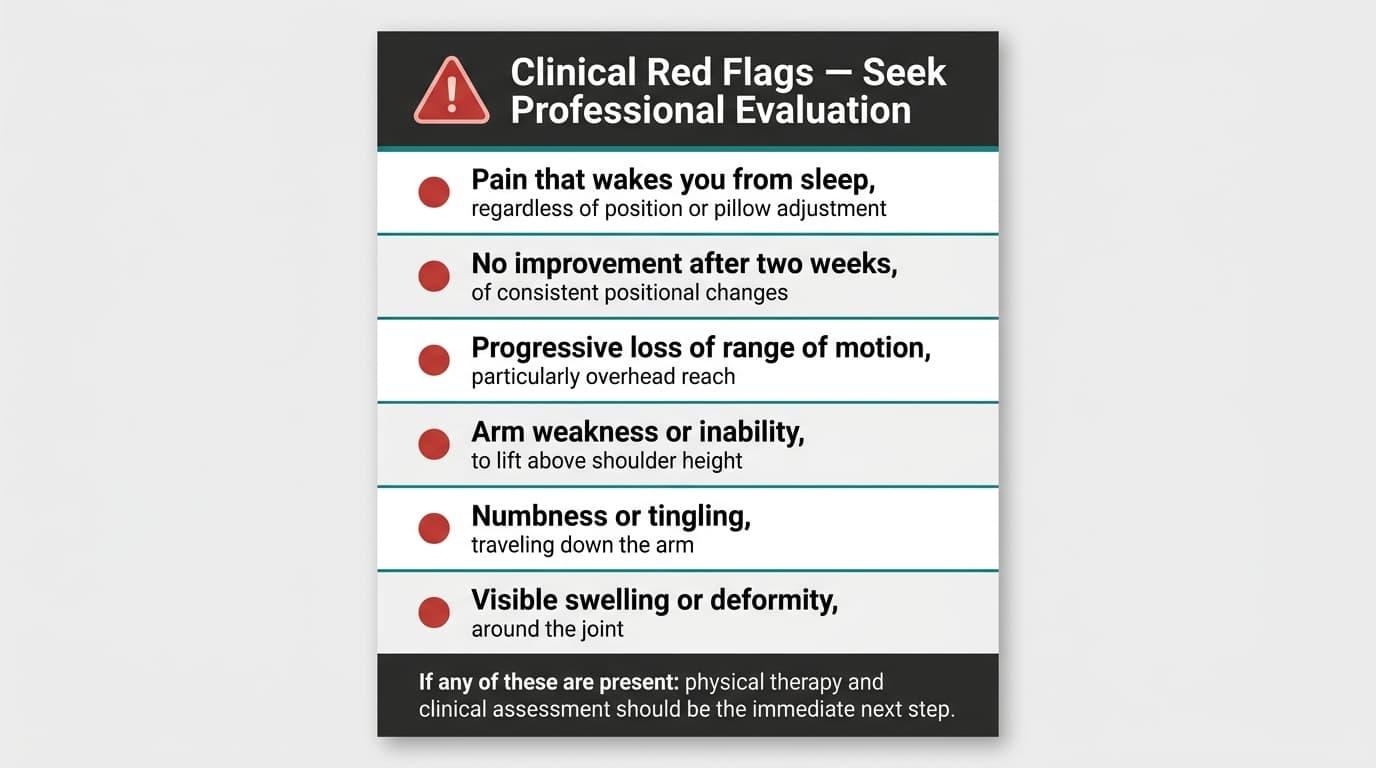
Watch for these warning signs that indicate self-management is no longer enough:
-
Pain that wakes you from sleep, regardless of position or pillow adjustment
-
No improvement after two weeks of consistent positional changes
-
Progressive loss of range of motion, particularly overhead reach
-
Arm weakness or inability to lift above shoulder height
-
Numbness or tingling traveling down the arm
-
Visible swelling or deformity around the joint
If any of these are present, physical therapy and clinical assessment should be the immediate next step. A proper evaluation can identify whether the driver is mechanical, inflammatory, or something that needs imaging.
Final Words
Waking up with shoulder pain doesn’t have to be your norm. The right sleep position, a consistent pre-sleep wind-down, and smart overnight support make a real difference for most rotator cuff and inflammation-related issues. If positional adjustments haven’t moved the needle after two weeks, or if pain is waking you regardless of how you sleep, that’s the signal to get a proper evaluation rather than reach for another pillow.
At Anaconda, we built our shoulder support range for athletes who take their recovery as seriously as their training. The Anaconda Shoulder Brace is designed to keep the joint stable, supported, and out of the positions that spike pain overnight, so you wake up ready to move, not dreading it.
Frequently Asked Questions
Waking up with shoulder pain every morning? Here are quick answers to the most common questions about nighttime shoulder pain, rotator cuff injuries, and when it’s time to seek professional help.
How do you get rid of shoulder pain after sleeping?
You can often reduce shoulder pain after sleeping by improving your sleeping position and shoulder support. Sleeping on your back with the affected arm supported or on the opposite side may help reduce pressure on the joint. Gentle stretching and mobility work in the morning can also ease stiffness. If symptoms persist for more than a few weeks, a professional evaluation is recommended.
What are two warning signs of rotator cuff tears?
Two common warning signs of a rotator cuff tear are significant shoulder weakness and pain that continues even at rest. Many people also struggle lifting their arm overhead or holding it in certain positions. Unlike typical muscle soreness, these symptoms often do not improve with warming up. Persistent weakness should always be assessed professionally.
What is a red flag symptom in shoulder pain?
A red flag symptom is shoulder pain that may indicate a more serious underlying issue. Examples include pain that wakes you at night regardless of position, unexplained weakness, fever, or unexplained weight loss. These symptoms are not typical of simple muscle strain or overuse injuries. Medical evaluation is recommended if any of these signs are present.
Can you tell if a rotator cuff is torn without an MRI?
A physical examination can suggest whether a rotator cuff tear is present, but it cannot confirm the severity of the injury. Healthcare professionals often use strength and movement tests to identify potential tears. However, imaging such as an MRI is usually needed to determine the exact location and extent of the damage. This helps guide the most appropriate treatment plan.
What other conditions can cause shoulder pain that feels worse at night?
Several conditions besides rotator cuff injuries can cause shoulder pain that worsens at night. Common examples include bursitis, shoulder impingement, arthritis, and neck-related nerve issues. In some cases, pain may even be referred from another area of the body. If changing your sleeping position does not improve symptoms, a proper clinical assessment is worth considering.


