


You know the feeling. You go for a shot, your shoulder gets cranked the wrong way, and something pops. Or maybe it has been a slow grind, weeks of grinding soreness that gets worse after every hard session. Either way, you end up in the same place: Off the mat, frustrated, and searching for something that actually lets you get back in the room.
At Anaconda, we get it. We’ve seen countless athletes deal with situations like these, and that frustration is exactly why this guide exists. Most shoulder braces were designed for recovery rooms, not live rounds. They slip, they bulk up under a singlet, they get flagged at weigh-in, or they lock down your arm when you need to shoot. Choosing the wrong one wastes your money and your training time.
This guide ranks five specific shoulder braces by how well they hold up under real wrestling demands. Every pick includes verified pricing, a full pros and cons breakdown, and a clear recommendation on who it is actually built for.
Key Takeaways
-
Match the brace to your injury stage, not just your sport. Prevention, chronic instability, and post-dislocation return all need different things from a brace.
-
A brace that slips is worse than no brace at all. Anti-migration design matters as much as compression level.
-
Both NFHS and NCAA allow shoulder braces in competition as long as the design does not endanger your opponent. Low-profile, no-velcro builds a clear inspection. Rigid harnesses often do not.
-
Your brace will loosen as you train. Soft tissues warm and stretch, which means the support you felt at warm-up is reduced by the scrambles that matter most. Structural grip features are the fix.
-
If symptoms are serious, a brace alone is not the answer. Know when to see a clinician. A brace supports the process. It does not replace it.
-
No exposed velcro. It snags on singlets, rashguards, and training partners. Every pick on this list handles closures cleanly.
The 5 Best Shoulder Braces for Wrestling, Ranked
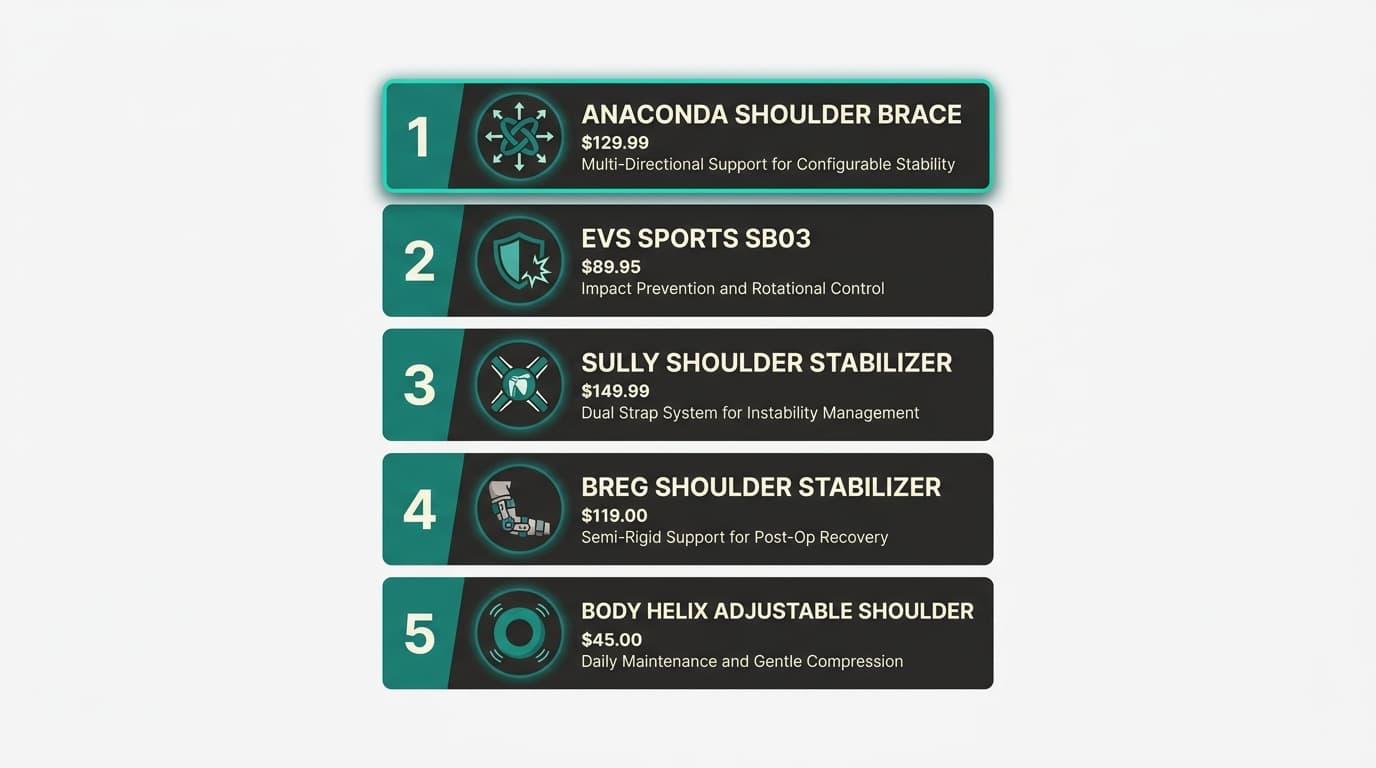
These five braces cover the full range of wrestling shoulder situations. Find your scenario and read the full breakdown before buying.
1. EVS Sports SB03 Shoulder Brace: Best budget pick for mild instability and injury prevention
-
Price: ~$52 (varies by retailer).
-
Best For: Wrestlers managing mild rotator cuff irritation or who want preventive support during heavy training blocks.
What Makes It Stand Out
If your shoulder is sore but functional, or if you're managing nagging rotator cuff irritation without a clear instability diagnosis, the SB03 is probably all you need right now. Its X-Strap compression system works by grabbing the bicep and lifting the shoulder into the joint, providing a layer of support that a bare sleeve just cannot replicate.
It sits on dedicated wrestling brace recommendation lists precisely because it hits the middle ground between a basic sleeve and a full soft active support. The air mesh build keeps things cooler than neoprene, which matters when you're deep into a tournament day or a long practice.
Where it runs out of road is real instability. If your shoulder is popping, sliding, or has a documented labral issue, the SB03 does not have the directional strapping to protect those movements. It’s a smart prevention tool, not a rehabilitation brace.

2. Anaconda Shoulder Brace: Best overall for training through instability and post-dislocation return
-
Price: $49.95 with 24-hour US shipping and a 30-day return guarantee.
-
Best For: Wrestlers managing chronic instability, returning from a shoulder dislocation, or training through rotator cuff irritation without stepping away from live rounds.
What Makes It Stand Out
We hear this constantly from athletes who come to us: They tried a cheaper brace, it slid halfway through round two, and they gave up on bracing altogether. That’s the problem the Anaconda shoulder brace was built to solve. The 3D knit construction molds to the specific shape of your shoulder and delivers compression that supports joint stability during movement, not just at rest.
The dual-strap system is the most important part for wrestling. As training progresses, soft tissues warm and expand, and a brace held in place by friction alone starts to drift. By round three, it’s in a place it shouldn’t be. The Anaconda's structural grip anchors it through the full session, which is exactly when your joint is most vulnerable and most in need of it.
Over 400,000 athletes have trusted Anaconda gear, and the reason we hear most often is simple: It doesn’t feel like a brace. It moves with you. At $49.95 with 24-hour shipping and a 30-day return guarantee, there’s little reason to settle for something that does less.

3. Sully Shoulder Stabilizer (Saunders/DJO): Best for multi-directional instability and labral irritation
-
Price: ~$75 (varies by size and retailer).
-
Best For: Wrestlers with multi-directional instability, labral irritation, or AC joint sprains who need strapping customized to their specific injury pattern.
What Makes It Stand Out
If you’ve been told your shoulder is unstable in multiple directions, or if your labrum is irritated and the pain changes depending on how your arm is loaded, the Sully is built for your situation. It is one of the few braces specifically designed for wrestling use because of a feature that no other brace offers: Straps that attach at any point, in any direction, with any amount of tension. Your clinician or athletic trainer can dial in the exact restriction your joint needs.
That configurability comes with a real cost, though. The Sully is not something you throw on five minutes before practice. You need to learn how to route the straps correctly, and if you do not tuck the velcro ends carefully, they’ll snag on a singlet or dig into a training partner during scrambles. It takes a few sessions to get the setup right.
For a straightforward dislocation history or general instability, the Anaconda offers comparable support at a lower price with a dramatically simpler setup. The Sully earns its place specifically when the instability pattern is complex, and the strapping needs to be tailored precisely.

4. Breg Shoulder Stabilizer: Best semi-rigid option for post-dislocation return under medical supervision
-
Price: ~$80 (varies by retailer and size).
-
Best For: Athletes returning from significant glenohumeral instability or a recent dislocation where a clinician has recommended mechanical range-of-motion restriction.
What Makes It Stand Out
Here’s the honest truth about the Breg: If your clinician has cleared you to return to the mat after a dislocation but wants hard limits on how far overhead your arm can travel, this is the brace that enforces that boundary mechanically.
The adjustable arm cuff limits the range of motion before the joint reaches the point of dislocation. For some athletes at a specific stage of recovery, that kind of protection is exactly what gives them the confidence to step back into live training.
But that protection comes at a real cost to function. External rotation restriction is foundational to underhook work, posting, and overhead scrambles.
Depending on how tight the Breg is set, those positions become harder or unavailable. This is not a brace for an open training session. It’s a structured tool for a structured protocol.
Athletes planning to compete with the Breg need to check with the event official before match day. Semi-rigid profiles can require additional padding to satisfy NFHS and NCAA inspection standards, and finding that out at weigh-in is a problem you do not want.

5. Body Helix Adjustable Shoulder: Best premium compression option for daily maintenance and mild rotator cuff irritation
-
Price: $100.00 from bodyhelix.com.
-
Best For: Wrestlers who train five or more days per week through mild rotator cuff irritation and want a compression option built to survive daily washing without losing performance.
What Makes It Stand Out
If you are a high-volume wrestler training six sessions a week with chronic, low-level rotator cuff soreness that never quite goes away, the Body Helix is worth the investment. The synthetic rubber core delivers medical-grade compression uniformly across the joint without the uneven tension loss that standard neoprene develops over time. It feels the same on day ninety as it did on day one.
The machine-washable construction is the practical detail that separates it from everything else at this price point. Most neoprene braces start breaking down by the third or fourth washing. After a month of daily use, they smell, they lose elasticity, and they need replacing. The Body Helix handles washing without performance degradation, which matters when you are wearing it nearly every session.
The honest limit of the Body Helix is that it’s a compression sleeve, not a stability brace. If you are dealing with real instability, a past dislocation, or a labral diagnosis, a hundred dollars on the Body Helix will not solve the problem the way the Anaconda or the Sully will. Know what you actually need before you spend.

Full Comparison: All 5 Braces Side by Side
Here are all the key factors across all five options in one place. Use this to narrow down your choice before reading the full breakdown.

How to Choose the Right Shoulder Brace for Wrestling
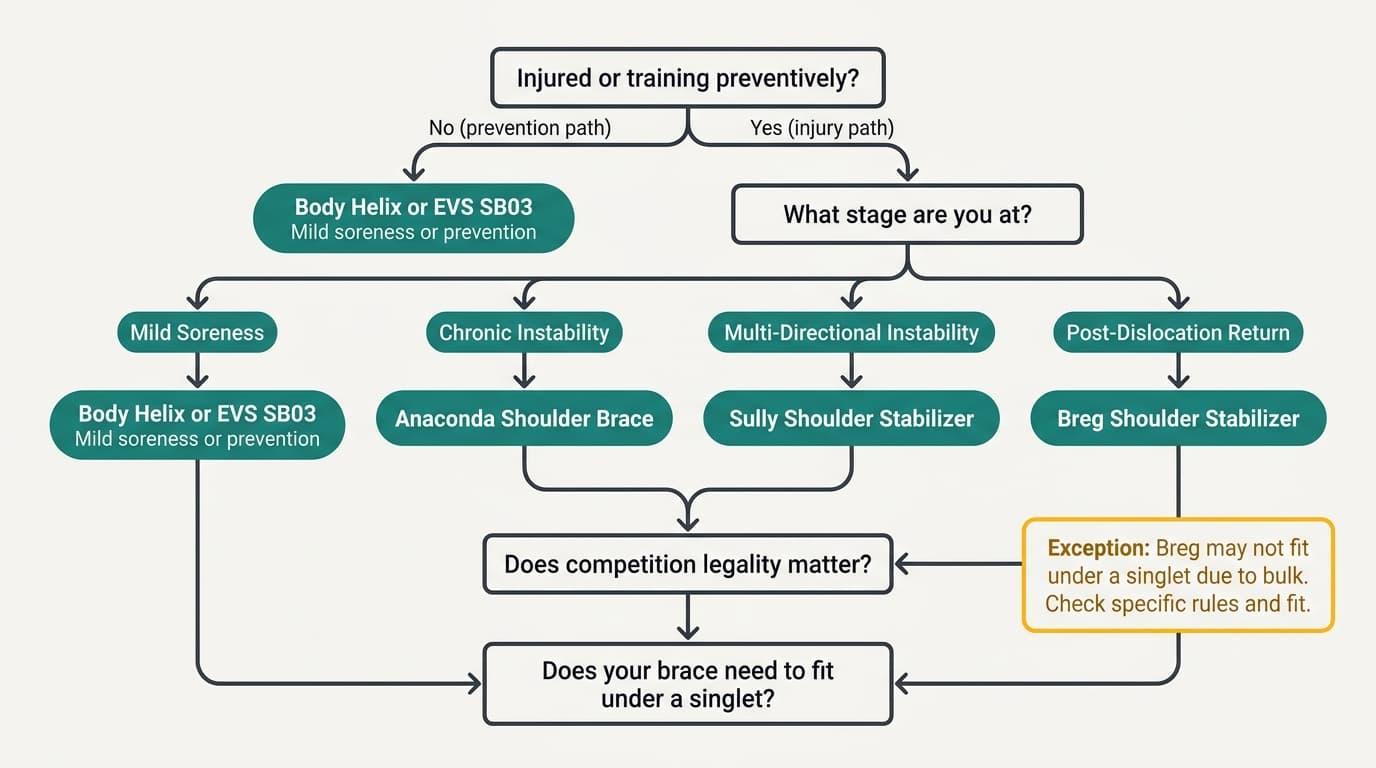
Choosing the right brace isn’t about finding the most supportive one, but about matching the right tool to what your shoulder actually needs right now. Work through these four questions, and the answer will get clearer.
Are you injured or training preventively?
If there’s no active injury, don’t over-brace. A compression sleeve, like the EVS SB03, provides proprioceptive support and joint warmth without restricting the movement you need.
Adding more mechanical restrictions than your shoulder actually requires just trains you to move with unnecessary limitations.
If there’s an active injury, diagnosed or suspected, the brace needs to match the specific pattern. General compression does not protect against a labral tear. Directional strapping does.
What stage are you at?
Injury stage matters more than injury type when choosing a brace. Here’s how the five options map to each stage:
-
Mild soreness or prevention: Body Helix or EVS SB03. Compression and proprioceptive feedback without restricting the active range of motion.
-
Chronic instability during active training: Anaconda Shoulder Brace. Soft active support with an anti-migration design that holds through live rounds.
-
Multi-directional instability or labral irritation: Sully Shoulder Stabilizer. Configurable strapping tailored to the specific instability direction.
-
Post-dislocation return under medical guidance: Breg Shoulder Stabilizer. Mechanical abduction and external rotation restriction for structured return-to-play.
Does competition legality matter?
Yes, and do not leave this question for the morning of the match. Both NFHS and NCAA permit shoulder braces in competition, provided they meet wrestling equipment rules and safety compliance standards and do not pose a hazard to opponents. No exposed hard edges, no uncovered metal, no rough velcro that can scratch or snag.
Low-profile neoprene and knit designs pass without issue. The EVS SB03, Anaconda, Sully, and Body Helix all have profiles that require clear inspection.
The Breg is the exception. Confirm legality with your coach and the event official well before competition day, since official approval depends on compliance with event safety standards, not just the general brace category.
Does your brace need to fit under a singlet?
If you’re competing, it does. A brace that bunches under a singlet shifts during live action. Once it moves out of position, you are adjusting the gear instead of wrestling. Low-profile, high-elasticity construction is what stays anchored through a full match.
The Breg is the only pick on this list that creates singlet-fit problems. Every other option here has a profile that works under competition gear.
When a Brace Is Not the Full Answer
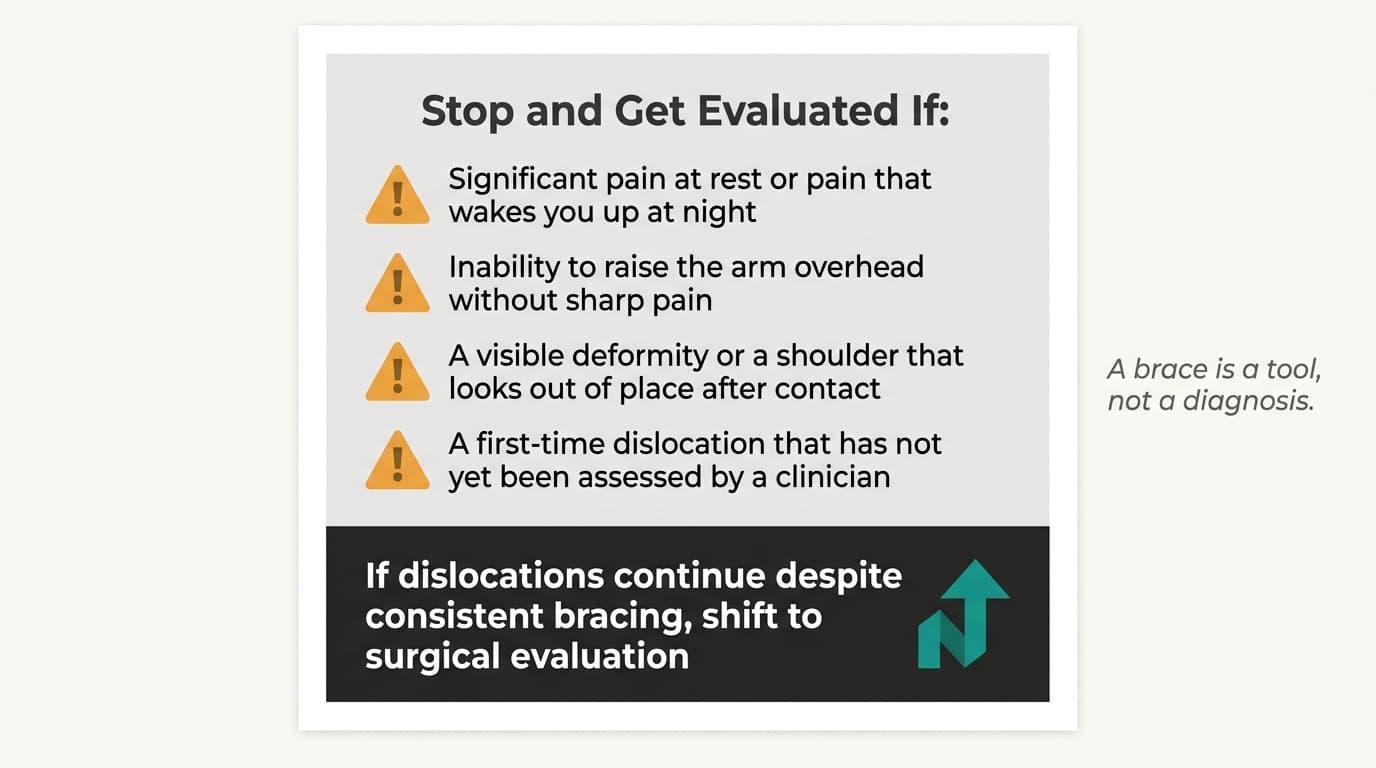
A brace is a tool, not a diagnosis. Wearing one consistently during training is a smart long-term strategy for wrestlers with recurring shoulder issues, and the right support can reduce the worrying that comes with every hard exchange even though it is not a substitute for evaluation.
But there are situations where bracing alone won’t get you where you need to go, and pushing through without medical input can turn a manageable problem into a surgical one, especially when symptoms suggest instability in the shoulder joint.
Stop and get evaluated before returning to the mat if any of the following apply:
-
Significant pain at rest or pain that wakes you up at night
-
Inability to raise the arm overhead without sharp pain
-
A visible deformity or a shoulder that looks out of place after contact
-
A first-time dislocation that has not yet been assessed by a clinician
If dislocations continue despite consistent bracing, the conversation should shift to surgical evaluation. Bracing manages instability, but it can’t rebuild a structure that has been damaged past the point of conservative management.
Final Words
We know why you’re reading this. You want to keep training. You don’t want to sit out, and you’re not willing to give up weeks or months just because your shoulder is giving you trouble. That is exactly the athlete we build for.
The Anaconda Shoulder Brace is the strongest all-around pick for wrestlers managing real instability at any training level. At $49.95 with 24-hour US shipping and a 30-day return guarantee, it delivers 3D knit compression, a dual-strap anti-migration system, and low-profile shoulder support for wrestlers who want to keep training, and you can add it to your cart to purchase with any available discount applied at checkout.
Frequently Asked Questions
Here are quick answers to the most common questions wrestlers ask about shoulder braces, instability, and safe return-to-sport support.
Can you wear a shoulder brace in wrestling?
Yes, you can wear a shoulder brace in wrestling as long as it meets competition safety rules. Most wrestling organizations allow braces that do not have exposed metal, sharp edges, or unsafe materials. Low-profile braces made from neoprene or knit materials usually pass inspection without problems. It’s still smart to check with your coach or event official before competition day.
What is the best shoulder brace for wrestling?
The best shoulder brace for wrestling depends on the type of support you need and the level of force your shoulder has to handle during live wrestling. Many wrestlers prefer the Anaconda Shoulder Brace because it stays secure during scrambles, which matters in the heat of competition when awkward contact happens fast, and allows full movement under a singlet. Athletes dealing with more severe instability may prefer braces with stronger directional support, like the Sully or Breg. The right option should balance mobility, stability, and comfort during live wrestling.
How do I stop a shoulder brace from slipping during wrestling?
You stop a shoulder brace from slipping by choosing one with proper anchoring features. Silicone grip lining, dual-strap systems, and anatomical shaping help the brace stay secure during takedowns and scrambles. Basic compression sleeves often slide once sweat and movement increase. Wrestling-specific braces are built to stay locked in place through live training.
What are the warning signs of a serious shoulder injury?
Two major warning signs of a serious shoulder injury are pain at rest and sharp pain when lifting your arm overhead. Weakness, instability, or repeated popping sensations can also signal structural damage. These symptoms may indicate a rotator cuff injury, a labral tear, or joint instability and may require medical evaluation. A brace can help support the shoulder, but it cannot fix underlying structural injuries.
Is a shoulder brace enough to return to wrestling after a dislocation?
No, a shoulder brace alone is usually not enough after a shoulder dislocation. A proper return-to-sport plan should include medical evaluation, rehab, and gradual return to live training. A brace provides support and stability during recovery, allowing a gradual return to early training sessions. Some braces also improve circulation, allowing recovery work to continue with better comfort and joint support. If dislocations continue even with a brace, the shoulder should be professionally assessed before resuming competition.


