


You've put years into building your training. You know your numbers, you show up consistently, and you take the work seriously. Then one overhead press session goes wrong, and suddenly the shoulder that felt invincible starts sending signals you can't ignore. If that story sounds familiar, you're in the right place.
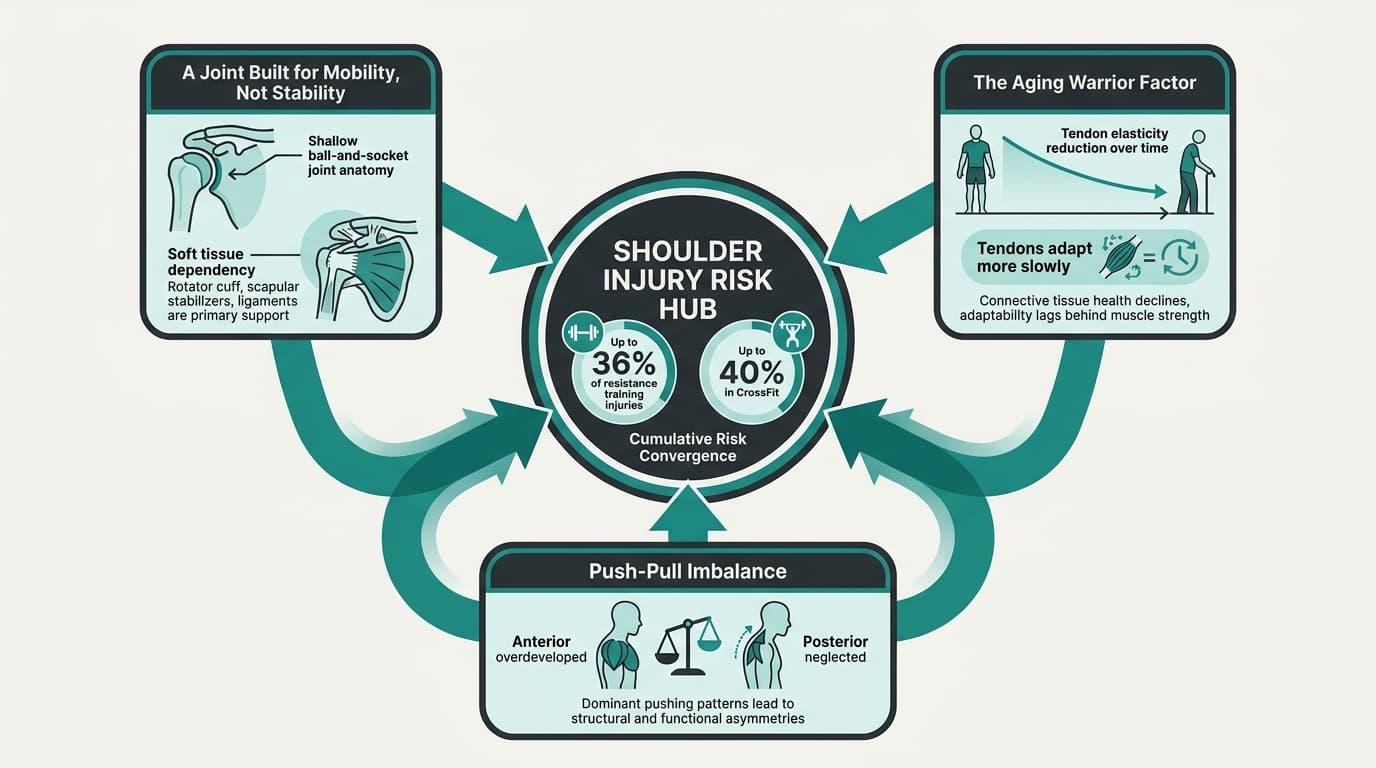
The reality is that up to 36% of all resistance training injuries occur at the shoulder. In CrossFit, shoulder injuries account for up to 40% of all reported injuries. And for athletes over 40, the risk compounds further as tendons and connective tissue adapt more slowly to training load. These aren't unlucky breaks. They're predictable outcomes of specific, correctable mistakes.
At Anaconda, we built our shoulder support range for athletes who are serious about training for the long haul. Whether you're lifting competitively, hitting CrossFit five days a week, or simply trying to stay strong into your 40s, 50s, and beyond, this guide gives you the framework to keep your shoulders healthy under real training loads.
Key Takeaways
-
Shoulder injuries in the gym are predictable and preventable. The root causes are consistent across athletes of all levels.
-
Dynamic warm-ups outperform static stretching for injury prevention, with structured programs showing injury rate reductions up to 36%.
-
Rotator cuff activation before pressing is a distinct step from warming up. Skip it, and the wrong muscles take over under load.
-
Push-heavy programming is the silent driver of most chronic shoulder problems. A 2:1 pull-to-push ratio is the fix.
-
Aging athletes face compounding risk. Tendons adapt more slowly than muscle, making smart load management non-negotiable after 35.
-
Preventive bracing is the fastest-growing application in the orthopedic support market in 2026. Athletes who brace proactively stay in the game longer.
Why Shoulder Injuries Are So Common in Strength Training
Understanding what makes the shoulder vulnerable is the first step toward protecting it. Most gym-goers are working with a joint that was never designed for the loads they ask it to handle, at least not without proper preparation.
A Joint Built for Mobility, Not Stability
The shoulder is a ball-and-socket joint, but unlike the hip, the socket is intentionally shallow. That design gives you an extraordinary range of motion. It also means the joint depends almost entirely on soft tissue, specifically the rotator cuff, the scapular stabilizers, and the surrounding ligaments, to hold it together under load.
The supraspinatus, the rotator cuff muscle that runs through a narrow bony channel at the top of the joint, takes the most punishment. Every overhead press, pull-up, and lateral raise compresses it. Over hundreds of sessions, that repeated compression accumulates. Weak or poorly coordinated scapular stabilizers make it worse, removing the stable platform the rotator cuff needs to do its job.
The Aging Warrior Factor
Shoulder injury risk doesn't stay static as you age.
Tendon tissue loses elasticity and blood supply over time, which means recovery between sessions takes longer, and tolerance for volume spikes drops. Research shows older athletes are at the highest risk for shoulder injuries, with conditions like rotator cuff tendinitis, impingement, and partial tears becoming significantly more common after 40. For athletes who've been training hard for years, they wear compounds every season.
That's not a reason to slow down.
It's a reason to train smarter, with prevention built into every session rather than addressed only after something goes wrong.
The Real Driver: Push-Pull Imbalance
Most gym programs are push-heavy by default.
Bench press, overhead press, and dips get prioritized. Rows, face pulls, and rear delt work get squeezed in as afterthoughts.
The result is that the anterior shoulder and chest become overdeveloped while the posterior rotator cuff and scapular stabilizers fall behind.
Research on recreationally trained adults confirms that common training patterns are biased toward large pushing muscles while neglecting the external rotators and lower trapezius, creating the exact imbalances associated with shoulder disorders.
The shoulder rounds forward, the subacromial space narrows, and impingement becomes a matter of time.
8 Proven Ways to Prevent Shoulder Injuries in the Gym
The following 8 strategies target the specific weak points that cause most training-related shoulder breakdowns.
Some fix mechanics, some fix programming, and some address the habits that quietly compound into injury over months.
Used consistently, they give your shoulder every structural advantage available.
1. Replace Static Stretching With a Dynamic Warm-Up
Most lifters still open their sessions with static holds. Reach overhead, hold 30 seconds, repeat. It feels like preparation. The research disagrees.
Static stretching before a heavy session can actually reduce force output and doesn’t adequately prepare the joint for loaded movement.
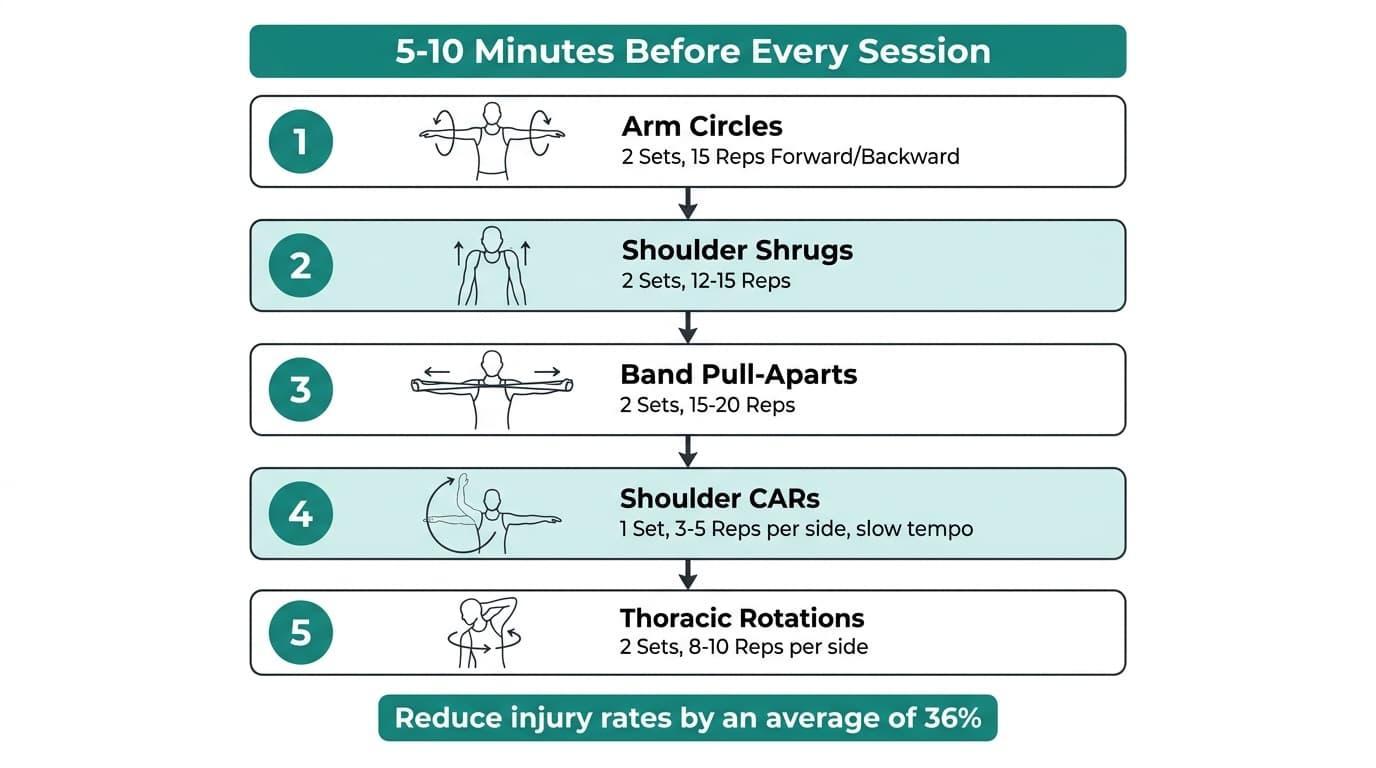
A dynamic warm-up increases tissue temperature, boosts blood flow and joint lubrication before lifting weights, and helps prevent injury by waking up the shoulder muscles instead of asking cold, tight muscles to handle load. Structured warm-up programs reduce sports injury rates by an average of 36% across athletic populations. That’s a material difference, not a marginal one.
Before any pressing or overhead session, spend 5-10 minutes running through this sequence:
-
Arm circles: 10 reps forward and 10 reps backward, progressively increasing the arc to open up the range of motion
-
Shoulder shrugs: 10-15 controlled reps to activate the area before training
-
Band pull-aparts: 2 sets of 15 reps with light resistance to wake up the posterior shoulder before loading
-
Shoulder CARs (Controlled Articular Rotations): 5 slow, deliberate rotations per side through the full range of motion
-
Thoracic rotations: 8 reps per side in a quadrupod position to mobilize the upper back and reduce downstream shoulder compensation
Save your static stretching for the cool-down, where it belongs.
2. Activate the Rotator Cuff Before Every Pressing Session
Warming up the shoulder and activating the rotator cuff are two separate steps. Most serious lifters get one right and skip the other.
The rotator cuff doesn’t automatically switch on when you unrack the bar, especially if the rotator cuff muscles haven’t been primed first. Without deliberate pre-activation, the larger prime movers take over.
The deltoid and pec dominate the movement, the humeral head drifts forward under load, and the supraspinatus gets compressed on every rep. Over hundreds of sessions, that compensation pattern becomes a structural injury.
A targeted activation sequence takes less than eight minutes. Use this before every pressing session:
-
Resistance band external rotations: 2 sets of 15 reps per side, elbow at 90 degrees, controlled tempo throughout; one of the most effective resistance band exercises for improving shoulder stability and shoulder strength
-
Face pulls: 2 sets of 15 reps with a cable or band, pulling to eye level with a deliberate external rotation at end range
-
Band pull-aparts: 2 sets of 15 reps, arms straight, consciously squeezing the rear deltoid and scapular stabilizers at the end of every rep
Keep the resistance light: use low weight, focus on controlled movement, and train this rotator cuff work 2-3 times per week. This is neuromuscular work, not a strength set.
The goal is to establish the right motor patterns before the joint goes under load, and incorporating resistance band exercises such as external rotations can significantly enhance rotator cuff stability and shoulder strength.
Athletes who build this habit consistently report fewer flare-ups and better pressing mechanics almost from the first session.
3. Fix Your Push-Pull Ratio Before It Becomes an Injury
Muscle imbalance is the slow-burning cause of most chronic shoulder problems in the gym. It builds quietly over months of push-dominant programming until the shoulder is structurally compromised, often without any dramatic warning signs until it's too late.
Anterior and posterior shoulder strength imbalances are directly linked to shoulder injury risk, and the fix is straightforward: pull more than you push. A 2:1 ratio of pulling to pushing volume per week is the widely supported target among strength and conditioning coaches working with overhead athletes.
The table below shows how to structure that balance in practice:
|
Push Exercises |
Pull Exercises |
Weekly Balance Target |
|
Bench press |
Barbell rows |
2 pull sessions per push session |
|
Overhead press |
Pull-ups/lat pulldowns |
Minimum 2:1 pull-to-push ratio |
|
Dips |
Face pulls |
Face pulls every pressing session |
|
Incline press |
Cable rows |
Rear delt work 3x per week |
This doesn't mean abandoning pressing. It means structuring your week so the posterior shoulder gets at least as much attention as the anterior.
Most programs causing shoulder breakdown are running the ratio backward.
Flip it, and the shoulder mechanics change completely.
4. Manage Progressive Overload Like the Long Game It Is
Progressive overload is the engine of strength development. For aging athletes, especially, it’s also one of the most abused principles in the gym.
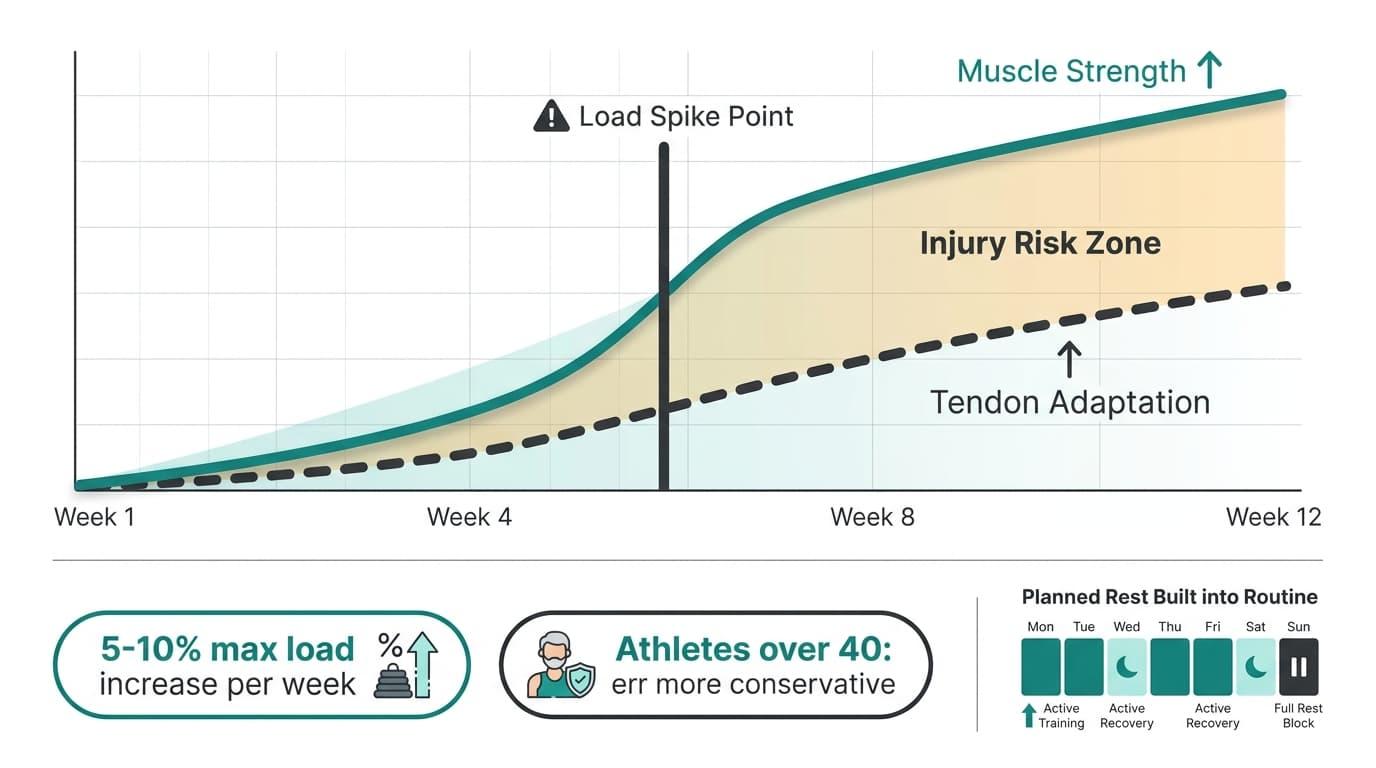
Tendons and ligaments adapt more slowly than muscle. That’s not a theory; it’s basic physiology. It means you can feel stronger, and you can genuinely be stronger through a training block, before your shoulder’s connective tissue is ready for the next weight jump.
Training load consistently appears as a key modifiable risk factor for shoulder injuries across baseball, handball, swimming, and tennis athletes. The gym population is no different.
The general guideline for compound pressing is a maximum load increase of 5 to 10% per week.
Planned rest and rehabilitation should also be built into a workout routine as part of progressive overload, especially when shoulder pain shows up after lifting.
On overhead exercises, where the shoulder is already in a mechanically demanding position, staying at the lower end of that range is the smarter call. For athletes over 40, erring even more conservative on volume spikes preserves the training career.
If your shoulder feels off during a session, that’s not the day to chase a new max. Back the weight down, clean up the mechanics, and earn the increase next week.
5. Mind Your Grip Width on Pressing Movements
Grip width is one of the most overlooked variables in shoulder health, and one of the easiest to correct.
A grip that’s too wide on the bench press forces the humerus into a position that compresses the supraspinatus and increases torque on the anterior capsule of the shoulder joint. Over a high-volume training block, that adds up faster than most lifters expect.
A grip slightly wider than shoulder-width keeps the shoulder in a more mechanically favorable position and distributes the load more evenly across the joint. This applies to both flat bench and incline pressing.
Two specific movements are worth calling out explicitly: behind-the-neck overhead presses and behind-the-neck lat pull downs. They place the shoulder in extreme external rotation and create unnecessary stress during overhead lifting, which is exactly where the joint is most vulnerable.
Respect the impingement zone by avoiding positions where medial rotation is applied as the elbow rises above shoulder height. The impingement and anterior capsule stress these movements create is disproportionate to any training benefit they offer. Remove them from your programming entirely.
6. Build Thoracic Mobility to Free Up the Shoulder Complex
The thoracic spine and the shoulder don't operate in isolation. When the upper back is stiff, the shoulder compensates, and it has no choice but to do so.
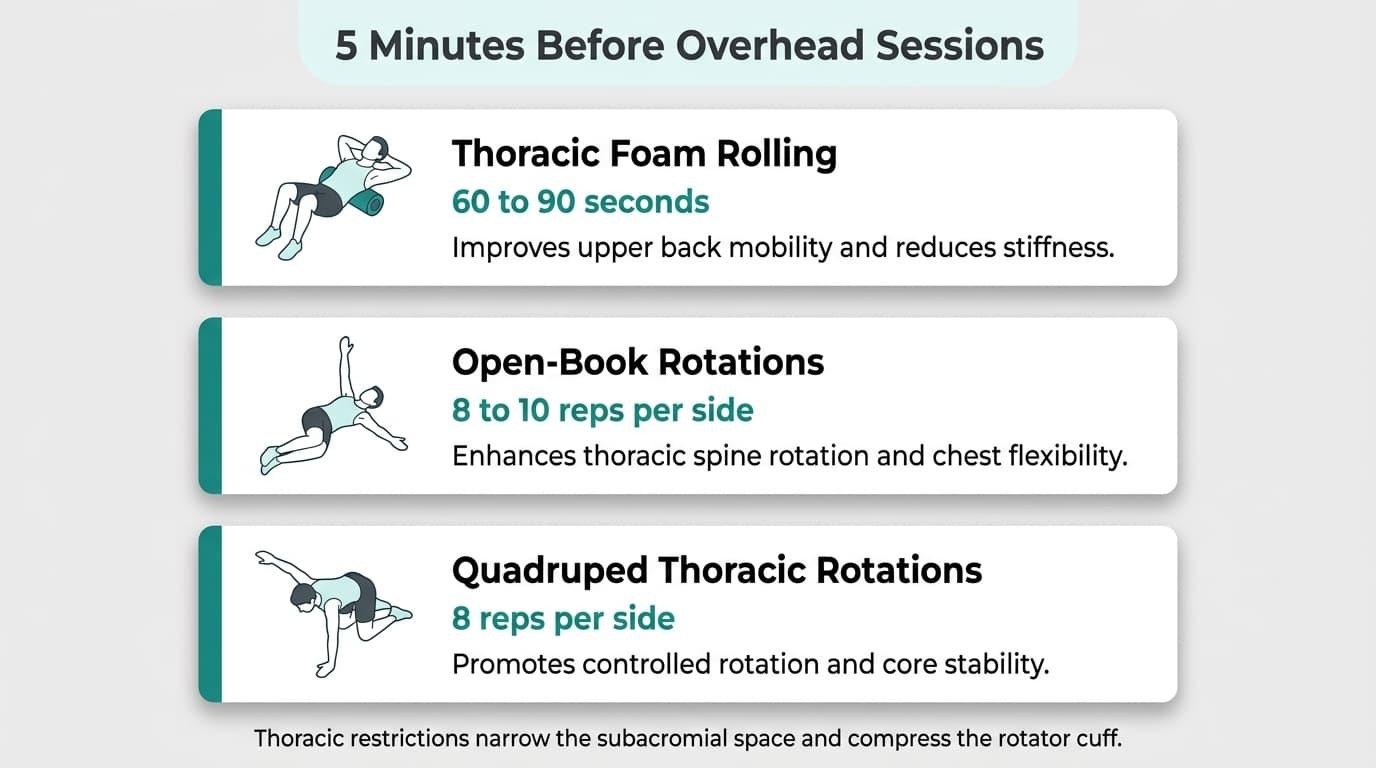
Thoracic restrictions force the shoulder blade to move inefficiently during overhead exercises. The scapula can't rotate upward properly, the subacromial space narrows, and the rotator cuff gets compressed on every rep.
This is a modifiable risk factor that most lifters never address because the pain shows up in the shoulder, not the upper back.
The good news is that five minutes of dedicated thoracic work before overhead sessions materially changes the mechanics of every rep that follows. Here are three drills worth building into your warm-up:
-
Thoracic foam rolling: 60 to 90 seconds of slow rolling across the mid and upper back, pausing on stiff segments. Do this before pressing sessions, not after.
-
Open-book rotations: eight to 10 reps per side in a side-lying position, rotating the top arm open toward the floor while keeping the hips stacked. Targets thoracic rotation directly.
-
Quadruped thoracic rotations: eight reps per side with one hand behind the head, rotating the elbow toward the ceiling. This reinforces segmental mobility under mild load, which transfers directly to overhead pressing positions.
Understanding how shoulder injuries compound over time without upstream intervention is a strong argument for making thoracic mobility a permanent part of your training week, not a temporary fix.
7. Learn the Difference Between Discomfort and a Warning Signal
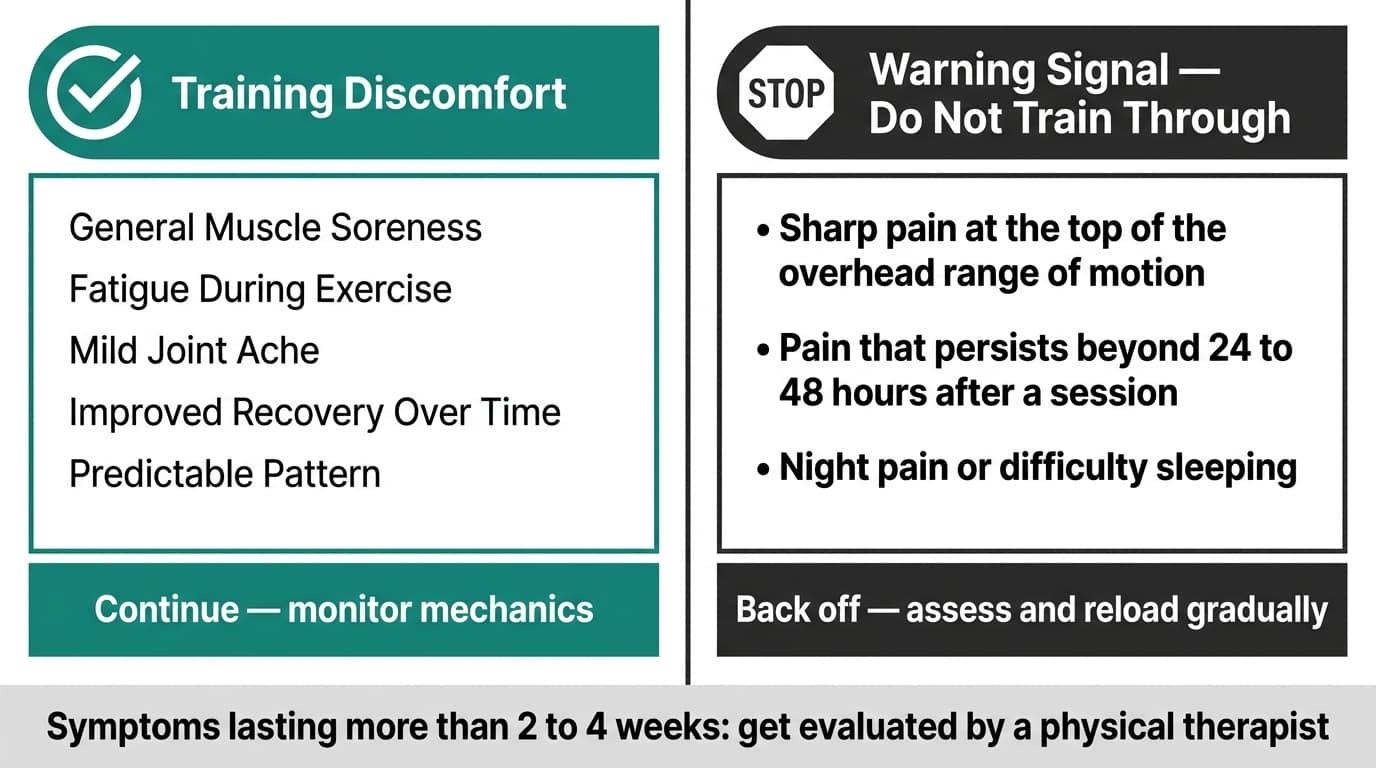
There is a difference between training discomfort and a warning signal, and noticing those early warning signs by listening to your body is how you keep shoulder discomfort from becoming a structural problem. Confusing the two is how minor irritation becomes a structural problem. Pushing through the wrong signals doesn’t build resilience. It accelerates breakdown.
Two specific signs indicate rotator cuff stress that should not be trained through:
-
Sharp pain at the top of the overhead range of motion during pressing or pulling movements
-
Pain that persists beyond 24 to 48 hours after a session, particularly if it’s present at rest or during normal daily activities
-
night pain or difficulty sleeping because of symptoms after training
If symptoms last more than 2 to 4 weeks, get evaluated by a physical therapist to help prevent a serious injury.
Either signal means the tissue is not recovering between sessions. For aging athletes, these signals appear earlier in a training block and are more consequential if ignored.
The path through a shoulder flare-up is not to push harder or to stop entirely. Addressing symptoms early usually avoids longer recovery periods. It’s proprioceptive training with light loads, controlled range of motion, and gradual reloading over time.
Backing off strategically is the decision that keeps you training through your 40s and 50s.
8. Use Preventive Bracing During High-Risk Movements
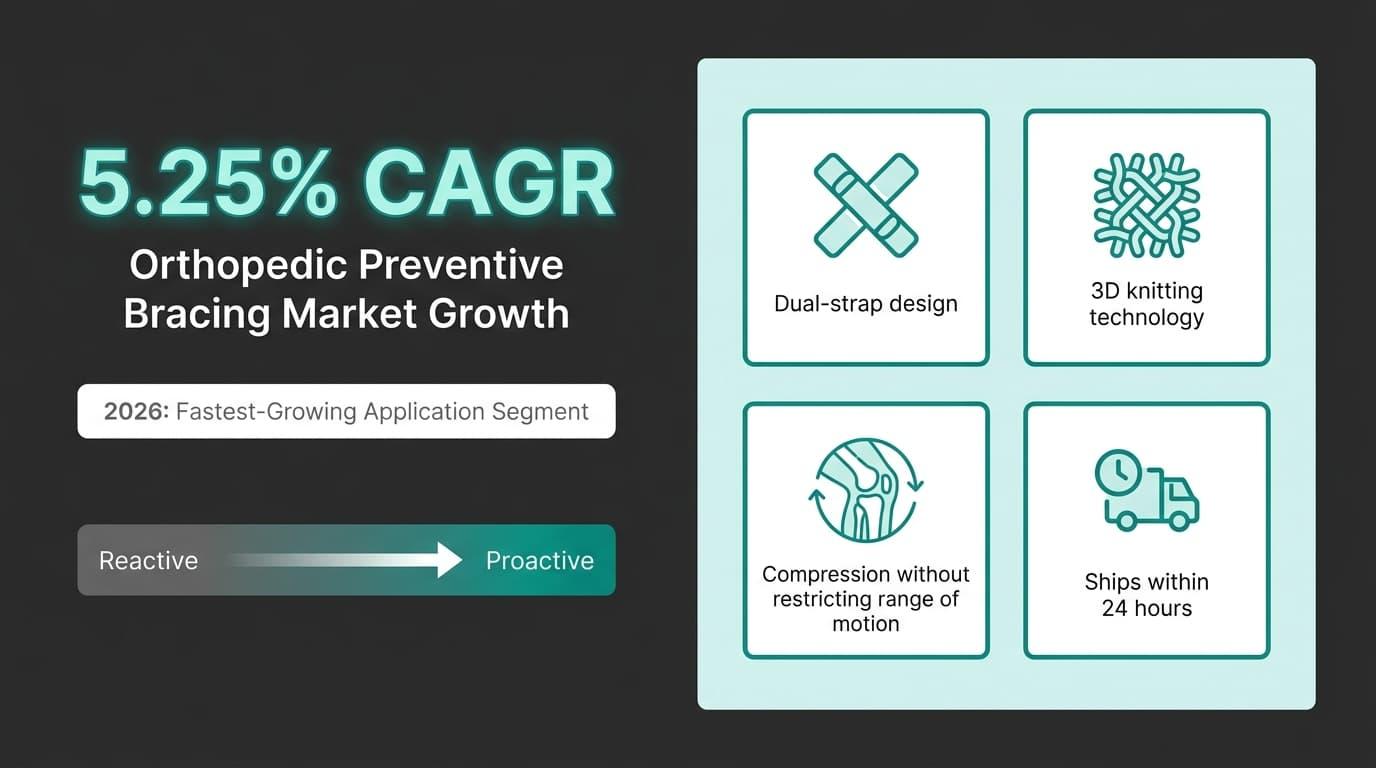
Preventive bracing isn't a recovery tool. It's a performance tool that belongs in your kit before injury shows up, not after. This distinction matters more in 2026 than it ever has.
Preventive care is the fastest-growing application segment in the orthopedic bracing market, advancing at a 5.25% CAGR, driven by athletes and aging active populations who understand that protecting a healthy joint is cheaper, faster, and less painful than repairing a damaged one. The shift from reactive to proactive joint support is one of the defining trends in sports performance in 2026.
During dynamic pressing, overhead exercises, and compound pulling movements, the shoulder absorbs significant repetitive stress. External support reduces joint strain, provides proprioceptive feedback, and helps you maintain positional awareness under fatigue, especially in the later sets of a heavy session when mechanics tend to drift.
The Anaconda Shoulder Brace is built for exactly this kind of training environment. Its dual-strap design keeps the brace locked in place during dynamic movement, eliminating the adjustment interruptions that make most supports impractical under real training conditions. It uses 3D knitting technology with a polyester, nylon, and spandex construction to deliver compression and joint stabilization without restricting the range of motion your pressing and pulling mechanics require. It ships within 24 hours and comes with a 30-day return guarantee.
Final Words
Shoulder injuries don't appear without warning. They build through months of accumulated errors: ignored imbalances, skipped warm-ups, and loads the rotator cuff was never ready for. The athletes who stay healthy aren't lucky. They're consistent with the habits that matter.
At Anaconda, we've supported over 400,000 athletes who take training longevity as seriously as performance. Our shoulder brace is part of a complete approach to shoulder health: Wear it during high-risk sessions, pair it with the warm-up and programming principles in this guide, and build the kind of shoulder resilience that keeps you lifting strong for decades.
Frequently Asked Questions
Curious about what causes shoulder injuries, when to worry about pain, or whether preventive bracing actually helps? Below are quick answers to the most common questions lifters ask.
What causes most shoulder injuries in the gym?
Most common shoulder injuries in gym settings come from muscle imbalances, poor warm-up habits, and excessive training load. Push-heavy workouts without enough pulling work can create instability around the shoulder joint and contribute to gym related shoulder injuries.
Skipping proper warm-ups also increases strain on the rotator cuff during heavy lifts. Rotator cuff injuries are especially common among gym enthusiasts because repetitive overhead movements in exercises like upright rows and bench dips can add stress over time. Over time, repeated overload without enough recovery becomes a major injury risk.
At what age do shoulder injury risks increase for lifters?
Shoulder injury risk usually starts increasing more noticeably after age 35. Tendons and connective tissue recover more slowly with age, especially under heavy training volume. Lifters over 40 are more prone to rotator cuff irritation, impingement, and tendinitis. Proper warm-ups, balanced programming, and controlled progression become even more important over time.
Is preventive shoulder bracing worth it for healthy athletes?
Yes, preventive shoulder bracing can be useful for healthy athletes during high-volume or heavy training blocks. A good brace provides extra shoulder awareness, compression, and support during demanding movements. It does not replace proper technique or balanced programming, but it can help reduce joint stress under fatigue. Many athletes use preventive bracing the same way they use supportive footwear or knee sleeves.
What are two warning signs I should not train through?
Two major warning signs are losing the ability to train pain free and soreness that lasts beyond normal recovery time. Pain at the top of pressing or overhead movements often signals irritation that should not be ignored. If your shoulder hurts during overhead work or daily activity, stop pushing through it and get it assessed. Persistent soreness during rest or daily activity is another sign the shoulder is not recovering properly. Continuing to train aggressively through those symptoms usually makes the issue worse.


