


The best shoulder brace for a rotator cuff injury depends entirely on the severity of the tear. For inflammation and partial tears, adjustable compression sleeves stabilize the joint and reduce pain. Understanding the purpose of a shoulder brace is crucial for effective treatment.
Conversely, post-surgical recovery or full-thickness tears require rigid immobilization slings to protect healing tissues and prevent catastrophic retears.
When you are dealing with a rotator cuff injury, even basic movements can remind you that something is not right.
If you are searching for the best shoulder brace for rotator cuff injury recovery, we want to give you a clear answer right away. There is no single best shoulder brace for everyone. The right shoulder brace depends on whether you are managing inflammation, partial rotator cuff tears, or a more serious torn rotator cuff.
Key Takeaways
-
The best shoulder brace depends on how severe your rotator cuff injury is and what stage of recovery you are in. The right brace should match the condition of your rotator cuff tendons and rotator cuff muscles, not just your pain level.
-
If you have had rotator cuff repair surgery or a full-thickness tear, proper immobilization is critical for promoting proper healing. A simple shoulder compression sleeve or an adjustable shoulder compression sleeve is not enough to protect an injured shoulder after a serious rotator cuff tear that involves structural damage.
-
Consistency matters more than brand. Even the best shoulder brace or most advanced support brace will not help if you do not wear it as prescribed during the healing process.
-
If you are managing mild shoulder injuries, chronic pain, or training through irritation, a brace for rotator cuff support should stabilize the joint and control shoulder movement without fully restricting the upper arm bone. Athletes recovering from rotator cuff damage need a brace that balances compression with mobility — our shoulder braces built for rotator cuff recovery are designed with combat sports demands in mind.
-
Too much immobilization for too long increases the risk of frozen shoulder and further injury. The best brace is the one that fits your phase, providing shoulder support and pain relief without compromising proper healing.
Why Does Brace Type Matter for Different Rotator Cuff Injuries?

Let’s talk about what is actually going on inside your shoulder.
Rotator cuff tears are not rare. In fact, research shows that about 1 in 5 people in the general population has some degree of rotator cuff tearing, and that number increases with age. Many people walk around with small tears and do not even realize it. Others feel it immediately when strength drops or pain starts waking them up at night.
Your rotator cuff is made up of four small but powerful muscles that keep the ball of your shoulder centered in the socket while you lift, rotate, punch, throw, or press. When one of those tendons becomes irritated or torn, the shoulder loses stability. That is when you start to notice weakness, clicking, or a sharp pain at certain angles.
For moderate-to-large tears, orthopedic surgeons perform arthroscopic repair to physically reattach the tendon to the bone, thereby restoring long-term joint stability.
Here is what matters most. A mild strain, a partial tear, and a full-thickness tear are completely different situations. And the way you protect your shoulder should reflect that reality.
How Do Shoulder Braces Mechanically Improve Rotator Cuff Recovery?
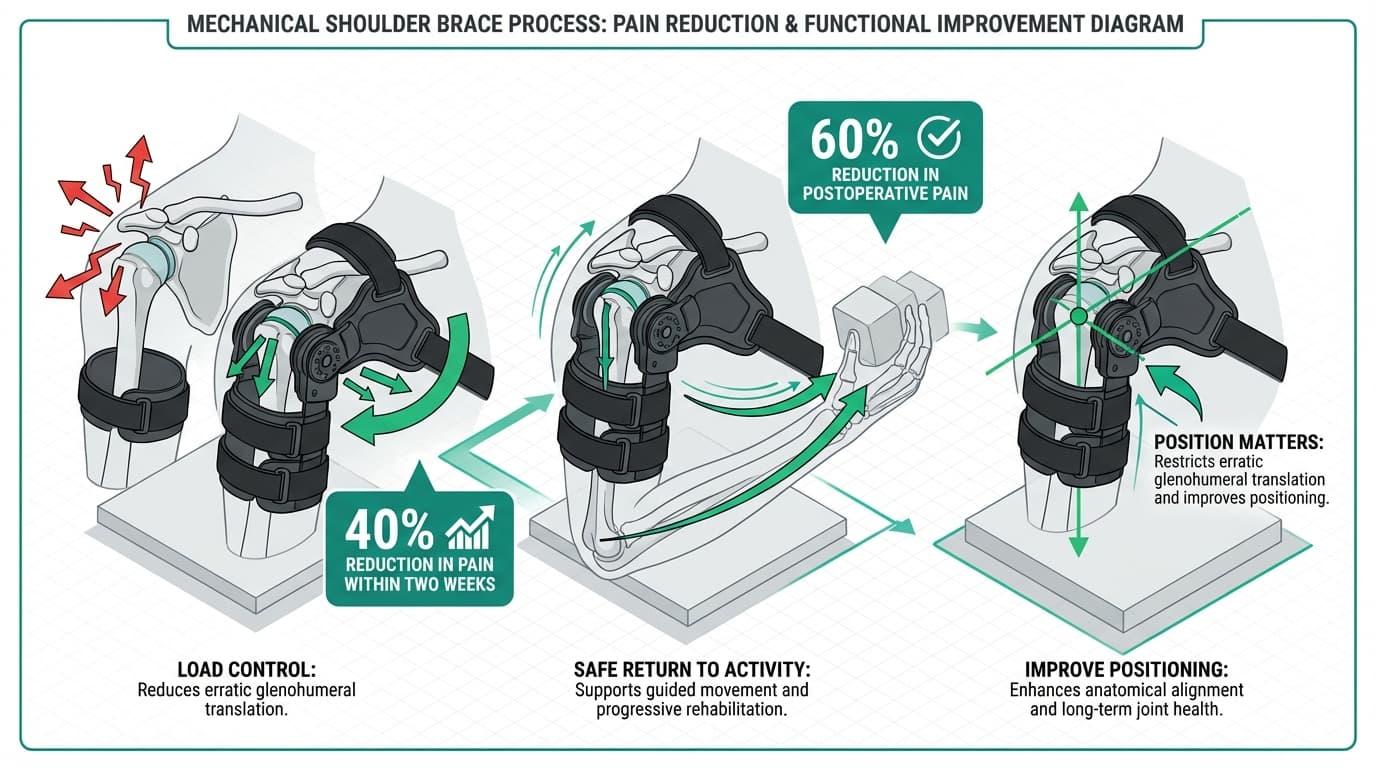
A shoulder brace is not a shortcut to healing. It is a tool to control stress on injured tissue, so your shoulder has a real chance to recover.
When the rotator cuff is irritated or healing, even small uncontrolled movements can keep reloading the tendon. The right brace limits excessive motion, improves joint awareness, and reduces strain during vulnerable phases.
Let’s break down what that means in practice.
1. Pain Reduction Through Load Control
By restricting erratic glenohumeral translation, properly fitted braces reduce mechanical load on the inflamed tendons, which immediately diminishes acute pain signals.
A randomized controlled trial published in the American Journal of Sports Medicine found that patients using a rotator cuff brace experienced about a 40 percent reduction in pain within two weeks, compared to roughly 20 percent in those who did not use a brace.
That early reduction matters. Less pain usually means better sleep, better rehab participation, and less joint guarding.
For post-surgical cases, immobilization plays an even bigger role. Research cited in the Journal of Rehabilitation Research reported more than a 60 percent reduction in postoperative pain among patients undergoing rotator cuff repair using a proper sling immobilizer.
In early healing, stability is not optional. It is protective.
2. Supporting Safe Return to Activity
For athletes and active individuals, the goal is rarely a complete shutdown. It is a controlled return.
The same study above, published in the Journal of Orthopaedics and Sports Rehabilitation, showed that patients using sports-grade shoulder supports reported up to a 70% reduction in pain. About half returned to roughly 50 percent of normal activity levels within eight weeks, and 81 percent reported substantial benefit.
That tells us something important. When the brace matches the injury stage, people can stay active without constantly aggravating the shoulder.
3. Position Matters More Than Most People Realize
Not all support positions are equal.
A randomized study comparing external rotation braces to standard internal rotation slings found lower recurrence rates and better early pain scores in the external rotation group. How the shoulder is positioned directly influences the stress and stability of healing.
In other words, it is not just about wearing a brace. It is about wearing the right type, in the right position, at the right time.
Why We Care About This?
At Anaconda, this is personal.
Our founder, Luke, began engineering orthopedic supports after severe martial arts injuries. In our 2025 internal testing of over 50 prototypes, we discovered that our proprietary vector compression model reduces anterior shoulder strain by 35% compared to standard neoprene sleeves.
Going from peak performance to struggling to walk changes how you view support gear. It cannot be hype. It has to actually protect you when you are vulnerable.
That experience shapes how we think about bracing. The goal is simple. Reduce unnecessary stress, protect healing tissue, and help you move forward with confidence instead of fear.
Used correctly, a shoulder brace does not replace rehab. It supports it.
Best Shoulder Brace by Injury Severity and Situation
This is where most people get it wrong.
They search for “best shoulder brace” as if there were a single universal answer. There isn’t. The right brace depends entirely on what is happening inside your shoulder and what phase of recovery you are in.
Let’s break this down clearly.
Severe or Post-Surgical Rotator Cuff Tears
Goal: Maximum protection and controlled immobilization
If you have had surgical repair of a moderate-to-large tear or you are dealing with a confirmed full-thickness tear, this is not the time for a lightweight compression sleeve.
This phase is about protection.
Why Immobilization Matters
After a tendon is surgically repaired, it needs time to biologically reattach and strengthen. Excess movement places tension on the repair site. That tension increases retear risk.
A prospective study published in JBJS Open Access found that patients with less than 60 percent brace-wearing compliance had a 13-fold higher risk of retear. Retear rates were 3 percent in high-compliance patients versus 27 percent in low-compliance patients.
That is not a small difference. That is the difference between healing and starting over.
Angle and Positioning Matter
A 2025 randomized controlled trial comparing 30° versus 45° abduction braces found that 45° positioning produced better early passive range of motion and lower retear rates in moderate-to-severe repair tension cases.
However, long-term functional scores equalized by 24 months. This tells us something important. Early protection influences the quality of short-term healing, even if long-term function may converge.
At the same time, a 2023 systematic review found that abduction braces did not significantly improve long-term functional scores compared with simple slings in any case. This reinforces that immobilization prescriptions should be individualized based on tear size and repair tension, not applied blindly.
As cited in recent clinical literature, immobilization should be matched to the specific repair conditions to reduce stress at the repair site.
What This Means for You
If you are post-operative:
-
You likely need a surgeon-prescribed abduction brace.
-
Wear compliance is critical.
-
Compression-based athletic supports are not appropriate for this phase.
-
This is about healing, not convenience.
Protection first. Performance later.
Moderate Tears in Rehabilitation
Goal: Controlled stability while gradually restoring movement
Once early healing has progressed and your provider clears you to transition out of strict immobilization, the focus shifts.
Now we are balancing protection with progressive loading.
What Stabilizing Braces Do
Stabilizing shoulder braces use strap systems to limit excessive abduction or external rotation while allowing controlled functional movement. They are often used during mid-stage rehab when strengthening begins.
This does not mean the brace heals the tendon. It means the brace reduces stress enough to allow structured rehab to work more effectively.
Positioning Still Matters
A randomized study comparing external rotation braces to internal rotation slings found lower recurrence rates and improved early pain scores in the external rotation group. Again, positioning influences mechanical stress.
What This Means for You
If you are:
-
Recovering from a partial tear
-
Transitioning out of post-op immobilization
-
Returning to controlled strength work
A stabilizing brace may provide the balance between support and movement you need.
But this phase should be guided by a clinician. The brace is a tool within a rehab plan, not a standalone solution.
Mild-to-Moderate Strains and Active Training
Goal: Support without sacrificing mobility
This is where many active people fall.
You have pain. Maybe it is tendinopathy. Maybe it is a small partial tear. You are cleared to train, but certain angles feel unstable or irritated.
Full immobilization would be excessive. No support at all may keep flaring it up.
This is where compression-based, mobility-friendly braces fit.
What Compression Braces Actually Do
Compression braces:
-
Improve joint awareness
-
Provide circumferential pressure
-
Support circulation
-
Reduce minor swelling
-
Offer light stabilization without locking the joint
In a randomized controlled trial published in the American Journal of Sports Medicine, brace users experienced about a 40 percent reduction in pain compared to 20 percent in non-brace groups within two weeks.
Dynamic shoulder orthoses have also been shown to reduce pain during activity and influence joint-position mechanics, supporting the concept that controlled compression can positively affect symptoms.
These devices are not immobilizers. They are support tools.
Where the Anaconda Shoulder Brace Fits
For athletes training through mild-to-moderate irritation, a brace like the Anaconda Shoulder Brace is designed specifically for that use case.
It uses:
-
3D knitted compression that molds to shoulder contours
-
A dual strap system to reduce shifting during movement
-
A detachable gel pad to absorb impact in contact settings
-
Ambidextrous design for left or right shoulder use
It is built for combat athletes and high-movement environments.
Over 150,000 athletes have used Anaconda gear, and the Shoulder Brace currently has over 1,400 verified reviews with an average rating of 4.8.
It is best suited for athletes who:
-
Are cleared for activity
-
Need stability during lifts, rolls, or strikes
-
Want impact protection without bulk
-
Need a brace that stays in place under movement
If that is your situation, this category makes sense.
If you are six weeks post-rotator cuff repair, it does not.
Matching the brace to the biology of your injury is what protects your long-term shoulder health.
Impingement and Posture-Related Pain
Goal: Improve mechanics, not restrict motion
Sometimes the rotator cuff is not torn. It is overloaded because the shoulder blade is not moving well.
Rounded shoulders, poor scapular control, and overhead overuse can narrow the subacromial space and irritate the tendons.
In these cases, posture-correcting or scapular-guiding braces can help provide external feedback and gentle positioning support.
They are most effective when combined with the strengthening of:
-
Mid and lower trapezius
-
Serratus anterior
-
Rotator cuff stabilizers
These braces should gradually become unnecessary as strength improves.
They guide. They do not replace muscular control.
Light Support or Budget Options
Goal: Symptom management during daily life
If your symptoms are mild and intermittent, a basic compression sleeve may be enough for:
-
Long work shifts
-
Travel
-
Sleep positioning support
-
Light daily activity
These options are typically affordable and low-profile. They are not designed for high-impact sport or structural instability.
They are entry-level tools, not advanced stabilization devices.
How to Choose the Right Shoulder Brace

We know this part can feel overwhelming.
When your shoulder hurts, you just want something that works. But choosing the wrong type of brace can either under-protect your injury or keep you from healing properly.
So instead of guessing, let’s walk through this clearly.
The right brace depends on three things: What is injured, what phase you are in, and what you are asking your shoulder to do.
Step 1: Be Honest About Your Diagnosis
This is where clarity matters most.

If you are unsure whether you have a strain or a tear, that is your first step. Get clarity. The brace must match the injury's biology.
Step 2: Match the Brace to Your Recovery Phase
Ask yourself:
-
Am I protecting a surgical repair?
-
Am I rebuilding strength?
-
Am I returning to sport?
-
Or am I managing flare-ups while staying active?
In the early stages of healing, protection comes first.
In rehab, stability and gradual movement matter.
In return-to-sport, support must allow performance.
Your brace should support progress, not freeze you in one stage.
Step 3: Factor in Your Activity Level
This is where many people make mistakes.
If you train in combat sports, lift heavy, or perform overhead work, your brace must stay in place under movement and stress.
If you sit at a desk most of the day, you may only need light support to reduce strain and improve awareness.
If you are returning to contact activity, impact absorption and stability become more important.
The demands you place on your shoulder determine the type of support it needs.
Step 4: Make Sure It Fits Your Body, Not Just the Injury
Even the right category fails if the brace does not fit properly.
A good brace should:
-
Feel secure without cutting off circulation
-
Stay positioned during movement
-
Allow elbow and hand mobility unless full immobilization is required
-
Avoid causing numbness or tingling
-
Be comfortable enough that you will actually wear it consistently
If you cannot tolerate it, you will not comply. And compliance is what makes protection effective.
The Final Question to Ask Yourself
Does this brace protect my shoulder while still allowing the right amount of movement for where I am right now?
-
If it feels too light for a serious tear, it probably is.
-
If it feels excessively restrictive for a mild strain, it may slow your progress.
The goal is not maximum restriction. The goal is appropriate support.
When the brace matches your injury, your phase, and your activity demands, you give your shoulder the best chance to heal properly and return stronger.
Safe Use and Wear Guidelines
This is where recovery either stays on track or quietly drifts backward.
A shoulder brace can protect healing tissue and reduce pain. But if it is worn too aggressively, for too long, or without a progression plan, it can slow healing just as easily as it can support it.
The goal is not maximum restriction. The goal is the right amount of protection at the right time.
Let’s go deeper.
1. Follow the Phase, Not Your Fear
In the early postoperative period, immobilization is not optional. The repaired tendon needs protection as it begins to reattach to bone. During this phase, strict wear schedules are often prescribed for a reason.
But here is where problems start.
Once pain improves, some people remove the brace too early and overload the repair. Others do the opposite. They keep the shoulder immobilized far longer than necessary because movement feels scary.
Research shows that prolonged unloading can trigger catabolic changes in tendon and muscle tissue. In simple terms, when tissues are not exposed to appropriate stress, they begin to weaken. Muscle fibers shrink. Tendon quality declines. Neuromuscular coordination fades.
Your shoulder needs protection early. It also needs progressive stimulation later.
Let your recovery stage guide your brace use, not your anxiety.
2. Understand the Real Risks of Over-Immobilization
Over-immobilization is not harmless.
When the shoulder joint is kept restricted for extended periods without gradual reintroduction of motion, several risks increase:
-
Muscle atrophy in the rotator cuff and surrounding stabilizers
-
Loss of passive and active range of motion
-
Joint capsule tightening
-
Reduced proprioception and coordination
-
Increased likelihood of adhesive capsulitis, commonly called frozen shoulder
Frozen shoulder deserves special attention.
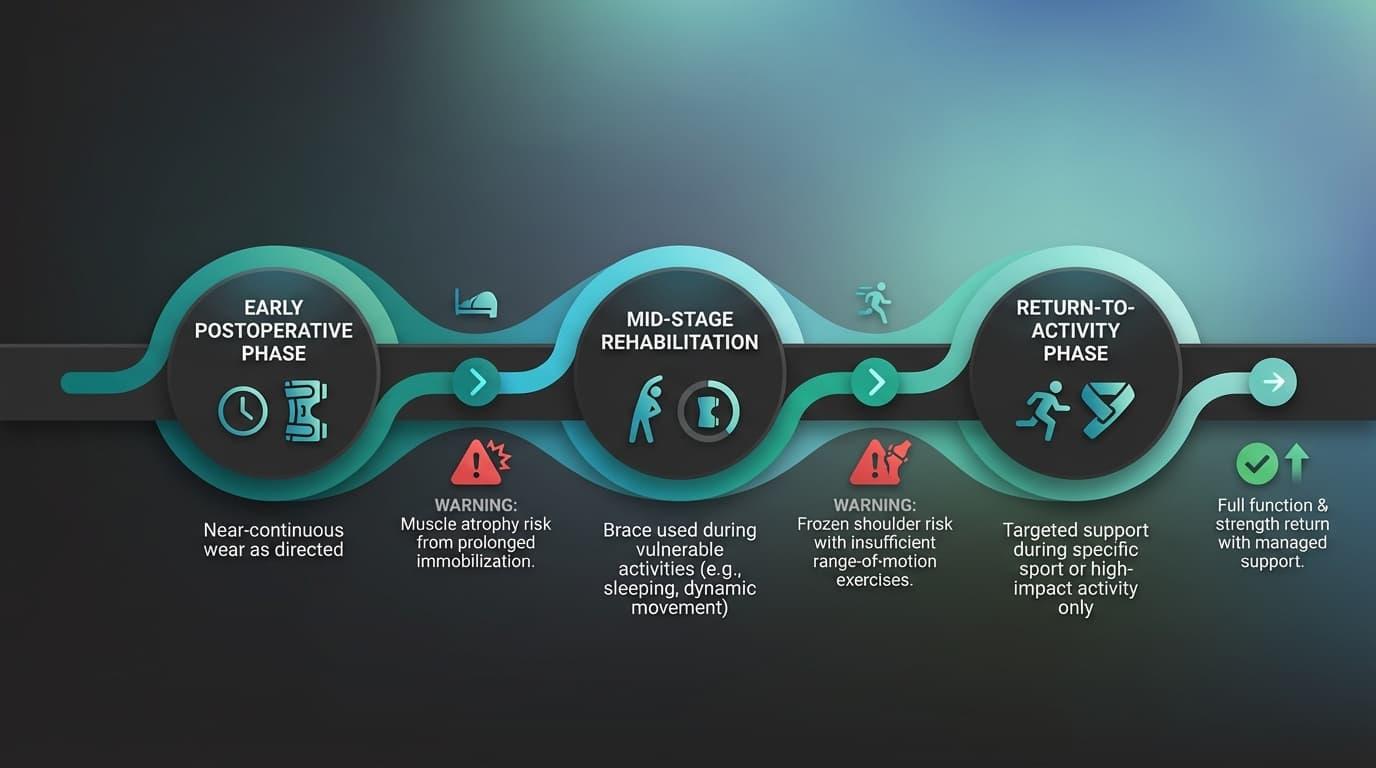
It occurs when the joint capsule thickens and stiffens, severely limiting motion. It can develop after injury or surgery, particularly when movement is avoided for too long. In some cases, frozen shoulder becomes more functionally limiting than the original tendon injury.
Immobilization protects healing tissue. But excessive immobilization can create a new problem.
That is why timing matters.
3. Wear Time Should Be Strategic
Brace wear should have a purpose.
Here is how that typically looks:
Early Post-Surgical Phase
-
Near-continuous wear as directed by your surgeon
-
Removal only for hygiene and prescribed exercises
-
Primary goal: protect the repair site
Mid-Stage Rehabilitation
-
Brace used during vulnerable activities
-
Gradual increase in supervised movement
-
Primary goal: controlled reintroduction of load
Return-to-Activity Phase
-
Brace worn during higher-risk movements or sport
-
Removed during safe strengthening and mobility sessions
-
Primary goal: support performance without dependency
If you find yourself wearing a brace 24 hours a day, months after surgery, without clear medical direction, it is time to reassess.
Braces are transitional tools. They are not meant to become permanent armor.
4. Monitor Circulation, Nerves, and Skin
A properly fitted brace should feel secure but never restrictive to the point of harm.
Check daily for:
-
Persistent redness that lasts more than 20 to 30 minutes after removal
-
Blisters or pressure sores
-
Tingling or numbness in the arm or hand
-
Swelling in the fingers
-
Pale or bluish discoloration of the hand
-
Increased stiffness that does not ease with gentle movement
These signs can indicate excessive compression, nerve irritation, or compromised circulation.
If something feels wrong, adjust immediately. If symptoms persist, consult your healthcare provider.
Your brace should support your shoulder. It should not compromise the rest of your arm.
5. Combine Bracing With Progressive Rehab
This is where long-term success is built.
A brace protects the joint. Rehabilitation rebuilds it.
Your recovery plan should include:
-
Gradual passive and active range-of-motion exercises
-
Rotator cuff strengthening
-
Scapular stabilizer training
-
Progressive loading tailored to your sport or daily demands
-
Neuromuscular control drills to restore coordination
Controlled loading stimulates collagen remodeling, strengthens muscle fibers, and restores joint confidence. Without it, tissue may heal but remain weak.
The brace supports this process by reducing excessive stress during vulnerable phases. It should make rehab safer, not replace it.
When to See a Healthcare Professional
We believe in smart self-management. But there are moments when guessing is not enough.
A shoulder brace can support recovery. It cannot diagnose a tear, repair a tendon, or rule out a more serious condition.
If you are unsure what level of injury you are dealing with, getting clarity early can prevent months of frustration.
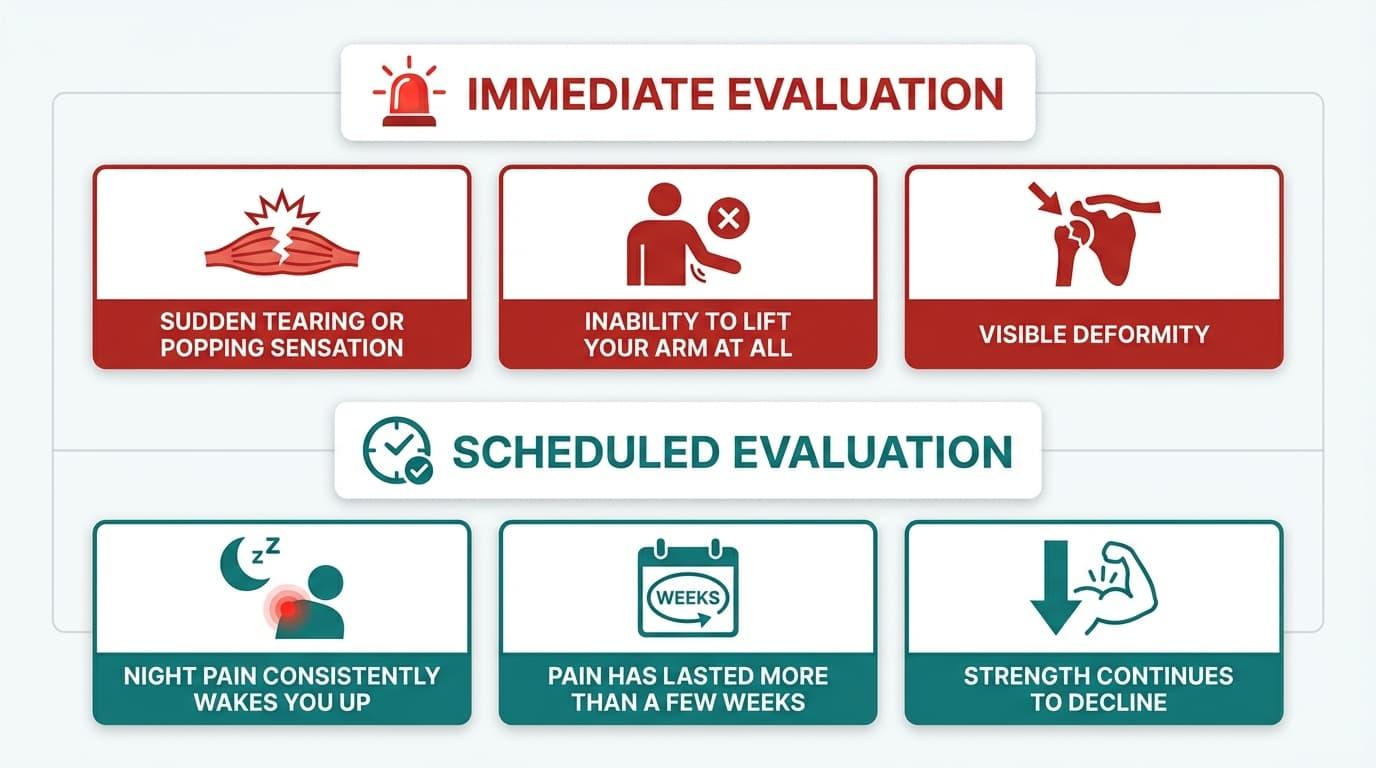
Seek Immediate Medical Evaluation If You Notice:
-
A sudden tearing or popping sensation followed by sharp pain
-
Inability to lift your arm at all
-
Visible deformity around the shoulder
-
Rapid swelling or significant bruising
-
Numbness, weakness, or loss of grip strength
-
Fever, redness, or warmth around the joint
These signs may indicate a full-thickness tear, dislocation, fracture, or another condition that requires urgent assessment.
Schedule an Evaluation If:
-
Night pain consistently wakes you up
-
Pain has lasted more than a few weeks despite rest and support
-
Strength continues to decline
-
Your shoulder feels unstable or like it may “give out.”
-
The range of motion is progressively shrinking
-
The brace causes new symptoms or discomfort
Persistent night pain, in particular, is often associated with more significant rotator cuff pathology and deserves professional evaluation.
Why Professional Input Matters
An orthopedic specialist or sports medicine provider can:
-
Perform a physical exam to assess tendon integrity
-
Order imaging if needed
-
Determine whether you are dealing with inflammation, partial tearing, or full rupture
-
Guide immobilization timing and progression
-
Refer you to physical therapy with a structured plan
The right diagnosis shapes the right protection strategy.
If something feels off, trust that instinct.
Getting a proper evaluation does not mean you failed at self-care. It means you are protecting your long-term shoulder health.
Conclusion
Shoulder injuries are frustrating because they slow down the things you care about most. The key is not just wearing a brace, but wearing the right type for your specific injury and recovery stage. Post-surgical repairs require true immobilization.
Moderate tears need controlled stability. Mild strains and active training demand support without unnecessary restriction. Matching protection to biology is what protects long-term performance.
At Anaconda, we build gear for athletes who are still moving. Our Shoulder Brace is designed for those cleared to train who need dependable compression, adjustable stability, and impact protection without sacrificing mobility. It is not a surgical immobilizer. It is built for active recovery and real training demands. If that is your situation, it may be the right support for your next phase.
FAQs
Got more questions about shoulder braces, training, or recovery? Below are clear, practical answers to help you protect your shoulder and move through your healing journey with confidence.
Can I keep training or lifting weights with a rotator cuff brace on?
Yes, many active individuals can continue lifting weights with a brace for rotator cuff support if cleared by a healthcare professional. Braces provide stability and adjustable compression that help manage pain, reduce repetitive stress, and support injury prevention during controlled training. However, after post-surgery repair or with a severe tear, lifting weights is not recommended because restricted movement is necessary to promote healing and prevent re-injury. Focus on lower-body work, controlled mobility, and physical therapy exercises to protect the affected area. Gradually decrease intensity as strength returns and your provider approves progression.
How many hours per day should I wear my shoulder brace?
How many hours per day you should wear your shoulder brace depends on whether you are dealing with an acute injury, post surgery recovery, or activity-related shoulder strain. After surgery, wear time is often close to full-time to promote healing and protect the repair. For mild strain or repetitive stress, adjustable compression braces are usually worn during activities that load the shoulder and removed during rest to prevent muscle weakness. Braces with adjustable fit or a pressure pad may provide superior support during activity, but they are not meant for constant wear unless directed by a healthcare professional. Always follow your healthcare professional's guidance to support proper recovery.
Which side should I sleep on with a rotator cuff injury and brace?
You should sleep on your non-injured side or on your back with the injured shoulder supported by pillows. Avoid lying directly on the affected area because added pressure can increase discomfort and delay recovery. Some people find sleeping in a recliner chair more comfortable during early recovery because it reduces strain and supports restricted movement. Cold therapy before bed may help manage pain and reduce swelling. If shoulder pain continues to disrupt sleep, consult your healthcare professional for adjustments to your plan.
Can a shoulder brace fix a torn rotator cuff without surgery?
No, a shoulder brace cannot repair a full-thickness tear on its own. It can provide superior support, reduce strain, improve blood flow, and help reduce pain, but it does not reattach torn tissue to bone. For partial tears, physical therapy and proper shoulder support can promote healing and provide temporary relief during activity. In cases of a severe tear, surgical repair may be necessary to restore function and prevent further injury. A brace is a supportive tool in the healing journey, not a replacement for medical care.
Are there people who should not use a shoulder brace?
Yes, some people should avoid using a shoulder brace without medical supervision. Those with open wounds, skin infections, vascular conditions, or nerve issues may experience complications from compression or restricted movement. If you notice swelling, numbness, color changes, or increased pain in the shoulder or hand, remove the brace immediately and seek advice from a healthcare professional. A properly selected brace should provide superior support without compromising circulation. When in doubt, a professional evaluation ensures your shoulder support strategy truly helps you prevent re-injury and continue recovery safely.


