


Metal hinged knee braces are overkill for gym injuries because most weightlifting tweaks involve tissue overload, tendinopathy, or mild inflammation—not catastrophic ligament failure.
Rigid hinged braces are designed for true joint instability and post-surgical recovery, whereas common gym injuries require load management and basic compression.
When something feels off, your brain jumps to worst-case scenarios. ACL tear. Surgery. Months off training. So you start looking at metal-hinged braces. They look serious. They look protective.
That reaction makes sense.
But most gym knee injuries are not catastrophic ligament failures. They are overload issues, tendon irritation, or temporary inflammation. Rigid metal hinges often address fear rather than the actual cause of pain.
At Anaconda Fightwear, we’ve seen firsthand how lifters jump to metal hinges after minor tweaks and how often it’s unnecessary.
This guide explores the proper use of knee support during training:
-
What are hinged knee braces designed for?
-
What are the most common gym knee injuries?
-
Why are hinged braces overkill for typical gym pain?
-
When should you avoid training and see a doctor?
Key Takeaways
-
Most gym-related knee joint pain is irritation, not true instability, which is why metal hinges are overkill for gym injuries. A bulky hinged knee brace or a rigid hinged brace is rarely needed when the goal is to heal and return to proper lifting.
-
If you can walk normally without sharp pain but feel discomfort during squats or lunges, adding a hinged knee brace will not fix your foot position, foot pressure, or poor hip hinge mechanics. The real point is to adjust the load, rebuild strength, and let the tissue heal.
-
A metal or plastic-reinforced hinged brace is designed for post-surgery cases or for true ligament laxity. For everyday training irritation, a simple knee brace that offers light compression and stabilizing support can provide enough relief while you continue walking and retraining movement.
-
Focus on the basics first. Improve your hip hinge, control your position, stack your ribs over your pelvis, and keep your thoracic spine stable. When your mechanics are adjusted properly, your knee brace becomes a temporary tool, not a crutch.
-
Big swelling after a twist, locking, or true giving way is different. At that point, skip the extra hinged knee brace hardware and get assessed. The right diagnosis helps you heal faster and avoid unnecessary stress on the knee joint.
What Are Hinged Knee Braces Designed For?
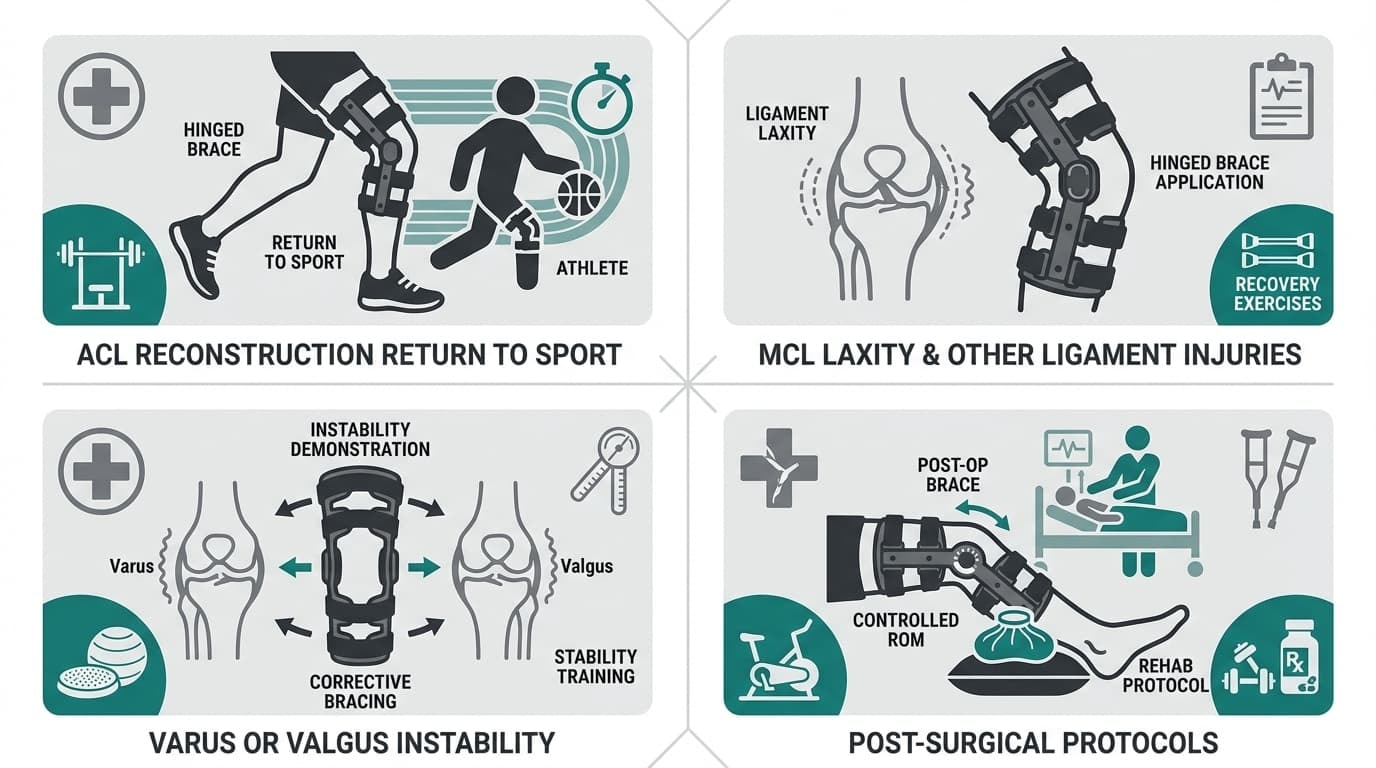
A hinged knee brace is designed for unstable knees, meaning the joint can shift in ways it should not. That is why they show up in:
-
ACL reconstruction return to sport
-
MCL laxity and other ligament injuries
-
Varus or valgus instability (knee collapses inward or outward)
-
Post-surgical protocols where a clinician wants motion-controlled
A 2025 review explains that hinged functional braces are designed for higher-level cutting and pivoting sports, where twisting forces are common.
Now zoom out to typical gym injuries. In a German CrossFit cohort study, 28.6% (85 of 308) reported injury, but most injuries were not severe: wounds 23.3%, contusions, sprains, strains 30.8%, fractures 2.9%, and surgery needed 8.2%. Many needed no medical treatmen,t 50.6%. Knee-specific cases were rare, with 4 meniscus lesions, 2 knee sprains, 1 case of patellar luxation, and no ACL tears listed.
According to a 2023 weight-training injury analysis by Bukhary et al, only 4.6% of reported injuries involved the knee joint, demonstrating that structural ligament damage is statistically rare in strength sports.
What Are the Most Common Gym Knee Injuries?
This is where the conversation shifts.
Most gym knee pain is not due to ligament snapping or joint collapse. It is an overload. It is tissue irritation. It is the body saying you increased volume, depth, or weight faster than it adapted.
Two recent studies make this clear.
In From Sweat to Strain: CrossFit Injuries, researchers surveyed 308 athletes and recorded 172 injuries. Most injuries were wounds, contusions, sprains, and strains. Many required no medical treatment. Knee-specific injuries were rare, and ACL tears were not common in that dataset.
In the same study, most injuries did not require surgery, and over half did not require any formal treatment. That means most gym injuries were manageable overload problems, not structural breakdown.
In a 2023 weight-training study (Bukhary et al.), 393 athletes were surveyed. About 27% reported an injury in the last six months. Only 4.6% involved the knee. “Ligament tear or muscle tear” was reported in 3.8% of cases.
In simple terms, most gym knee injuries are:
-
Patellofemoral irritation
-
Tendinopathy
-
Mild sprains
-
Volume-related inflammation
Because typical gym pain stems from volume-related inflammation rather than catastrophic ligament collapse, athletes can effectively manage these injuries with load reduction and light compression sleeves instead of restrictive hinged braces.
For the vast majority of gym and mat injuries, a well-designed compression brace is all you need — browse our lightweight knee braces suited to gym and mat training to find a practical alternative to bulky hinged options.
Most gym pain is a load problem. Not a hardware problem.
Why Are Hinged Knee Braces Overkill for Typical Gym Pain?
Now let’s break this down logically.
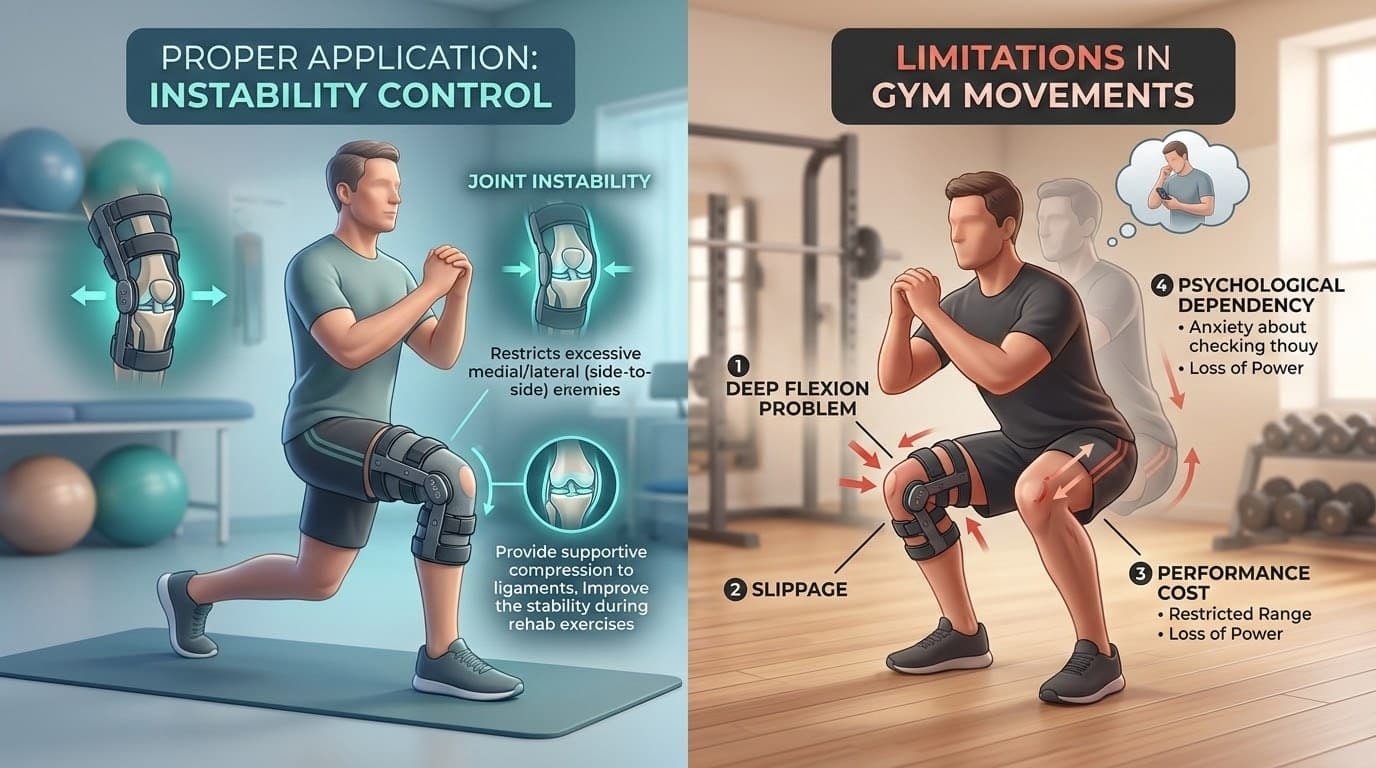
Hinges Control Joint Instability
A hinged knee brace is designed to control instability. It limits side-to-side movement and twisting forces. That is its job.
According to a 2025 review by Heyworth et al., functional knee braces are “specifically rigid and hinged” and are intended for higher-level cutting and pivoting sports.
They are built for ACL reconstruction, post-surgery return to sport, and confirmed ligament laxity.
But most gym pain is not instability. It is irritating. If your knee can handle standing, walking, and controlled squats without buckling, the hinges are solving the wrong problem.
B) The Deep Flexion Problem
In the gym, your knee bends deeply. Squats, lunges, split squats, box jumps. Your thigh muscles expand and change shape as you bend past 90 degrees.
Rigid hinged braces often migrate during deep flexion. The metal sidebars shift. The brace slides down the leg. You tighten the straps to compensate. That creates pressure and discomfort.
In the same 2025 review, some patients reported complaints about fit, slippage, and negative effects on sports performance.
When a brace shifts 1 to 3 centimeters during a squat, it loses alignment with the joint. That means the hinges are no longer correctly positioned to provide meaningful support.
C) Performance Cost
Bulk matters.
A hinged knee brace adds weight, restricts range of motion, and changes how your body moves. Deep-knee-bend exercises feel less natural. Hip mechanics change. Sometimes, even your neutral spine position can be altered as you compensate for the added structure around the leg.
Common issues reported:
-
Reduced mobility during deep bending
-
Brace slippage mid-set
-
Pressure hotspots around the thigh
-
Skin irritation from overtightening
-
Reduced comfort during dynamic movement
Research also notes that while biomechanical benefits exist in controlled settings, clinical outcomes are mixed and guidelines remain uncertain.
In other words, outside of true ligament instability, the benefit of a hinged knee brace is not clearly proven for routine gym injuries.
D) Psychological Dependency
This part is important.
Wearing a large brace can feel protective. It can feel like you are preventing injuries. But protection without addressing the cause of pain can create dependency.
If you rely on metal hinges instead of:
-
Correcting movement patterns
-
Strengthening hip and quad muscles
-
Managing volume
-
Rebuilding proper knee control
You delay recovery.
Compression sleeves often provide enough support to relieve mild irritation while you rebuild strength. They provide warmth and proprioception without restricting movement.
A hinged brace can create a false sense of security. It may reduce fear, but it does not strengthen the muscles that actually stabilize the joint.
The real difference is this:
Hinges are built for patients with unstable knees after surgery or with confirmed ligament injuries.
Most gym knees are irritated, not unstable.
When you match the tool to the problem, recovery improves. When you overbuild the solution, you add complexity without solving the root cause.
The Missing Middle: Structured Support Without Hinges
Most people think knee support is binary. You either wear nothing or strap on a bulky, hinged metal knee brace.
But there is a smarter middle ground.
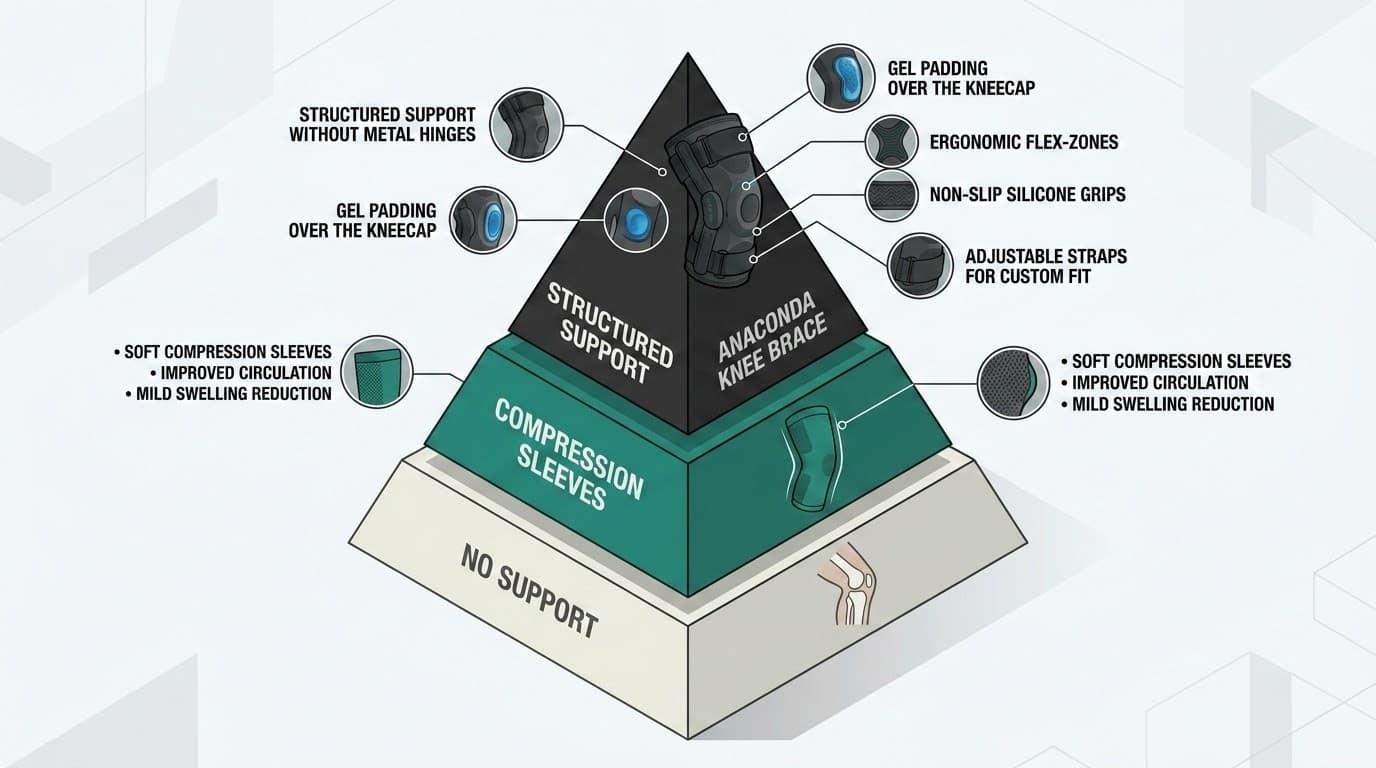
When you break down knee support logically, there are three tiers:
-
No support: Good for mild soreness that disappears quickly and does not affect movement.
-
Soft compression sleeves: Light compression and warmth that improve blood circulation, reduce swelling, and provide proprioceptive feedback during recovery or low-load sessions.
-
Structured support without metal hinges: This is the sweet spot for gym athletes whose knees are stable but need guidance during loaded movement without restricting range of motion.
Structured braces differ from both simple sleeves and rigid hinges. Instead of locking the knee, they guide motion through controlled support, helping prevent inward collapse or excessive lateral loading while preserving natural movement patterns.
A well-designed, structured brace, such as the Anaconda Knee Brace, integrates thoughtful biomechanics rather than hardware restraint:
-
Wraps under, around, and above the knee: Multi-angle coverage that gently guides knee movement without restricting the normal range of motion.
-
Optional side stabilizer: Adds targeted lateral reinforcement when your workout demands it.
-
Gel padding over the kneecap: Helps absorb impact during dynamic movement and reduces local pressure.
-
Rubber inseam grip: Keeps the brace in place during deep squats, lunges, and rotational drills.
-
Fight Tech straps: Allow you to fine-tune support and pressure without cutting off circulation or limiting muscle activation.
Biomechanically, structured support provides:
-
Directional assistance: Helps the knee resist unwanted twisting or shear forces without rigid hinges.
-
Functional stability: Encourages muscles to engage correctly while the brace offers guidance.
-
Freedom of motion: You maintain natural leg mechanics, allowing the hip, knee, and ankle to move efficiently during exercises.
This tier is ideal for gym athletes whose knees are stable enough not to require a hinged brace, but whose training demands more support than a simple compression sleeve offers.
It is not about adding bulk. It is about adding the right level of support for the movement you actually perform in the gym.
Comparison Table: Hinged Brace vs Sleeve vs Structured Brace
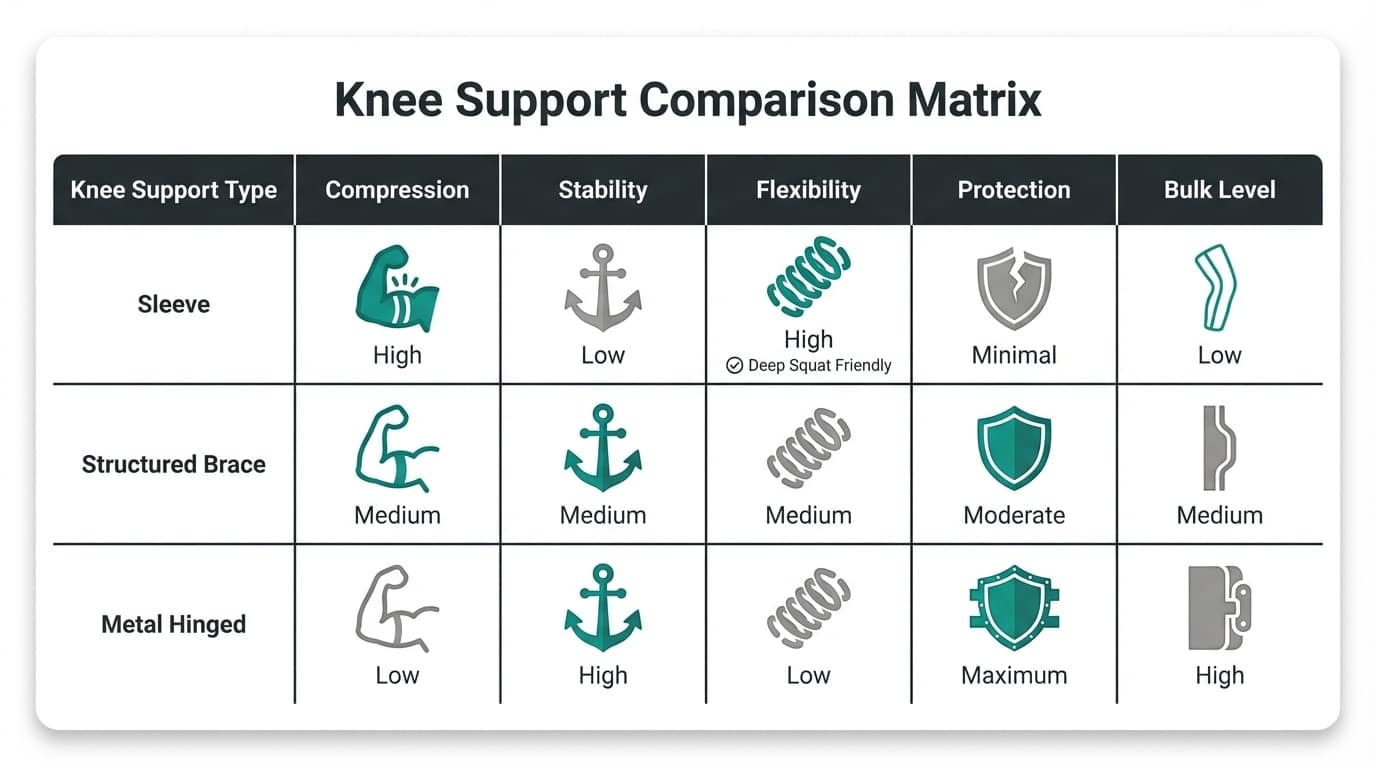
By now, the difference should be clear. Not all knee support is built for the same problem. Some tools manage irritation. Some manage instability. Some try to do both and end up overbuilt for the average gym athlete.
Instead of asking “Do I need a brace?” the better question is “What level of support does my knee actually require?”
Here is a simple breakdown:

Most gym-related knee pain falls into the irritation category. That means warmth, compression, and controlled movement are usually enough.
Metal hinges belong in the instability category. They are built for post-surgical ACL cases or confirmed ligament laxity.
The structured middle ground exists for athletes who need directional stability during heavy training without sacrificing range of motion.
Matching the tool to the demand is what protects long-term performance.
Decision Framework: What Should You Actually Use?
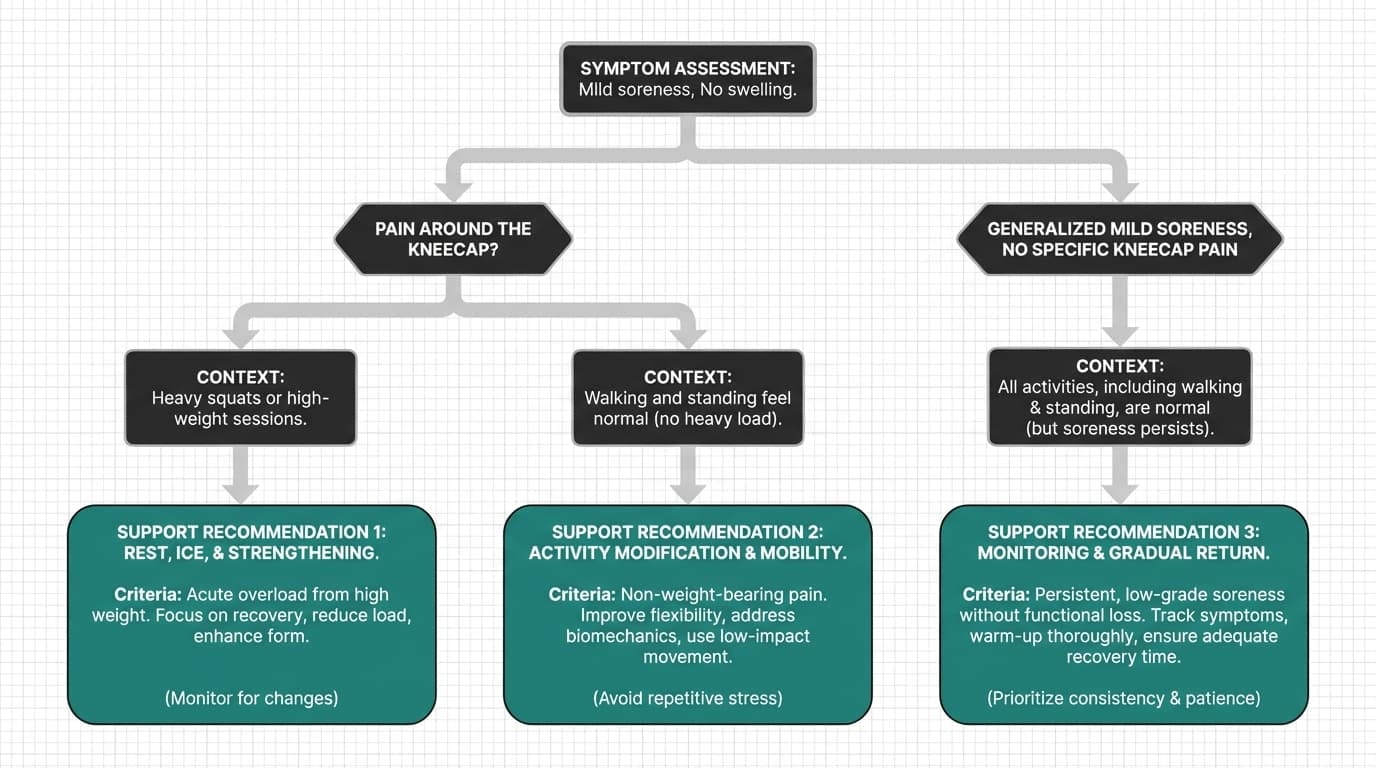
Keep it simple. Match the support to the problem.
No Brace
Use no brace if:
-
Mild soreness
-
No swelling
-
No instability
-
Walking and standing feel normal
-
Pain improves with rest
This is usually training overload. Reduce weight, improve posture, maintain a neutral spine, and allow recovery. Most mild irritation settles with smart adjustments.
Compression Sleeve
Use a sleeve if:
-
Pain around the kneecap
-
Tendon irritation below the kneecap
-
Mild swelling after workouts
-
Discomfort during deep bend, but no giving way
Compression improves circulation, helps reduce swelling, and offers light support without limiting motion.
For many gym athletes, this is enough support while you adjust volume and rebuild strength.
Structured Brace
Use structured support if:
-
Heavy squats or high-weight sessions
-
CrossFit workouts
-
Grappling or wrestling
-
Sports with lateral load and rotation
-
You want more stability without metal hinges
Structured braces sit between sleeves and hinged braces. They provide directional stability while keeping a full range of motion.
For example, the Anaconda Knee Brace wraps under, around, and above the knee for controlled support. It offers an optional side stabilizer for lateral control, gel padding for impact absorption, and a rubberized inseam grip to prevent sliding during deep squats.
It currently holds a 4.9 rating across 3,448 reviews and is used by over 300,000 athletes who train hard. That trust comes from real sessions, not theory.
When Hinges Actually Make Sense
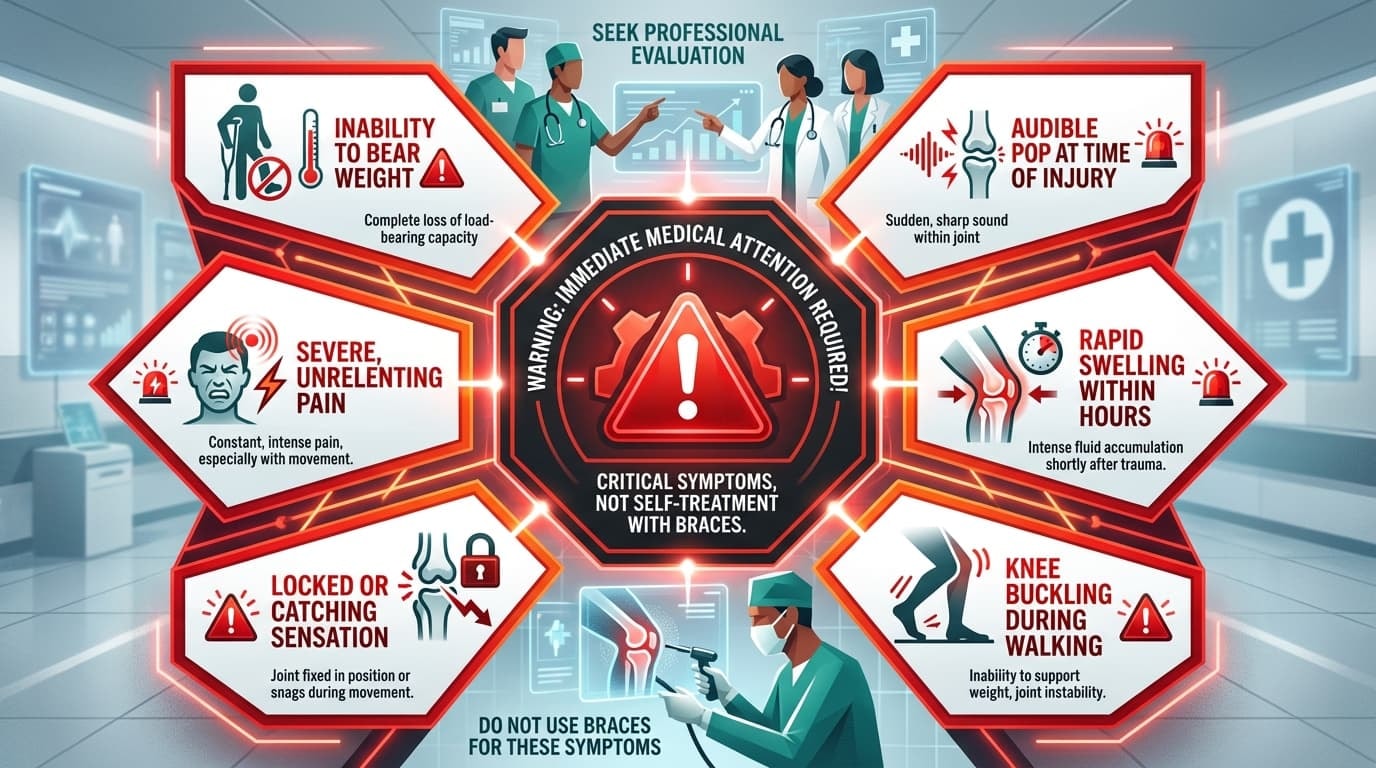
This is where the tone shifts.
Metal hinges are not evil. They are simply specific tools for specific problems. If you are dealing with real structural compromise, a hinged brace may be appropriate under medical guidance.
Pay attention to red flags:
-
An audible pop at the time of injury
-
Rapid swelling within hours
-
Knee buckling during walking
-
Inability to fully straighten the knee
-
A locked or catching sensation
-
A recent post-operative timeline after ACL or MCL surgery
These signs suggest possible ligament damage, meniscus injury, or structural instability. In these cases, imaging and professional evaluation matter more than online shopping.
If your knee gives way while walking or standing, that is not simple irritation. That is instability. Hinges are designed to control that instability and protect healing tissue during recovery.
When surgery is involved, bracing decisions should follow your surgeon’s protocol. Hinges are often prescribed during return-to-sport phases, when protecting reconstructed ligaments is critical.
Using a hinged brace for confirmed instability is responsible. Using it for mild gym soreness is unnecessary.
Rehab Over Hardware
No brace replaces strength.
Most gym knee pain improves with:
-
Load management
-
Volume reduction
-
Gradual strength progression
-
Quad and glute strengthening
-
Controlled return to full range
If swelling increases, reduce intensity. If walking improves and pain decreases, you are progressing correctly.
Strong thigh and hip muscles provide real stability. Clean movement, neutral spine, and proper posture reduce unnecessary pressure on the joint.
Even though Anaconda designs are supported by professional athletes, the foundation remains the same. Support enhances training. It does not replace recovery.
Use braces when needed. Build strength always.
Common Mistakes With Knee Braces
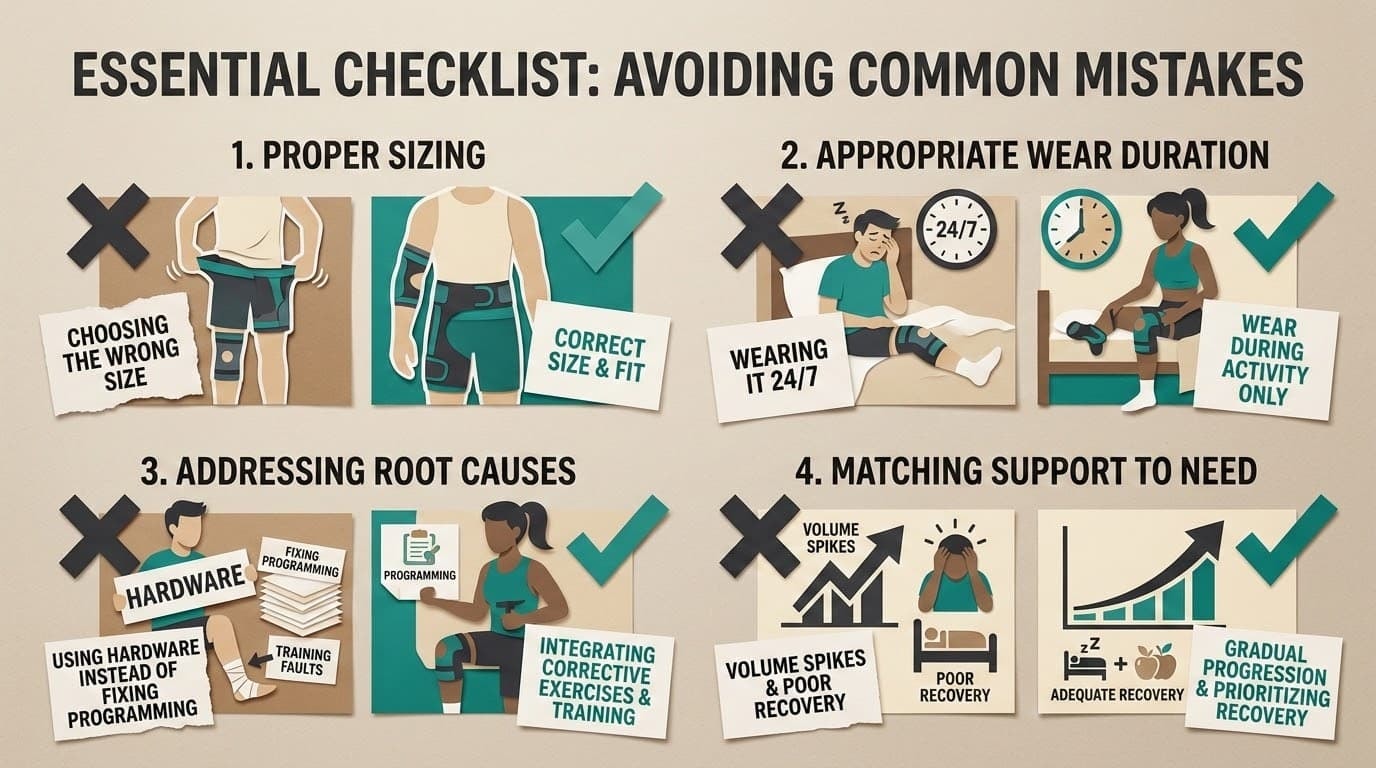
Most brace problems are not about the brace itself. They are about how and why it is used.
Choosing the Wrong Size
Too tight creates excessive pressure, skin irritation, and discomfort.
Too loose leads to slipping, poor support, and frustration.
Proper fit matters. A brace should feel secure without cutting off circulation or limiting natural movement.
Wearing It 24/7
A brace is not meant to be worn all day at work, during sleep, and through every activity unless medically directed.
Constant wear can reduce muscle activation and create dependency. Your body needs to stabilize itself during normal walking and standing.
Using Hardware Instead of Fixing Programming
If your pain comes from volume spikes, poor recovery, or technique breakdown, a brace will not fix that.
Unbalanced programming, weak hip and thigh muscles, and poor posture create unnecessary joint stress. Correct the training load first. Adjust exercises. Improve movement quality.
Choosing Hinges When You Need Controlled Stability
Sometimes the issue is not true instability. It is an uncontrolled movement under load.
If your knee collapses inward during squats, that is a hip control problem. If deep bend causes discomfort without buckling, that is irritation.
In those cases, rigid hinges may restrict motion without solving the root cause.
The difference matters.
-
Hinges protect unstable knees.
-
Structured support assists heavy training.
-
Compression manages mild swelling and discomfort.
The goal is always the same. Protect the knee without unnecessarily limiting performance.
Support should match the injury. Not the fear.
Final Thoughts
Most gym knee pain is irritation, not structural failure. That means better programming, smarter load management, and stronger muscles will usually do more than bolting metal to your leg. Hinged braces are appropriate after surgery or in cases of confirmed ligament instability, but they are not the default answer for everyday lifting discomfort.
The real goal is stability without sacrificing movement. Strong quads and glutes, along with a controlled technique, protect your knee long term. Support should enhance that process, not replace it.
For athletes who train hard and want structured stability without bulky hinges, the Anaconda Knee Brace offers compression, directional support, optional stabilizers, and a no-slip design trusted by over 300,000 athletes.
Choose the level of support your knee actually needs and keep building strength that lasts.
FAQs
Still unsure which option fits your situation? These quick answers cover the most common questions lifters have about knee braces, sleeves, and when hinges actually make sense.
Do metal-hinged knee braces help my knee heal faster from a gym strain?
Hinged braces do not speed up biological healing of tendons, ligaments, or cartilage. They mainly limit certain movements and provide stability when structures are compromised. For mild gym strains and overuse injuries, healing speed is driven by smart load management, adequate rest and sleep, and progressive rehab exercises rather than metal sidebars. A soft compression sleeve may aid comfort and swelling control, but the main “medicine” is appropriately dosed training and recovery.
Can wearing a metal-hinged brace in the gym weaken my knee over time?
Short-term use under medical direction is unlikely to cause weakness. However, long-term, unnecessary reliance can reduce confidence in moving without it. If the brace leads you to avoid challenging your muscles through normal ranges, you miss out on strength adaptations your knee needs for resilience. Research suggests that prolonged rigid bracing in stable knees can reduce quad activation and strength over several weeks. Gradually phase out any brace as pain decreases and strength improves.
Is a compression knee sleeve enough support for heavy squats?
For a healthy or mildly irritated knee with no instability, a compression sleeve is usually enough for comfort and joint awareness during heavy squats. Technique, appropriate load progression, and overall programming have a far bigger impact on safety than the difference between a sleeve and a metal-hinged brace. If heavy loads cause true giving-way rather than pain or stiffness, that is a sign to seek evaluation rather than upgrading to hinges.
When should I completely avoid training and see a doctor instead of just buying a brace?
Key warning signs include: sudden large swelling within a few hours of injury, an audible pop at the time of injury, inability to bear weight on the leg, knee locking or catching during movement, or visible deformity. Persistent pain beyond 4–6 weeks despite sensible load reduction and basic rehab also warrants proper assessment. In these situations, self-prescribing any brace is not enough. Imaging and clinical testing may be needed to rule out serious damage to bones, ligaments, or cartilage.
How long should I keep using a knee sleeve or light brace after a gym injury?
For mild overuse injuries, many lifters can reduce dependence on a sleeve within 2–4 weeks as symptoms calm and strength work progresses. Use the brace only for higher-load or higher-volume sessions during this period, not all day at work or at home. Test shorter periods without the brace during low-risk exercises like walking, warm-up sets, or bodyweight movements. If the knee tolerates this well, continue phasing the support out over time until you only reach for it on particularly heavy training days, if at all.


