


A labrum tear can stop your training overnight. One day, you’re pushing hard, and the next, you’re searching for answers about surgery, timelines, and whether your shoulder or hip will ever feel right again.
The uncertainty is the hardest part. At Anaconda, we built our shoulder support range for athletes who refuse to sit on the sidelines. Whether you’re mid-season, post-surgery, or somewhere in between, our gear is designed to move with you through every stage of recovery.
This guide breaks down labrum tear recovery honestly: what the phases demand, when surgery makes sense, and what separates a full return to sport from a frustrating plateau.
Key Takeaways
-
Tear type changes everything. SLAP, Bankart, and posterior tears follow different recovery paths.
-
Two valid routes exist. Both non-surgical and surgical options can lead to a full return to sport.
-
PT completion is the biggest variable. Finishing your full rehab program lifts return-to-sport rates from 53.7% to 78%.
-
Recovery has three phases. Protection (weeks 0 to 6), rebuilding (weeks 6 to 12), and return to sport (week 12 onward).
-
Proprioception is non-negotiable. Rebuilding neuromuscular feedback is what gets athletes back to competing with confidence.
-
You control more than you think. PT attendance, sleep, nutrition, and staying active around the injury all drive your timeline.
What a Labrum Tear Does to Your Joint
To understand why recovery takes time, you first need to understand what the labrum actually does.
The labrum is a ring of fibrocartilage, a type of cartilage that lines the shoulder socket and other joint sockets. The labrum deepens the socket and gives the ball of the joint something to brace against during dynamic movement, and tears can be partial or complete detachment from the bone. Without it, the joint loses a significant amount of stability under load.
In the shoulder, the labrum supports the shoulder joint by surrounding the glenoid, the shallow shoulder socket that the upper arm bone sits in, making this ball and socket joint more stable. In the hip, it lines the acetabulum. Both joints depend on an intact labrum for stability, but they fail in different ways.
Shoulder tears more often come from acute trauma or overhead loading. Hip labral damage tends to build gradually from repetitive stress and shows up as deep groin pain or a catching sensation during rotation.
SLAP, Bankart, and Posterior Tears
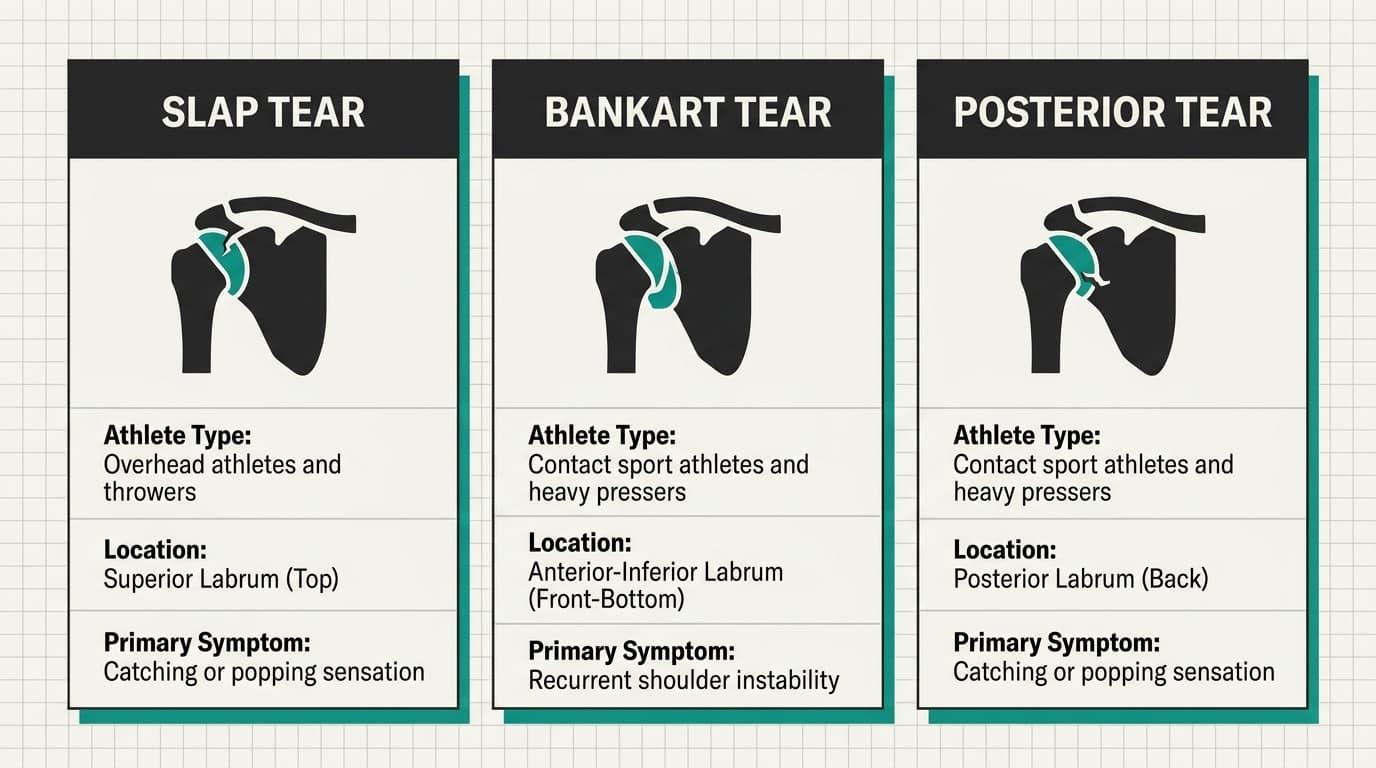
Tear type and location are the two biggest variables in how your recovery unfolds. Here is how the three main shoulder labrum tear types differ:
-
SLAP tear: Also called slap tears, this is a superior labrum anterior-to-posterior injury at the biceps tendon attachment and may extend in the posterior direction. Common in overhead athletes and throwers. Often causes deep shoulder pain with a catching or popping sensation. SLAP lesions are commonly classified into four types based on severity.
-
Bankart tear: Also called bankart tears, this occurs at the front-bottom of the glenoid and often follows an anterior dislocation, driving recurrent shoulder instability and a high re-dislocation risk without intervention.
-
Posterior tear: Affects the labrum in the posterior direction. More common than previously recognized, particularly in contact sport athletes and heavy pressers.
Partial tears often respond well to conservative management.
Full-thickness tears, especially Bankart lesions with recurrent instability, more frequently require surgical repair.
Research on location-specific labral pathology confirms that tear position within the glenoid significantly influences both symptom presentation and treatment outcomes.
Non-Surgical vs. Surgical Treatment
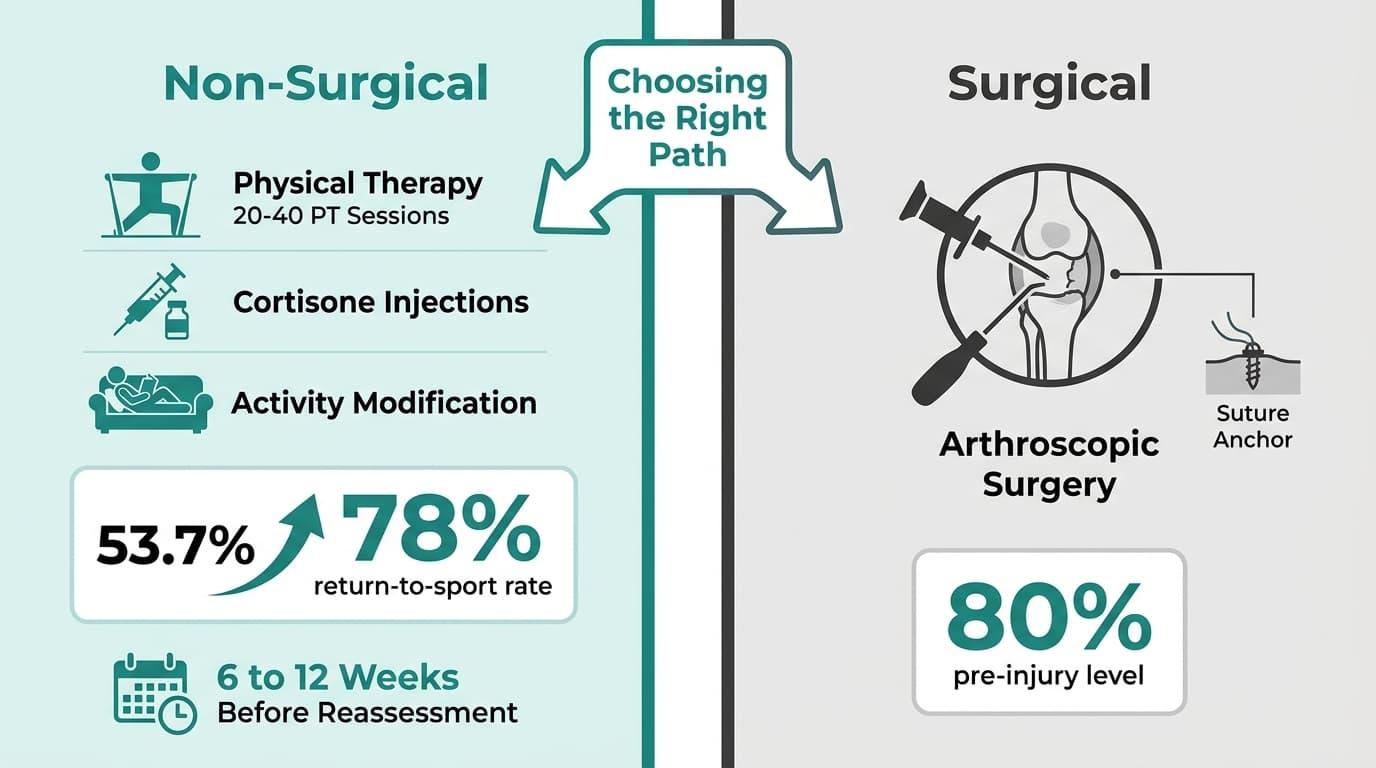
Choosing between conservative care and surgery is rarely straightforward.
The right answer can vary depending on your tear severity, activity demands, and how much instability is affecting daily function, and recovery time may vary based on treatment type and injury severity.
Both paths can lead to full performance, but with shoulder labral tears, conservative care and surgery each work best when the decision is made for the right reasons.
What Non-Surgical Treatment Actually Involves
For most labrum tears, conservative care starts with rest and physical therapy, and early, consistent rehab is essential for recovery. Physical therapy targets rotator cuff strength, scapular control, and range of motion to reduce joint stress and restore functional stability by improving how the rotator cuff tendons and shoulder muscles support the joint around the shoulder blade.
Cortisone injections may be used alongside PT to manage inflammation early on, making it easier to progress in rehab without pain holding you back.
Activity modification matters too. Reducing overhead loading, avoiding provocative movements, and dialing back training volume gives irritated tissue the space it needs to settle, and regular icing plus anti-inflammatory medications such as ibuprofen can help manage swelling and symptoms early on.
Shoulder labral tears may also follow repetitive motion, falls, or age-related fraying, which is more common in older patients.
Non-surgical rehab may involve 20-40 PT sessions in the first 6 months.
For athletes managing shoulder instability during this phase, external joint support can play a useful role. Structured compression that provides proprioceptive feedback helps maintain joint awareness during movement without restricting the range of motion.
Research on operative vs. non-operative outcomes for labral tears shows a 53.7% overall return-to-sport rate with non-surgical treatment.
That number climbs to 78% when rehab is completed in full. The gap comes down to one thing: athletes who see the program through versus those who stop when pain starts to ease.
Conservative care typically runs six to 12 weeks before reassessment. If meaningful improvement hasn’t occurred at that milestone, surgical consultation becomes the appropriate next step.
When Surgery Becomes the Right Call
Not every shoulder labral injury responds to physical therapy. Some unstable or severe tears have structural characteristics that make non-surgical recovery unlikely, and pushing through months of PT without progress only delays the inevitable.
These are the clear escalation triggers for surgical consultation:
-
Persistent shoulder instability after 3 or more months of structured physical therapy
-
Recurrent dislocations from unstable tears, where surgery is required, especially when symptoms do not resolve with conservative care and clinicians may recommend surgery
-
Full-thickness tears in high-demand athletes where labral repair is required for return to sport
-
Failure to regain the functional range of motion despite completing a full rehab program
Arthroscopic surgery is the standard approach. Arthroscopic techniques are preferred for labrum repairs because this minimally invasive approach uses small incisions, letting suture anchors reattach the torn labrum directly to the bone while restoring the structural integrity that the joint depends on. That typically means less pain than open surgery and, for the right candidate, is the most direct path back to full performance. Most patients regain about 80% of their pre injury level after surgery.
The Recovery Timeline: Phase by Phase
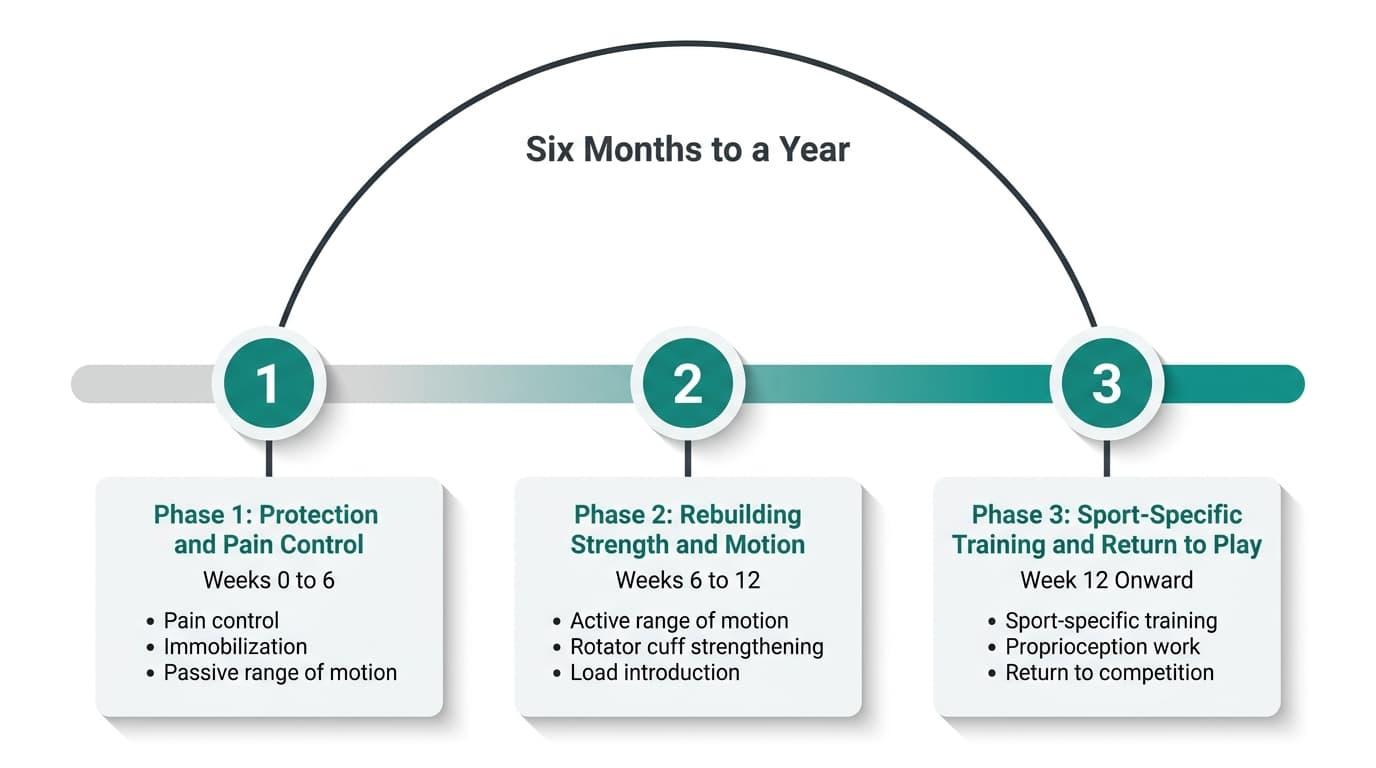
Recovery from a labrum tear is typically a long phased process rather than a straight line, but it does follow a predictable structure.
-
Phase 1 (weeks 0 to 6) focuses on pain control, immobilization, and passive range of motion.
-
Phase 2 (weeks 6 to 12) shifts to active range of motion, rotator cuff strengthening, and load introduction.
-
Phase 3 (week 12 onward) covers sport-specific training, proprioception work, and return to competition, with full recovery often taking six months to a year, especially after surgery.
Phase 1: Protection and Pain Control (Weeks 0 to 6)
For surgical patients, weeks 0-4 focus on controlling pain and protecting the joint while initial healing typically takes four to six weeks. Many patients wear a sling for about four weeks after surgery, though the exact timeline depends on the tear type and surgical complexity. The goal is simple: keep the joint still enough for the labrum to reattach without disruption.
Pain and inflammation management take priority here. Ice, elevation, and pain medication help keep symptoms manageable. Physical therapy during this phase focuses on the gentle passive range of motion only. A therapist moves the joint for you, rather than asking you to drive the movement yourself.
Non-surgical patients skip the sling but still need to respect this window. Jumping into aggressive loading too early is one of the most common reasons conservative rehab fails. Joint protection matters in both surgical and non-surgical recovery, which means avoiding over-stressful activities early on.
Phase 2: Rebuilding Strength and Motion (Weeks 6 to 12)
This is where rehabilitation shifts from protection to progression. Active range of motion exercises replace passive ones, and structured rotator cuff strengthening begins in earnest. Scapular control work, shoulder stability drills, and gradual load introduction form the core of this phase.
Progress is not linear. Some weeks feel like breakthroughs, and others feel flat. That’s completely normal. Consistent PT attendance during this window is what separates athletes who recover fully from those who plateau.
Phase 3: Sport-Specific Training and Return to Play (Weeks 12 Onward)
Sport-specific drills and a gradual return to sport often begin around the 12-week mark, but recovery from labrum surgery can take six months to a year depending on sport demands and how Phase 2 progressed.
Proprioception is the defining element of this phase and one of the most undertreated parts of labrum tear recovery. After a tear, the joint loses neuromuscular feedback, which is the automatic communication between the shoulder and the nervous system that tells your body where the joint is in space.
Proprioceptive training rebuilds that signal through controlled instability drills, reactive exercises, and progressive loading under fatigue.
Without it, athletes often return physically strong but mentally hesitant, and that hesitation creates compensation patterns that lead to re-injury. Return-to-sport guidelines from the American Academy of Orthopedic Surgeons confirm that clearance should be based on functional benchmarks, not time alone. Most patients also report good outcomes, with 80% to 85% reporting satisfactory results after treatment.
What Physical Therapy Actually Looks Like for a Labrum Tear
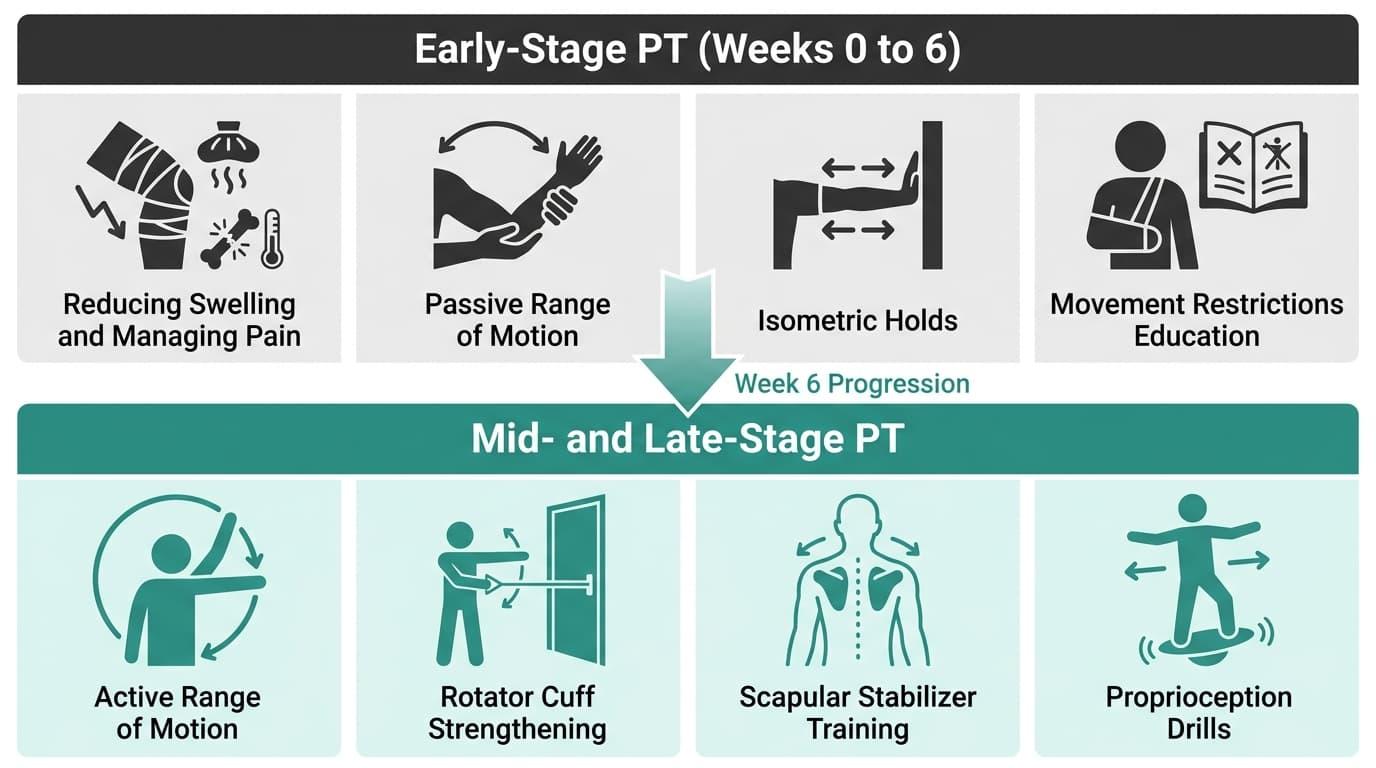
Physical therapy isn’t a single protocol. What happens in your sessions changes significantly depending on where you are in recovery, and understanding that progression helps you stay committed when early sessions feel slow.
Early-Stage PT: Protecting the Repair (Weeks 0 to 6)
The first six weeks are not about building strength. They’re about protecting what was repaired and keeping the joint from stiffening completely.
PT goals during this phase include:
-
Reducing swelling and managing pain through ice, elevation, and gentle manual therapy
-
Maintaining a passive range of motion without stressing the healing labrum
-
Preventing rotator cuff atrophy through isometric holds that do not load the repair
-
Educating the athlete on movement restrictions and positioning during daily activity
A therapist moves the joint for you during this window. That distinction matters because premature active loading is one of the most common reasons early repairs fail.
Mid- and Late-Stage PT: Strength, Stability, and Proprioception
Around week six, the focus shifts as a physical therapist progresses this stage by restoring shoulder strength and motion through more active work. Active range of motion replaces passive work, and rotator cuff strengthening begins alongside scapular stabilizer training.
The goal is to offload stress from the repaired labrum by building the surrounding musculature to absorb force instead, while the arm relearns controlled movement as stability improves.
Late-stage PT introduces proprioception as a distinct training target. Controlled instability drills, reactive exercises, and fatigue-based loading rebuild the neuromuscular signal that the joint lost after the tear. This is what separates athletes who return confident from those who return hesitant.
For hip labrum tears, the emphasis shifts toward hip flexor flexibility, glute activation, and core stability rather than rotator cuff work. The progression logic remains the same.
Factors That Affect How Fast You Recover
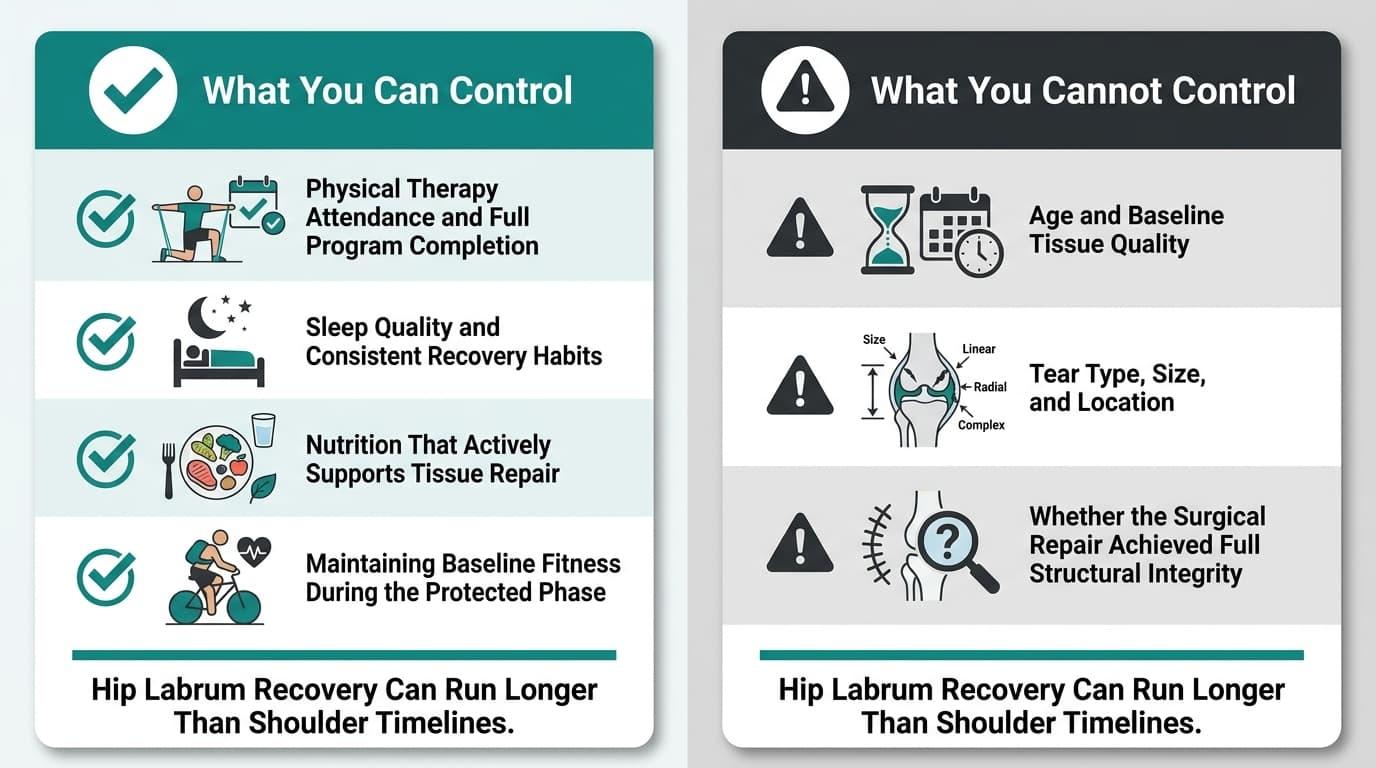
Recovery speed comes down to a mix of things you can control and things you cannot. Knowing the difference helps you focus your energy where it actually moves the needle.
What You Can Control
These are the variables with the biggest impact on your timeline:
-
Physical therapy attendance and full program completion
-
Sleep quality and consistent recovery habits
-
Nutrition that actively supports tissue repair
-
Maintaining baseline fitness and rebuilding compensatory strength and stability during the protected phase
Athletes who maintain conditioning during recovery consistently return to sport faster than those who go fully sedentary. Keeping the body strong around the injury site, rather than simply resting, accelerates the later phases of rehab significantly, especially for baseball players returning to throwing.
What You Cannot Control
Not everything is in your hands, but understanding these factors helps set realistic expectations:
-
Age and baseline tissue quality (older tissue heals more slowly)
-
Tear type, size, and location
-
Whether the surgical repair achieved full structural integrity
Hip labrum recovery can run longer than shoulder timelines because weight-bearing cannot be fully eliminated. That places ongoing demand on healing tissue throughout every day of recovery.
Over 400,000 athletes have come to Anaconda for support during exactly this kind of recovery. The most consistent thing we hear? The hardest part isn’t the injury; it’s the waiting. That’s why we built gear that keeps you moving and supported through every phase of your comeback.
The Bottom Line
A labrum tear is a serious injury, but it’s a recoverable one. Both surgical and non-surgical paths lead athletes back to full performance when the structure is right, and the commitment to physical therapy stays consistent.
The biggest controllable factors are simple: Show up to your sessions, respect the timeline, and don’t cut the program short the moment pain starts to ease. That discipline is what the 78% return-to-play figure is built on.
At Anaconda, we built our shoulder support range for athletes who refuse to wait out recovery from the couch. If you’re navigating shoulder or hip labrum rehab and want support that moves with you, our braces are designed to stabilize without immobilizing, so you can train, recover, and come back stronger.
Frequently Asked Questions
Dealing with a torn labrum or wondering what recovery looks like? Here are quick answers to the most common questions athletes ask about labral tears, treatment options, and returning to activity.
Will a torn labrum heal on its own?
Some minor or partial labral tears may improve with physical therapy, activity modification, and proper shoulder strengthening. However, larger tears or those causing repeated instability are less likely to heal completely on their own. The labrum has a limited blood supply, which slows its natural healing ability. A healthcare professional can help determine whether conservative treatment is appropriate.
What should you avoid with a torn labrum?
You should avoid activities that place excessive stress on the shoulder, especially overhead lifting, throwing, and explosive rotational movements. These motions can worsen symptoms and increase instability. Returning to sports or heavy training too soon is another common mistake. Following your rehabilitation plan is important even after pain starts to improve.
Is surgery worth it for a labral tear?
For athletes with ongoing instability, repeated dislocations, or significant tears, surgery is often recommended for a torn shoulder labrum when instability persists, especially after dislocations or failed rehab, and unstable tears may require shoulder labral tear surgery or labral repair surgery rather than continued conservative care. Many people successfully return to sports and training after surgical repair and rehabilitation. However, not every labral tear requires surgery. The decision depends on the severity of the tear, lifestyle demands, and response to physical therapy.
How long does labrum surgery take?
Labrum surgery typically takes between one and three hours, depending on the extent of the injury and the type of repair required. Most procedures are performed arthroscopically through small incisions. In many cases, patients can return home on the same day as surgery. Recovery time, however, extends well beyond the procedure itself.
How painful is a torn labrum?
A torn labrum can cause anything from mild discomfort to significant pain, depending on the severity of the injury. Many people experience pain deep in the front of the shoulder near the biceps area, especially with certain tear patterns, along with deep shoulder aches, clicking, catching sensations, or pain during specific movements. Some athletes notice instability more than pain, especially during overhead activities. Symptoms of shoulder injuries can differ by tear type, and baseball pitchers are at particularly high risk for SLAP tears. Symptoms often become more noticeable during lifting, throwing, or rotational movements.


