


Post-run knee pain occurs because the cessation of movement causes blood flow to drop and inflammatory molecules to pool in micro-stressed soft tissues.
For 70% of long-distance runners, this delayed throbbing indicates irritated structures—like the patellar tendon or iliotibial band—rather than structural joint damage.
That familiar throb, the stiff shuffle to the kitchen, the moment you regret not taking the elevator. Knee pain after running affects nearly 70% of long-distance runners at some point. You are not alone, and you are not falling apart.
Our founder, Luke, tore his ACL and MCL on the mats in Thailand and went from winning medals to needing help just to stand. That injury is the reason the Anaconda Knee Brace exists. We build recovery gear for athletes who refuse to sit on the sidelines.
“I took my own joints for granted for years. Trained hard, skipped recovery, figured my body would sort itself out. It didn't. My knee blew out in Thailand and that was the wake-up call that started Anaconda.
Every athlete deals with injuries at some point, some big and some small, but we believe you can always overcome them with the right mindset and approach. Our products are built to support your recovery and prevent setbacks, so you can keep pushing your limits and enjoying the sport you’re passionate about.”
-
Luke, Founder of Anaconda
In this article, you will learn:
-
Why does knee pain show up after the run, not during it
-
How to read the location of your pain like a diagnostic map
-
A three-color triage system: push through or pull back
-
Immediate steps to calm the inflammation tonight
-
Long-term habits that prevent knee pain and build more durable knees
Here is what your knee is telling you, and what to do about it tonight.
Key Takeaways
-
Most post-run knee pain is irritated but intact tissue. Your knees are not breaking down.
-
Where it hurts is your fastest clue. Front, outer, below the kneecap, and inner knee: each location points to a different place.
-
Training errors cause most cases. Sudden mileage jumps, weak hips, and poor running form beat out age and genetics every time.
-
A dull pain that clears in 24 hours is manageable. Sharp pain, swelling, or locking are red flags.
-
Short strengthening exercises, performed four to five times a week, reduce the risk of lower limb injury by 25% across a full season.
Why Your Knee Starts Hurting After a Run (Not During)
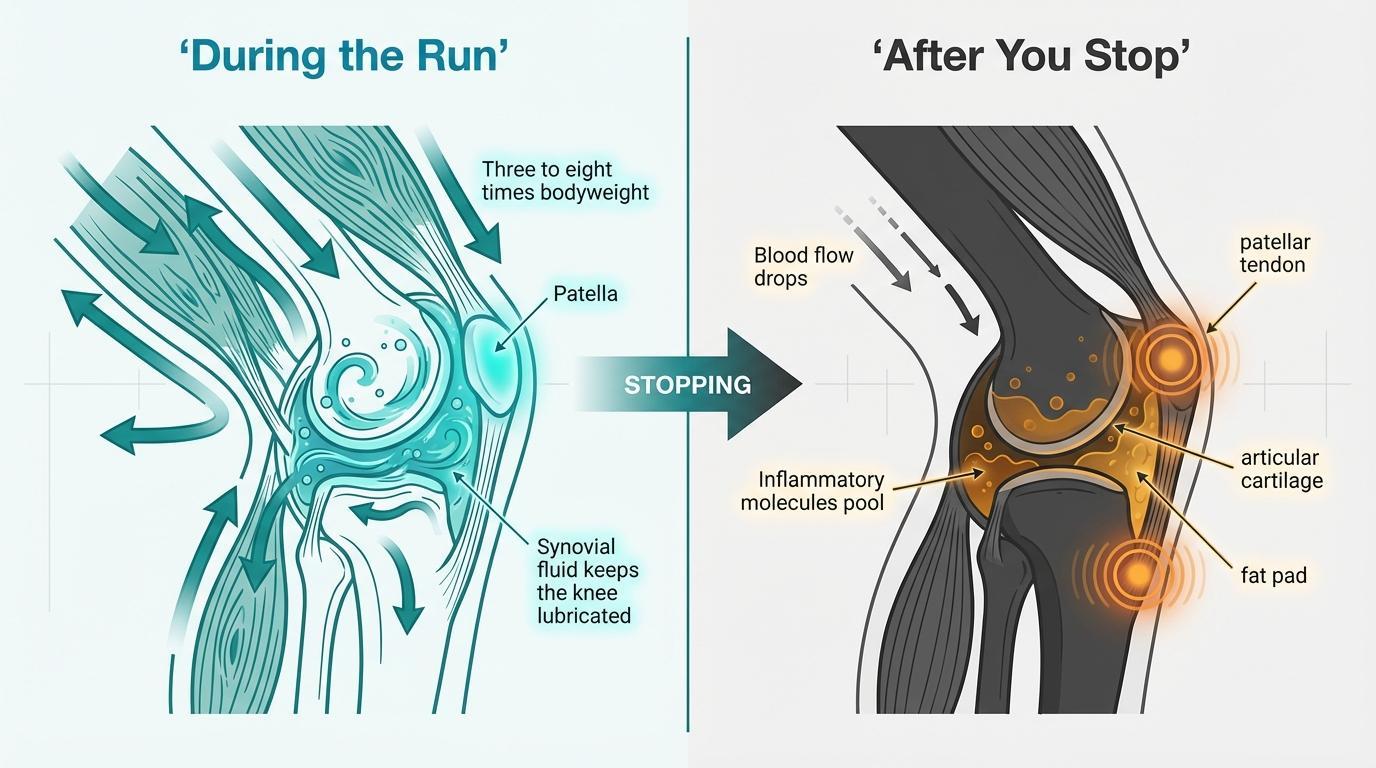
Knee pain frequently manifests after a run rather than during it due to a sudden drop in joint lubrication and blood flow upon stopping.
While in motion, synovial fluid actively lubricates the knee joint and surrounding musculature absorbs up to eight times your body weight per stride.
Once running ceases, the protective muscle engagement stops, allowing inflammatory molecules generated by tissue micro-trauma to pool, resulting in delayed stiffness and throbbing.
While you are moving, your body acts as a buffer for the knee joint. Synovial fluid keeps the knee lubricated, blood flow stays high, and your muscles absorb the three to eight times your bodyweight hammering through with every stride. Your body handles this repetitive stress brilliantly while you are in motion.
Then you stop.
Blood flow drops. Inflammatory molecules that were being flushed out start to pool. The muscles that were doing all the protective work clock out. That is when the aching pain and stiffness finally arrive.
Here is the important reframe: in most cases, this is not structural damage. It is your body's soft tissues that got pushed past their comfortable load. The patellar tendon, the articular cartilage, the fat pad behind the kneecap: stressed, not broken.
Sore knees after one hard run? That is a signal. Does the same pain come on earlier and get louder with every run? That points toward more severe injuries in the making. Pay attention to the pattern.
What Does the Location of Your Knee Pain Indicate?
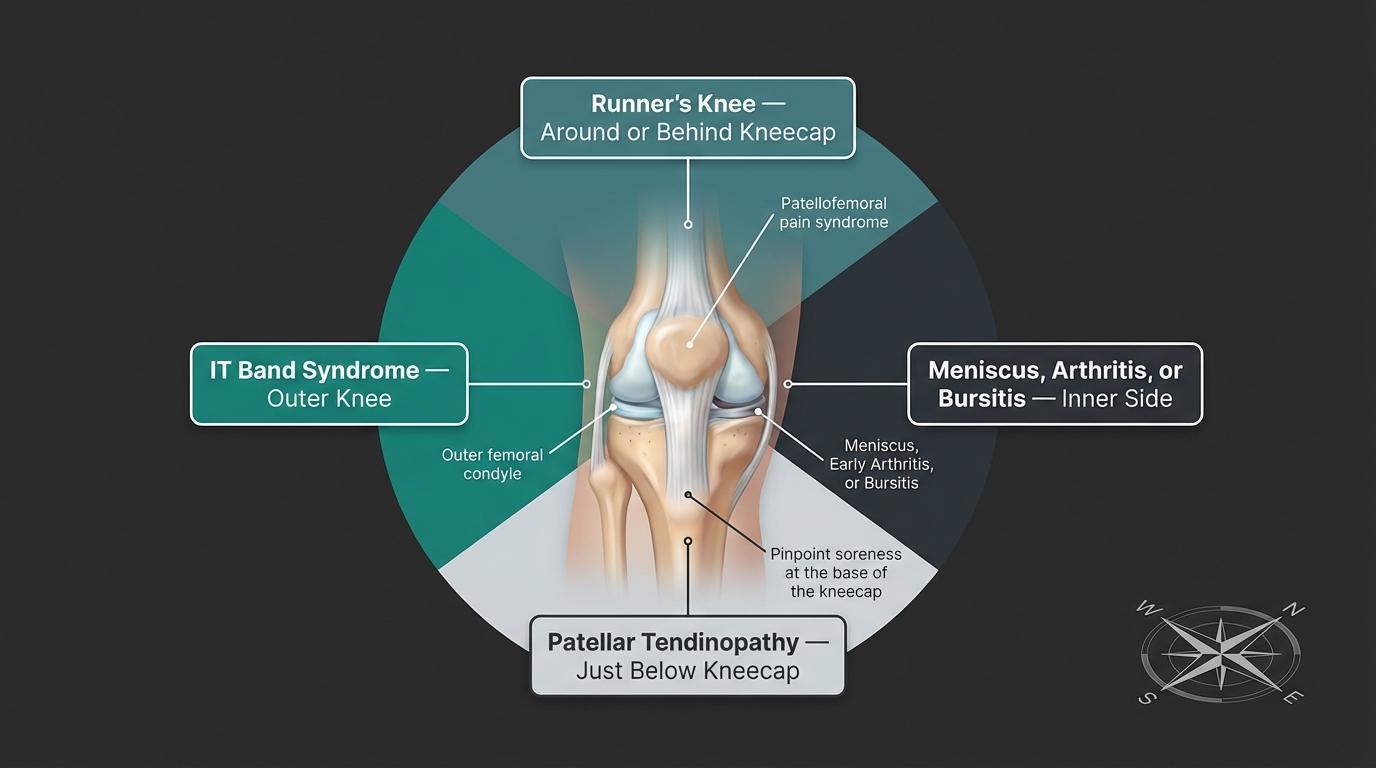
Before you spiral into a search engine rabbit hole, try this first.
The location of your knee pain is a surprisingly accurate diagnostic shortcut. Front, outer, below the kneecap, inner knee: each zone has a signature. Once you know how to read the map, you can stop guessing.
Pain Around or Behind the Kneecap: Runner's Knee
This is the most common knee complaint in runners, full stop.
Patellofemoral pain syndrome (sometimes called chondromalacia patella) produces a dull pain around or behind the kneecap. It flares after running, on stairs, and after long periods of sitting with knees bent. Runners know it as the moviegoer's sign: you sit through a film, you stand up, and your knee has completely stiffened.
The root cause is almost never a worn-out joint. It is a tracking problem in the femoral groove. Muscle imbalances around the hip and quad, combined with tight muscles in the surrounding area, cause the kneecap to grind instead of glide.
If pain eases with light walking or cycling, and you can lower yourself into a chair without kneecap swelling or sharp pain, this is a manage-and-monitor situation. Not a stop-everything emergency.
Pain on the Outer Side of the Knee: IT Band Syndrome
A sharp, burning sensation on the outer knee that builds the longer you run and lights up on downhills? That is your iliotibial band.
IT band syndrome happens when the band passes over the thigh bone just above the outer knee. The shin bone absorbs the downstream effect. When the band becomes overloaded, it compresses against the outer femoral condyle, triggering significant inflammation. This is almost always tied to sudden spikes in training volume.
First moves: reduce volume, add hip strengthening, respect downhills. Foam rolling the glute and hip (not the band itself, a common mistake) helps address the weak muscles driving the problem. If pain is arriving earlier with each run, take a full break before coming back.
Pain Just Below the Kneecap: Patellar Tendinopathy
Pinpoint soreness at the base of the kneecap. This is patellar tendonitis, also known as jumper's knee.
Patellar tendonitis occurs when the tendon connecting the kneecap to the shin bone absorbs more mechanical load than its cellular repair rate can handle.
This structural overload is most commonly triggered when runners introduce high-impact variables—specifically track speedwork or downhill repeats—before the tendon matrix has adapted.
Recognizing this specific localized pain allows runners to halt speedwork before the tendon undergoes chronic, degenerative changes.
Patellar tendinopathy often warms up mid-run and feels asymptomatic, but the inflammation returns with increased severity 1-2 hours after the workout concludes.
Eccentric loading exercises are the best-researched fix, paired with temporarily shifting to softer surfaces. Mild cases resolve in weeks. Chronic ones take longer. Catch it early.
Sudden warmth, visible swelling, or a popping sensation? That is not normal tendinopathy behavior. Get it checked.
Pain on the Inner Side or Deep Aching Stiffness: Meniscus, Early Arthritis, or Bursitis
Medial knee pain, catching sensations, deep aching stiffness that lingers long after you stop: these point to the meniscus, articular cartilage, or the bursae.
Pes anserine bursitis is one of the most commonly missed diagnoses in runners. Prior knee injuries are among the strongest other risk factors for damaged cartilage and early arthritis down the line.
True locking, repeated giving way, visible swelling that fills the knee, or pain waking you at night: these are stop-and-get-evaluated situations. Depending on severity, the path may involve imaging and potentially minimally invasive surgery. Do not push through these symptoms.
Is My Knee Pain Safe to Run Through? A Simple Self-Triage Framework
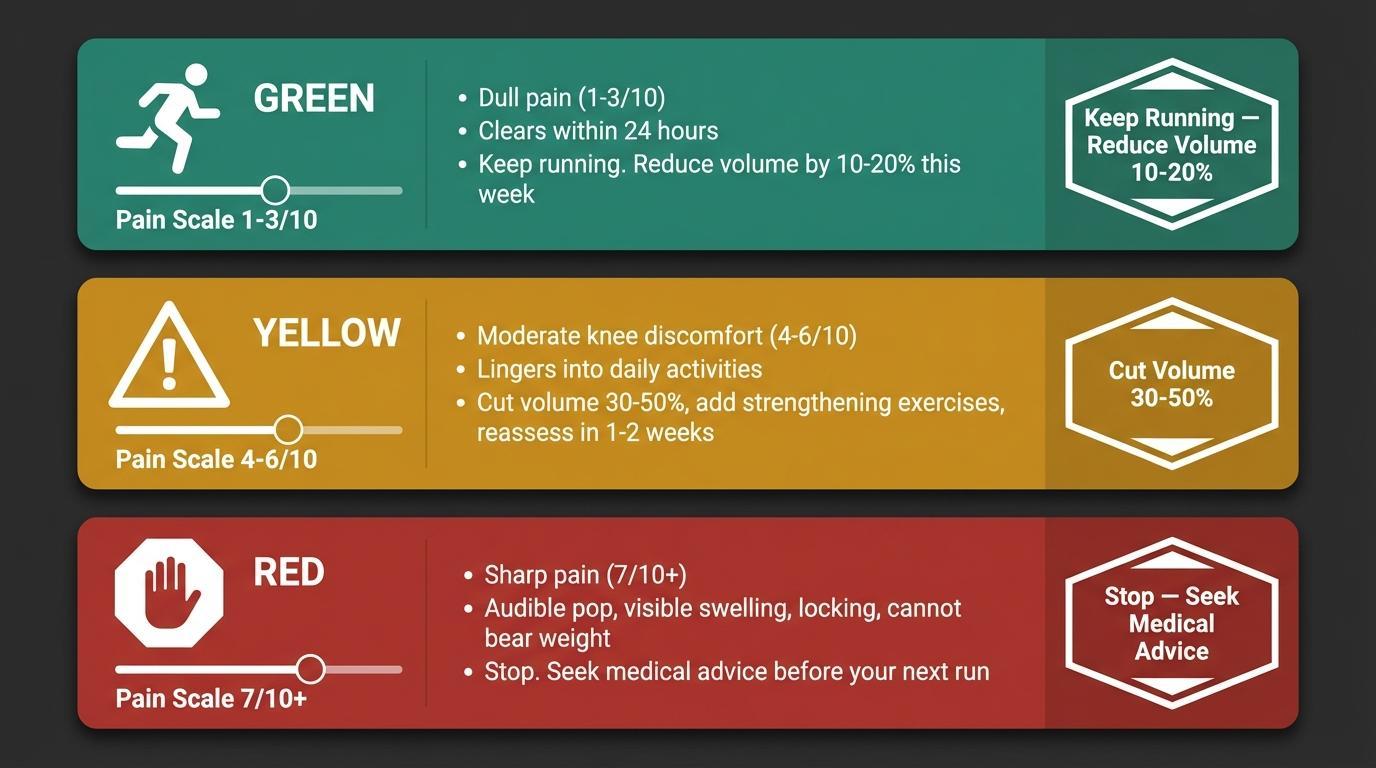
Most runners live in one of two modes: ignore everything until it becomes a limp, or catastrophize a minor twinge into a six-week break.
Neither works. Here is a cleaner system.

Most runners land in green or yellow. Red flags pointing to serious running or knee injuries are less common, but when they do, they are not negotiable.
The Main Culprits: Common Causes of Knee Pain After Running
Now you know where the pain is. Here is what is actually behind each condition and what to do about it.
Patellofemoral Pain Syndrome (Runner's Knee)
PFPS is the most misunderstood entry on this list. MRI scans and X-rays frequently show no structural joint damage, even when the runner experiences debilitating patellofemoral pain.
Hip and quad strengthening through physical therapy is the first-line treatment. Your physical therapist will typically build a six to twelve-week treatment plan around hip and quad work. It is one of the most responsive conditions to structured rehab when caught before it becomes chronic.
Iliotibial Band Syndrome
IT band syndrome has a reputation for being stubborn. But it responds well when you address the actual problem: hip weakness and volume overload.
Short-term load reduction, targeted glute and hip work, and a gradual return to mileage over 4 to 8 weeks clear most cases. One common mistake: foam rolling the band itself. Focus on the hip and glute instead. If IT band issues keep recurring, a running form assessment is worth the investment.
Patellar Tendinopathy (Patellar Tendonitis)
Jumper's knee responds well to a deliberate, patient approach.
Reduce high-impact load, add a structured eccentric-strengthening program, and temporarily shift to softer surfaces to reduce pain. Mild cases resolve in weeks. Chronic tendinopathy can drag on for months. The runners who recover fastest stop trying to train through it.
Meniscus Irritation or Tears
Minor irritation settles with managed rest and load reduction.
Mechanical symptoms, such as true locking or giving way, may indicate damaged cartilage. That conversation may include imaging and possibly minimally invasive surgery. Do not push through these.
Early Osteoarthritis and Cartilage Wear
Running does not cause arthritis. Recreational marathoners show lower arthritis prevalence than sedentary populations.
Prior ligament trauma and high-impact occupational loading are the real risk factors here, not your weekly kilometres. Runners with mild OA can continue with sensible programming. Frequent flares or worsening articular cartilage changes mean it is time to speak to a sports medicine specialist.
The Hidden Drivers: Training and Technique Mistakes That Make Knees Angry
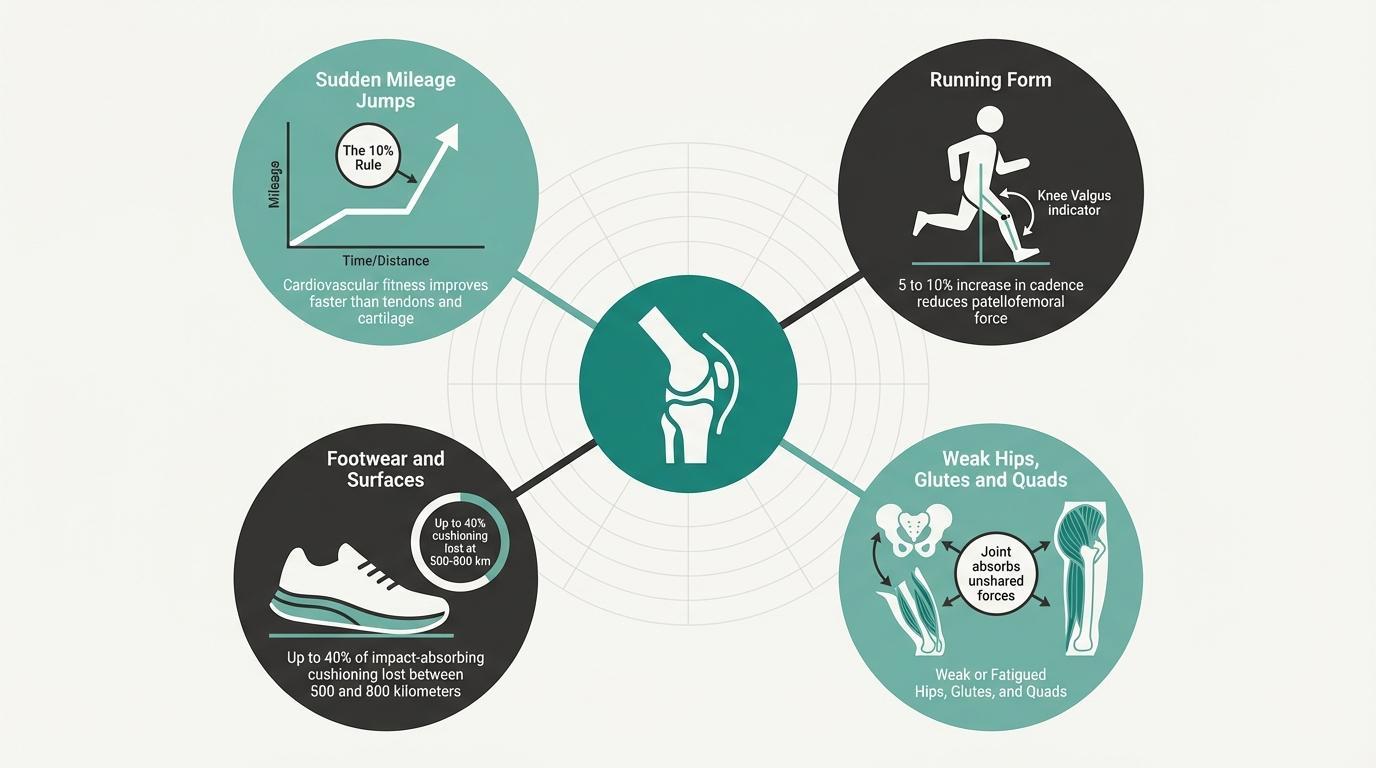
In most cases, the injury was not bad luck. It was a pattern. Something quietly accumulating stress until it crossed a line. Here is where to look.
Sudden Mileage Jumps
Cardiovascular fitness improves faster than tendons and cartilage. That gap is exactly where overuse injuries and repetitive stress conditions are born.
The 10% rule is a useful guideline, not a law. But violating it week after week increases your risk of everything from IT band syndrome to stress fractures. Tissue needs time to adapt. Give it that time.
Running Form That Loads the Knee Heavily
Overstriding means your foot hits the ground far ahead of your centre of mass. It is the mechanical equivalent of braking with every step while driving force up through your knee. Heavy heel striking and knee valgus, the knees caving inward, do the same damage.
Research on cadence and joint loading consistently shows that increasing step rate by just 5 to 10% measurably reduces patellofemoral force. Correcting muscle imbalances in the hip is what makes that cadence change stick.
Weak or Fatigued Hips, Glutes, and Quads
This is the big one.
Weak glutes, hips, and calf muscles force the knee joint to absorb forces it was never designed to handle on its own. When the muscles surrounding the knee fatigue during a long run, the joint compensates.
Single-leg squats, clamshells, step-downs, and Romanian deadlifts are the most targeted strengthening exercises for this pattern. They reduce strain on the joint by rebuilding the surrounding support structure. Not glamorous. They work.
Footwear and Surfaces
Because standard EVA foam running shoes lose up to 40% of their impact-absorbing cushioning between 500 and 800 kilometers, running on high-density surfaces like concrete directly transfers excess ground reaction forces into the knee joint.
Wearing proper running shoes matched to your gait mechanics is one of the most underrated ways to keep your knees healthy. Quality running shoes suited to your mechanics matter most when weekly volume is high. During your biggest training weeks, softer surfaces are your knees' best friend.
What You Can Do Tonight: Immediate Care That Doesn’t Derail Your Training
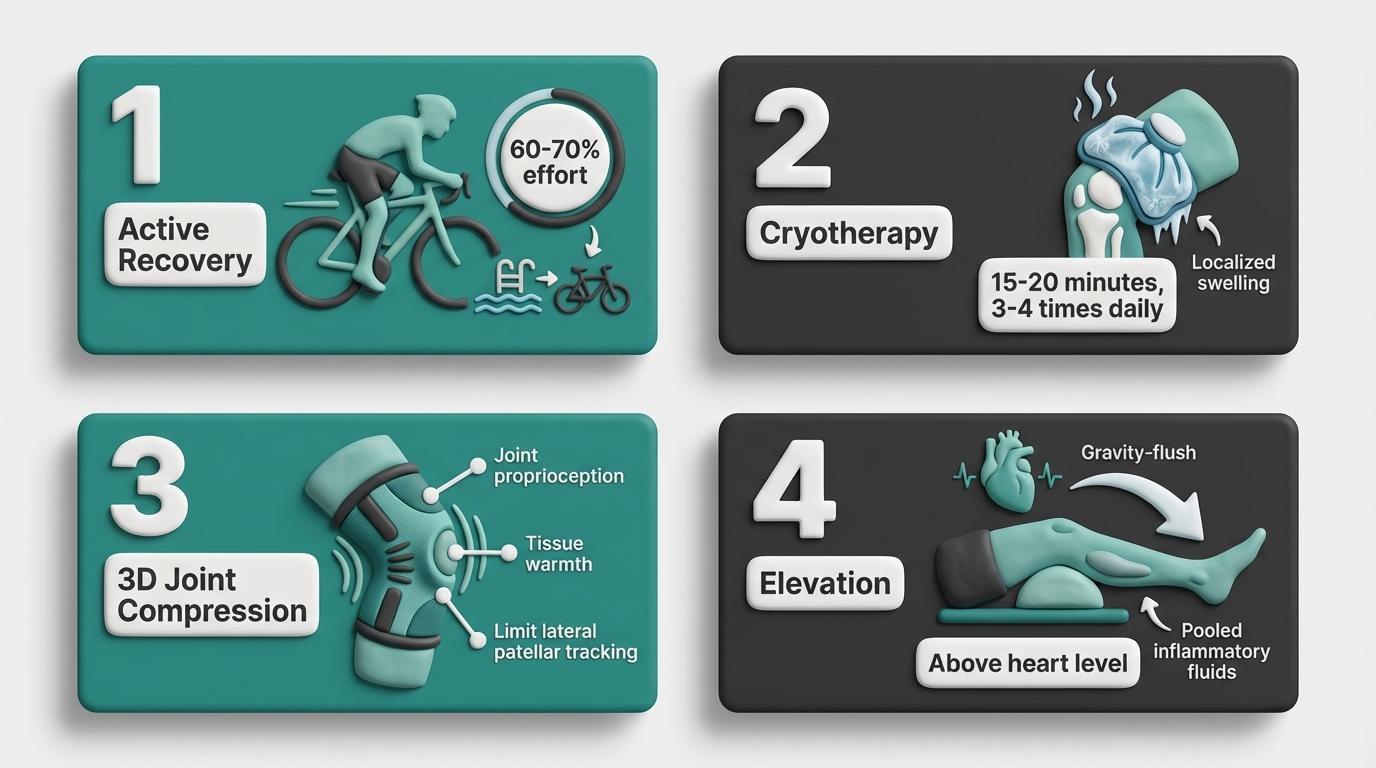
You want to train tomorrow. That goal is reasonable. Here is how to use the next 24 to 72 hours without losing ground.
-
Active Recovery (Relative Rest): Replacing high-impact running with low-impact cycling or pool running at 60-70% effort to maintain cardiovascular fitness without reloading aggravated knee tissues.
-
Cryotherapy (Ice Application): Applying ice for 15-20 minutes, 3-4 times daily, to constrict blood vessels and artificially reduce localized swelling in the affected joint.
-
3D Joint Compression: Utilizing a structured knee brace (like the Anaconda Knee Brace) to improve joint proprioception, maintain tissue warmth, and physically limit excessive lateral patellar tracking.
-
Elevation: Elevating the knee above heart level to leverage gravity in flushing pooled inflammatory fluids out of the lower extremity
In terms of compression, the Anaconda Shoulder Brace is a good example of how we think about support gear.
It uses 3D compression to hold the joint in optimal alignment without restricting natural movement. Gel padding absorbs direct impact during activity. A secure strap system keeps everything in place through a full training session, providing adequate support even at peak effort.
Designed for athletes still moving, not sitting in recovery mode. You put it on and get back to work. Trusted by over 400,000 athletes across martial arts, functional fitness, and endurance sports.
Build a Knee That Can Handle the Miles: Long-Term Strategies
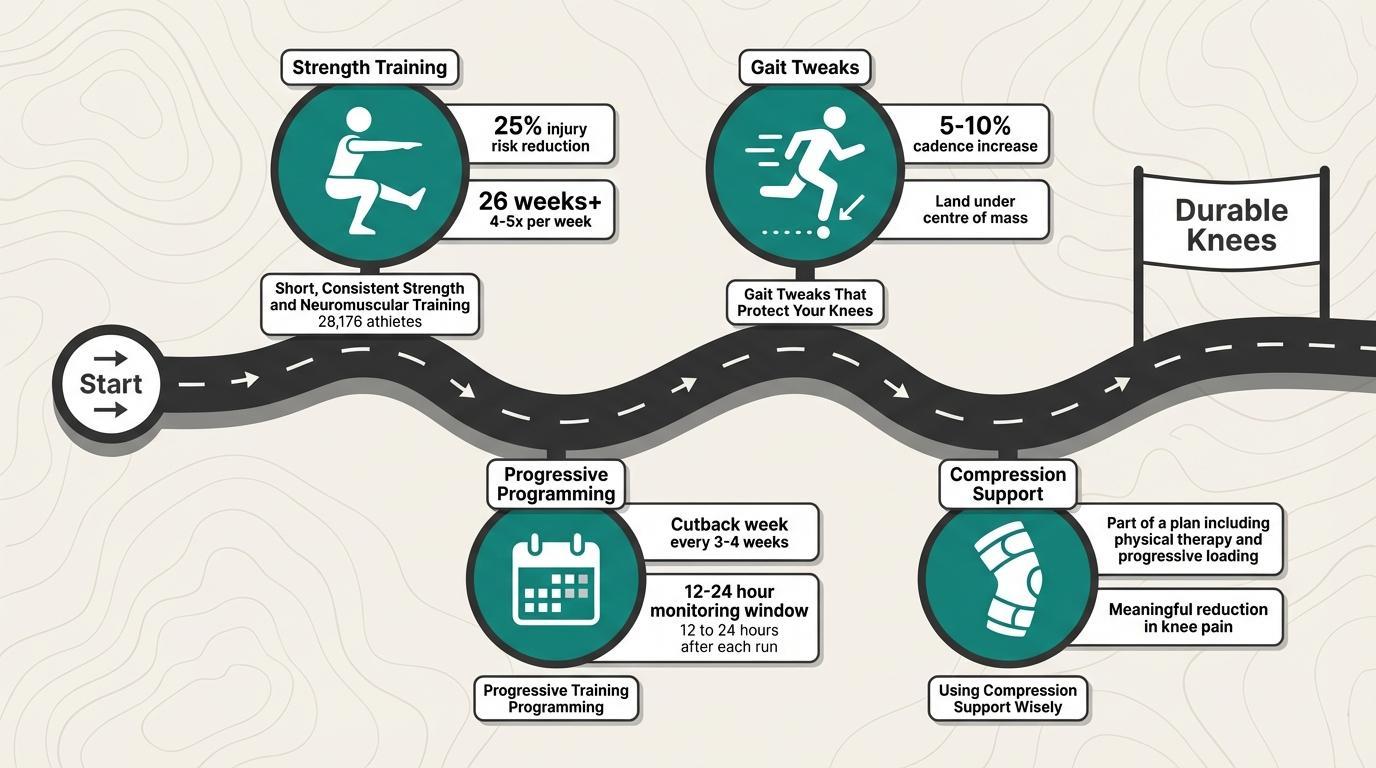
Getting through tonight is one problem. Building a knee that does not keep becoming a problem is a different one entirely.
Short, Consistent Strength and Neuromuscular Training
Five to fifteen focused minutes, four to five times a week.
Targeted exercises like lunges, step-downs, clamshells, and single-leg squats form the foundation. Nothing complicated.
A meta-analysis of 28,176 athletes found that these short sessions reduced the risk of lower limb injury by 25% when maintained for 26 weeks or more. This is the most evidence-based way to prevent knee pain and keep knees healthy in the long term. Consistency is the multiplier.
Progressive Training Programming
Volume up modestly most weeks. Cutback week every third or fourth week. Avoid long periods of sustained high load without built-in recovery. Add one new stressor at a time: speed, hills, or volume, never all three at once.
Track how your knees feel 12 to 24 hours after each run. That window is your early warning system before annoyance becomes a running injury.
Gait Tweaks That Protect Your Knees
Even experienced runners benefit from gait checkups. A 5 to 10% increase in cadence on easy runs reduces patellofemoral load without slowing you down meaningfully.
Land under your centre of mass so your foot hits directly below your hips rather than ahead of them. Keep your knees tracking over your second and third toes rather than caving inward. Introduce any changes gradually on easy runs, not hard ones.
Using Compression Support Wisely
A quality knee brace on higher-stress runs helps many runners manage load and stay confident through the joint.
Research on bracing and patellofemoral pain shows a meaningful reduction in knee pain when bracing is part of a plan that includes physical therapy and progressive loading. Bracing instead of those things does not fix anything.
At Anaconda, every piece in our support range is designed to earn its place in a real training plan. Not just sit on a shelf.
When Should You See a Doctor or Physio About Knee Pain After Running?
Most mild post-run aches respond to smart load management within 1 to 3 weeks. Persistent pain that does not settle with those adjustments is a different story.
The longer you wait, the more time it ultimately costs you.
Seek medical advice immediately if any of the following apply:
-
Sudden trauma with an audible pop and rapid swelling
-
Inability to fully bear weight after your run
-
True locking, where the knee joint will not straighten
-
Repeated giving way or dramatic instability underfoot
-
Pain at 7/10 or above, or persistent pain that suggests more severe injuries forming
A sports medicine physician or physiotherapist will conduct a physical examination, assess your movement patterns and load capacity, and determine whether imaging adds anything useful. Early input means less total time away from running.
Final Thoughts
Knee pain after running is common, manageable, and for most runners, preventable.
Understand what your knee is signaling. Identify the patterns behind it. Give your joints the support they need through hard training. That is the difference between a runner who stays healthy and one who keeps accumulating running injuries.
At Anaconda, we build gear for athletes who want to stay in the game. Everything in our recovery and support range is tested on real athletes doing real training. If your knees need support, we have something worth trying.
FAQs
Quick answers to common questions about knee pain after running.
Is it ever okay to run the day after my knee starts hurting?
Yes, it is okay to run if the knee pain is mild and goes away within 24 hours. Keep the run short, easy, and on flat ground, and monitor how your knee feels. If the pain worsens or affects daily movement, it is better to rest or cross-train.
How long should I back off my training if my knee hurts after every run?
You should reduce your training for about 1–2 weeks if you feel knee pain after running consistently. Cut mileage, avoid hills or speedwork, and focus on recovery and strength. If the pain continues, it is best to seek professional advice.
Does running actually cause arthritis in the knees over time?
No, running does not directly cause arthritis for most people. Research shows that regular runners often have lower rates of arthritis than non-runners. Previous injuries and overall joint health matter more than running itself.
Should I wear a knee brace every time I run if I’ve had knee pain before?
You can wear a brace during longer or more intense runs if it helps reduce knee pain. However, you should not rely on it every time without improving strength and movement. A brace should support your recovery, not replace proper training.
What if my knees only hurt when I run on concrete but not on trails?
If your knees hurt more on concrete, it usually means your joints are sensitive to impact. Hard surfaces place more stress on the knee joint, especially if your shoes are worn out. Running on softer surfaces and using proper footwear can help reduce discomfort.


