


You're injured, but you're not even thinking about stopping training. If this sounds like you, that's not stubbornness; that's the athlete's mindset. A shoulder injury doesn't have to end your training cycle. It does, however, mean you need to think about adjusting your approach, protecting the joint, and making smarter decisions about how you load, move, and recover.
At Anaconda, we built our shoulder support line for athletes who refuse to sit on the sidelines. Whether you're managing a rotator cuff strain, returning from a dislocation, or dealing with ongoing shoulder instability, our braces are designed to keep you moving, not hold you back.
But training through injury only works when you fully comprehend the details. Thats why we put together this guide to help you understand what a shoulder brace actually does, which injuries respond well to braced training, and where the hard limits are.
Key Takeaways
-
A shoulder brace works through compression, proprioception, and joint stabilization, not by healing the injury itself.
-
Injuries like rotator cuff strains, AC joint sprains, and shoulder instability respond well to braced training when managed correctly.
-
Bench press, rows, and cable pulls are generally safe with a brace; overhead loading and high-velocity movements require extra caution or should be avoided.
-
3D knit construction outperforms neoprene for high-intensity sports like BJJ, MMA, and CrossFit.
-
A poor fit creates compensatory movement patterns that can make your injury worse. Fit matters as much as the brace itself.
-
Know the green-light criteria and the red flags before deciding whether to train through it.
What a Shoulder Brace Actually Does When You Train
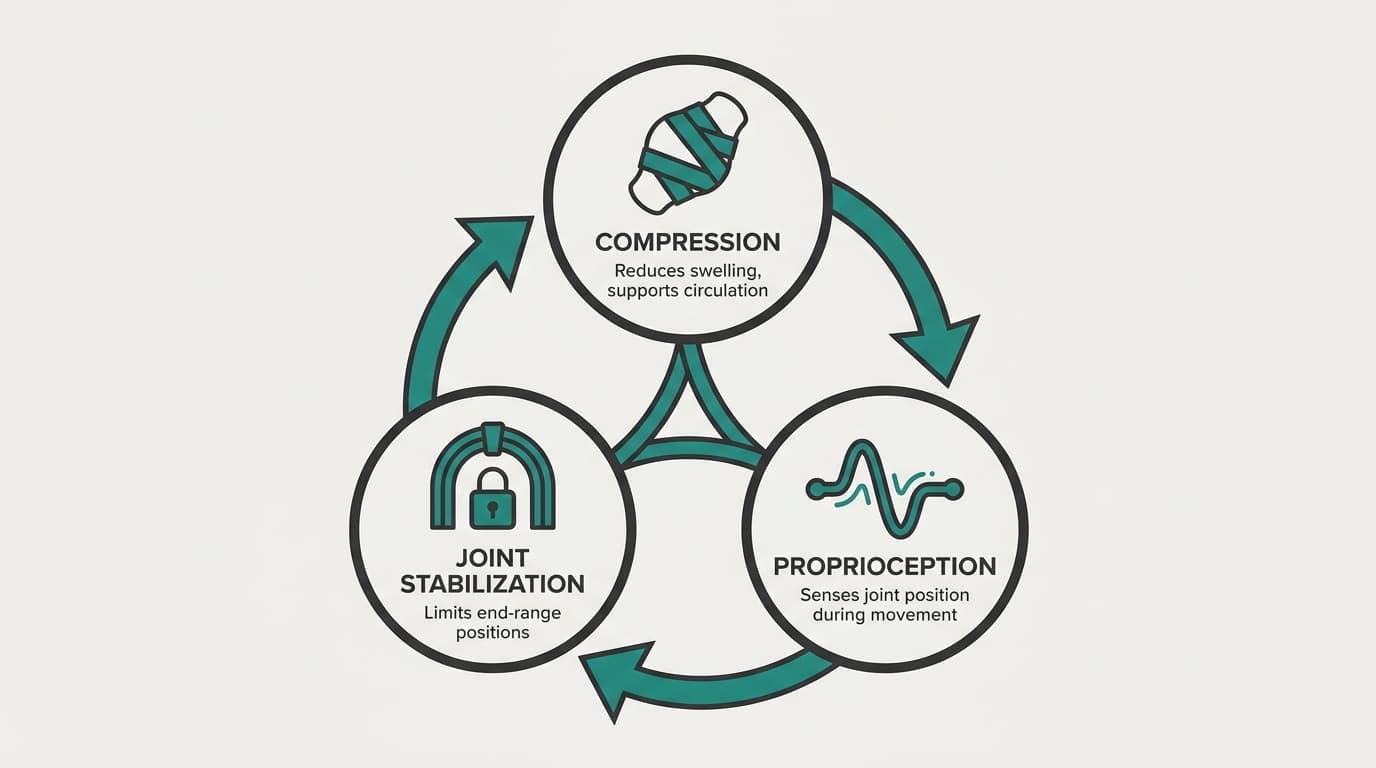
Most athletes grab a shoulder brace for pain relief and leave it at that. But understanding the three mechanisms behind how a brace works is the real key that will change how you use it and how much you get out of it.
Compression Braces
Compression braces apply gentle, consistent circumferential pressure around the shoulder joint to reduce localized swelling, support blood circulation, ease pain, and still allow limited mobility during and after training. That pressure limits fluid accumulation and increases skin receptor feedback, improving your brain’s awareness of joint position and giving your nervous system a constant tactile signal about where the joint is in space.
Proprioception
That tactile signal is called proprioception, the body's ability to sense joint position during movement. When you injure a shoulder, proprioceptive accuracy drops. The joint feels unreliable, and fear of re-injury changes how you move, creating compensations that can lead to secondary problems elsewhere. A well-fitted brace restores that sensory feedback loop, which helps rebuild movement confidence faster than rest alone.
Joint Stabilization
Joint stabilization is the third mechanism. A well-designed brace limits end-range positions where impingement or dislocation risk spikes, without locking down your full range of motion. You’re not immobilized; you’re protected at the positions where the shoulder is most vulnerable.
Research on shoulder bracing and muscle activation found that external support actively alters how the shoulder moves and how surrounding muscles fire, confirming that a brace isn't passive protection. It actually changes how you train.
One thing a brace doesn’t do is heal the injury. Scapular stabilization, rotator cuff loading, and tissue repair still require structured rehab alongside braced training. The brace buys you the ability to keep moving throughout that process.
Shoulder and Rotator Cuff Injuries That Respond Well to Braced Training
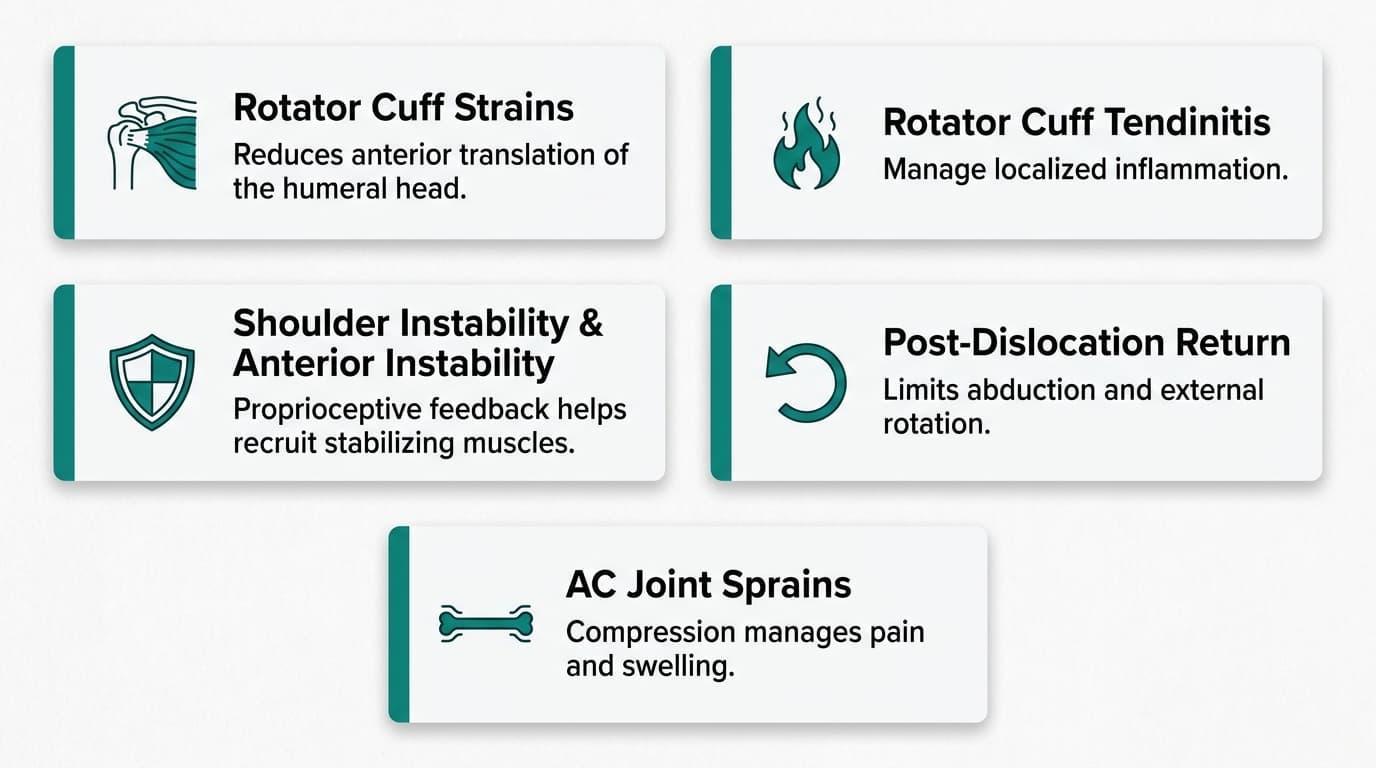
Not every shoulder injury belongs in a sling. Many respond well to continued training when the joint has the right external support, but the key is knowing which injury type you're dealing with and how bracing supports the recovery process.
Here's how bracing helps with the most common training-related shoulder injuries:
-
Rotator cuff strains: Compression reduces anterior translation of the humeral head during pressing movements, limiting the micro-instability that aggravates the injury under load.
-
Rotator cuff tendinitis: Consistent compression and warmth help manage localized inflammation during low-to-moderate intensity training, keeping tissue reactive without pushing into a flare.
-
Shoulder instability and anterior instability: Proprioceptive feedback helps athletes recruit stabilizing muscles more reliably, which is critical for return to sport, especially in grappling, where the shoulder is loaded at unpredictable angles.
-
Post-dislocation return: A structured brace limits abduction and external rotation, the two positions where re-dislocation risk is highest, without shutting down functional movement entirely.
-
AC joint sprains: Compression manages pain and swelling during horizontal pulling movements, allowing upper body training to continue at modified intensity.
One hard line to hold: Acute injuries, sharp nerve pain, and suspected fractures are not brace territory. Those require medical evaluation before any training resumes. Bracing supports rehabilitation exercises and modified training. It doesn’t replace a proper diagnosis or professional care.
Exercises You Can Train With a Shoulder Brace
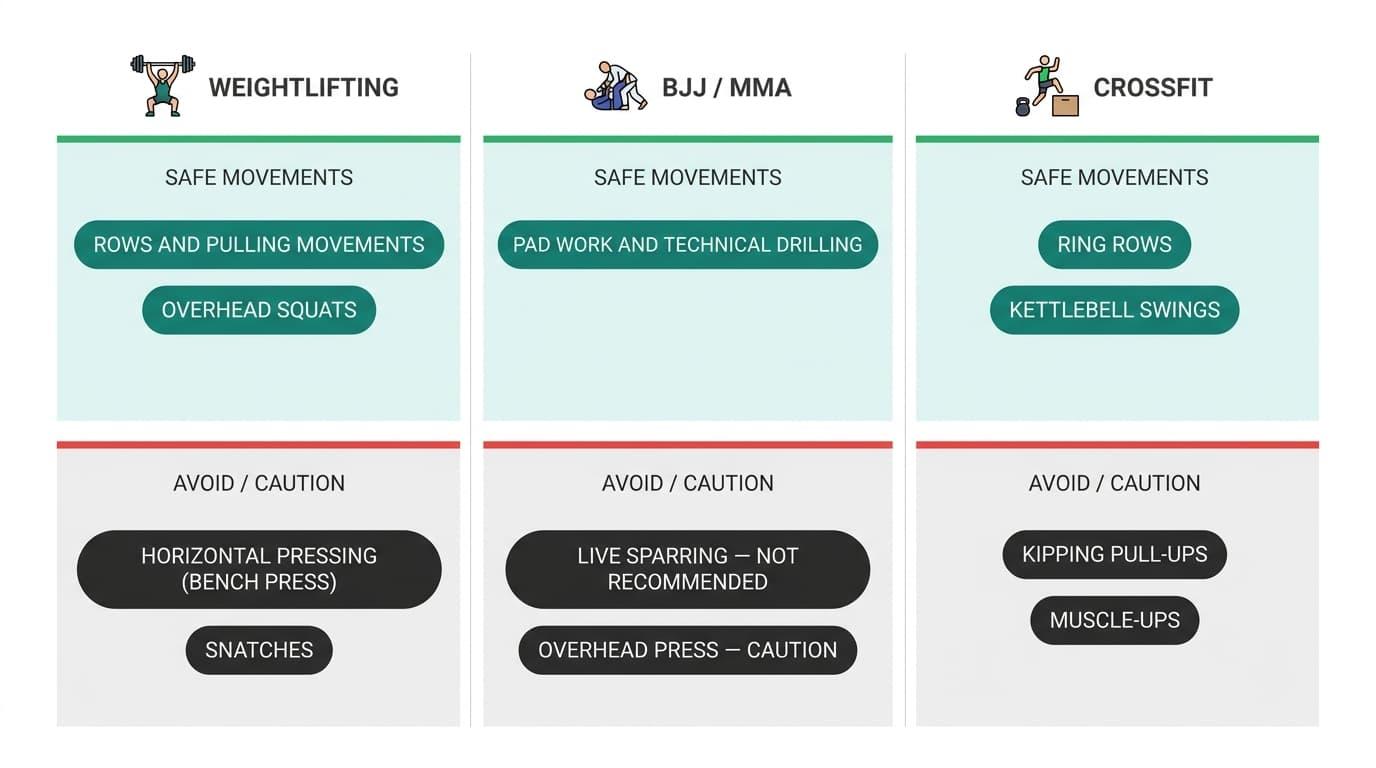
Not every movement is off the table during shoulder recovery. The goal is to identify which exercises work with a braced shoulder and which push against it. Sport context matters here. A movement that's safe for a lifter may be contraindicated for a grappler in the early recovery phase.
Weightlifting and Gym Training
For gym athletes, the following guidelines help structure a safe braced session: for weight training, the brace can act as an alignment guide and may reduce shoulder pressure by about 15% during heavy efforts, but it still won’t correct poor posture or bad lifting form.
-
Horizontal pressing (bench press): Generally brace-compatible. The shoulder stays in a more mechanically stable position compared to overhead loading. Reduce working weight and avoid sinking the bar too deep at the bottom, where impingement risk spikes. Keep the range of motion controlled, since some injuries can affect your ability to lift safely through deeper ranges.
-
Rows and pulling movements: Among the safest options available. Scapular retraction during rows reinforces the compression rather than fighting it. Cable rows, dumbbell rows, and machine pulls are all solid choices during early return-to-training phases. Early on, prioritize joint-stabilizing, low-impact variations to maintain muscle without compromising recovery.
-
Overhead press: Requires caution. Overhead loading places significant demand on a compromised joint. If you include it, keep the range of motion short of full lockout and drop the load significantly.
A practical load management principle worth internalizing: Braced training isn’t full-intensity training. Start with lighter weights during the initial return, then increase the load gradually by 5% to 10% per week as tolerated. The Anaconda Shoulder Brace for active training is built to provide the joint stabilization needed to manage these movements without shutting down your upper body session entirely.
BJJ, MMA, and Combat Sports
This is where most brace guides go quiet. They cover the gym and ignore the mat.
A shoulder brace for BJJ provides meaningful protection during grip-fighting, clinch work, and guard passing, the exact positions where anterior instability and re-dislocation risk are highest. The proprioceptive feedback loop keeps your stabilizing muscles engaged during scrambles, which is critical when the shoulder is loaded at unpredictable angles.
For MMA, a brace is appropriate during pad work and technical drilling. It isn’t recommended for live sparring. Unpredictable contact during full-resistance rounds creates loading patterns a brace cannot fully account for, and the risk of compounding the injury outweighs the benefit of staying in the round.
CrossFit and Functional Fitness
Shoulder injuries account for up to 46% of CrossFit-related injuries, which makes load selection and movement screening non-negotiable when training braced.
The movements below are generally safe when braced at controlled intensity:
-
Kettlebell swings
-
Ring rows
-
Dumbbell pressing at moderate load
-
Banded pull-aparts and accessory work
The following should be removed from the session until recovery is further along:
-
Kipping pull-ups
-
Snatches and overhead squats
-
Muscle-ups
-
Any high-velocity overhead movement
The brace supports functional training at controlled intensity, but it doesn’t make high-skill, high-velocity movements safer. If a movement requires full shoulder stability and unrestricted range of motion under speed, it stays out of the session.
3D Knit vs. Neoprene: Choosing the Right Brace Material
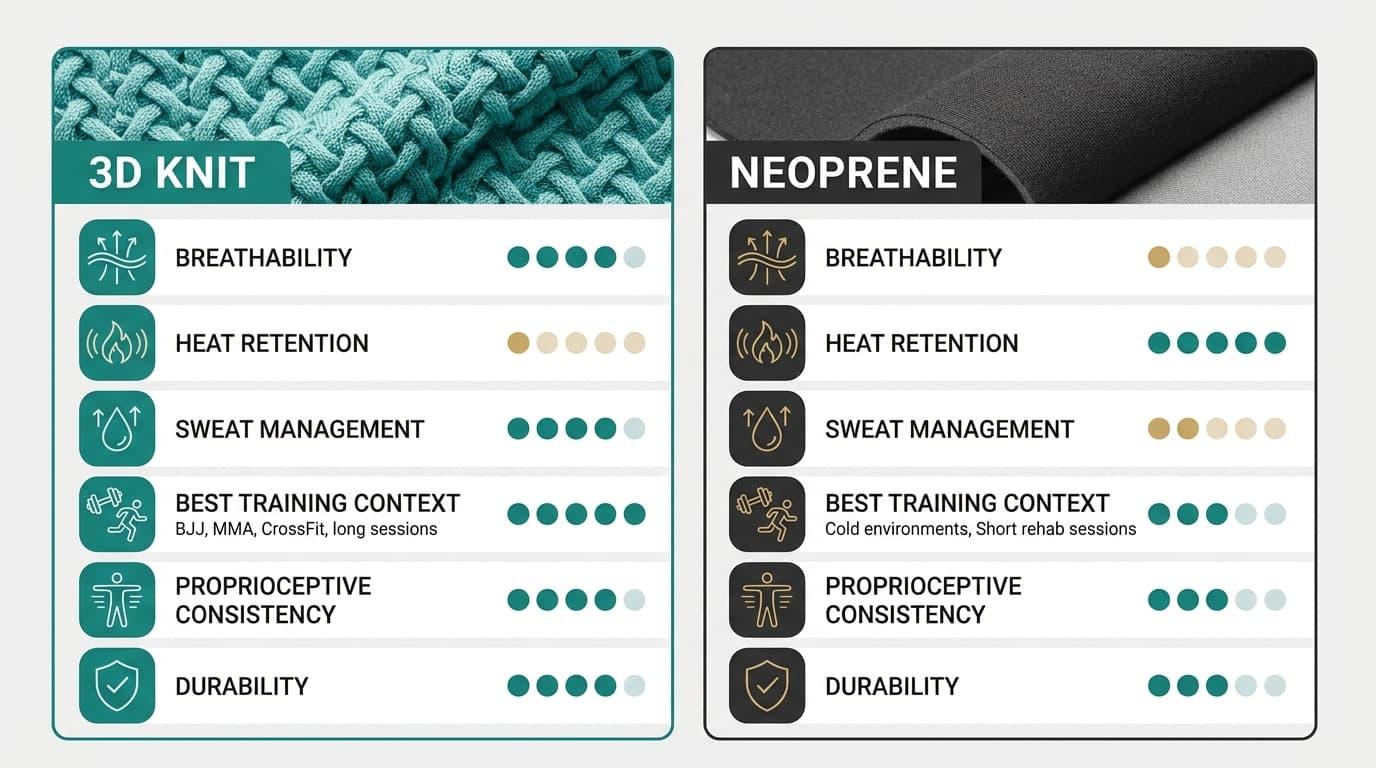
Material isn’t a minor detail. It determines how a shoulder brace performs under real training conditions, and the wrong choice creates problems that have nothing to do with your injury.
The two dominant materials are neoprene and 3D knit construction, and the differences between them are significant in high-intensity environments.
Neoprene
Neoprene retains heat well, which benefits warmth and compression in cold environments or during low-intensity rehab. The tradeoff is breathability. Neoprene traps sweat, builds heat quickly, and can cause skin irritation during longer sessions. It also tends to be heavier and less conforming, which affects how consistently it sits on the joint during movement.
3D Knit
3D knit construction solves the problems neoprene creates in high-intensity environments. The open-weave structure allows airflow, wicks moisture away from the skin, and maintains consistent compression without heat buildup.
For athletes in BJJ and MMA, where sweat management and grip interference are critical factors, 3D knit is the clear choice.
A brace that bunches, slips, or overheats mid-roll isn’t providing reliable proprioceptive feedback; it's adding friction.
The table below shows how the two materials compare across the factors that matter most to active athletes:
|
Feature |
3D Knit |
Neoprene |
|
Breathability |
High |
Low |
|
Heat Retention |
Low |
High |
|
Sweat Management |
Excellent |
Poor |
|
Best Training Context |
BJJ, MMA, CrossFit, long sessions |
Short rehab sessions, cold environments |
|
Proprioceptive Consistency |
High, maintains position under load |
Moderate, prone to slipping |
|
Durability |
High with repeated washing |
Degrades faster with sweat exposure |
For weightlifting and general gym training, either material works, but 3D knit outperforms in sessions longer than 45 minutes. Matching the brace to your training environment is just as important as matching it to your injury.
The Real Risks of a Poor Fit for Pain Relief
A shoulder brace only works if the brace fits properly and is used with intention. If a poor fit increases shoulder pain or is so tight that it restricts blood flow and causes nerve compression, it creates problems that compound the original injury rather than protecting it.
To avoid issues from wearing it for long periods while adapting, start with short intervals of 2 to 3 hours at a time.
Compensatory Movement Patterns
A poorly fitted brace restricts natural scapular movement, and that restriction alters muscle activation patterns across the entire shoulder girdle. When scapular stabilization breaks down, surrounding muscles compensate.
The result is scapular dyskinesis, where the shoulder blade moves incorrectly during pressing, pulling, and overhead patterns.
Athletes rarely notice it happening. The body quietly redistributes load to structures that weren't designed to carry it.
Over-reliance on external support creates a second problem. When the brace does the stabilization work, the active stabilizers stop doing theirs. Proprioception drops, and the neural drive to stabilize independently weakens. Extended dependence can also weaken the dynamic stabilizers, including the rotator cuff muscles, and gradually reduce shoulder function.
Athletes who train exclusively braced without progressing through rehabilitation exercises often find that removing the brace feels destabilizing, and that’s because it is. Regular mobility work and strengthening exercises are needed to preserve shoulder function and support proper healing, rather than letting the shoulder depend on external input instead of generating its own.
Compensatory patterns also shift load laterally. Athletes unconsciously offload the braced shoulder onto the opposite side or overload the biceps tendon to compensate for reduced rotator cuff engagement. Both patterns create secondary injuries that were entirely avoidable.
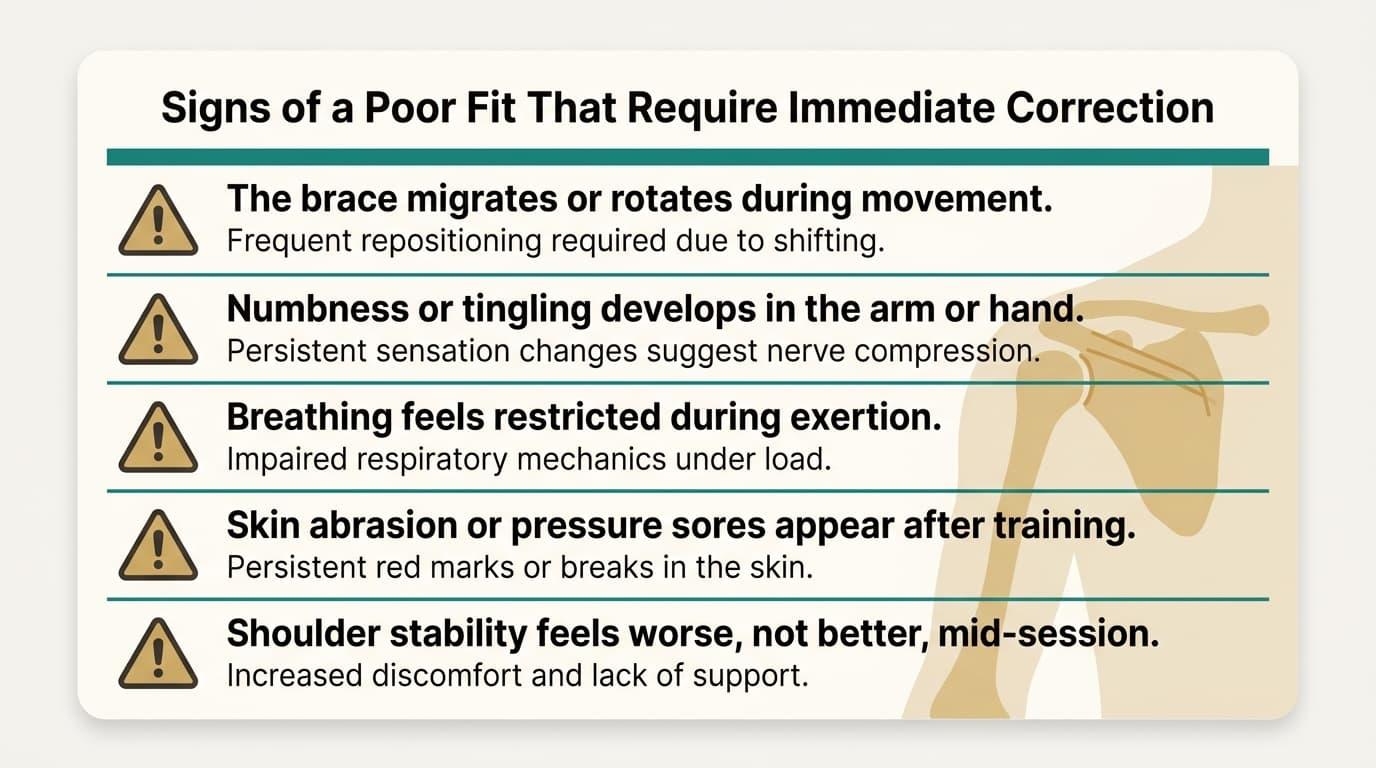
These are the signs of a poor fit that require immediate correction:
-
The brace migrates or rotates during movement
-
Numbness or tingling develops in the arm or hand
-
Breathing feels restricted during exertion
-
Skin abrasion or pressure sores appear after training
-
Shoulder stability feels worse, not better, mid-session
When to Train Through It and When to Step Back
Knowing your injury type and your brace material only gets you so far. The next question is whether the situation actually calls for continued training or a temporary step back.
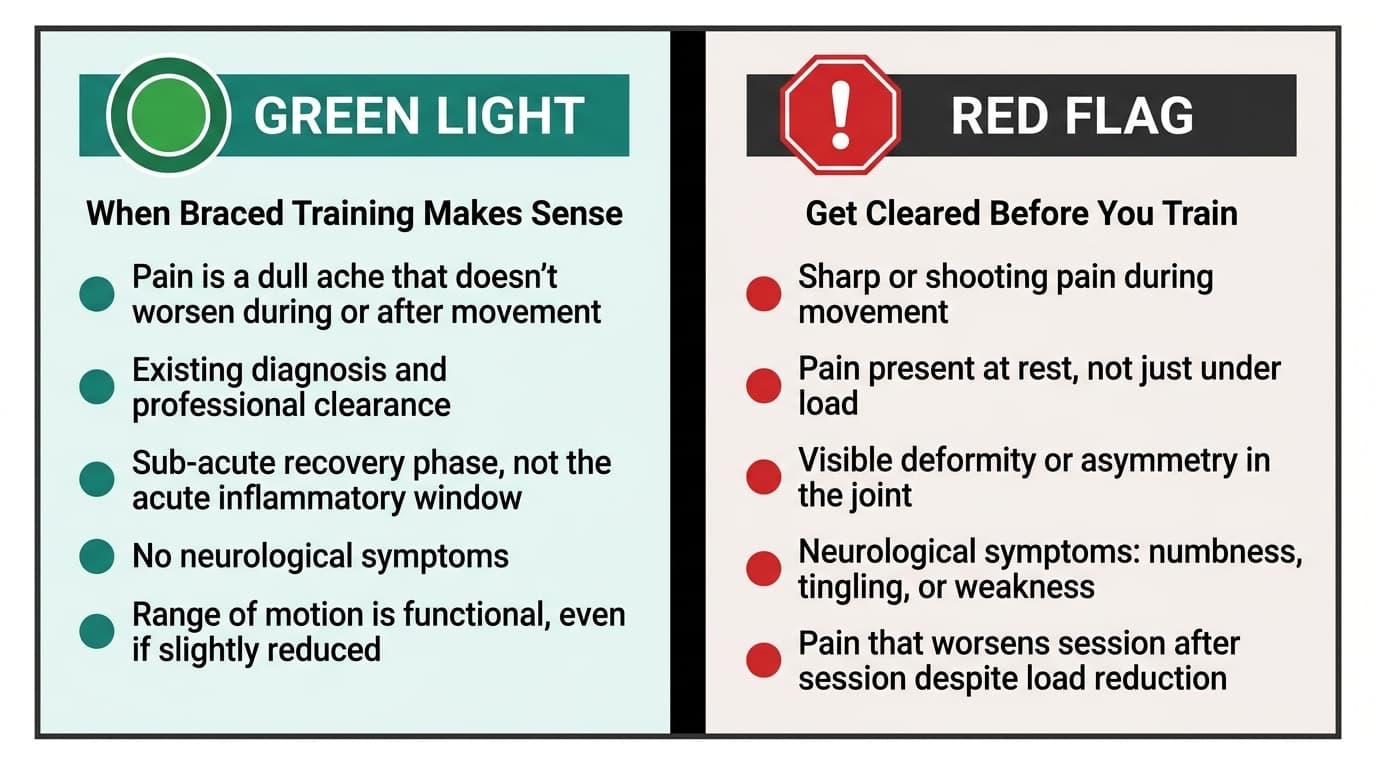
Green Light: When Braced Training Makes Sense
Not every shoulder injury is a reason to shut down. If the following criteria apply, braced training is a reasonable path forward:
-
Pain is a dull ache that doesn’t worsen during or after movement
-
You have an existing diagnosis and professional clearance to continue activity
-
You’re in the sub-acute recovery phase, not the acute inflammatory window
-
No neurological symptoms are present: no numbness, tingling, or radiating pain
-
Range of motion is functional, even if slightly reduced
The return-to-sport framework matters here. Start each session with at least 10 minutes of dynamic stretching before putting on the brace.
Then begin with low-load isolated movements targeting rotator cuff and scapular control, progress to compound movements once those feel stable, and reintroduce sport-specific patterns last.
During the return phase, regular shoulder mobility work and targeted strengthening exercises help maintain flexibility, and studies show 2–3 stretching sessions per week can improve shoulder range of motion by 12% for better long-term rotator cuff support.
The 2022 Bern Consensus Statement on shoulder return-to-sport supports this graduated loading model, recommending a four-to-six-week progressive increase in load alongside active stabilizer work rather than a binary stop-or-go decision.
Red Flags: Get Cleared Before You Train
Some symptoms mean the brace stays off until a professional clears you. Training through these doesn't protect the shoulder; it delays a diagnosis. Watch for:
-
Sharp or shooting pain during movement
-
Pain present at rest, not just under load
-
Visible deformity or asymmetry in the joint
-
Neurological symptoms: numbness, tingling, or weakness in the arm or hand
-
Pain that worsens session after session despite load reduction
Shoulder instability that includes any of the above, or a history of dislocation with recurring episodes, requires evaluation before bracing becomes part of the plan. See a professional first, then train.
Final Words
Staying in the game while protecting long-term joint health is not a contradiction. It's the standard we hold at Anaconda. A well-fitted brace, the right material for your sport, and a structured approach to load management give you the foundation to keep training through recovery without making things worse.
We built the Anaconda Shoulder Brace for athletes who refuse to sit out. It uses a 3D knit compression design that moves with you, delivering joint stabilization and proprioceptive feedback from your first session back.
Trusted by over 400,000 athletes, with orders shipped within 24 hours and backed by a 30-day return guarantee, it's the support you can train in.
Frequently Asked Questions
Not sure when to wear a shoulder brace or how it fits into your recovery plan? Here are quick answers to the most common questions athletes ask about training, competition, and shoulder support.
Can I wear a shoulder brace during competition or live rolling?
Yes, many competitions allow soft shoulder braces, but rules vary by organization. It’s always best to check with the event organizer before competing. During live rolling, a brace can provide extra support and confidence while returning from injury. However, it shouldn’t be relied on as a substitute for proper recovery and shoulder stability.
How long should I wear the brace during a training session?
You should wear the brace during active training when your shoulder is under the most stress. Most athletes remove it once the session is finished rather than wearing it all day. The goal is to provide support during lifting, drilling, or sparring, not create constant dependence on the brace. Using it strategically helps maintain its effectiveness.
Will training in a brace weaken my shoulder muscles?
No, training in a brace will not automatically weaken your shoulder muscles. Problems only arise when athletes rely on the brace while neglecting rehabilitation and strengthening work. A brace supports the joint, but your muscles still need to do the work of stabilizing and controlling movement. Pairing brace use with proper rehab helps maintain long-term shoulder strength.
What is the difference between a shoulder brace and a shoulder sleeve?
A shoulder sleeve mainly provides compression, warmth, and mild support. A shoulder brace offers greater stability by helping control shoulder movement and support the joint during activity. Braces are typically better for injury recovery, instability, and high-demand sports. Sleeves are usually more suitable for mild discomfort, soreness, or preventive support.
Should I sleep in a shoulder brace after a hard session?
No, most shoulder braces aren’t intended for overnight use. Wearing a brace while sleeping can be uncomfortable and may restrict natural movement during recovery. In most cases, it’s best to remove the brace once training is finished. If shoulder instability affects your sleep, consult a healthcare professional for appropriate support options.


