


You're mid-WOD, locked out overhead on a snatch, and your shoulder fires a warning you've been trying to ignore for two weeks. You're not ready to stop training. You just need the right support to keep going without making it worse.
We've tested what's out there, and most of it was engineered for a completely different athlete.
At Anaconda, we build products specifically for people doing overhead barbell work under fatigue, not desk workers with posture problems or patients recovering from surgery.
Our Shoulder Brace was designed around the snatch, the kip, and the jerk because those are the movements that actually punish a shoulder.
This guide breaks down the five products worth considering, with verified prices, honest pros and cons, and a fit guide matched to your specific training situation.
Key Takeaways
-
Shoulder injuries account for up to 40.6% of all CrossFit injuries, making the shoulder the most commonly injured joint in the sport
-
Kipping pull-ups, snatches, and ring muscle-ups are the highest-risk movements based on published research
-
Most shoulder braces on the market were built for collision sports or post-surgical recovery, not overhead barbell work
-
Five real, named products are reviewed here with verified prices, honest pros and cons tables, and a Best For breakdown for each
-
A full comparison table and four-step fit guide help you match the right brace to your specific injury, training volume, and budget
Why Shoulder Brace Choice Matters More in CrossFit Than Any Other Sport
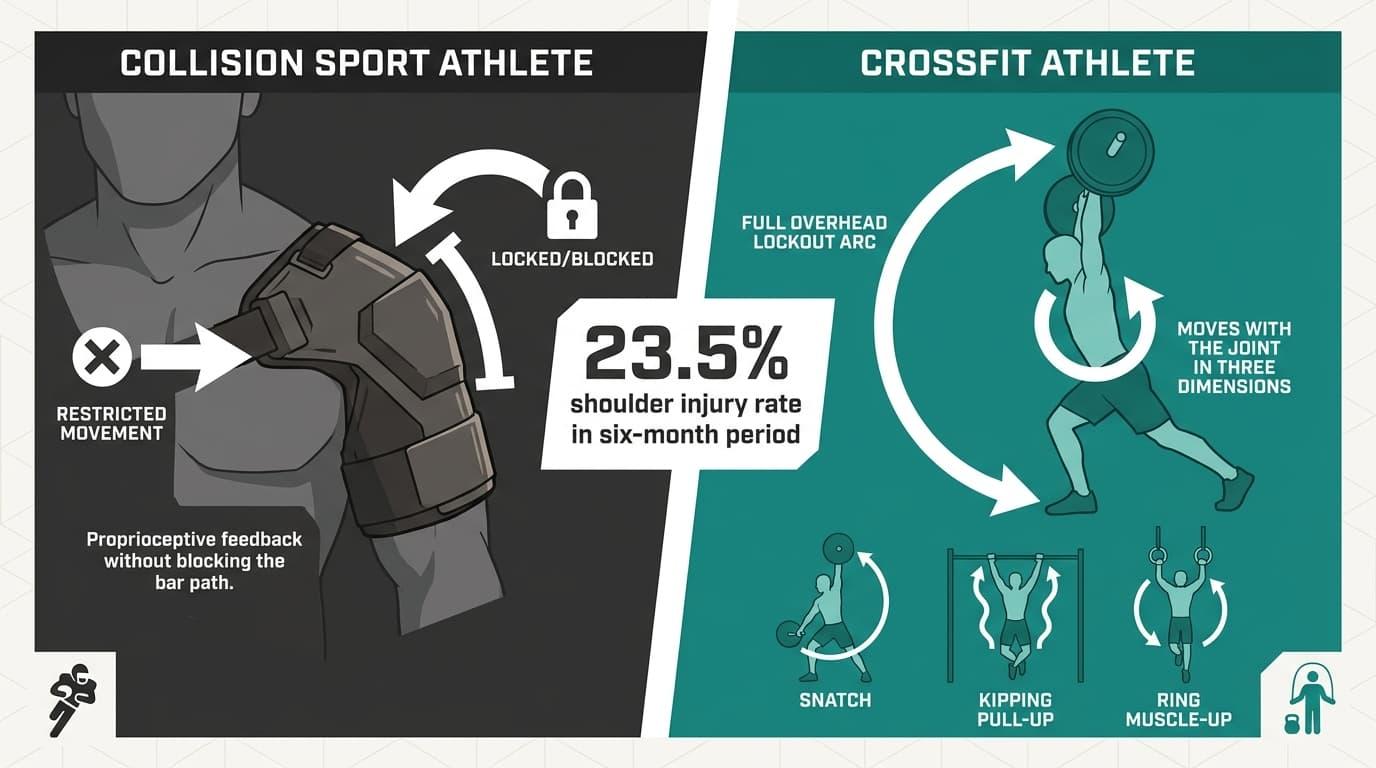
Most shoulder braces on the market are designed to limit the range of motion. For a football player absorbing a collision, that restriction protects the joint. For a CrossFit athlete who needs to lock out a barbell overhead, that same restriction is the problem.
23.5% of CrossFit athletes reported a shoulder injury in a six-month period, with improper form and overuse identified as the leading causes.
The kipping pull-up, snatch, and ring muscle-up generate the highest shoulder loads in the sport, repeatedly placing the joint in maximum abduction and external rotation at speed.
A rigid brace pushes the shoulder toward those positions and holds it there. A sleeve that migrates gives you the false confidence of wearing support without any of the substance.
What CrossFit athletes need is a brace that moves with the joint in three dimensions, anchors without slipping during a sweaty WOD, and provides proprioceptive feedback without blocking the bar path. Not everything on this list delivers that. That distinction is exactly why this roundup exists.
1. Rehband UD X-Stable Shoulder Support: Best Premium Option for Serious Competitors
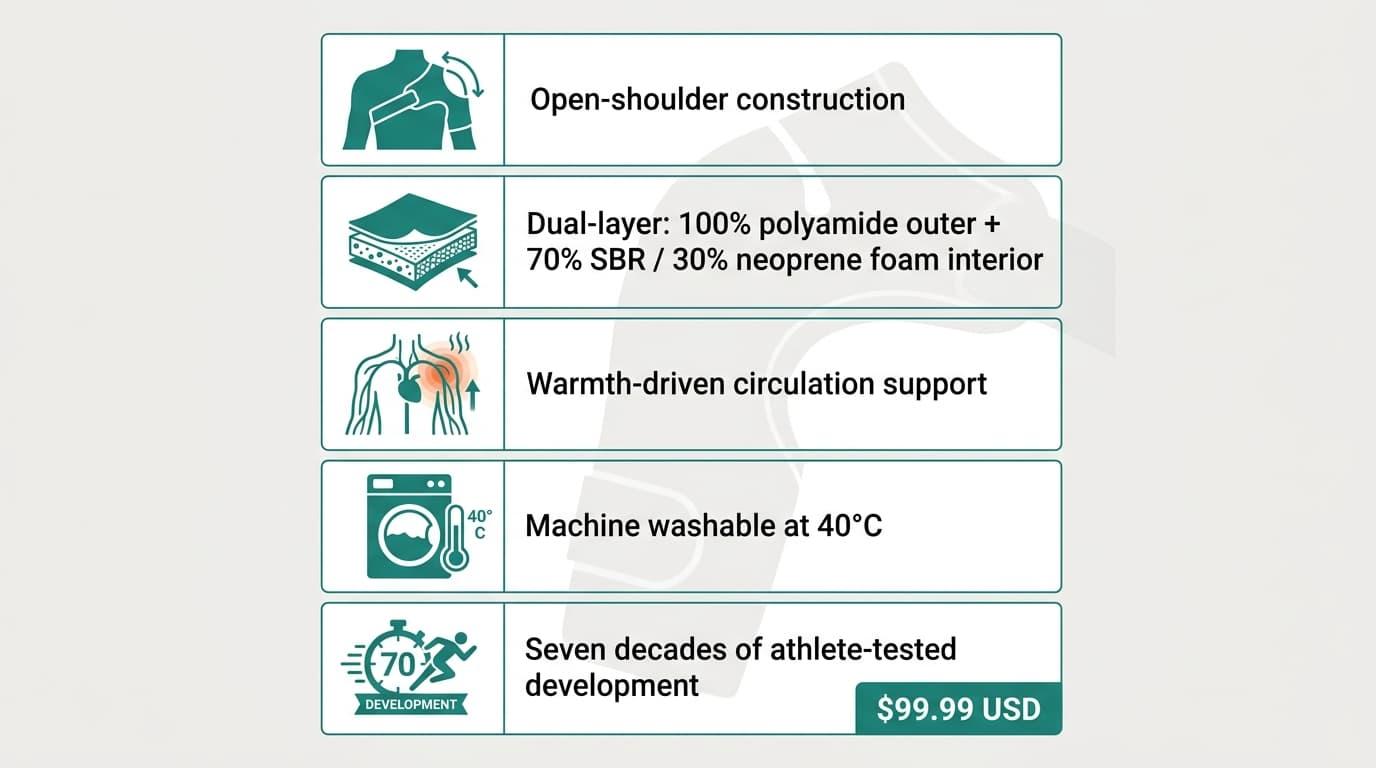
Rehband has been engineering sports supports since 1955, and its products are used by elite CrossFit competitors, Olympic weightlifters, and professional athletes worldwide across multiple disciplines. The UD X-Stable is their flagship shoulder support, and every detail of the build quality reflects seven decades of refinement.
What Makes It Stand Out
The Rehband UD X-Stable earns its premium price through engineering decisions that show over months of daily use. Here's what sets it apart:
-
Open-shoulder construction: The brace wraps around the shoulder girdle, leaving the shoulder cap unobstructed. You can achieve full overhead extension in a snatch or jerk without the brace physically blocking the lockout, a critical distinction for CrossFit.
-
Dual-layer material engineering: A 100% polyamide outer shell over a 70% SBR and 30% neoprene foam interior delivers warmth and structured compression, maintaining its shape through months of daily training. Cheaper single-layer products lose their compression profile within a competitive season.
-
Warmth-driven circulation support: Consistent heat to the shoulder, chest, and neck muscles stimulates blood circulation, reduces joint stiffness, and supports activation of scapular stabilizers. For athletes managing chronic impingement or long-standing overuse, this is a meaningful therapeutic benefit in addition to the compression.
-
Seven decades of athlete-tested development: Rehband manufactures according to European environmental standards and tests all materials in its own laboratory. Their products have been on the wrists and knees of CrossFit Games athletes for years, a track record that matters.
-
Machine washable construction: The brace withstands machine washing at 40 degrees Celsius, which matters when you're training daily and need gear that stays clean through a full season without losing its structure.
Price
At $99.99 USD, the Rehband UD X-Stable is the most expensive product on this list, costing exactly double the Anaconda Shoulder Brace, and that premium is most justified for athletes with the training volume and time horizon to extract real value from its long-term material durability.
Pros and Cons

Best For
The Rehband UD X-Stable is the right investment for a specific type of CrossFit athlete. It belongs in these situations:
-
Serious CrossFit competitors who invest in premium gear and train five or more days per week, where material durability across a full season is the priority and the support can help protect the shoulder during high-frequency training
-
Athletes managing chronic impingement or overuse who benefit significantly from the warmth-plus-compression combination over extended training blocks to reduce discomfort
-
Weightlifters who compete in both CrossFit and Olympic lifting and need a single support trusted in both disciplines
-
Athletes who prioritize long-term build quality and brand credibility over the widest feature set at the sharpest price
2. Anaconda Shoulder Brace: Best Overall for CrossFit Athletes
If you've ever pulled a sleeve on before class, felt solid during the warm-up, and watched it slide uselessly down your arm by round two of kipping pull-ups, you already understand the problem we set out to solve.
We built the Anaconda Shoulder Brace because nothing on the market held up under real CrossFit training conditions.
Over 400,000 athletes have trusted Anaconda gear. We test everything in real training environments, not labs. If it slid, we fixed it. If it pinched, we redesigned it. What we shipped is the version that survived.
What Makes It Stand Out
There’s no other brace at this price point that combines all of these features in a single product built for overhead CrossFit work:
-
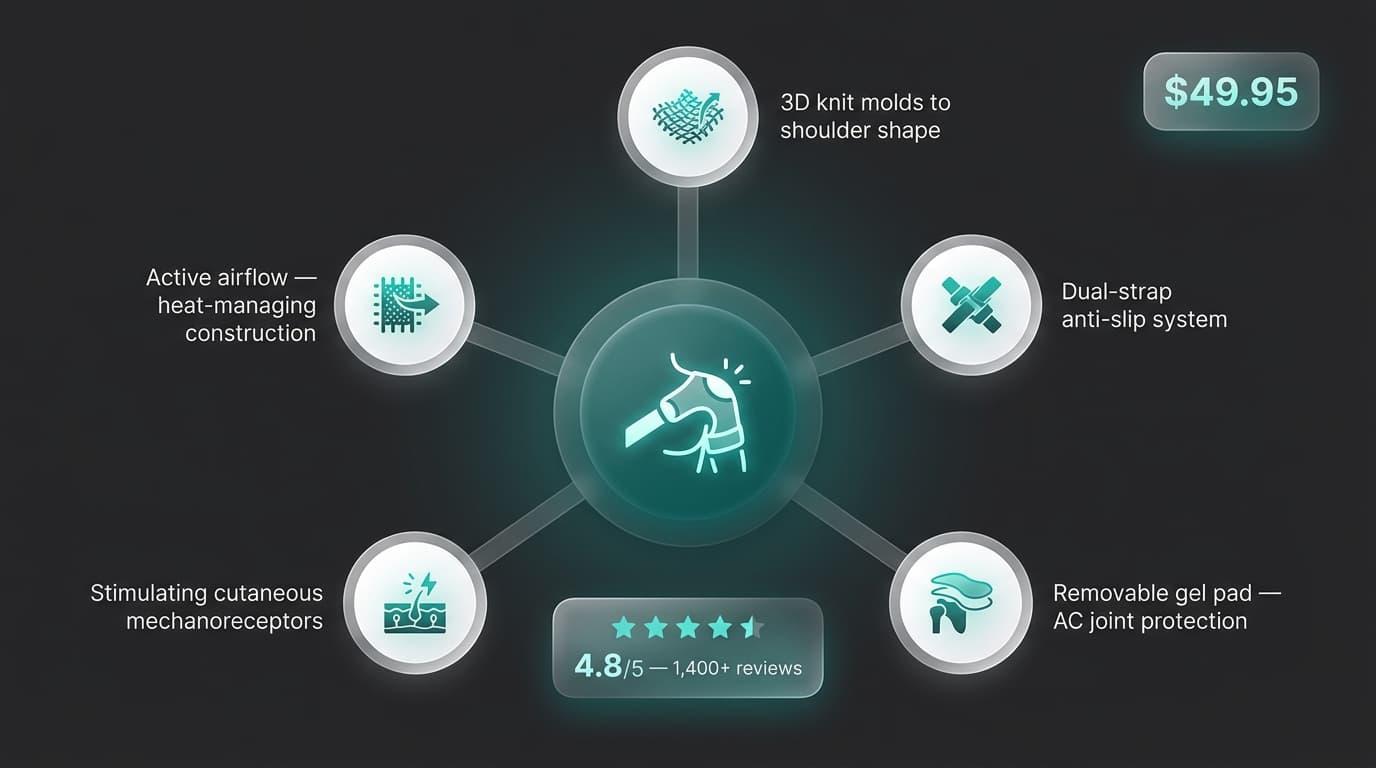
3D knit construction: Unlike neoprene sleeves that compress in one plane and trap heat, the 3D knit molds to your shoulder shape and moves with the joint in every direction, providing targeted shoulder compression. Full snatch lockout. Full kipping arc. Full overhead squat range. Nothing is blocked.
-
Dual-strap anti-slip system: Two adjustable straps anchor the brace at two contact points rather than relying solely on friction, giving additional support while helping limit unnecessary movement to reduce strain and stress during exercises. This is what keeps it on your arm through round four of a high-sweat WOD when a basic sleeve is already halfway to your elbow.
-
Removable gel pad: A detachable gel pad sits over the shoulder cap to absorb contact forces during barbell racking and overhead pressing. Targeted protection for the AC joint without adding bulk that disrupts the bar path. Pull it off for sessions where bar clearance is the priority.
-
Research-backed proprioceptive compression: Compression garments improve active joint repositioning sense by stimulating cutaneous mechanoreceptors. That’s the mechanism behind why this brace makes the catch position of a fatigued snatch feel more controlled. Your brain receives clearer signals about where your joint is in space, which matters most when your muscles are already burning.
-
Breathable, heat-managing construction: The 3D knit structure allows active airflow rather than trapping heat like neoprene. Breathable materials help manage sweat and reduce irritation during intense workouts for additional comfort. A brace that becomes uncomfortable mid-session gets pulled off. This one stays on.
Price
At $49.95 USD, the Anaconda Shoulder Brace sits at the mid-range of this list and delivers the most complete CrossFit-specific feature set per dollar, offering the dual-strap anti-slip system, 3D knit construction, and removable gel pad that the $25.00 and $30.00 options don't include, while costing exactly half the price of the Rehband.
Pros and Cons

Best For
We built this brace for athletes who are still moving, not sitting it out. Here's where it fits best:
-
CrossFit athletes managing rotator cuff strains, AC joint irritation, or impingement who need to stay active in training
-
Athletes in high-volume overhead programming blocks who want preventive proprioceptive support without any range-of-motion restriction
-
Competitors in Open prep or peak cycles, where a slipping brace during a WOD is simply not an option
-
Athletes returning to overhead barbell work after a rest period who need a confidence layer during the transition back
Choosing the right support depends heavily on what's happening in the joint.
3. Copper Compression PowerKnit Shoulder Sleeve: Best Budget Entry-Level Compression Option
Not every CrossFit athlete needs a full structural brace. If your shoulder is fundamentally healthy and you want warmth, light compression, and basic proprioceptive awareness without spending $50, the Copper Compression PowerKnit Shoulder Sleeve is the most accessible starting point on this list.
What Makes It Stand Out
Compared to a standard neoprene pull-on sleeve, the PowerKnit offers genuine upgrades that improve the daily training experience. Here’s what matters:
-
Copper-nylon PowerKnit fabric: The proprietary copper-nylon blend is more breathable than neoprene and fights odor through repeated sessions. For athletes who train daily before washing their gear, that’s a practical quality-of-life advantage.
-
Adjustable strap retention: A single adjustable strap provides better migration resistance than a basic pull-on sleeve with no structure. It won’t rival a dual-strap system, but it’s a meaningful step up from nothing.
-
Seamless, low-profile construction: The seamless knit sits cleanly under workout clothing without bunching or creating pressure points, making it comfortable for everyday activities before and after a session. Easy to wear all day.
-
Low-risk trial entry: At $25.00, this is the lowest-risk way to test whether compression support makes a difference for your shoulder before committing to a more structured brace, especially for athletes who want light shoulder supports rather than a full brace.
Price
At $25.00 USD, the PowerKnit Sleeve is the most affordable option on this list, priced as a warmth and awareness tool for light training rather than a performance brace for high-intensity overhead work.
Pros and Cons

Best For
The PowerKnit Sleeve performs well in low-demand situations where warmth and basic awareness are the goal. It fits best here:
-
Newer CrossFit athletes with no active injury who want basic joint warmth, awareness, and light relief during training
-
Athletes in prevention mode who carry low overhead volume and want light compression during general gym work
-
Anyone wanting to trial compression support before investing in a more structured product
-
A complementary layer to wear outside of training alongside a more structured training brace, where it supports natural movement during low-demand use
4. Copper Compression Recovery Shoulder Brace: Best for Rotator Cuff Injuries Recovery Between Sessions
There's a meaningful difference between a training brace and a recovery brace. The Copper Compression Recovery Shoulder Brace is built for what happens outside of WODs: rest days, daily activities, sleep positioning, and low-intensity movement when a healing shoulder needs consistent support without the demands of a training session.
What Makes It Stand Out
What sets this product apart from a basic sleeve is its clinical design. Here’s what’s worth noting:
-
4-way stretch nylon-lycra construction: The fabric moves with the shoulder in four directions, providing stable compression without the rigidity that makes structural braces uncomfortable for all-day wear. Ideal for wearing through a workday, a commute, or sleeping on a recovering shoulder, it supports the healing process without causing restricted movement during low-intensity use.
-
Copper Compression’s real-world validation: With over two million products sold, independent testers across CrossFit and combat sports communities have validated the Recovery Brace’s performance for mild-to-moderate rotator cuff strain management.
-
Practical complementary pricing: At $30.00, it’s accessible enough to pair alongside a training brace. Use the Anaconda Shoulder Brace during WODs and the Recovery Brace for daily wear between sessions to support healing, covering both phases of the recovery window.
-
Works on either shoulder: No left- or right-handed SKUs required, simplifying buying and letting you switch sides as needed, whether on the right shoulder or left shoulder.
Price
At $30.00 USD, the Copper Compression Recovery Shoulder Brace is priced as an accessible recovery and daily-wear tool, and it works best as a complementary product alongside a training brace rather than a standalone solution for CrossFit sessions.
Pros and Cons

Best For
The Recovery Brace performs its intended job well when matched to the right situation. It belongs for:
-
Athletes in active recovery from a rotator cuff strain, impingement, or AC joint sprain, as well as similar sprains, who need comfortable daily-wear support between training sessions
-
Athletes managing shoulder pain on rest days who want stable compression without the bulk of a full training brace to enhance comfort during low-intensity recovery
-
Anyone using the Anaconda Shoulder Brace for training who wants an affordable complementary option for recovery hours
-
Athletes whose physiotherapist has recommended consistent compression support outside of training, or as part of physical therapy, to manage inflammation
5. Mark Bell Reactive Sling Shot: Best for Reducing Shoulder Instability and Strain During Pressing Movements
The Mark Bell Reactive Sling Shot earns its place on this list with full transparency: It’s not a traditional shoulder brace, and it won't help you during snatches, kipping pull-ups, or overhead squats.
What it does exceptionally well is reduce the mechanical stress that pressing movements place on the shoulder joint. If push-up volume, ring dips, or bench press accessory work are what's wearing your shoulder down, this product addresses that problem in a way nothing else on this list can.
Mark Bell created the original Sling Shot in 2009, backed by two US patents (8,771,155 and 9,265,983). The Reactive version uses level 2 stiffness material, the most flexible in the range, making it the appropriate starting point for CrossFit athletes.
What Makes It Stand Out
The Reactive Sling Shot operates on a completely different mechanical principle than every other product on this list. Here's what makes it unique:
-
Patented pressing mechanics: Two US patents back the mechanism. The elastic band wraps around the forearms and connects across the chest, creating a mechanical assist that loads the triceps and chest while reducing the eccentric stress that falls on the rotator cuff during pressing. That deloading effect on the shoulder is the CrossFit-specific value.
-
Level 2 stiffness for functional fitness athletes: The Reactive is the most pliable version in the Sling Shot lineup. It provides 5 to 10% more pressing capacity than your unassisted max while taking tension off the shoulder, a useful margin for athletes who need to continue pressing volume during shoulder recovery.
-
Form reinforcement under fatigue: The Sling Shot mechanically prevents elbow flare during pressing, one of the main breakdowns that increases shoulder injury risk during high-volume push-up and dip metcons. When form degrades late in a session, the Sling Shot compensates to keep the shoulder in a safer position.
-
Bodyweight-based sizing for accurate fit: Sized as S/M for under 140 lb, L for 140 to 180 lb, XL for 181 to 220 lb, 2XL for 221 to 300 lb, and 3XL for over 300 lb. Athletes over 6 feet 4 inches or with larger forearms should size up.
Price
At $52.00 USD, the Reactive Sling Shot sits just above the midpoint of this list and is a strong value for what it does specifically, but it works best as a supplementary purchase for pressing movements rather than a standalone shoulder brace for CrossFit.
Pros and Cons

Best For
The Reactive Sling Shot has a clearly defined role. It belongs in these specific situations:
-
CrossFit athletes whose shoulder pain is driven primarily by pressing movements, including push-ups, ring dips, and handstand push-up accessory work, where it helps reduce strain on the shoulder muscles during repeated pressing volume
-
Athletes in a programming cycle with heavy push-up or dip volume who want to complete that work without the shoulder absorbing the full mechanical cost
-
Lifters who include bench press as accessory work and want to manage shoulder stress while maintaining pressing volume, including for relief during rehabilitation phases focused on pressing tolerance
-
Athletes who already have a training brace for overhead movements and want a specialized tool to address the pressing side of their shoulder load
Full Comparison Table: 5 Best Shoulder Braces for CrossFit
Use this table to compare all five products across every factor that matters for CrossFit overhead training.

How to Choose the Best Shoulder Brace for Your Training
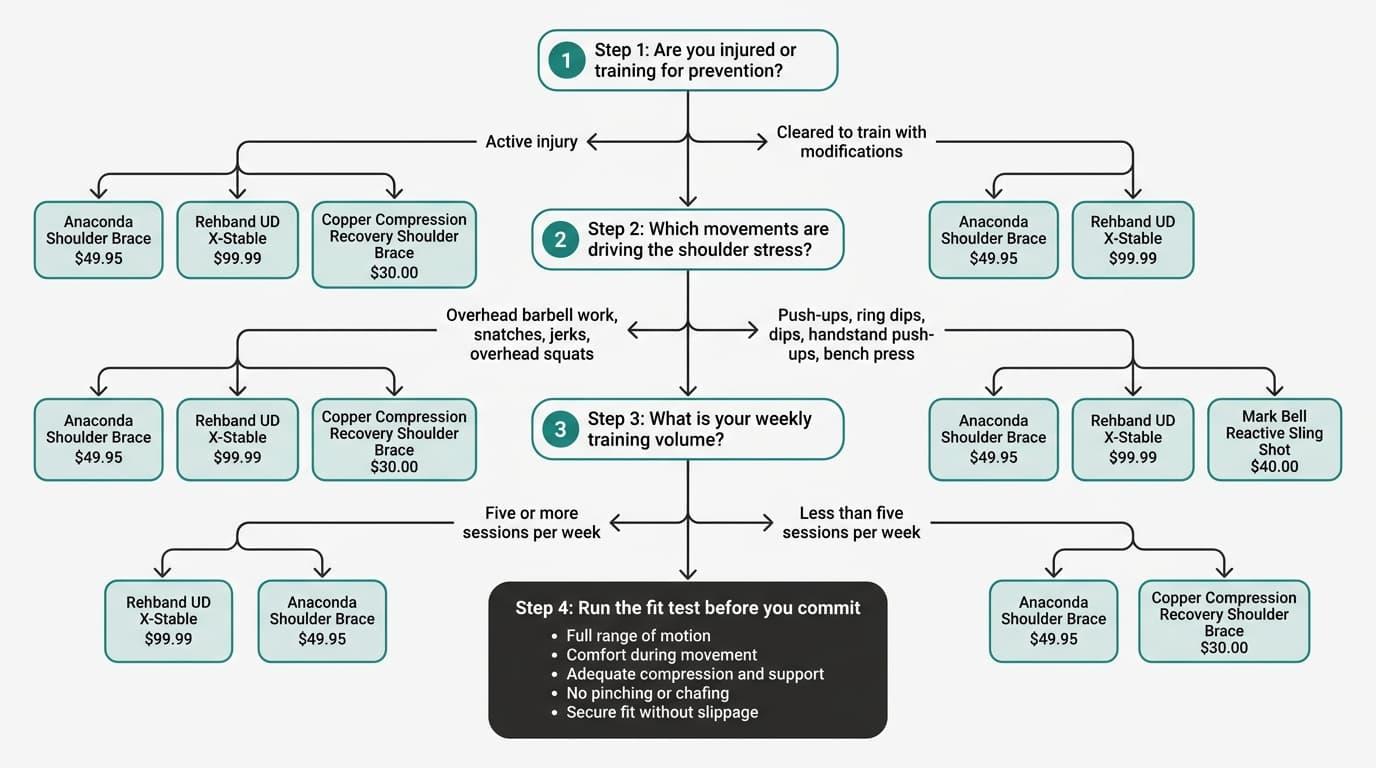
Comparing features is useful, but getting to the right product requires understanding what's happening in your shoulder right now and what you need the brace to do. Work through these four steps in order to determine the best shoulder brace for your specific training needs.
Step 1: Are you injured or training for prevention?
This is the most important question because it changes everything that follows.
-
Active injury, cleared to train with modifications: You need real mechanical support that stays in place through a full WOD. The Anaconda Shoulder Brace at $49.95 is the clearest choice. If long-term durability across a competitive season matters more than price, the Rehband UD X-Stable at $99.99 is the premium alternative.
-
Active injury, using bracing between sessions: The Copper Compression Recovery Shoulder Brace at $30.00 is designed for comfortable daily wear, rest-day support, and recovery-period compression. Use it alongside a training brace, not instead of one.
-
Healthy shoulder, training for prevention: The Copper Compression PowerKnit Sleeve at $25.00 is the lowest-risk entry point for mild warmth and proprioceptive awareness. For high-volume overhead, the Anaconda Shoulder Brace at $49.95 provides significantly better support.
Step 2: Which movements are driving the shoulder stress?
Not all shoulder pain in CrossFit comes from the same source. Matching the brace to the movement pattern changes the outcome.
-
Overhead barbell work, snatches, jerks, overhead squats: Full range of motion and anti-slip security are non-negotiable. The Anaconda Shoulder Brace or the Rehband UD X-Stable is the appropriate choice.
-
Kipping pull-ups, muscle-ups, bar and ring gymnastics: Same requirements. Full arc maintained, dual-strap system essential. The Anaconda Shoulder Brace is built specifically for these demands.
-
Push-ups, ring dips, dips, handstand push-ups, bench press: The Mark Bell Reactive Sling Shot addresses pressing mechanics in a way no traditional shoulder brace does, but it is not designed for shoulder instability during overhead movement. If pressing movements are the primary problem, add the Sling Shot alongside a training brace.
-
General overhead fatigue with no specific injury: The Copper Compression PowerKnit Sleeve provides warmth and mild awareness for lower-demand situations.
Step 3: What's your weekly training volume?
Training frequency determines how much the anti-slip system matters and how long the brace needs to hold up across a season.
-
One to two sessions per week with light overhead work: A compression sleeve may be adequate. Migration is less critical at lower rep counts and intensity.
-
Three to four sessions per week with regular barbell overhead: An anti-slip system becomes essential. The Anaconda Shoulder Brace is the right tier for this frequency.
-
Five or more sessions per week, competition prep, or peak cycles: You need consistent performance across a full season. Both the Anaconda Shoulder Brace and the Rehband UD X-Stable are built for this volume. The Rehband's material quality makes the most difference at this level.
Step 4: Run the fit test before you commit
Fit determines whether any brace delivers its benefit or just looks good in the listing. Confirm all of the following in an actual training session before deciding:
-
The brace stays in position through five consecutive overhead reps without shifting
-
You feel compression across the shoulder cap and into the joint, not just around the upper arm
-
Full overhead lockout is achievable without the brace pulling, pinching, or disrupting the bar path
-
The brace remains comfortable after 20 minutes of continuous movement. Heat buildup or skin irritation is a red flag
-
If it has straps, you can adjust them mid-session without removing the brace entirely
When a Shoulder Brace Is Not the Answer
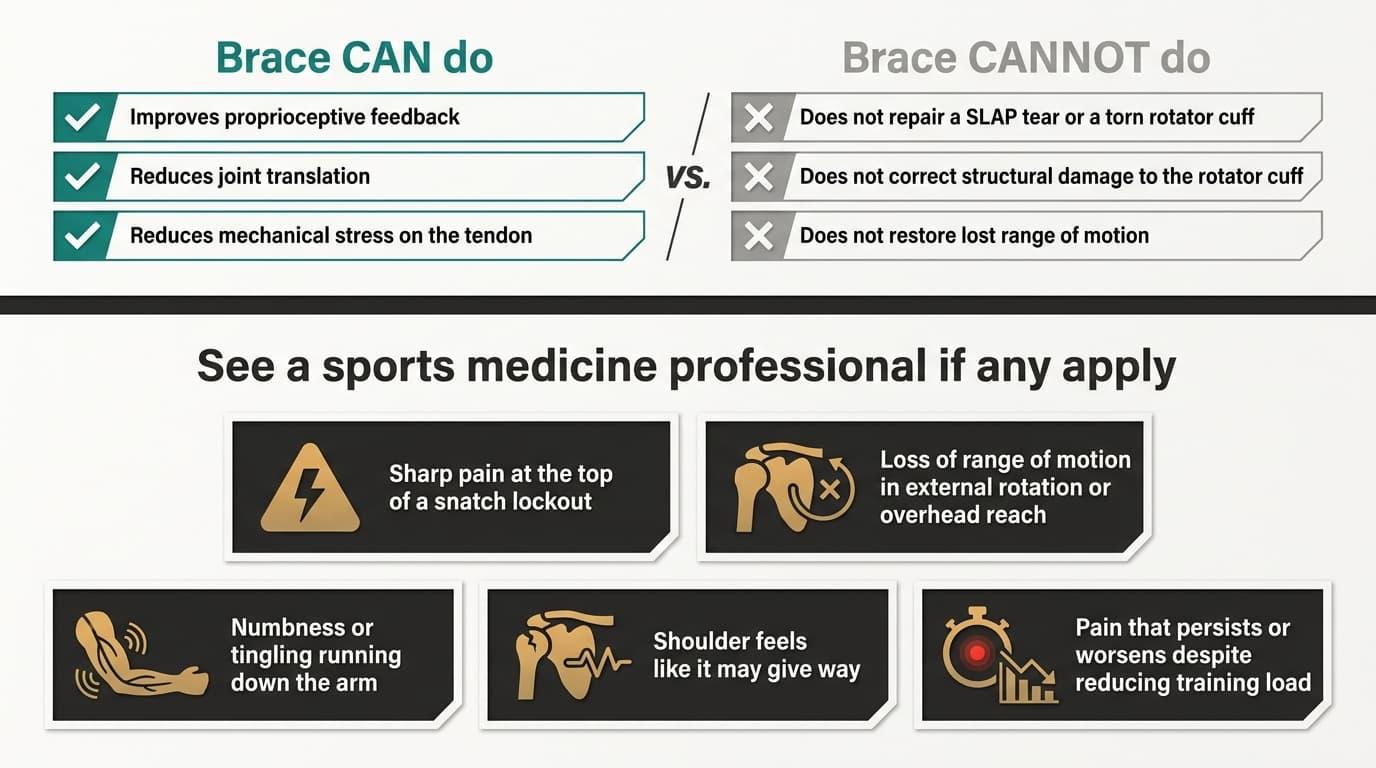
Every product on this list supports athletes’ training through discomfort under appropriate guidance. None of them should act as a substitute for a medical evaluation when something more serious is happening at the tissue level.
A brace supports a shoulder that’s fundamentally intact. It improves proprioceptive feedback, reduces joint translation, and reduces mechanical stress on the tendon. It doesn’t correct structural damage to the rotator cuff, repair a SLAP tear or a torn rotator cuff, or restore range of motion lost to structural damage, and it does not repair connective tissues on its own.
If you’re relying on a brace to make a movement possible that would otherwise be impossible, that’s the signal to see a sports medicine professional, not a reason to add more support.
Get a clinical assessment if any of the following apply:
-
Sharp pain at the top of a snatch lockout or overhead position that doesn’t ease with warm-up
-
Loss of range of motion, particularly in external rotation or overhead reach
-
Numbness or tingling running down the arm during or after training
-
Instability or shoulder instability where the shoulder feels like it may give way during even low-intensity movement
-
Pain that persists or worsens despite reducing training load
Persistent restricted movement should be formally evaluated rather than managed with more bracing.
Final Words
The shoulder is the most commonly injured joint in CrossFit, and the movements that put it most at risk are the same ones that define the sport. Compression sleeves slip when you need them most. Rigid braces block the range of motion your overhead work demands.
The Anaconda Shoulder Brace was built for athletes who are still showing up. At $49.95, it ships within 24 hours from our warehouse in Arizona, is backed by a 30-day return guarantee, and has a 4.8 out of 5 rating across more than 1,400 verified reviews. Your gear should hold up as hard as you train.
FAQs
Here are quick answers to the most common questions athletes ask when choosing the best shoulder brace for CrossFit.
What is the best shoulder brace for CrossFit overall?
The Anaconda Shoulder Brace is one of the best overall options for CrossFit athletes because it balances support, mobility, and stability during overhead movement. Its 3D knit construction and dual-strap anti-slip system help keep the brace secure during intense WODs. Athletes commonly use it for movements like snatches, jerks, pull-ups, and overhead squats. It supports the shoulder without heavily restricting the range of motion.
How common are shoulder injuries in CrossFit?
Shoulder injuries are very common in CrossFit due to the high volume of overhead lifting and repetitive movements. Research has shown that the shoulder is one of the most frequently injured areas among CrossFit athletes. Improper form, overtraining, and fatigue are some of the biggest contributing factors. High-volume movements like kipping pull-ups and overhead presses place significant stress on the joint.
Is the Rehband UD X-Stable worth twice the price of the Anaconda?
For most CrossFit athletes, probably not. The Anaconda Shoulder Brace already provides many of the key features athleteLukes need for training, including stability, mobility, and anti-slip support at a lower price point. The Rehband UD X-Stable mainly stands out for its premium materials and long-term durability. Athletes training at very high volume every week may appreciate the upgrade more than casual or intermediate CrossFit athletes.
Can you do CrossFit with a shoulder injury?
Yes, many athletes continue doing CrossFit with a shoulder injury by modifying movements and reducing aggravating exercises. The key is avoiding movements that worsen pain while maintaining safe training volume. A supportive shoulder brace can help stabilize the joint during recovery, reduce discomfort, and support healing when training is modified. However, serious injuries should always be evaluated before returning to high-intensity training, and a brace is not a replacement for rehabilitation.
What is the Mark Bell Sling Shot for in CrossFit?
The Mark Bell Sling Shot is mainly used to reduce stress during pressing exercises. CrossFit athletes often use it for movements like push-ups, dips, and bench press accessory work. It helps deload the shoulder during pressing without completely removing training volume. Unlike a traditional shoulder brace, it is not designed for overhead lifting or shoulder stabilization during gymnastics movements.


