


Most shoulder braces fail athletes in the same way: They work fine for 20 minutes, then the heat kicks in. The fit shifts, and suddenly the brace is on the bench instead of your shoulder. Getting through a full training session, a long shift, or a whole day in a shoulder brace takes more than good intentions; it takes the right product.
This guide cuts through the noise. We tested and researched every option below for real daily wear: breathability, compression quality, fit stability, and whether the product actually belongs on your shoulder for the phase of recovery you are in.
At Anaconda, we build shoulder support for athletes who can’t afford to tap out early. Whether you’re three days post-injury or easing back into full training, our products are designed to help. We’ve been there with over 400,000 athletes who came to us asking the same question you’re asking right now.
Key Takeaways
-
The right brace depends on your recovery phase as much as your injury type
-
3D knit fabric outperforms neoprene for all-day wear because it breathes; neoprene bakes
-
A good brace improves how your shoulder senses its own position during movement, not just how it feels
-
Wearing a brace too long works against you; timing matters as much as product choice
-
Rehabilitation runs alongside brace use, not after it
Best Shoulder Braces for Daily Wear: At a Glance
Eight picks, one table. Use this to find your fit fast, then read the breakdown for whichever catches your eye.
|
Product |
Best For |
Material |
Approx. Price (USD) |
Fit Type |
|
Velpeau Arm Sling |
Acute immobilization (days 1-7) |
Sponge/canvas with air holes |
$25-$27 |
Universal, L or R |
|
Anaconda Shoulder Brace |
All-day active support |
3D knit polyester, nylon, spandex |
$29.95-$49.95 |
Universal |
|
Bauerfeind OmoTrain S |
Targeted compression + massage |
Medical-grade knit, made in Germany |
~$190 |
Sizes 0-6 by bicep |
|
DonJoy UltraSling IV |
Post-surgical immobilization |
Padded polyester/nylon |
$35-$90 |
Universal (converts L/R) |
|
Ossur Sling and Swathe |
Acute sprains, strains, post-op |
Soft padded polyester |
~$20 |
Universal, L or R |
|
McDavid Shoulder Wrap |
Light daily compression |
Neoprene OR nylon/spandex (2 versions) |
$25-$45 |
S, M, L |
|
Copper Compression Brace |
Rotator cuff recovery |
Copper-infused knit, 4-way stretch |
$25-$40 |
S/M, adjustable strap |
|
BraceUP Shoulder Brace |
Daily support + hot/cold therapy |
Neoprene/nylon blend |
$25-$35 |
One size, adjustable |
The Best Shoulder Braces for Daily Wear
Here’s the full breakdown on every pick, starting with what each is actually good for and where its limits are.
Velpeau Arm Sling Shoulder Immobilizer: Best for Acute Recovery
Think of the Velpeau as the brace you need before you need a brace. In those first raw days after an injury, the goal is simple: limit movement and stabilize the shoulder during early recovery. The Velpeau does that well, and braces like this can also facilitate healing after surgery.
The sponge construction with air holes keeps the arm comfortable even when swelling is doing its worst.
The waist strap locks the arm against the body so it cannot swing during movement, and the hook-and-loop shoulder strap adjusts as swelling changes day to day. It fits left or right, runs $25 to $27, and works without any fuss.
Once you’re through the acute phase and rehabilitation starts, put this one away and move to a support brace that lets your shoulder work again. Key features of this product include:
-
Sponge with air holes: light, breathable, sweat-absorbing during extended acute wear
-
Waist strap prevents arm swing; adjustable shoulder strap tracks swelling changes
-
Fits left or right arm; price approximately $25 to $27
Anaconda Shoulder Brace: Best Overall
This is the one built for athletes who refuse to cut sessions short because their gear gave up first. The 3D knit construction in polyester, nylon, and spandex lets air move across your skin continuously, and for daily wear, moisture-wicking breathable materials help prevent excessive sweating, so two hours in, your shoulder still feels supported rather than suffocated.
It’s a low-profile brace designed for all-day wear and daily tasks, with quality materials that matter for comfort as much as performance.
What sets it apart from compression-only options is the scapular stabilization design. Good proprioception, your shoulder's ability to sense its own position during movement, is what gets disrupted by injury and what rehabilitation works to restore.
The Anaconda brace actively feeds that sensory loop instead of just wrapping the joint tightly and hoping for the best, which helps with preventing discomfort while improving comfort and effectiveness, not support alone.
It fits left or right shoulder without separate sizing, ships within 24 hours from the Arizona warehouse, and comes with a 30-day return and exchange guarantee. Over 400,000 athletes have come to us after burning out on cheaper alternatives. This is what they switched to:
-
3D knit polyester, nylon, and spandex: continuous airflow, no heat trap
-
Scapular stabilization supports proprioceptive re-education during active recovery
-
Universal fit, 24-hour shipping from Arizona, 30-day returns
-
Price: $29.95 to $49.95
Bauerfeind OmoTrain S: Best for Targeted Compression
If you want a brace that does more than compress, the OmoTrain S is worth the premium. Its targeted compression provides therapeutic compression for pain relief and can also help reduce swelling.
The removable delta pad sits against the shoulder and delivers targeted soft-tissue massage with every movement, activating the stabilizing muscles rather than just surrounding them.
For AC joint pain, mild shoulder instability, or athletes managing a specific hot spot during training, that is a meaningful difference.
Sizing runs 0 to 6, measured by bicep circumference with the arm hanging relaxed. Get this measurement right before ordering, as a poorly fitted OmoTrain S loses most of what makes it worth $190.
Made in Germany, its medical-grade compression knit uses breathable knit construction for comfort, much like daily-wear braces that use neoprene or mesh. Machine washable, wears on either shoulder.
Key details include:
-
Removable delta pad massages soft tissue and activates stabilizers during movement
-
Medical-grade compression knit, made in Germany, machine washable
-
Sizes 0 to 6 by bicep circumference; measure carefully before ordering
-
Price: Approximately $190
DonJoy UltraSling IV: Best for Post-Surgical Immobilization
Coming out of rotator cuff repair or a Bankart procedure, your surgeon will likely prescribe a sling with a specific abduction angle. The UltraSling IV delivers that.
The 3-point strapping system distributes weight across the shoulder and back instead of dumping it on your neck, and the contoured cushion holds the arm at 15 degrees of abduction while relieving pressure on the ulnar nerve, which is where most slings quietly cause misery over days of wear.
A note worth knowing: some distributors have listed the IV model as discontinued, with the UltraSling PRO as the current equivalent.
Check availability before ordering and confirm with your clinician which model fits your protocol, and consult a healthcare provider when choosing a post-surgical brace so it aligns with your surgeon’s protocol. Price ranges from $35 to $90 depending on the retailer.
-
3-point strapping distributes weight evenly; takes pressure off the neck
-
Contoured cushion at 15 degrees of abduction; reduces ulnar nerve pressure
-
Breathable mesh inner lining; converts from right to left use
-
IV model may be discontinued; UltraSling PRO is the current equivalent
-
Price: Approximately $35 to $90
Ossur Sling and Swathe: Best for Acute Sprains and Strains
At around $20, the Ossur Sling and Swathe punches above its price for early-stage injuries. Where a standard sling holds your arm, the swathe component wraps around your torso and stops the shoulder from rotating, helping limit range of motion to promote healing and protect against re injury in the early phase.
It is the right call for mild sprains, strains, dislocations, tendonitis, bursitis, rotator cuff tears, and post-fracture support in those first days before a more defined management plan takes over, especially when the goal is to prevent re injury.
Some users note fit variability at the extremes of the size range, so if you are very slight or very broad, check fit carefully. But for most body types, the soft, padded polyester construction is comfortable enough for the hours of daily wear the acute phase demands. Here’s what makes this option stand out:
-
The swathe wraps the torso to restrict shoulder rotation alongside the sling
-
Soft padded polyester; adjustable straps fit most body types
-
Covers sprains, strains, tendonitis, bursitis, and post-fracture support
-
Price: Approximately $20
McDavid Shoulder Wrap: Best for Lightweight Daily Compression
McDavid actually makes two different shoulder wraps, and picking the wrong one is an easy mistake. The classic Shoulder Wrap uses latex-free neoprene with micro-cell structure: warm, compressive, good for arthritis, bursitis, and any shoulder that responds well to heat.
Many light compression braces use breathable neoprene material, but heat retention still varies by build, activity level, and how much mobility you want during daily wear.
The 4-Way Elastic version swaps neoprene for 70 percent nylon and 30 percent spandex, cutting out the heat retention entirely.
That one is the call for athletes with neoprene sensitivity or anyone in a warm training environment where the last thing you need is more heat building up.
Neither version is a stabilization brace. These are light daily compression options for the return-to-activity phase or for managing mild, ongoing shoulder soreness, not acute injuries. Here’s what you need to know:
-
Two versions: neoprene (warm, ideal for arthritis/bursitis) or 4-Way Elastic (70% nylon/30% spandex, no heat retention)
-
Both apply adjustable compression to the AC joint; available in S, M, and L
-
Price: approximately $25 to $45, depending on the version
Copper Compression Recovery Shoulder Brace: Best for Rotator Cuff Recovery
The copper-infused knit in this brace is not just a marketing claim. The 4-way stretch fabric wicks sweat continuously and holds its shape through a full range of motion, so the brace does not bunch or shift when you reach overhead or across your body.
A cross-chest strap adjusts compression to your shoulder width and chest sizes, and the whole thing wears under or over clothing, depending on whether you are on the mat or at a desk.
It comes in S/M sizing and fits the left or right shoulder. For rotator cuff strains, AC joint pain, and impingement during the sub-acute and return-to-activity phases, it’s a comfortable daily option for an injured shoulder during everyday activities when you still need comfortable movement, at $25 to $40. Let’s look at the details:
-
Copper-infused knit with 4-way stretch; stays in place through overhead and across-body movement
-
Cross-chest adjustable strap for personalized compression; wearable under or over clothing
-
S/M sizing; designed for sub-acute and return-to-activity phases
-
Price: Approximately $25 to $40
BraceUP Shoulder Brace: Best for Everyday Support with Hot/Cold Therapy
The BraceUP's standout feature is the oversized internal pocket that fits an ice pack or heat pad directly against the joint while the brace is on.
No other pick on this list does that. For athletes managing ongoing shoulder pain through a long workday, the ability to stack compression and targeted thermal therapy in a single product is a practical edge, and the pocket targets the affected area while the brace stays on.
The pad isn’t included, but the pocket fits standard gel packs. Some shoulder braces include features for cold or hot therapy, and this is one of the clearest examples on the list.
Fully adjustable chest and bicep straps make one-size-fits-most a reality rather than a marketing claim here. The neoprene/nylon construction does build heat during intense training, so think of this as your daily-life brace rather than your gym brace. It features:
-
Internal ice/heat pad pocket for combined compression and thermal therapy (pad not included)
-
Adjustable chest and bicep straps; fits left or right shoulder
-
Better for lower-intensity daily activity than high-sweat training sessions
-
Price: Approximately $25 to $35
What Actually Separates a Good Daily Wear Brace from a Mediocre One
Four things determine whether a shoulder brace holds up through a full day or ends up stuffed in a bag. Not all shoulder injuries need the same brace style, so daily wear performance has to be judged alongside injury purpose. Below is the quick version of what separates a good shoulder brace.
Fabric: The Make-or-Break Factor
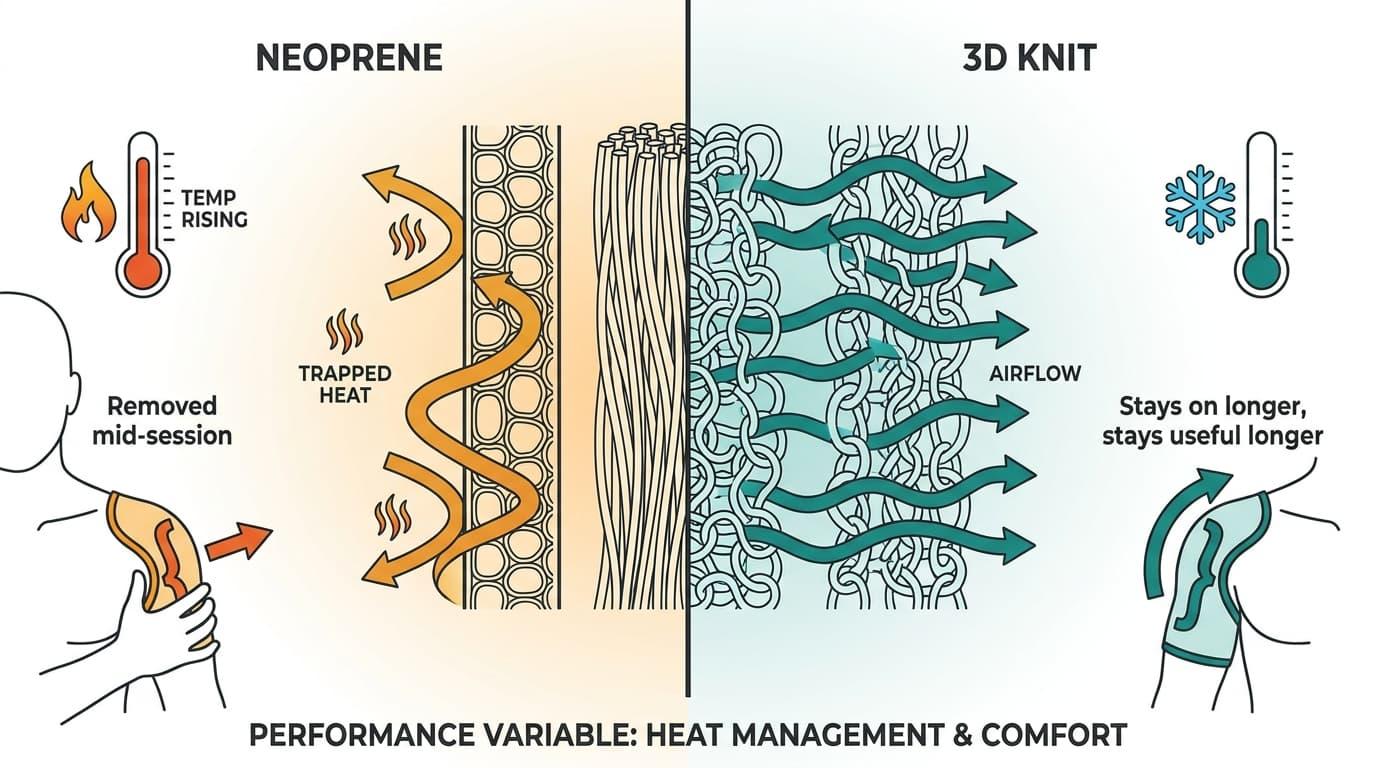
Neoprene traps heat. It’s the single biggest reason athletes remove a brace mid-session. 3D knit fabrics let air circulate across the skin, which is why breathable options stay on longer and stay useful longer. If you train hard or work physically, fabric choice is not a preference. It’s a performance variable.
Fit Consistency Under Load
A brace that feels great at rest but migrates, bunches, or loses tension during movement is actively undermining your proprioception. Your shoulder relies on consistent sensory input to track its own position. A shifting brace interrupts that signal.
Try any brace through a full range of motion before trusting it in training. Look for arm straps and accessible, single-handed adjustment straps, since fit often needs to be corrected mid-session to maintain consistent support under load.
Phase Match: Right Brace, Right Moment
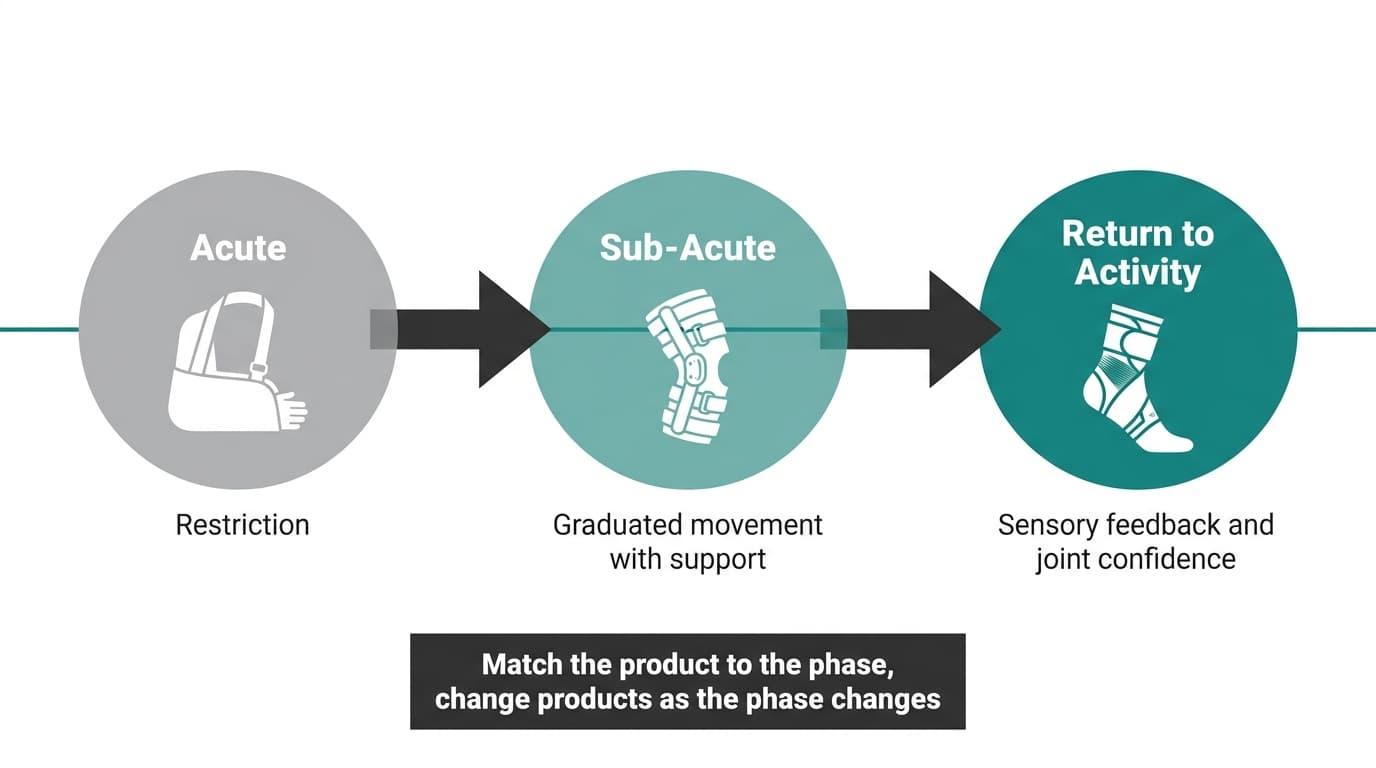
Acute injuries need restriction. In practice, shoulder brace limits movement differently depending on the phase, with more controlled movement later in rehab instead of full immobilization. Sub-acute recovery needs graduated movement with support.
Return to activity needs sensory feedback and joint confidence. A sling worn in the gym, or a performance brace worn post-surgery, both slow down recovery. Match the product to the phase and change products as the phase changes.
Bilateral vs. Side-Specific Design
Universal braces work on either shoulder. Sized or anatomically shaped options can deliver more precise compression but require you to order correctly and measure accurately. For most daily wear use cases, a well-made universal brace outperforms a poorly-fitted one.
How Long Should You Wear a Shoulder Brace Daily
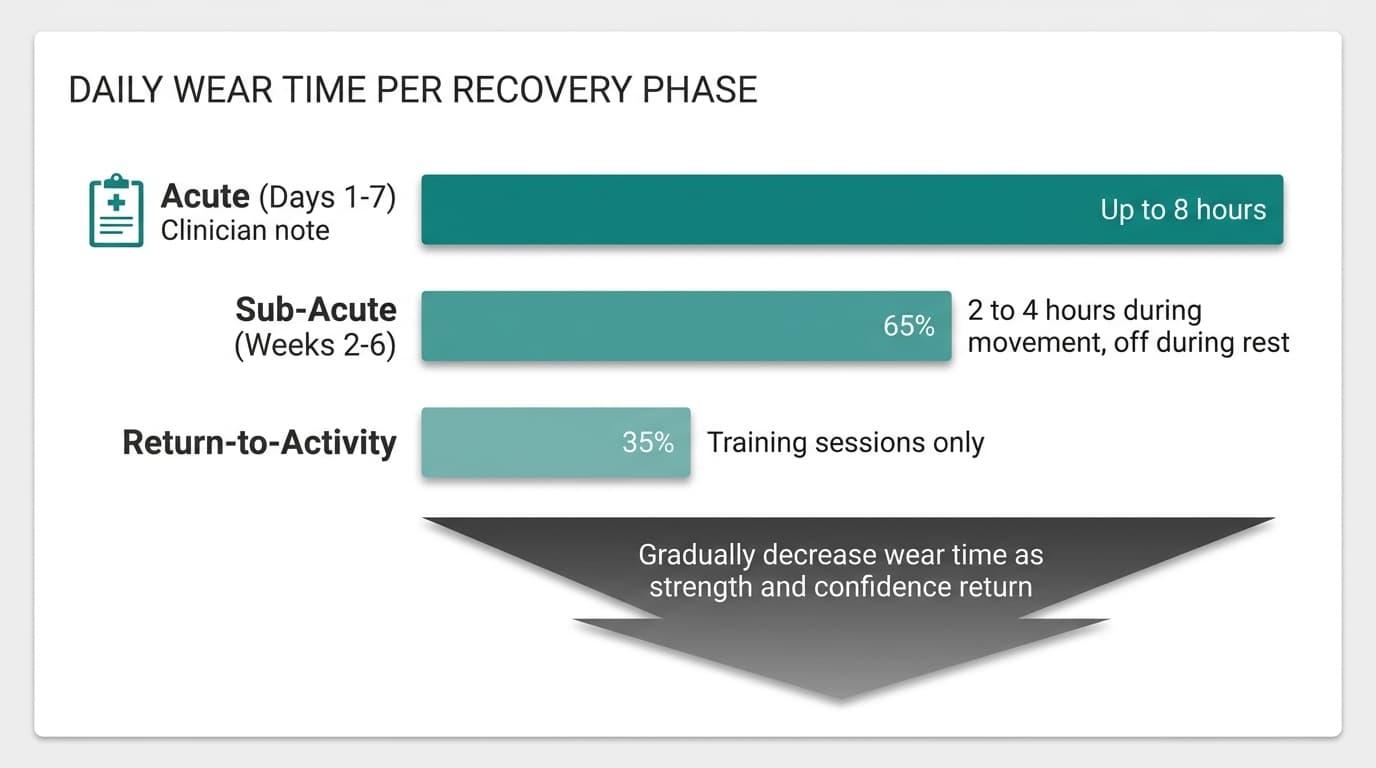
The general rule: wear it during activity, take it off during rest, though for a rotator cuff injury or after surgery, follow your healthcare provider's guidance. Here’s how that breaks down by phase:
-
Acute phase (days 1 through 7): Up to 8 hours or as directed by your clinician.
-
Sub-acute phase (weeks 2 through 6): 2 to 4 hours during movement; off during rest.
-
Return-to-activity phase: On for training sessions, off the rest of the day.
All-day wear without a clinical reason slows recovery. Your shoulder muscles need to work unassisted to rebuild strength. The longer you keep them off the hook, the longer they stay off the hook. Athletes should gradually decrease wear time as strength and confidence return through the recovery process.
Final Words
There’s a version of this where you pick the right brace, wear it at the right times, and pair it with structured rehab. That version is a smooth comeback. Then there’s the version where you wear the wrong product all day, skip the rehab because the brace feels like progress, and stall out six weeks in.
At Anaconda, we built our Shoulder Brace to be the one athletes actually keep on through the hard sessions. 3D knit construction, scapular stabilization, and a fit that does not quit when the training gets real. Come find out why over 400,000 athletes made the switch.
Frequently Asked Questions
Still deciding which shoulder brace is right for you? Here are quick answers to the most common questions about shoulder brace sizing, wear time, and recovery support.
Is it okay to wear a shoulder brace all day?
No, not all shoulder braces are intended for constant daily wear, since some are built to stabilize the shoulder joint while others are meant for training, sports, or other active use. Overuse can also reduce natural shoulder movement and muscle engagement over time. For most athletes, it's best used when extra support is actually needed.
How do I know if my shoulder brace is the right size?
A shoulder brace is the right size if it feels secure without causing numbness, tingling, or discomfort. Many products list chest sizes or bicep measurements, while others use universal sizing with adjustable straps. It should stay in place throughout your workout without slipping or requiring frequent adjustments. A properly fitted brace provides support while still allowing comfortable movement. If it shifts constantly, you may need a different size or design.
Should I wear a shoulder brace while sleeping?
No, most shoulder braces aren’t designed for overnight use. Sleeping in a brace can create unnecessary stiffness and discomfort.
Sleeping on the injured area can also increase discomfort, especially in the initial stages after a torn rotator cuff or surgery. If shoulder pain is affecting your sleep, supportive pillows and proper sleeping positions are usually more effective. Always follow your healthcare provider's advice if overnight bracing has been recommended.
Will a shoulder brace help with a torn labrum?
Yes, a shoulder brace can help support a shoulder with a torn labrum or rotator cuff tears during daily activities and training. It may reduce discomfort and improve stability by limiting excessive movement, and physical therapy often works alongside bracing in the healing process. However, a brace doesn’t heal the tear itself. A torn labrum or rotator cuff tear left untreated can lead to chronic pain or further injury, so medical evaluation matters. The best treatment approach depends on the severity of the injury and medical guidance.
When should I stop wearing my shoulder brace?
You should stop wearing a shoulder brace when your shoulder feels stable, strong, and pain-free without extra support. Many athletes gradually reduce wear time as confidence returns, since a good shoulder support brace should support healing without becoming a crutch. A good sign is being able to train and perform daily activities comfortably without relying on the brace. If you're recovering from an injury, follow your clinician's recommendations before discontinuing use completely. Stopping is appropriate once daily tasks and shoulder motions feel stable, and confidence in the recovery process has returned.


