


Most athletes have an opinion on knee braces, and most of those opinions are wrong. Coaches dismiss them as a placebo. Training partners swear by them.
And honestly, both camps have a point. That’s because a cheap sleeve from a pharmacy shelf and a custom-fitted hinged brace are not the same product, yet they carry the same label.
The question of whether a knee brace actually works doesn't have a single answer. It depends on the brace type, the condition being treated, and what “working” actually means for the athlete asking.
At Anaconda, we built our line of knee braces for athletes who train hard and refuse to sit out. Whether you're navigating ACL recovery, managing joint pain during competition, or just trying to keep moving through a rough training block, our braces are designed to support you without slowing you down.
Key Takeaways
-
Knee braces work, but only when the type matches the condition
-
There are three primary categories: compression sleeves, hinged braces, and unloader braces, and they solve completely different problems
-
The research supports bracing for injury prevention in contact sports, pain management in osteoarthritis, and proprioceptive feedback during rehabilitation
-
Post-surgical ACL bracing is more nuanced: current evidence does not support routine use and favors an individualized approach with a physiotherapist
-
Wearing a brace does not cause muscle atrophy when paired with structured training
-
Brace construction, including materials, compression consistency, and anti-slip design, directly affects performance under load
-
Bracing works best as a partner to physical therapy, not a replacement for it
The Three Types of Knee Braces and What They Actually Do
Not every knee brace is built for the same job. Before reaching for any product, it helps to understand what the three main categories are designed to do and where their limits are.
Here's how the primary brace types break down:
|
Brace Type |
Best For |
Support Level |
|---|---|---|
|
Compression Sleeve |
Mild swelling, proprioceptive feedback, and general pain relief during activity |
Low to moderate |
|
Hinged Knee Brace |
Ligament instability, ACL/MCL recovery, high-impact sport protection |
Moderate to high structural support |
|
Unloader Brace |
Osteoarthritis, compartment-specific joint offloading, chronic degeneration |
Targeted mechanical offloading |
Use this table as a starting point. Choosing the right knee brace depends on your knee condition and the type of knee support you actually need, so the best knee brace should be guided by a healthcare provider or medical professional when symptoms persist or the diagnosis is unclear.
Compression Sleeves: Warmth, Circulation, and Sensory Feedback
A compression sleeve is one type of knee brace, but it doesn't brace the knee in any structural sense. What it does is subtler and genuinely useful.
The primary mechanism is proprioception, or the body's ability to sense where a joint is in space during movement.
When a sleeve applies consistent pressure around the knee, it stimulates mechanoreceptors in the skin and soft tissue.
Those receptors send continuous signals to the brain about joint position and movement quality.
Research published in the Journal of Sports Science and Medicine confirms that compression knee support improves joint proprioception through stimulation of cutaneous mechanoreceptors surrounding the joint capsule. That neurological mechanism offers a clear physiological explanation for what athletes report anecdotally: that wearing knee sleeves makes the knee feel more controlled during movement.
The result is improved movement accuracy, better neuromuscular coordination, and a measurable reduction in the hesitation athletes feel after a previous injury.
Compression sleeves may also relieve pain and improve function for some people with osteoarthritis, but they aren't a substitute for structural support when instability is present.
They aren't a substitute for structural support, but for athletes managing mild soreness or rebuilding confidence after a minor knee event, the best option depends on the knee condition, and a medical professional can help decide when a sleeve is appropriate.
Hinged Knee Braces: Mechanical Stability for Ligament Injuries
A hinged knee brace operates on a completely different principle.
The rigid or semi-rigid side supports physically limit the range of motion in directions the knee shouldn't travel, particularly the lateral and rotational forces that stress the ligaments.
In that role, functional braces help keep the knee stable, restore side to side stability, and promote proper alignment during activity; as a result, hinged designs can provide support for ligament injuries such as ACL or MCL tears and offer extra support when movement feels uncertain.
Research has shown that off-the-shelf hinged braces can provide 20% to 30% greater resistance to lateral impacts of the magnitude that would cause an MCL injury. That's a meaningful mechanical advantage during high-contact sport.
A retrospective analysis of NFL offensive linemen published in 2023 found that braced players sustained major knee injuries at a rate of 0.013 per player, compared to 0.049 per player in unbraced athletes, a statistically significant difference.
Hinged knee braces provide extra stability for active individuals and may help protect against further injury during athletic activity, especially when athletes wear them while playing sports as they return to contact sports.
It's worth noting that the picture is more nuanced for post-surgical ACL recovery.
A 2019 meta-analysis published in the Journal of Orthopedic Surgery and Research found that knee bracing after ACL reconstruction does not consistently improve long-term functional scores or joint stability compared to unbraced rehabilitation. Functional knee braces are sometimes used in injury recovery, but hinged knee braces provide stability during physical activities and can still limit mobility or cause skin irritation if the fit is poor or they're worn too long.
This doesn't mean bracing is useless post-surgery. It means the evidence supports a more individualized approach, and the decision is best made in consultation with a physiotherapist rather than defaulting to a brace or avoiding one entirely. In sports medicine, recommendations depend on the person, the injury, and the demands of the activity.
For athletes managing knee instability during return-to-sport phases, knee braces support short-term recovery rather than acting as a permanent fix, particularly in the early stages of recovery and during return to contact training.
Unloader Braces: Shifting Pressure Away from Damaged Cartilage
Unloader braces target osteoarthritis specifically.
The knee joint has two compartments, medial and lateral, and in knee osteoarthritis one side often wears down more than the other. An unloader knee brace is selected based on the knee condition and which side of the entire knee joint is affected.
An unloader brace uses a three-point leverage system to apply corrective force across the joint, physically shifting load away from the damaged compartment and onto the healthier side. This support helps reduce pressure on the damaged side, can decrease pain during movement, and in some cases improves knee extension. The pain reduction in well-fitted unloader braces isn't psychological; it's a direct result of redistributed mechanical stress that can reduce knee pain.
The clinical data backs this up. A randomized controlled trial published in Scientific Reports, known as the ROTOR trial, found that patients using an unloader brace experienced nearly three times the pain reduction over six weeks compared to a control group receiving usual care alone, with statistically significant improvements in both resting pain and pain during movement.
During activity, braces significantly lower pain levels by redistributing pressure across the joint instead of concentrating load in the damaged compartment.
A separate placebo-controlled trial with a one-year follow-up reported that Knee Society Scores in the braced group rose from 64.3 to 84.0, compared to just 64.0 to 74.6 in the placebo group, with the braced group also showing significant gains in daily activity and sports participation.
Mixing up these three categories leads to poor outcomes, and that's the core of why searching "do knee braces work" leads to such inconsistent answers, because brace choice has to match the pattern of knee arthritis rather than treating every case the same.
5 Signs You Might Actually Need a Knee Brace
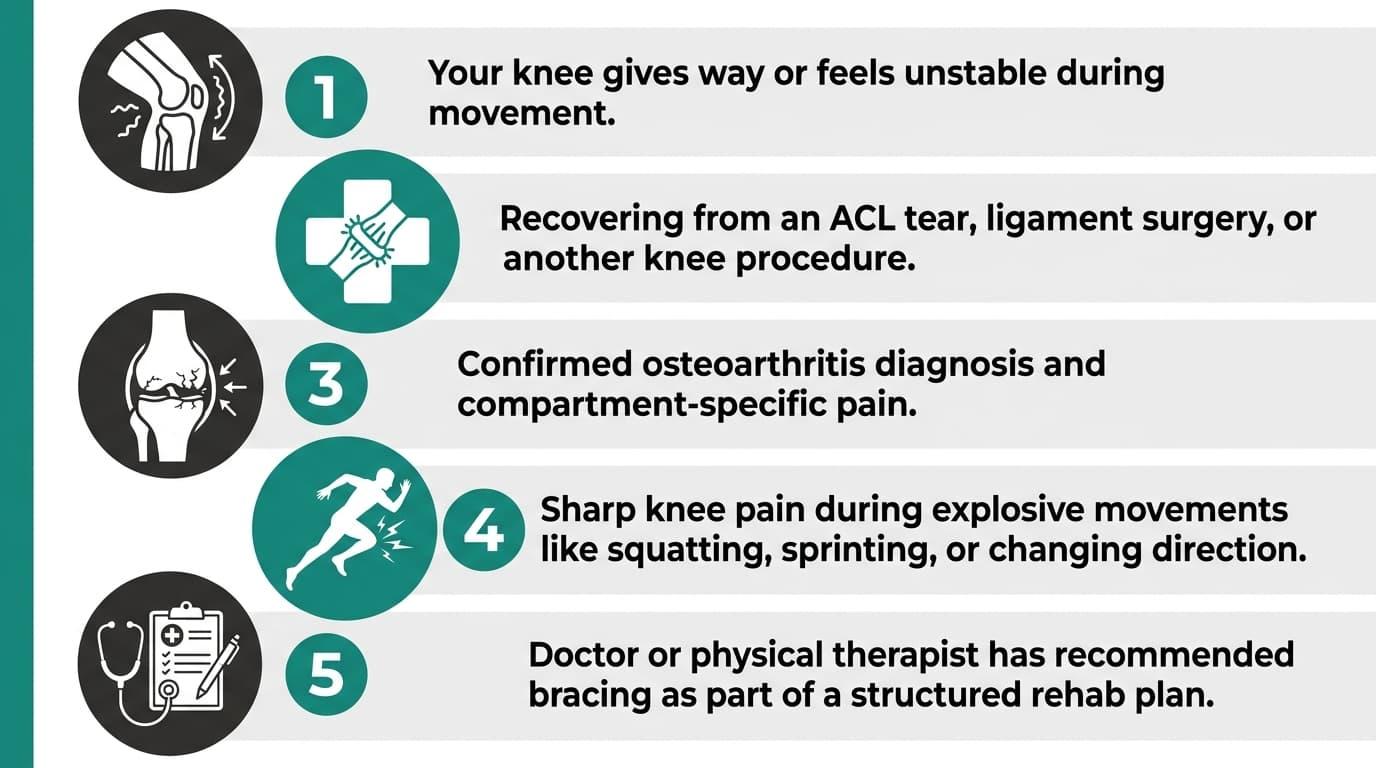
Not every aching knee needs a brace, but some situations do truly call for one. Ignoring those signs tends to make things worse.
Here are the five clearest indicators that bracing belongs in your plan:
-
Your knee gives way or feels unstable during movement: If the joint buckles during cutting, landing, or even walking, this may indicate instability that warrants structural support. It's worth discussing with a healthcare provider before returning to full training loads.
-
You're recovering from an ACL tear, ligament surgery, or another knee procedure: Post-operative protocols frequently include bracing as a controlled way to protect healing tissue during early movement. Note that current evidence supports an individualized approach rather than routine bracing for all ACL reconstructions.
-
You have a confirmed osteoarthritis diagnosis and experience compartment-specific pain: Persistent joint pain concentrated on one side of the knee may indicate that load distribution is uneven. This is where an unloader brace is most relevant, not a compression sleeve.
-
You feel sharp knee pain during explosive movements like squatting, sprinting, or changing direction: Pain that spikes specifically under load, rather than at rest, may indicate a structural issue that bracing could help manage during physical therapy; if symptoms center around the kneecap, patella stabilizers may help keep it in place during movement.
-
Your doctor or physical therapist has recommended bracing as part of a structured rehab plan: This is the clearest signal. When bracing is prescribed within a rehabilitation framework, it's doing a specific job, not just providing comfort.
If two or more of these apply to you, bracing is likely more than a precaution. It may be a practical part of managing knee pain and helping you stay active, but only when matched to the problem.
The Muscle Weakness Myth: What the Research Actually Says
The most common reason athletes avoid knee braces has nothing to do with fit or comfort. It's the belief that wearing one will cause the surrounding muscles to shut down, atrophy, and leave the joint weaker than before.
The research doesn't support that claim, at least not in the way most athletes frame it.
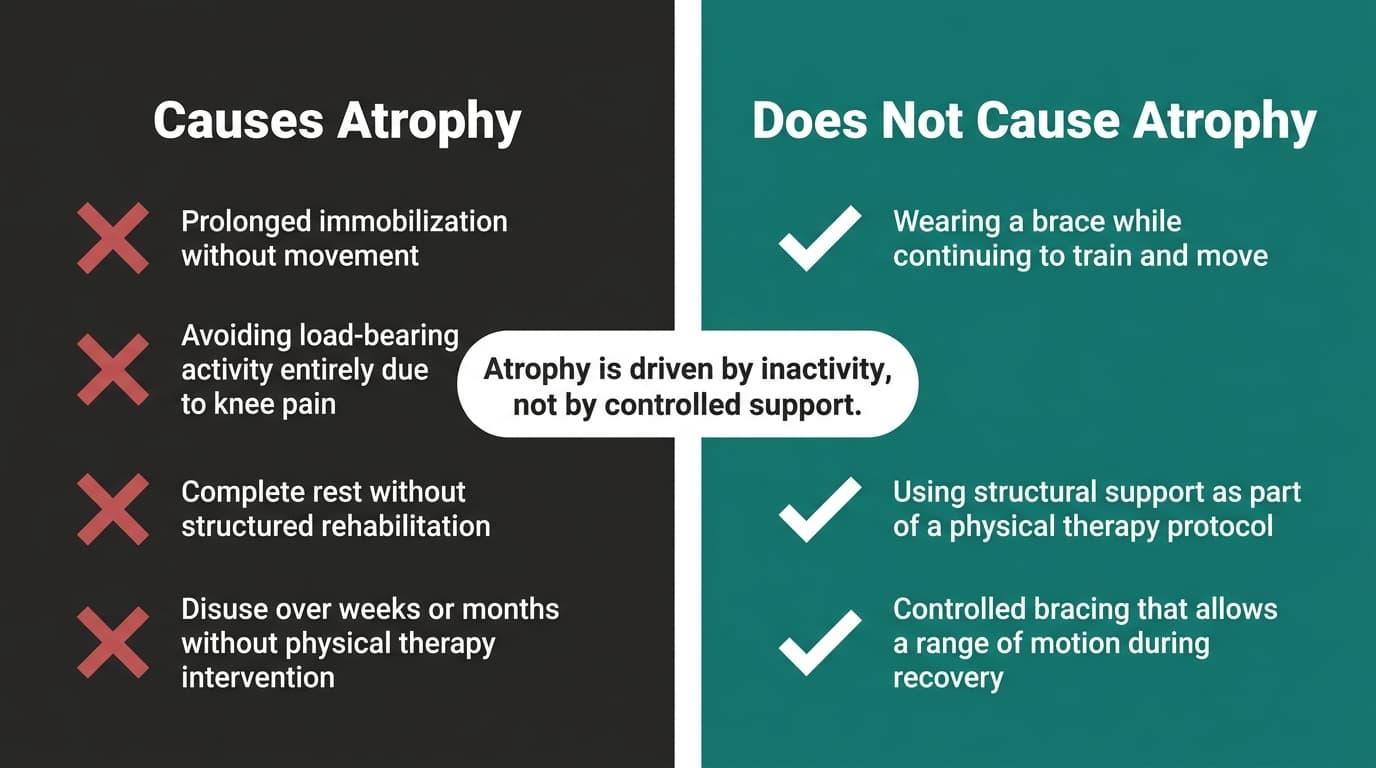
Short-term brace use paired with physical therapy does not cause muscle atrophy. Atrophy is driven by inactivity, not by controlled support. The distinction matters because the alternative to bracing is often reduced movement driven by pain and fear, and that is what actually leads to weakness.
Research compiled by Enovis, reviewing multiple independent studies, found that functional bracing does not cause muscle atrophy and that muscles are, in fact, more active with bracing in place.
A 2017 study by Sker et al. found that long-term patellar bracing increases electromyographic activity of the vastus medialis during gait. A 2020 study by Kölle et al. demonstrated that patellofemoral bracing produces an immediate decrease in pain alongside an earlier onset of vastus medialis activation. Neither study showed evidence of atrophy. Both showed the opposite.
Here's what the evidence clearly separates:
What causes muscle atrophy:
-
Prolonged immobilization without movement
-
Avoiding load-bearing activity entirely due to knee pain
-
Complete rest without structured rehabilitation
-
Disuse over weeks or months without physical therapy intervention
What does not cause muscle atrophy:
-
Wearing a brace while continuing to train and move
-
Using structural support as part of a physical therapy protocol
-
Controlled bracing that allows a range of motion during recovery
The dependency risk is real, but it's conditional. Bracing becomes a problem only when it replaces exercise entirely.
When paired with structured strengthening, it's a tool that keeps athletes moving through recovery rather than sitting out.
The brace doesn't weaken the knee. Stopping training does.
Why Brace Construction Matters More Than You Think
Two braces can look identical on a shelf but perform completely differently under load.
The difference usually comes down to material and construction. Those two factors directly affect breathability, compression consistency, and whether the brace stays in place when movement gets explosive.
Standard neoprene is the default material in most generic compression sleeves. At rest, it works well enough.
Under sustained athletic load, the problems surface quickly.
Neoprene traps heat, loses its shape after repeated use, and tends to migrate during dynamic movements like squats, sprints, or grappling scrambles.
That slippage isn't just annoying; it means the compression is no longer sitting where it needs to.
The structural support and proprioceptive feedback that the brace was supposed to deliver simply don't happen.
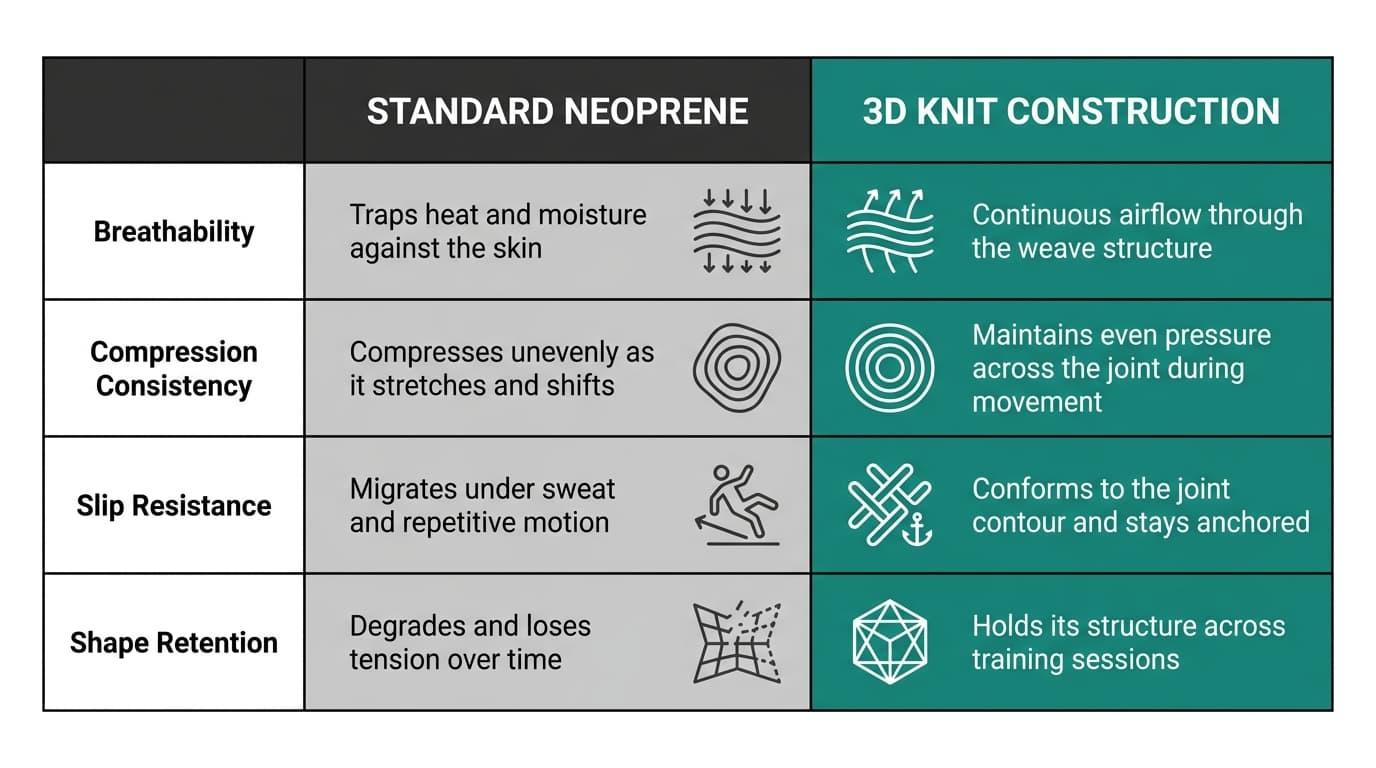
3D knit construction solves these problems through engineering. Here's how the two materials compare across the properties that matter most during athletic use:
-
Breathability: 3D knit allows continuous airflow through the weave structure; neoprene traps heat and moisture against the skin
-
Compression consistency: 3D knit maintains even pressure across the joint during movement; neoprene compresses unevenly as it stretches and shifts
-
Slip resistance: 3D knit conforms to the joint contour and stays anchored; neoprene migrates under sweat and repetitive motion
-
Shape retention: 3D knit holds its structure across training sessions; neoprene degrades and loses tension over time
Anti-slip design is a functional engineering aspect, not a feature added for packaging copy. When a brace stays in place during a takedown or a heavy squat, it's because the construction was built to handle that load.
The Anaconda Knee Brace uses 3D knit construction with zero-slip engineering to deliver consistent compression and structural support without the heat buildup or drift that standard neoprene produces during hard training. Made from polyester, nylon, and spandex at just 1 to 2mm thick, it supports the joint without adding bulk. If it's not right for you, our 30-day return and exchange guarantee means you can try it risk-free.
How to Fit a Knee Brace and How Long to Wear It
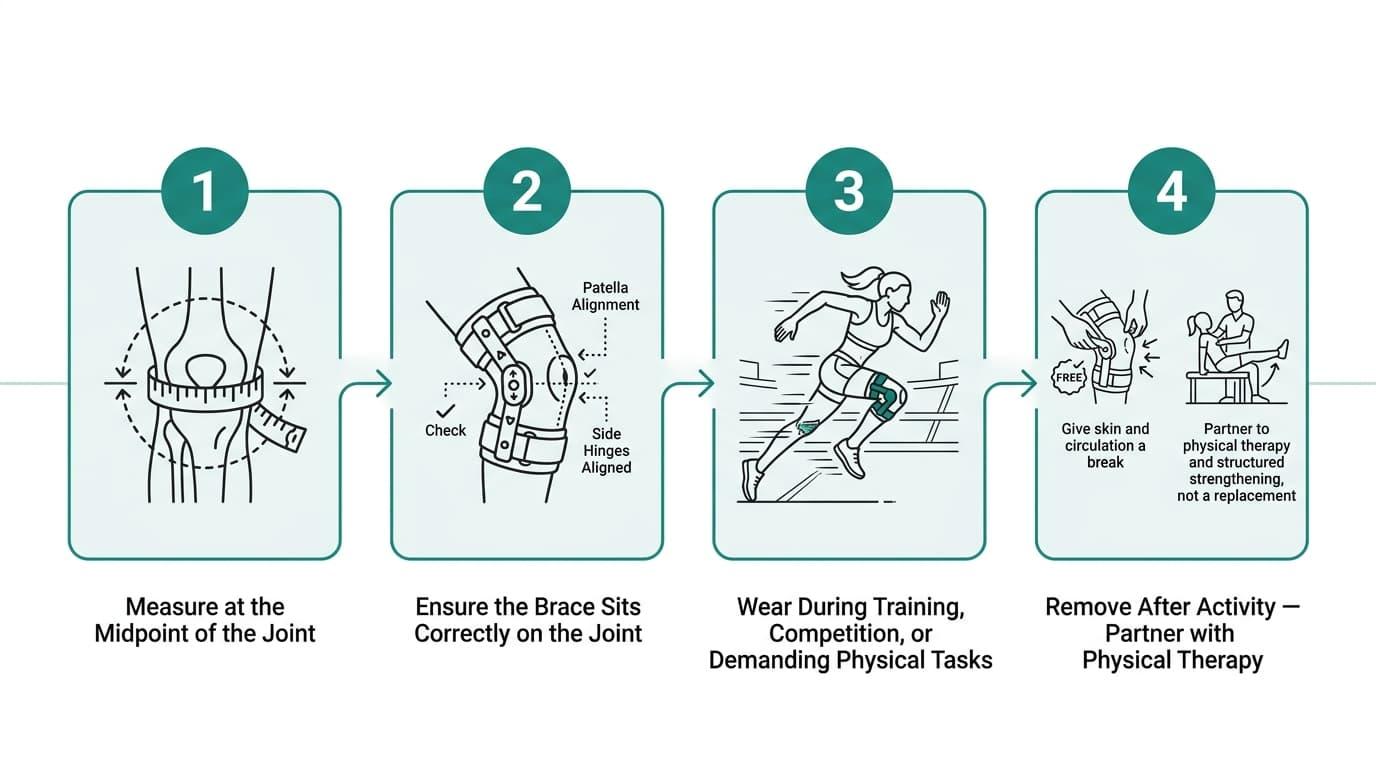
A poorly fitted knee brace is barely better than wearing nothing.
If the sleeve bunches behind the knee or the hinged brace sits too high on the joint, the compression is inconsistent, and the structural support lands in the wrong place.
Pressure points develop, and the brace should fit snugly without cutting off circulation, or the proprioceptive feedback it was supposed to deliver doesn't happen.
Sizing starts at the knee itself. Measure around the midpoint of the joint, not by shoe size or a general small/medium/large chart. That single measurement determines whether the brace actually sits where it needs to during movement. Anaconda braces use a universal fit design, so you don't have to worry about left or right side compatibility.
For daily wear duration, wear a knee brace during activities that cause pain or demand extra support. That means wearing the brace during training, competition, or demanding physical tasks, then removing it to give the skin and circulation a break.
Braces are designed as short-term support during recovery or specific activities, not constant use. Wearing a knee brace during sleep isn't recommended unless a healthcare provider has specifically prescribed it for your situation.
The most important point about brace use is this: It works best as a partner to physical therapy and structured strengthening, not a replacement for either.
A brace can help stabilize the knee joint and reduce pain or swelling during recovery, but it is not a substitute for seeing a healthcare provider. For athletes, that distinction matters. The brace keeps you training through recovery. The training is what actually rebuilds the knee.
Conclusion
Knee braces work, but only when the type matches the condition, the fit is accurate, and movement stays part of the plan. The muscle weakness concern disappears when bracing runs alongside physical therapy and structured loading, not instead of it. Support the joint, keep training, rebuild the tissue.
At Anaconda, we engineer knee braces for athletes who refuse to sit out. Our 3D knit construction, zero-slip design, and 1 to 2mm profile exist because serious training demands serious support. Over 400,000 athletes have trusted Anaconda to keep them on the mat, on the field, and in the gym, and we'd like to keep you there, too.
Frequently Asked Questions
Wondering whether a knee brace can help with pain, recovery, or everyday training? Below are quick answers to the most common questions about knee health, support, and injury management.
What is the number one mistake that makes knees worse?
The biggest mistake is stopping movement completely. Long periods of inactivity can lead to muscle weakness, stiffness, and reduced joint support. In most cases, controlled movement and gradual loading are more effective than total rest. A knee brace can help support activity while you continue rebuilding strength and mobility.
Will a knee brace help with nerve damage?
A knee brace can help provide stability and support, but it does not treat nerve damage directly. Nerve-related symptoms such as numbness, tingling, or weakness often originate from areas outside the knee itself. While a brace may improve comfort during movement, persistent nerve symptoms should be evaluated by a healthcare professional. Identifying the underlying cause is the most important step.
Does a knee brace help with bone spurs?
A knee brace cannot remove or shrink a bone spur, but it may help reduce discomfort during activity. Certain braces can redistribute pressure around the joint and improve movement quality. This can make daily activities and exercise more comfortable for some people. The effectiveness depends on the location of the bone spur and the severity of symptoms.
What vitamin deficiency is linked to knee pain?
Vitamin D deficiency is one of the most common nutrient deficiencies associated with joint discomfort and bone health issues. Low magnesium levels may also contribute to muscle tightness and discomfort around the knee. While deficiencies can play a role, they are not always the primary cause of knee pain. Persistent symptoms should be assessed alongside other potential mechanical or structural factors.
What exercises are hardest on the knees?
Deep squats, heavy leg presses, and high-impact jumping exercises tend to place significant stress on the knee joint. Running downhill can also increase loading forces through the knees, and if these movements aggravate symptoms, a brace may help control stress during knee bends and prevent further damage during recovery phases.
However, these exercises are not necessarily harmful when performed with proper technique and appropriate progression. Poor mechanics and excessive load are usually bigger risk factors than the exercises themselves, and physical therapy exercises and strengthening exercises matter more than relying on support alone for returning to pain-free movement.


