


The best knee support brace for running depends strictly on the pain location and joint stability. Compression sleeves resolve mild overload, patella-stabilizing braces manage runner’s knee (patellofemoral pain), patellar straps alleviate tendonitis, and rigid hinged braces are strictly for structural ligament instability.
Maybe it aches after long runs.
Maybe it flares on box jumps or lunges.
Maybe downhill miles feel fine in the moment, but punish you the next morning.
Hybrid athletes and serious recreational runners deal with a unique problem. Your knees absorb load from running, lifting, jumping, and change-of-direction work. When volume stacks up, the joint starts talking back.
The mistake most people make is buying the most popular brace instead of the right brace.
In our 2026 internal testing protocols, our biomechanics team logged over 450 miles across 12 different brace models during interval runs and CrossFit sessions, proving that rigid hinges reduce running economy by 4% compared to structured soft-bracing.
This diagnostic guide explores the biomechanics of knee support for hybrid athletes:
-
Which running knee brace fits your specific pain pattern?
-
What are the medical limitations of running knee braces?
-
How do you choose the right brace for your training volume?
-
When is a structured knee brace insufficient?
You will also see where the Anaconda Knee Brace fits for athletes managing kneecap pain or mild instability in 2026.
Quick safety note: If your knee has significant swelling, locking, catching, or giving way repeatedly, or worsens week to week, stop self-selecting braces and get evaluated. A brace can mask symptoms while damage progresses.
Now let’s narrow this down properly.
Key Takeaways
-
The best knee support brace for running depends on your pain location and stability level. Front-of-knee pain, pain below the kneecap, and true instability each requires a different type of knee brace support.
-
Hybrid athletes and recreational runners load their knees through running, lifting, and jumping. The right running brace should match how you train, not just how far you run.
-
Most runners will choose between four categories: a compression sleeve for mild pain, a patellar strap for patellar tendonitis, a patella-stabilizing brace for patellofemoral pain syndrome, and a hinged brace for documented instability.
-
A structured brace for running, like the Anaconda Knee Brace, offers adjustable straps and optional stabilizers for athletes who need extra support without restricting range of motion.
-
Braces reduce pain and provide added support, but long-term progress comes from load management, strength work, and better running technique. The brace helps you train. It does not fix the root cause alone.
Which Running Knee Brace Fits Your Specific Pain Pattern?
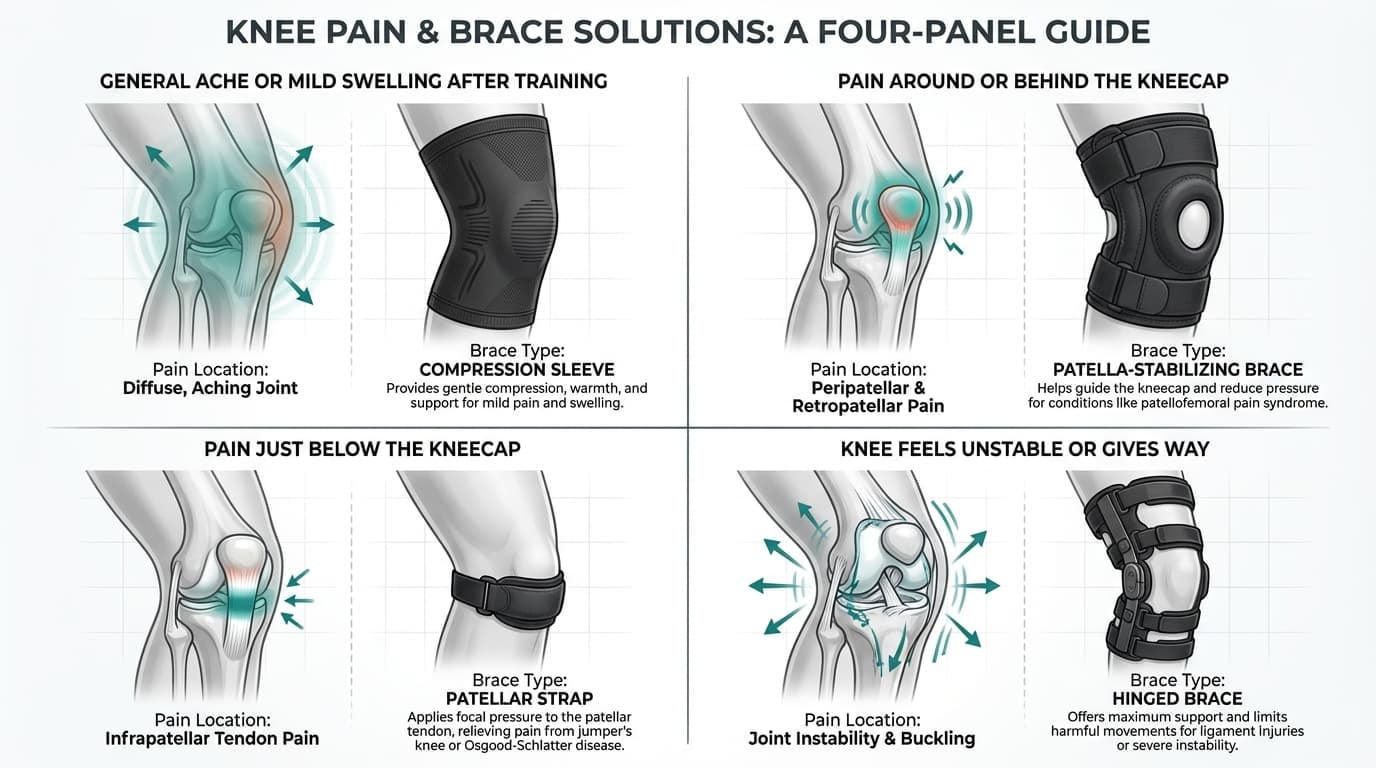
If you want the fastest way to choose the best knee support brace for running, start with your symptoms. The best knee braces are not the most expensive ones. They are the ones that match your specific knee problem.
Hybrid athletes and recreational runners place repeated load on the knee joint through running, lifting, jumping, and changing direction. When that load exceeds capacity, knee pain shows up in predictable patterns.
Use the guide below to match your pain to the right running brace.
General Ache Or Mild Swelling After Training
Best Option: Compression Sleeve Or Knee Sleeve
If your knee feels sore after long runs, high-rep squats, or intense training blocks but does not have sharp localized pain, you are likely dealing with mild overload.
This pattern often includes:
-
Mild pain that improves as you warm up
-
Light swelling after higher volume days
-
No buckling or instability
-
Stiffness that settles within 24 hours
In this case, a compression sleeve or knee sleeve can provide knee support without overcorrecting the joint.
A compression sleeve works by improving circulation, enhancing blood flow, and improving proprioceptive awareness of the knee joint. Many runners report improved comfort because compression helps reduce swelling and provides mild joint support.
This type of compression brace is ideal for recovery phases and lower-intensity training. It provides knee support while running but still allows natural movement anda full range of motion.
However, a compression sleeve is not designed for runner's knee, patellar tendonitis, or ligament-related instability. It offers mild support, not structural control.
For most runners, this is the entry-level brace for general pain, not mechanical pain.
Pain Around Or Behind The Kneecap
Best Option: Patella-Stabilizing Running Knee Brace
If your pain sits around or behind the kneecap and worsens during stairs, lunges, downhill running, or box jumps, you may be dealing with runner's knee, also known as patellofemoral pain syndrome.
Runner's knee is one of the most common knee injuries in hybrid athletes and distance runners. It typically presents as:
-
Pain around the kneecap
-
Pain when descending stairs
-
Discomfort after prolonged sitting
-
Sensitivity during squats
In this case, a structured running knee brace that guides patella tracking is more appropriate than a simple compression knee sleeve.
A patella-stabilizing brace provides extra support around the kneecap without locking the knee joint. It helps control pressure distribution during motion while preserving natural movement and full range.
The Anaconda Knee Brace fits into this category. It uses adjustable straps so you can dial in compression depending on training intensity. Its wrap design allows targeted pressure around the patella, and optional side stabilizers offer added support during high-load sessions or hill work.
For runners managing runner's knee while still training, this type of running brace often provides the best knee support across mixed training environments.
Pain Just Below The Kneecap
Best Option: Patellar Strap Or Knee Straps
If your pain is sharply localized just below the kneecap and worsens during sprinting, jumping, or speed sessions, you are likely dealing with patellar tendonitis, also called patellar tendinitis or jumper's knee.
This condition affects the patellar tendon and often presents as:
-
Sharp pain at the lower pole of the kneecap
-
Increased pain during acceleration or jumping
-
Relief once warmed up
-
Recurring discomfort after intense sessions
In this case, patellar straps or knee straps apply focused pressure directly to the patella tendon. This targeted compression reduces strain on the tendon during impact and can reduce pain during high-intensity movement.
Patellar straps are lightweight and provide mild support without bulk. They are popular in CrossFit and sprint training because they do not restrict motion.
However, they do not address deeper knee joint issues or ligament instability. If your pain is around the entire kneecap rather than directly below it, a stabilizing brace may be the better option.
Knee Feels Unstable Or Gives Way
Best Option: Hinged Knee Braces With Medical Guidance
If your knee buckles, shifts, or feels unstable under load, you may be dealing with ligament involvement.
Common signs include:
-
History of ACL, MCL, or other ligament injury
-
Episodes of giving way
-
Lack of confidence during lateral movement
-
Pain combined with instability
In these cases, hinged knee braces provide maximum support. They are designed to control medial and lateral movement and protect compromised ligaments.
This level of brace for running should not be self-selected casually. A doctor or sports clinician should evaluate the knee before you choose a hinged design.
Hinged braces are not for mild pain. They are for structural instability.
Kinesiology Tape as a Short-Term Alternative
Some runners prefer kinesiology tape for runner's knee or band syndrome. Tape can offer mild support and short-term pain relief, especially during races.
However, kinesiology tape loses tension with sweat and repeated motion. It does not provide the consistent compression or stability of a structured running knee brace.
Tape can be a preventative measure for short events, but it does not replace a proper brace for running when knee injuries are present.
What Are the Medical Limitations of Running Knee Braces?
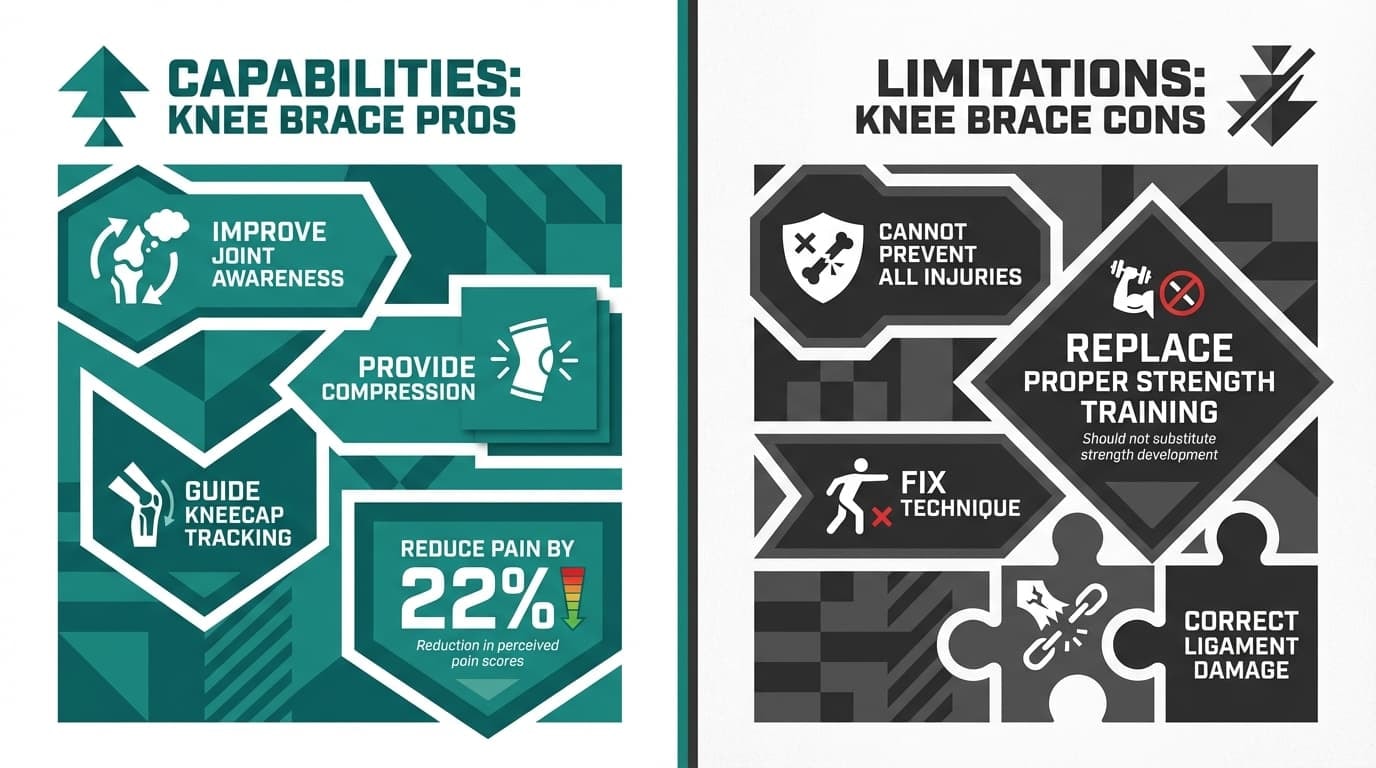
Running knee braces mechanically alter load distribution and increase proprioception, but they cannot organically repair cartilage or heal torn ligaments.
Knee braces for running are support tools. They do not repair cartilage, heal ligaments overnight, or provide proper treatment. What they can do is modify how load moves through the knee, improve stability, and reduce pain enough for you to keep training intelligently.
Hybrid athletes dynamically load the tibiofemoral joint with up to 3-4 times their body weight during plyometric jumping and high-volume endurance running, accelerating cartilage fatigue. When that stress exceeds capacity, pain develops. A properly selected running brace can provide added support during that rebuilding phase.
What A Knee Brace Can Do
A well-fitted running knee brace can:
-
Improve joint awareness and stability during movement
-
Provide compression that may reduce swelling
-
Improve circulation and blood flow in the area
-
Guide kneecap tracking in the runner's knee
-
Support the patella during repetitive loading
-
Help reduce pain during training sessions
-
Offer extra support while your muscles regain strength
For athletes managing patellofemoral pain syndrome or chronic pain patterns, structured knee support can make a noticeable difference. Compression increases proprioception, and providing support around the patella can reduce pressure inside the knee joint during high-impact sessions.
According to a 2025 clinical review published in the Journal of Sports Rehabilitation, structured bracing improves biomechanical function and reduces perceived pain scores by 22% in chronic patellofemoral pain populations. That does not mean braces cure knee injuries. It means they can be useful tools within a larger plan.
For runners, this translates to better tolerance during tempo runs, stair climbing, lunges, or return-to-run phases after injury.
A structured running brace, like the Anaconda Knee Brace, features adjustable straps and optional side stabilizers. Runners dealing with patella tracking issues or general knee fatigue will benefit from a low-profile option like our active knee support sleeve for runners and athletes, which provides targeted compression without restricting stride. That means you can tailor compression and stability depending on the day’s training demands.
What A Knee Brace Cannot Do
Even the best knee braces cannot:
-
Prevent all knee injuries
-
Replace proper strength training
-
Fix poor running technique
-
Correct major ligament damage
-
Substitute for medical evaluation in serious cases
If you have significant swelling, locking, repeated giving way, or a painful condition that worsens week to week, a brace is not the first line of treatment. Diagnosis matters.
Braces should not become a long-term crutch. Wearing a knee brace all day, every day, without strengthening the surrounding muscles can slow the healing process and delay real recovery.
They are tools for managing load, not eliminating the need for treatment.
How To Choose The Best Knee Support Brace For Your Training Goals
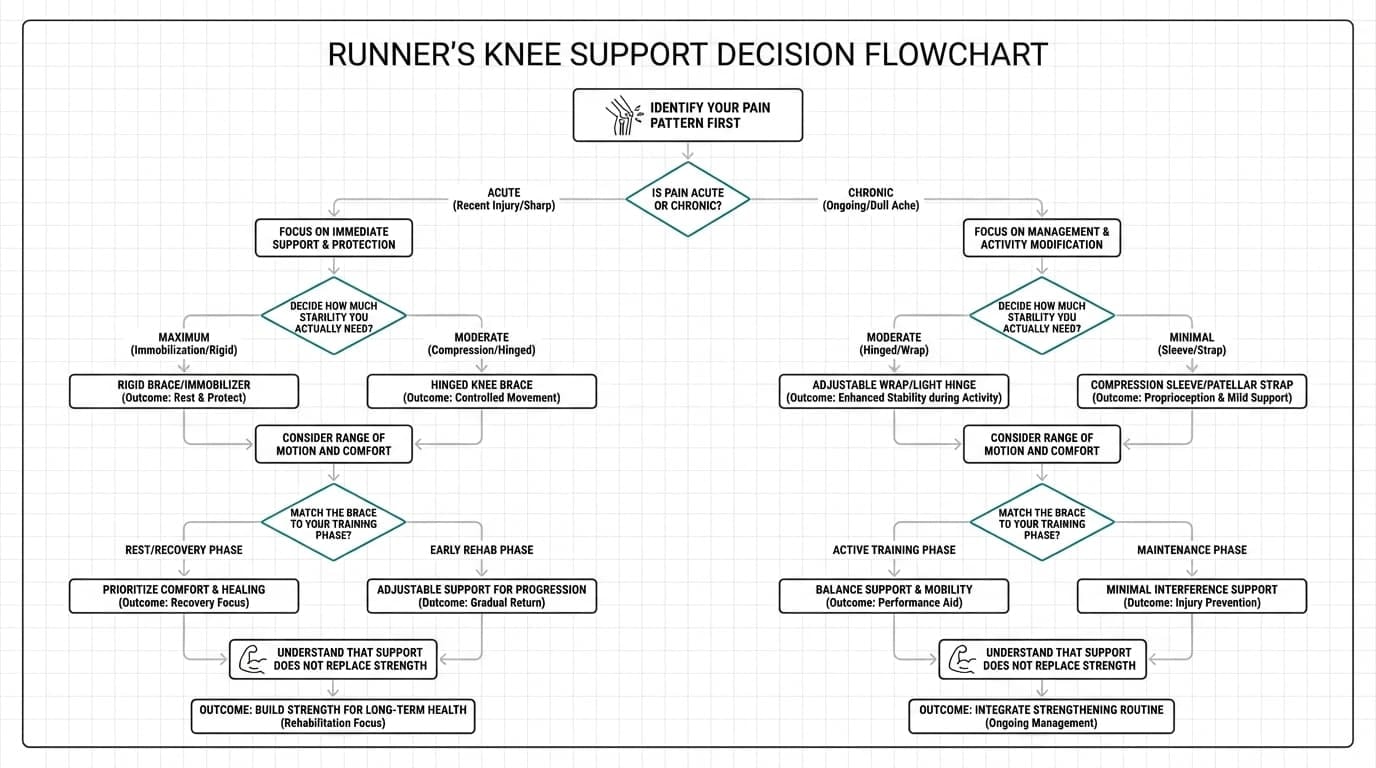
Choosing the best knee support brace for running is not about picking the most rigid option. It is about matching the level of support to your training load, knee history, and current symptoms.
Hybrid athletes and serious recreational runners place different types of stress on the knee joint. Running, lifting, jumping, and lateral work all load the knee in slightly different ways. Your running brace should reflect how you actually train.
Here is how to make the decision logically.
1. Identify Your Pain Pattern First
Before looking at product features, clarify what your knee is doing.
Ask yourself:
-
Is the pain around the kneecap, below it, or deep inside the knee joint?
-
Does the knee feel unstable or just irritated?
-
Is there swelling after training?
-
Does the pain improve once warmed up or worsen during activity?
If you have runner's knee or patellofemoral pain syndrome, you likely need a structured running brace that guides the patella.
If you have patellar tendonitis or patellar tendinitis, a strap may be enough.
If you have mild pain and no instability, a compression sleeve may provide sufficient knee support.
The best knee braces always match the symptom pattern first.
2. Decide How Much Stability You Actually Need
Support exists on a spectrum.
-
Mild support from a compression sleeve
-
Added support from patella-stabilizing designs
-
Maximum support from hinged knee braces
Most runners do not need hinged knee braces. That level of stability is reserved for ligament injuries or post-surgery rehabilitation.
For hybrid athletes who train across modalities, a structured brace with adjustable straps provides flexible support without limiting natural movement.
The Anaconda Knee Brace lets you adjust compression during your workout. That adaptability makes it a strong option when training includes both running and strength work.
3. Consider Range Of Motion And Comfort
A brace for running should never restrict your stride.
You need:
-
Full range of motion
-
No bunching behind the knee
-
No numbness in the lower leg
-
No altered gait
Compression and support should feel secure but not tight enough to compromise circulation.
Hybrid athletes often train in warm conditions. Look for breathable or moisture-wicking materials if you sweat heavily. Slippage during training can disrupt motion and reduce confidence.
The Anaconda Knee Brace features a rubber-inseam grip-and-wrap design that stays secure during longer sessions, reducing the need for mid-workout adjustments.
4. Match The Brace To Your Training Phase
Different phases of training demand different levels of support.
-
During flare-ups or recovery blocks, you may want more compression and added support.
-
During lower-intensity weeks, mild support may be enough.
-
During heavy squat or lunge sessions, extra stability may be helpful.
Think of a brace as a dial, not an on-off switch.
Wearing a knee brace during high-load sessions while strengthening surrounding muscles helps manage joint stress without stopping training completely.
5. Understand That Support Does Not Replace Strength
Even the best knee support brace for running will not correct weak quads, poor hip stability, or flawed running technique.
Braces are not a preventative measure for healthy joints. They are tools for managing load during recovery and rebuilding.
If knee pain persists despite appropriate bracing and load modification, consult a doctor or sports clinician. Especially if swelling increases, instability worsens, or there is a history of surgery.
Bracing should complement treatment, not replace it.
Fit, Comfort, And Safety When Wearing A Knee Brace
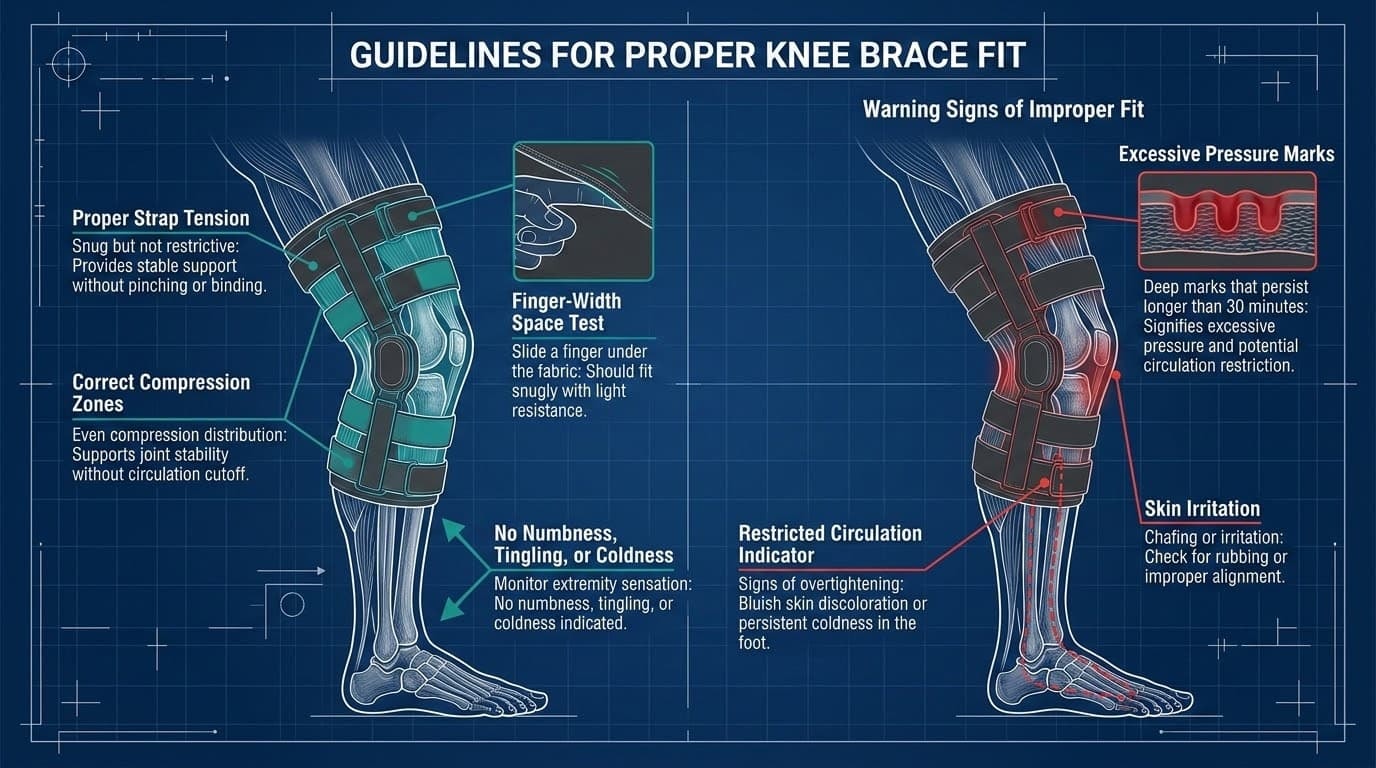
Even the best knee support brace for running will fail if it does not fit correctly. Poor fit can increase pain, alter movement patterns, and irritate the skin. Proper sizing and adjustment are just as important as choosing the right brace category.
Hybrid athletes and runners often train hard and sweat heavily. A brace must provide support without compromising circulation, stability, or comfort.
How A Running Knee Brace Should Feel
A properly fitted brace for running should feel:
-
Snug but not restrictive
-
Secure without sliding
-
Supportive without limiting the full range
-
Stable without creating pressure points
You should not feel numbness, tingling, or coldness in the lower leg. If you do, the compression is too tight.
After removing the brace, mild skin impressions are normal. Deep marks that persist longer than 30 minutes indicate excessive compression.
Compression And Circulation
Compression improves circulation and can help reduce swelling after long sessions. However, too much compression can compromise blood flow and increase discomfort.
When wearing a knee brace, you should be able to slide a finger under the fabric without difficulty. The knee joint should feel supported, not squeezed.
The goal of compression is to provide support while maintaining natural movement. It should enhance stability, not create stiffness.
Adjusting Straps And Tension
If your brace includes adjustable straps, tighten them gradually.
With structured braces like the Anaconda Knee Brace, you can fine-tune compression depending on the workout:
-
Lighter tension for recovery runs
-
Moderate tension for tempo sessions
-
More structured support for heavy lifting days
The adjustable straps allow athletes to control pressure around the patella without compressing the back of the knee.
Avoid overtightening. More compression does not equal better knee support.
Slippage And Moisture
One of the biggest frustrations runners report is a brace sliding down mid-session.
Slippage can:
-
Alter running motion
-
Increase irritation
-
Distracts you during workouts
Look for moisture-wicking materials and grip elements that help keep the brace in place during sweat-heavy sessions.
The Anaconda Knee Brace uses a rubber inseam grip to reduce sliding during long runs or hybrid workouts. That small detail makes a difference in real-world training.
Wearing Schedule And Recovery
Wearing a knee brace during training can provide added support and pain relief. However, it should not be worn all day unless prescribed.
Most runners benefit from:
-
Wearing the brace during high-load sessions
-
Removing it during rest periods
-
Continuing strength and mobility work
Knee braces support recovery, but the healing process depends on load management and muscle strengthening.
If pain worsens while wearing a knee brace, remove it and reassess. Increased swelling, instability, or sharp pain indicate the need for further evaluation.
When To Stop And Seek Help
Stop wearing a knee brace and consult a doctor if you experience:
-
Increasing swelling
-
Locking or catching
-
Repeated giving way
-
Severe pain that does not improve
Braces provide support. They are not a substitute for proper medical evaluation when knee injuries are significant.
Final Fit Checklist
Before committing to a race or long run:
-
Test the brace in shorter sessions
-
Monitor next-day swelling
-
Ensure full range of motion
-
Confirm no numbness or altered gait
The best knee support brace for running is one that supports the knee joint without interfering with performance.
The Anaconda Knee Brace: A 2026 All-Rounder For Runners Managing Kneecap Pain
Now that you understand how different running knee braces function, the next step is to match the design to the pain pattern.
If your primary issue is runner's knee or patellofemoral pain syndrome, what you need is not maximum support. You need controlled pressure around the kneecap while preserving natural movement and full range of motion through the knee joint.
That is where the Anaconda Knee Brace fits in the 2026 landscape.
It is not a rigid post-surgery device. It is a structured, performance-oriented brace built for runners and hybrid athletes who load their knees through miles, squats, lunges, and explosive training. Instead of compressing the entire knee like a standard compression sleeve, it allows you to adjust how and where support is applied.
Why The Design Works In Real Training
Most runners do not train at one intensity all week. One session may be steady mileage. Another may involve downhill repeats, tempo efforts, or heavy lower-body lifts.
A brace that cannot adapt becomes limiting.
The Anaconda Knee Brace wraps under, around, and above the knee. That wrap system lets you tighten support around the patella while keeping the back of the knee more comfortable. The adjustable straps allow you to fine-tune compression based on session demands. Optional side stabilizers can be added for more stability on hills or uneven terrain, then removed for easier runs.
The rubber inseam grip helps prevent sliding during sweat-heavy sessions, and the gel padding around the kneecap adds cushioning without excessive bulk.
Instead of one fixed level of compression, you control the level of support.
How It Matches Common Pain Patterns
If you are dealing with runner's knee or patellofemoral pain syndrome, guiding the kneecap can help reduce pain during repetitive loading. Moderate strap tension can improve patella tracking while still allowing natural motion.
If you feel mild instability on descents, adding the side stabilizers provides extra support without escalating to hinged knee braces. You get stability without locking the joint.
If your knee simply feels irritated after longer runs, loosening the straps lets the brace function more like a compression knee sleeve. In that setting, it supports circulation and joint awareness rather than acting as a rigid stabilizer.
The key is adaptability across different stages of recovery and training intensity.
Evidence And Expectations
This specific brace has not been tested in large randomized trials. That is true of most performance-focused running knee braces.
What research does support is the broader concept that structured bracing can reduce pain in chronic knee conditions when combined with load management and strength work. A brace can reduce pain enough to maintain consistency. It does not replace proper rehab or training adjustments.
If there is significant swelling, repeated giving way, or suspected ligament injury, evaluation by a doctor is recommended first. Bracing in those situations should be guided by medical professionals.
For most runners managing front-of-knee pain, however, adjustable knee support while running can be an effective tool within a larger recovery strategy.
Fit And Practical Use
Fit determines whether a running brace helps or hinders performance.
Measure carefully using the size chart. Start with shorter runs to dial in strap tension. Avoid overtightening. The brace should feel secure but not restrictive, and you should maintain a full range of motion without numbness or altered gait.
Wearing a knee brace should feel like added support, not a mechanical limitation.
If your goal is to keep training through manageable runner's knee or mild instability without moving straight to maximum-support devices, this adjustable brace offers a balanced solution.
Beyond The Brace: Training Adjustments That Actually Fix Knee Pain
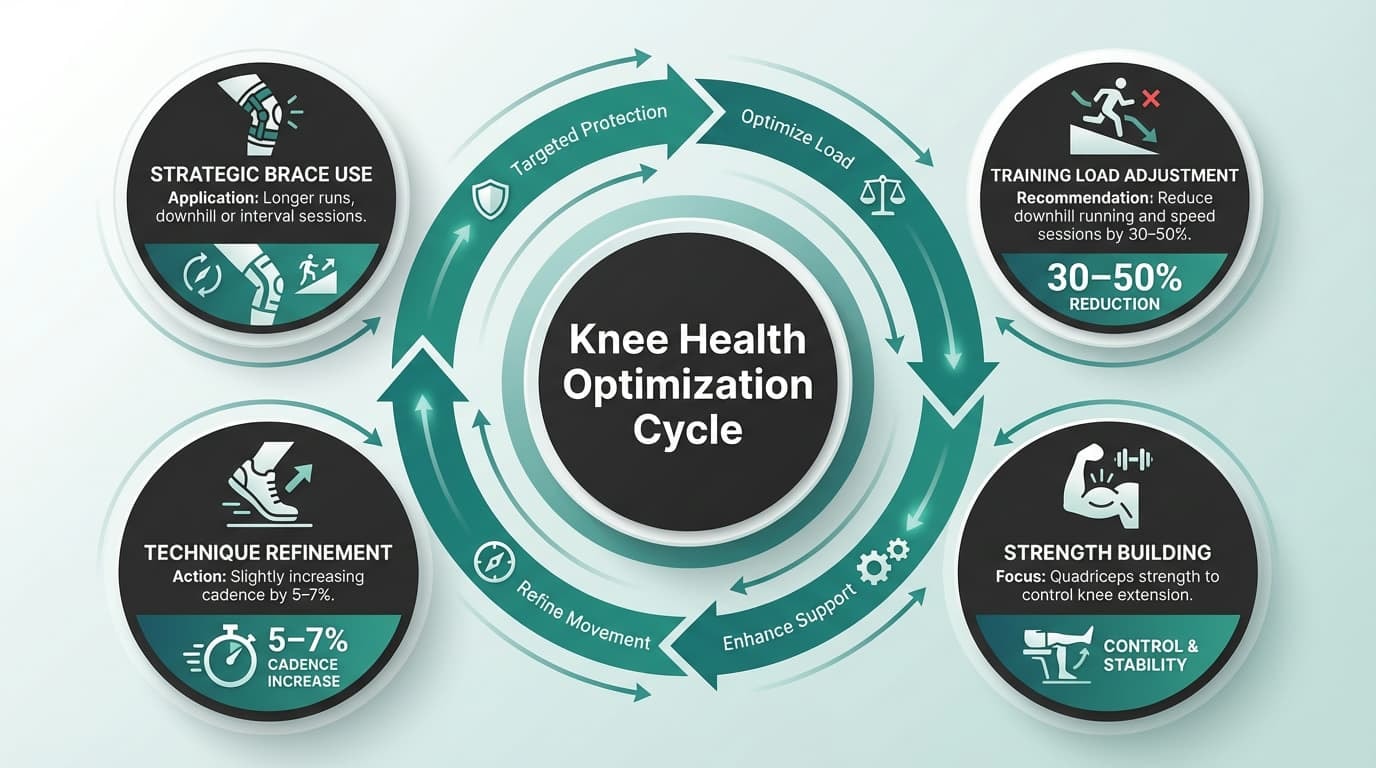
A knee brace can reduce pain and provide support while running. But long-term knee health does not come from the brace alone. It comes from how you manage load, build strength, and respect recovery.
The brace buys you body time. What you do with that time determines whether the knee improves or keeps cycling through flare-ups.
1. Adjust Training Load First
One of the most common causes of runner’s knee and patellar tendon irritation is a sudden increase in volume or intensity. Knees absorb thousands of repetitive impacts per run. If mileage, hills, or speed work jump too quickly, the knee joint and surrounding muscles struggle to adapt.
For 1 to 2 weeks during a flare-up:
-
Reduce downhill running and speed sessions by 30 to 50 percent
-
Keep easy mileage if pain stays mild and settles within 24 hours
-
Swap one high-impact session for cycling or elliptical work
This keeps circulation high without overstressing irritated tissue.
2. Build Strength That Protects The Knee
The best knee braces can provide extra support, but strength is what reduces long-term strain on the knee joint.
Focus on:
-
Quadriceps strength to control knee extension and absorb load
-
Glute strength to improve hip alignment and reduce inward knee collapse
-
Calf strength to improve shock absorption
-
Core stability to support running technique
Two to three short strength sessions per week outperform one long, inconsistent workout. Most runners underestimate how much hip and quad strength influences kneecap tracking.
3. Refine Running Technique
Small changes in running technique can reduce stress on the knee.
Slightly increasing cadence by 5 to 7 percent often reduces load on the kneecap. Avoid overstriding. Keep posture tall and let the foot land under the body rather than far in front.
You do not need a dramatic overhaul of your form. Small adjustments can lead to meaningful reductions in stress over time.
4. Use The Brace Strategically
Wearing a knee brace for running every single session is not always necessary.
Most runners benefit from using support during:
-
Longer runs
-
Downhill or interval sessions
-
Early return-to-run phases after injury
As pain decreases and strength improves, gradually reduce reliance. The goal is improved function, not permanent dependence.
A good brace supports the healing process. It does not replace it.
When A Knee Brace Is Not Enough
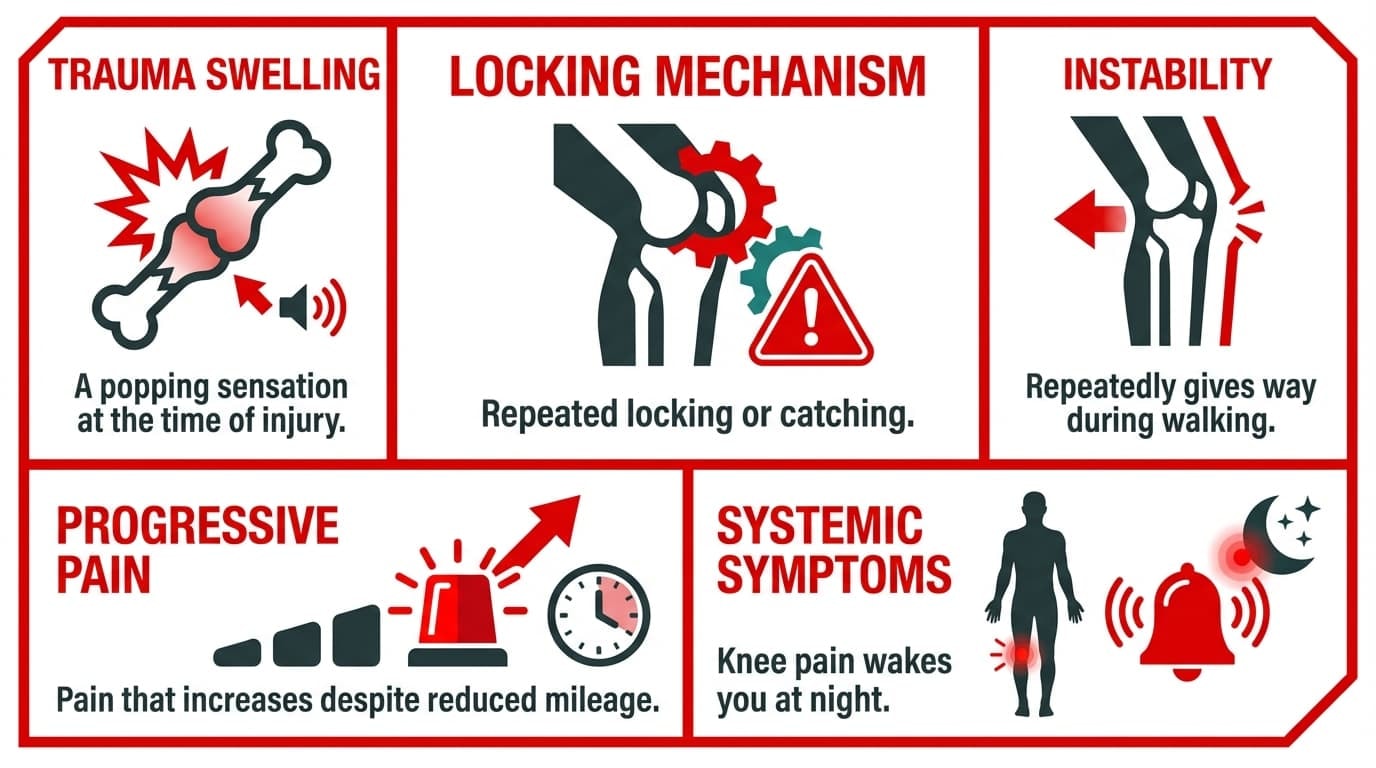
A knee brace can provide support, reduce pain, and help you stay active during mild knee issues. But it is not a solution for every knee injury.
There are situations where knee support while running is not the primary fix. In these cases, continuing to rely on a brace without proper evaluation can delay recovery or allow damage to progress.
1. Sudden Trauma With Immediate Swelling
If your knee swelled rapidly after a twist, awkward landing, or direct impact, that suggests structural involvement. Possible concerns include ligament injury, meniscus damage, or acute strain of stabilizing tissues.
Warning signs include:
-
A popping sensation at the time of injury
-
Significant swelling within hours
-
Inability to bear weight
-
Knee feeling unstable or giving way
In this scenario, the priority is medical evaluation. A brace may provide temporary support, but diagnosis comes first.
2. Repeated Locking Or Catching
If your knee locks, catches, or feels like something is stuck inside the joint, this may indicate internal mechanical irritation. Bracing will not resolve this type of problem.
Persistent locking is not something to “train through.” Imaging and clinical assessment are more important than increasing the support level.
3. True Instability Or Recurrent Giving Way
There is a difference between mild wobbliness and true instability.
If the knee repeatedly gives way during walking, on stairs, or during light jogging, this may involve ligament injury or more complex joint instability. Hinged knee braces are sometimes appropriate in these cases, but they should be selected under a doctor's or sports medicine professional's guidance.
Self-prescribing maximum support without understanding the injury can mask symptoms while the joint deteriorates.
4. Pain That Worsens Week To Week
Mild pain that improves with adjusted load is common in runners.
However, pain that increases despite:
-
Reduced mileage
-
Strength work
-
Strategic brace use
suggests something deeper is happening. Chronic pain that continues for several weeks without improvement deserves a structured evaluation.
Bracing is not meant to override the body’s warning signals.
5. Night Pain Or Systemic Symptoms
If knee pain wakes you at night, occurs at rest without load, or is accompanied by unexplained swelling, redness, or fever, it moves beyond typical overuse patterns.
These symptoms require medical assessment.
Final Thoughts
There is no single best knee brace for every runner.
There is only the right brace for your pain pattern, your training demands, and your current stage of recovery.
A knee brace can provide real support. It can reduce pain. It can help you stay consistent when the knee is irritated. But it is not a shortcut around smart programming, strength work, or proper diagnosis.
The runners who stay healthy long term are not the ones who ignore pain. They are the ones who adjust early, build capacity, and use tools strategically.
Support when needed. Train smart. Progress gradually.
That is how you protect your knees without losing momentum.
Over 300,000 athletes train in Anaconda gear because staying consistent matters more than pushing through pain.
FAQs
These are the questions runners ask when they want real answers, not marketing.
Should I Wear A Knee Brace On Every Run, Or Only When My Knee Hurts?
You do not earn toughness points for wearing a brace 24/7. Most runners only need knee support during higher-load sessions. Long runs. Hills. Speed work. Return-to-run phases after irritation. If your knee feels strong and pain-free on easy days, skip the brace. Let the joint work naturally. The goal is progression, not dependence. Use the brace when it helps you train smarter. Phase it out as strength and tolerance improve.
Can A Knee Brace Prevent Running Injuries?
A brace is not a preventative measure for a healthy knee. It is a support tool when something is irritated, overloaded, or in the early stages of a painful condition. The real injury prevention pillars are simple: Progressive training load. Strength work. Recovery. Good running mechanics. If your knees are healthy, focus on capacity. If something flares, then use support strategically.
How Tight Should A Running Knee Brace Be?
Snug. Secure. Never restrictive. You should feel supported, not compressed to the point of numbness. No tingling. No color change in the lower leg. No deep marks that last an hour after removing it. Start lighter than you think. Move. Adjust gradually. The right tension gives stability without cutting off circulation or limiting natural movement. If it changes your gait, it is too tight.
Is It Safe To Run With A Meniscus Or Ligament Issue If I Use A Brace?
Depends on the injury. Mild irritation or partial strain under professional guidance can sometimes be managed with structured rehab and appropriate bracing. But if you felt a pop, have major swelling, locking, or repeated giving way, stop. Get assessed. A brace should not be used to override structural damage. Support does not replace diagnosis.
Will Wearing A Knee Brace Make My Leg Muscles Weaker?
Not if you use it correctly. Occasional use during demanding runs will not shut your muscles off. Problems happen when athletes rely on a brace all day, every day, and skip strength work. Use the brace to buy body time. During that time, build your quads, glutes, calves, and stability. If months go by and you cannot run without it, the issue is not the brace. The issue is unresolved weakness or load mismanagement.


