


Knee injuries are no joke. Between 100,000 and 200,000 ACL injuries occur in the United States every year, and that doesn't even count the sprains, meniscus tears, and chronic instability that keep athletes off the mat, out of the gym, and away from the sport they love.
So when you're shopping for a knee brace, the stakes are real, and picking the wrong one can make things worse, not better.
The Anaconda Knee Brace and the DonJoy Defiance III are both respected products. But they were built for completely different situations. One is a clinical rehabilitation device. The other is a performance compression sleeve made for athletes who are already moving and need support that moves with them.
At Anaconda, we built our brace from firsthand experience on the mat. Our founder went through an ACL/MCL injury through grappling and designed a solution with no metal, no bulk, and no compromises that belong in a hospital but fall apart in a live round.
If you're trying to figure out which brace fits your life, we'll give you an honest breakdown, side by side, feature by feature.
Key Takeaways
-
Anaconda and DonJoy aren't true competitors: They're built for different stages of recovery and different types of activity.
-
DonJoy is a strong clinical choice for post-surgical stabilization, where the range of motion must be tightly controlled.
-
Our Anaconda brace is built for daily training, BJJ, and athletes who need real joint support without sacrificing movement.
-
Research published in the Scandinavian Journal of Medicine & Science in Sports found that compression-based knee support improves proprioception, especially in fatigued joints.
-
DonJoy's metal components make it prohibited in most grappling competition rulesets.
-
Once you're cleared for full training, a flexible compression sleeve is almost always the more practical daily choice.
Anaconda vs. DonJoy: At a Glance
Before we get into the details, here's how these two knee braces stack up across the key features most buyers compare when choosing between them.
|
Feature |
Anaconda Knee Brace |
DonJoy Defiance III |
|---|---|---|
|
Price |
$49.95 |
$600+ |
|
Design Type |
Compression sleeve with 3D knit construction |
Rigid hinged knee brace |
|
Best Use |
BJJ, MMA, weightlifting, running |
Post-surgical rehab, clinical recovery |
|
Post-Surgery Suitability |
Mild-to-moderate support during active return |
High-grade ACL injury stabilization |
|
Daily Comfort |
Lightweight design with breathable materials, comfortable for extended wear under gear |
Bulky, restrictive for extended daily use |
|
Competition Legal (Grappling) |
Yes |
Typically prohibited |
|
Proprioceptive Feedback |
Enhanced through continuous skin contact |
Reduced, rigid frame limits sensory input |
|
Durability for Mat Sports |
Built for high-friction, high-frequency training |
Vulnerable to the mechanical stress of mat sports |
Price
Let's start with the number that most people notice first.
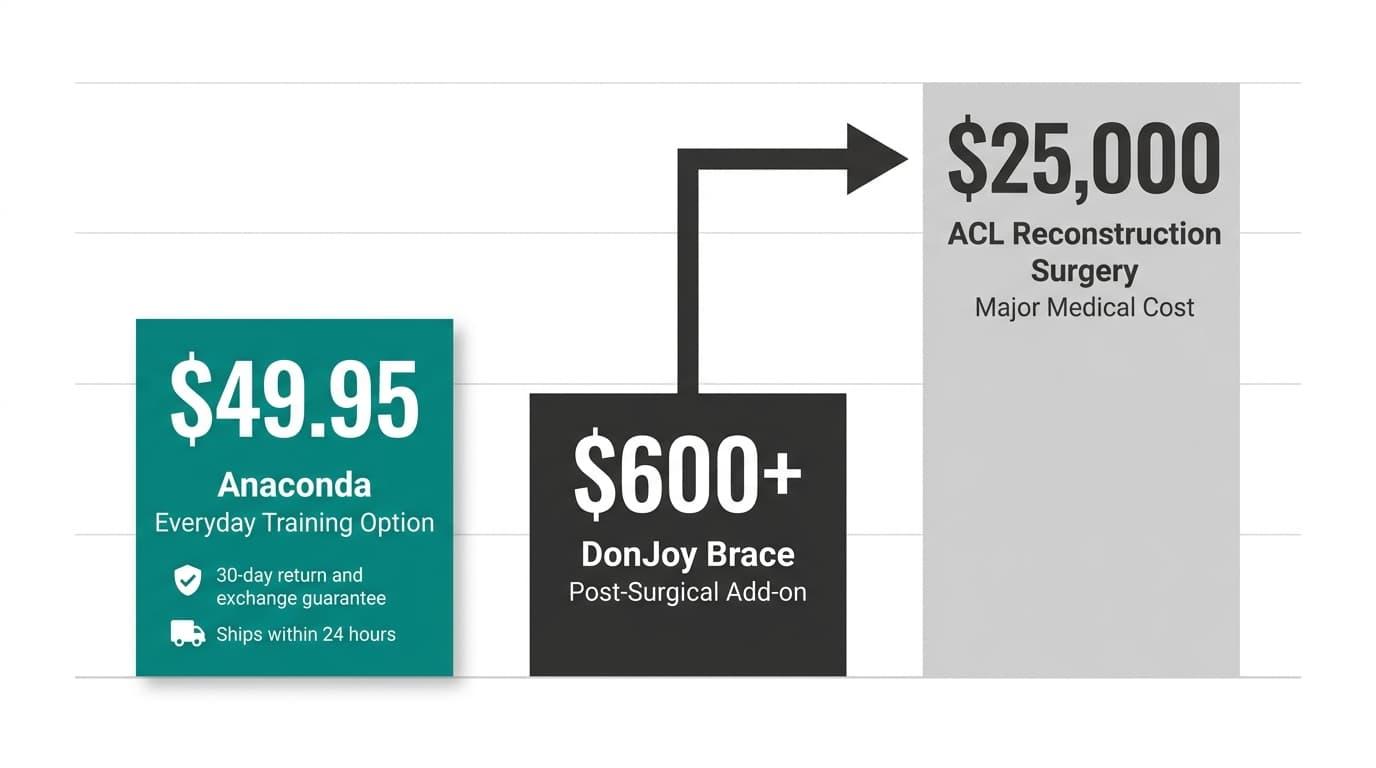
Our Anaconda Knee Brace is priced at $49.95. It ships within 24 hours and comes with a 30-day return and exchange guarantee. For an athlete training three to four times a week, it's a practical, low-risk investment.
The DonJoy Defiance III starts at $600 or more. It's a custom-fitted clinical device, typically prescribed through an orthopedic surgeon as part of a post-surgical recovery program. That price makes sense in that context. ACL reconstruction surgery averages around $25,000, so a $600 clinical brace is a reasonable add-on to a medically supervised rehab plan.
Outside that context, though? It's a lot of money for a brace that wasn't designed for daily athletic use.
Bottom line: For everyday training, the Anaconda knee brace delivers solid daily support at a fraction of the clinical price tag.
Design, Construction, and Key Features
This is where the two braces are most different and where that difference matters most.
Our Anaconda Knee Brace is built from a 3D knit construction using Polyester, Nylon, and Spandex. It's one to two millimeters thin and weighs between 220 and 300 grams, depending on size. The sleeve wraps around the joint and moves with it. No hinges, no rigid frames, no metal. It conforms to your knee and stays in contact through every plane of movement.
The DonJoy Defiance III is a hard-shell custom brace built around polycentric hinges that replicate the natural rotation of the knee. It's engineered to mechanically restrict the range of motion within a surgeon-prescribed range. In a post-surgical setting, that control is exactly what you need. In a live grappling round, that same rigidity becomes a problem.
Bottom line: Anaconda moves with your body. DonJoy controls it. Which one you need comes down entirely to where you are in your recovery.
Best Sport Use
These two braces weren't built for the same environments, and trying to use one in the other's setting creates real issues.
Our brace was built for BJJ, MMA, weightlifting, and running. Sports that demand a full range of motion, fast directional changes, and a sleeve that won't shift mid-scramble. The no-metal, wraparound design fits under a gi or shorts without creating friction points or catching on a training partner's gear.
Athletes dealing with different knee issues may need different support options depending on the specific condition.
If you need more support or a patellar-tendon-focused solution, patellar straps target the patellar tendon to reduce pain, while Anaconda is designed for broader active use.
The DonJoy Defiance III was built for clinical rehabilitation. It performs well in controlled recovery settings where protecting healing tissue takes priority over mobility and helping reduce the risk of further injury during structured rehab.
On the mat, though, its bulk becomes a genuine problem. Positional transitions, guard passing, and leg entanglements all require the brace to follow the body. A rigid frame resists that, which leads to slippage, constant readjustment, and reduced confidence at the worst possible moment.
It's also worth noting that in college football alone, 22 of the Associated Press Top 25 teams use the Defiance knee brace, but football players wear it on the sidelines and in structured plays, not in the continuous ground-based movement that grappling demands, where a different brace may do more to lower re injury risk.
Bottom line: For mat sports and active training, Anaconda is the practical fit. For structured clinical rehab, DonJoy serves its purpose well.
Post-Surgery Suitability and Pain Relief
Both braces can play a role in returning to activity, but at very different stages.
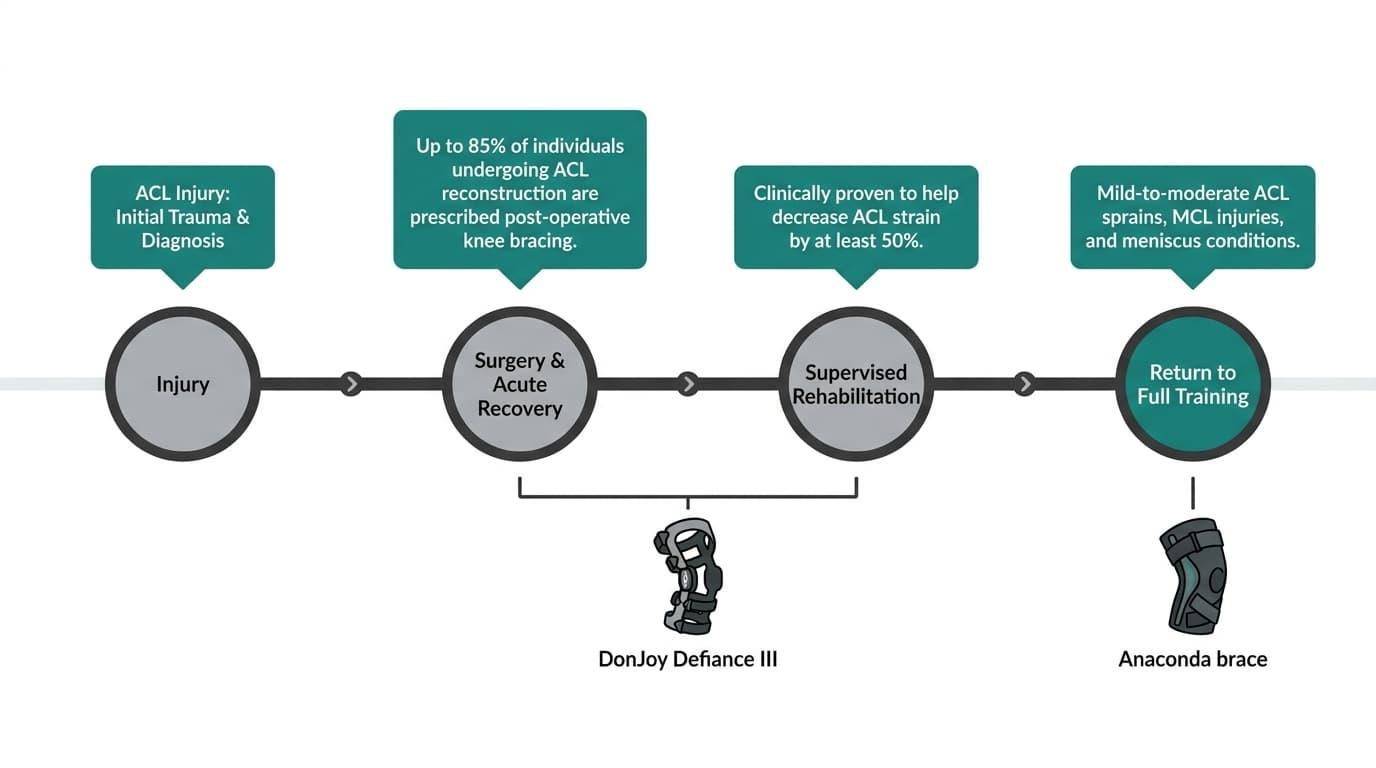
DonJoy earned its clinical reputation honestly. The Defiance III is legitimately recommended by orthopedic surgeons following post-surgical ACL reconstruction.
According to the American Orthopedic Society for Sports Medicine, up to 85% of individuals undergoing ACL reconstruction are prescribed post-operative knee bracing.
When a surgeon needs to control exactly how much the knee bends during early-stage healing, a hinged brace with a calibrated range of motion restriction isn't a limitation; it's the entire point.
DonJoy's technology is clinically proven to help decrease ACL strain by at least 50%, which is meaningful in a controlled rehabilitation setting.
Our Anaconda brace is best suited for athletes who've been cleared for full activity and are returning to training. For mild-to-moderate ACL sprains, MCL injuries, and meniscus conditions during active sport, our 3D compression design supports movement without restricting it.
It's not a substitute for a clinically prescribed hinged brace in the acute stages of post-surgical recovery, and users managing osteoarthritis or knee arthritis may need a different brace type; the same applies to some cases of arthritis. Unloader braces can significantly reduce pain in knee osteoarthritis, which is a different use case from active return-to-training compression support.
Bottom line: DonJoy is the right call right after surgery, under medical supervision. Anaconda is the better fit once you're cleared to train, but consult a healthcare provider for post-surgical bracing decisions or condition-specific recommendations.
Competition Legality
This one's simple, and it matters a lot if you compete.
Our Anaconda Knee Brace is competition-legal in most BJJ and grappling rulesets. No metal components, no rigid frames, no edges that could create a safety hazard for your training partner. Grapplers in the BJJ community consistently report it passes competition checks and stays in place through full rounds without adjustment.
The DonJoy Defiance III is typically prohibited in grappling competitions. Its metal hinges and rigid frame create safety hazards in contact sports, and most rulesets ban hard-shell braces outright. Even in formats where it might technically pass, the bulk and rigidity make it a poor practical fit for live rolling.
Bottom line: If you compete in BJJ or grappling, Anaconda is the only realistic option between these two.
Proprioceptive Feedback
This is the feature most athletes don't think about until they've been through a knee injury, and then it becomes everything.
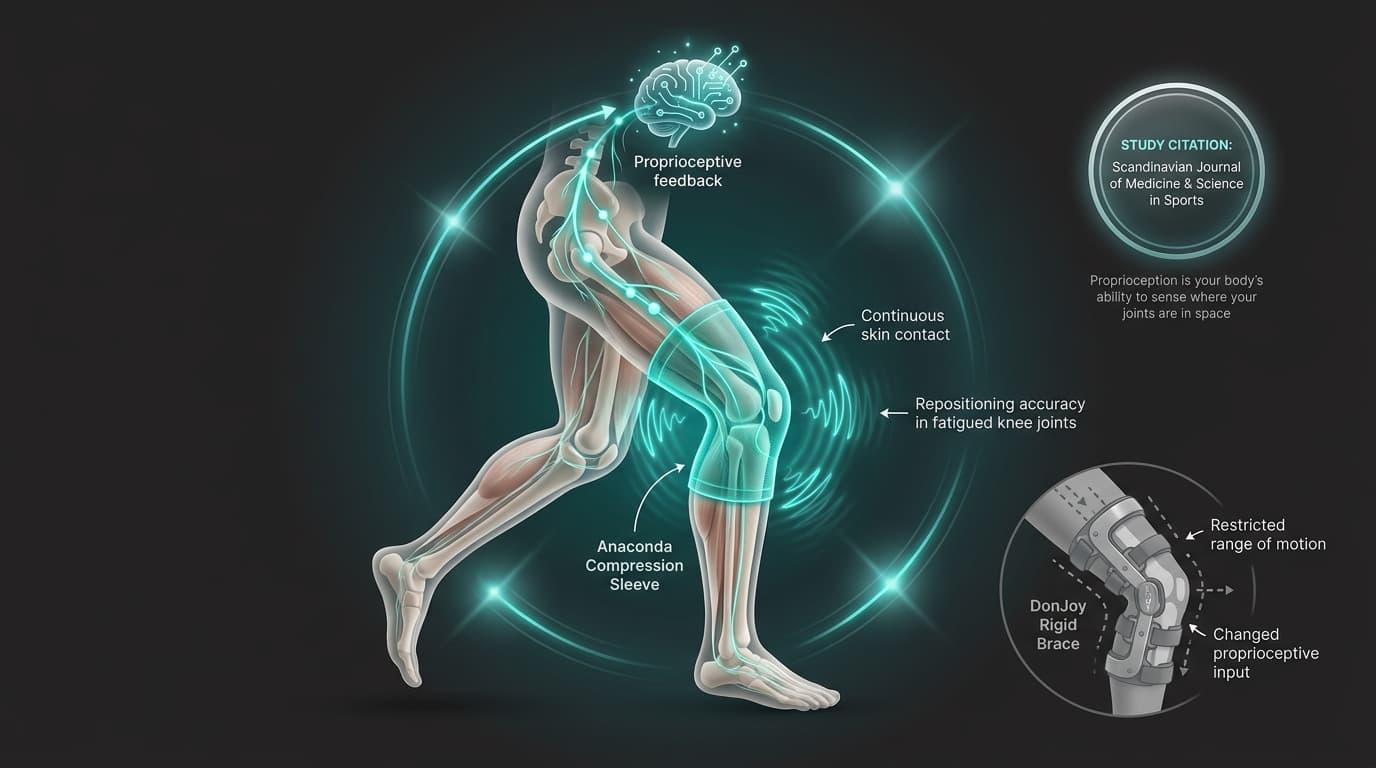
Proprioception is your body's ability to sense where your joints are in space. After a sprain or partial tear, the nervous system loses some of that positional awareness, which is part of why athletes feel unstable or hesitant even after the tissue has technically healed.
Compression against the skin helps restore that signal. Compression sleeves can improve blood flow and blood circulation while helping reduce swelling, which supports recovery and improved function during active training.
A study published in the Scandinavian Journal of Medicine & Science in Sports found that braced and supported knees handled fatigue better, with neoprene sleeves improving repositioning accuracy in fatigued knee joints.
Our Anaconda brace maintains continuous skin contact through the full range of motion, feeding that positional information back to the nervous system during every transition, every takedown, and every rep.
The DonJoy Defiance III restricts the range of motion by design, which changes the proprioceptive input the joint receives.
In a post-surgical context, that tradeoff is acceptable; protecting healing tissue is the priority. For athletes past that stage, though, reduced sensory feedback can work against the natural stability the joint is trying to rebuild.
Bottom line: For athletes focused on restoring confidence and joint awareness during active training, compression-based proprioceptive support is the more beneficial approach.
Durability for High-Frequency Training

How a brace holds up after six months of real training matters as much as how it performs on day one.
Our Anaconda brace was built for athletes who train three to four times a week. The 3D knit construction is designed to maintain its compression and structure over months of consistent use, not degrade into a loose sleeve after a few washes.
For athletes managing patellofemoral pain syndrome or chronic knee instability, long-term consistency is what makes the brace genuinely worth wearing.
Consistent compression can help reduce swelling and relieve pressure on the joint during repeated training, which also helps with managing knee pain. We've heard this from over 400,000 athletes who came to Anaconda after cheaper alternatives let them down.
DonJoy's rigid braces are built for clinical durability and can last several years with proper care, but that longevity is most relevant in rehabilitation settings with controlled, limited use.
Athletes training daily in high-friction environments like grappling may find that rigid frames and metal components take on more mechanical stress than a flexible compression design.
Bottom line: For high-frequency athletic use, Anaconda's compression construction holds up where rigid frames can struggle.
Daily Comfort
A brace that's uncomfortable to wear is a brace you won't wear, and that's no good to anyone.
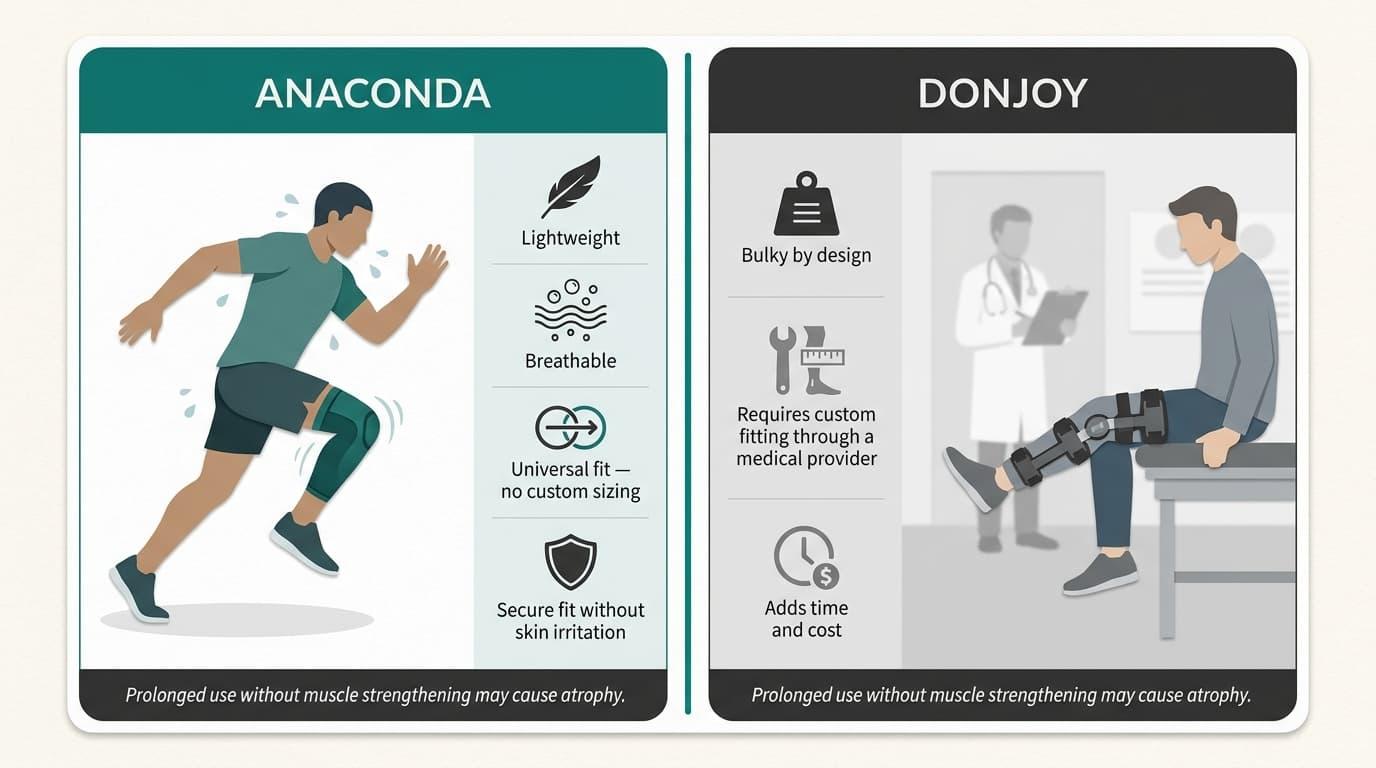
Our Anaconda brace is lightweight, breathable, and built with comfortable materials to maintain a secure fit for active individuals during physical activity without causing discomfort or skin irritation through a full session.
Athletes use it across BJJ, weightlifting, and running without needing to pull it off between rounds. The fit should feel secure and supportive, not tight enough to restrict movement or circulation. It's a universal fit, so there's no custom sizing process or waiting on a medical provider to get you set up.
The DonJoy Defiance III is bulky by design. That's a feature in a rehabilitation setting, where controlled movement matters more than comfort during extended activity. For daily wear or multi-session training days, that bulk becomes a real limitation. It also requires custom fitting through a medical provider, which adds time and cost before you can even put it on.
For extended use, braces should still be paired with strength work, since prolonged use without muscle strengthening may cause atrophy.
Bottom line: For all-day wear and back-to-back training sessions, Anaconda is the more comfortable everyday option by a clear margin.
Final Words
Both braces are legitimate tools built for different purposes. The deciding factor is fit-to-purpose, not brand prestige.
DonJoy earns its place in post-surgical recovery and clinical rehabilitation; that credibility is real, and it belongs in that context. For athletes cleared to train, returning to grappling, or managing daily joint stress through BJJ and combat sports, a compression sleeve that moves with the joint is simply the more practical choice.
At Anaconda Fightwear, we built our brace for athletes who train hard and need support that keeps up with them. The anaconda knee brace offers pain relief and support for athletes who want to stay active after common knee issues. Browse our collection and find your fit.
Frequently Asked Questions
Choosing the right knee brace depends on how you train, the type of support you need, and whether you're using it for recovery or performance. Here are quick answers to the most common questions athletes ask about knee braces.
Are Anaconda knee braces good for daily training?
Yes, Anaconda knee braces are designed for regular athletic use and are a good fit for active individuals managing knee pain during regular training. Their compression-based sleeve is designed to provide targeted support while preserving mobility, rather than the more rigid feel associated with superior support braces. Many athletes use them for activities like BJJ, weightlifting, and running.
Their breathable construction also works well for mild support needs and extended wear. They are built to deliver stability while maintaining comfort during frequent workouts.
What knee brace do orthopedic surgeons recommend?
Orthopedic surgeons often recommend rigid hinged braces for post-surgical recovery and significant ligament injuries. These braces help control knee movement and protect healing tissues during rehabilitation, and a healthcare provider may recommend measuring above and below the knee, including calf circumference, to support proper sizing and avoid a poor fit or the wrong size with a more rigid brace. However, once athletes return to normal activity, many transition to lighter compression-based braces for daily support. The best knee brace depends on your injury, proper sizing, and recovery stage.
How long do DonJoy knee braces last?
DonJoy knee braces are known for their durability and can often last several years with proper care. Their rigid construction is designed to withstand long-term rehabilitation and support use. Lifespan depends on how frequently the brace is worn and the type of activity performed.
Regular inspection and maintenance help extend its usability. Users should also hand wash soft goods with mild soap according to the manufacturer’s care instructions, since proper care helps maintain fit and performance over extended wear.
What's the number one mistake that makes bad knees worse?
The biggest mistake is stopping movement completely. Long periods of inactivity can weaken the muscles that help stabilize and protect the knee joint. In most cases, controlled movement and gradual load management are more beneficial than total rest. Staying active within a comfortable range often supports better long-term outcomes.
Which knee brace is best for BJJ and grappling competitions?
A lightweight compression knee brace is usually the best choice for BJJ and grappling competitions because it should fit the kneecap area securely without sliding during movement.
Most organizations restrict braces with exposed metal or rigid components for safety reasons, and while some options use straps to adjust fit, grapplers usually prefer a low-profile sleeve that does not slip. Compression-style braces provide support while allowing full movement during scrambles, guard work, and takedowns.
They are also more comfortable in training gear and competition uniforms. For competition, a perfect fit should cover the knee and, depending on the model, part of the calf without bunching, so athletes do not need to constantly adjust it.


