


Two shoulder braces, a $130 price gap, and a question asked constantly by athletes everywhere: Is the Bauerfeind OmoTrain actually worth it, or are you paying for a clinical reputation that has no place on the mat?
The honest answer is that both questions miss the point. These two braces weren’t built to compete with each other. They were built for completely different humans in completely different situations. Getting that wrong is expensive, literally and physically.
At Anaconda, we built our shoulder brace for one kind of athlete: Someone with a shoulder problem who refuses to stop training. The OmoTrain was built for a different kind: Someone in structured recovery who needs medical-grade joint guidance. This breakdown will tell you exactly which one you are.
Key Takeaways
-
The Anaconda and the Bauerfeind OmoTrain are not competing products. They serve different phases of shoulder health, and buying the wrong one for your phase is a common and costly mistake.
-
Anaconda's 3D knit compression is built to move with an athlete through live training; Bauerfeind's omega-shaped medical knit is built to guide and protect a joint through clinical recovery.
-
Bauerfeind's removable viscoelastic delta pad is a rehab tool; Anaconda's detachable gel pad is an impact management tool. They do different jobs.
-
Bauerfeind is FSA/HSA eligible, has been made in Germany since 1929, and is backed by peer-reviewed clinical research. That matters in the right context.
-
Anaconda is machine washable, ships within 24 hours, costs $130 less, and was built for maximum performance specifically.
-
If your physiotherapist prescribed a brace for post-surgical recovery, read the Bauerfeind section carefully. If you’re training through shoulder irritation and need to survive Thursday's sparring session, keep reading.
The Specs: What You’re Actually Choosing Between
Before the feature breakdown, take a look at the full picture side-by-side.

Compression: Two Knits Built for Two Completely Different Jobs
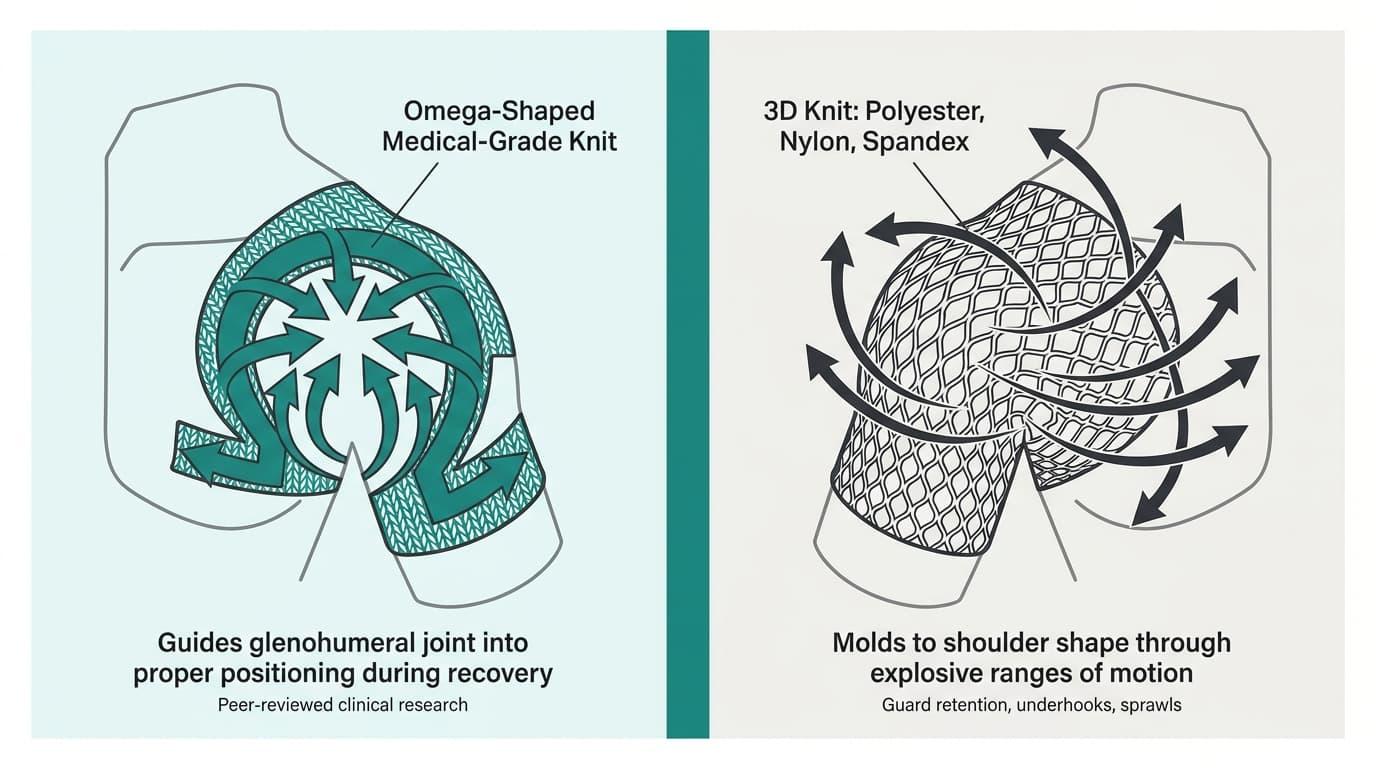
The word "compression" appears on both product pages, which is where most comparisons go wrong. Treating these two compression systems as variations of the same thing misses what makes each one good at what it does.
Bauerfeind's OmoTrain uses an omega-shaped medical-grade knit developed alongside physiotherapists and validated by peer-reviewed clinical research.
The knit applies graduated compression to guide the glenohumeral joint into proper positioning during recovery. For an athlete coming off labrum surgery, managing an acute AC joint separation, or working through physiotherapy for shoulder instability, that guidance is doing real clinical work. It’s not just applying pressure; it directs tissue and joint behavior during healing.
Anaconda's 3D knit does something entirely different. Made from Polyester, Nylon, and Spandex, it molds to the shoulder's shape and moves with it through explosive ranges of motion. Guard retention, deep underhooks, sprawls, and single-leg defense all require the shoulder to rotate freely and dynamically.
The honest tradeoff: Bauerfeind's medical knit adds warmth and profile that becomes a liability during live training. The Anaconda's athletic knit does not deliver the clinical joint guidance Bauerfeind provides during structured recovery.
If you’re in rehab, Bauerfeind's compression is doing something Anaconda’s product can’t replicate. If you’re on the mat, Anaconda's compression is doing something Bauerfeind was never designed to handle.
Padding: Impact Absorption vs. Joint Offloading
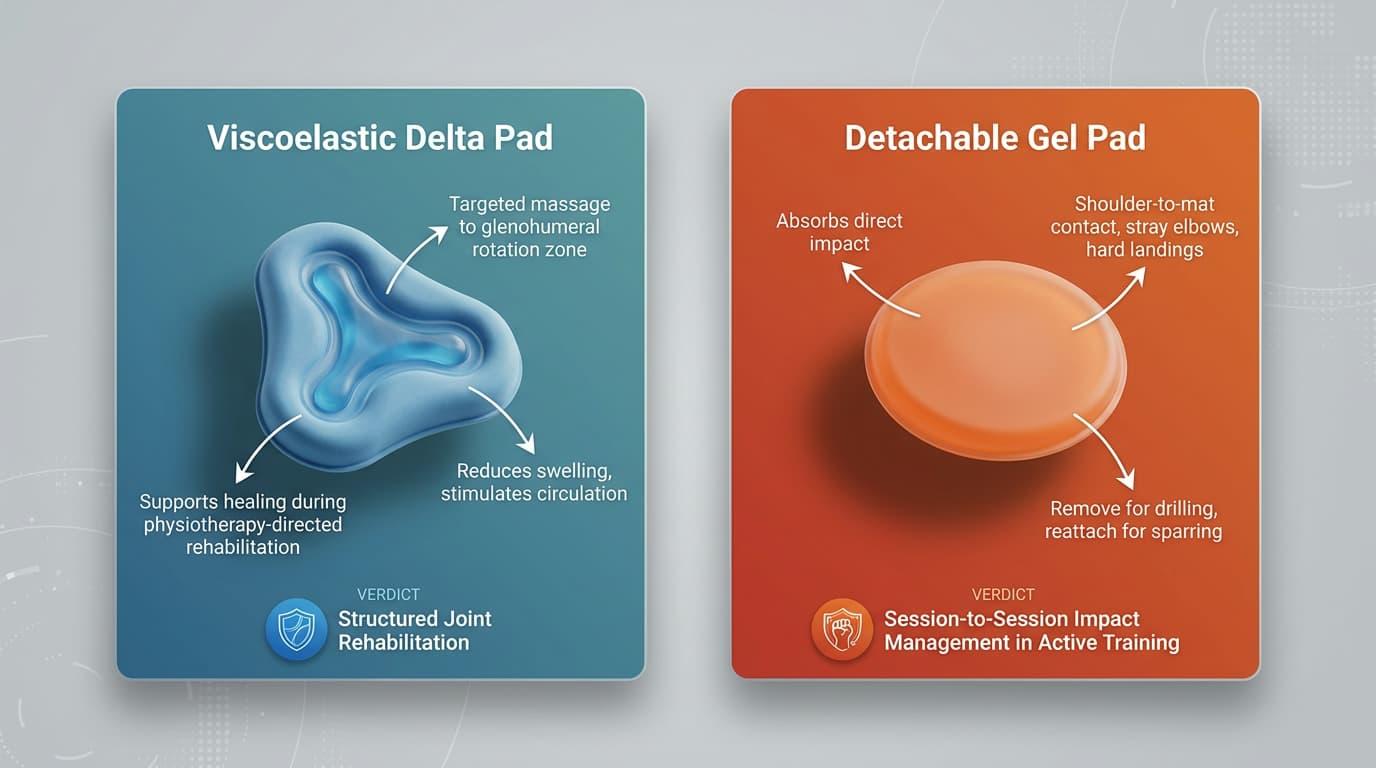
Both braces include removable pads. Both pads sit near the shoulder joint. That’s where the similarity ends.
Bauerfeind’s viscoelastic delta pad is positioned to deliver targeted massage to the glenohumeral rotation zone and offload the joint during recovery movement. Its intermittent massage effect can help reduce swelling, while also stimulating circulation, reducing localized pressure, and supporting the healing of tissues during physiotherapy-directed rehabilitation. It’s a clinical instrument embedded in a brace.
Anaconda’s detachable gel pad absorbs direct impact and was built to handle impacts during sports. Shoulder-to-mat contact, stray elbows, and hard landings are the use cases it was designed for, making it an excellent option for grapplers and BJJ athletes. You take it off for technical drilling where impact risk is low, and put it back on for sparring rounds where it isn’t. Removing it before washing also preserves the attachment points over months of daily use.
Neither pad is necessarily “better.” They are purpose-built for different problems. Comparing them is like comparing a foam roller to a massage gun because both touch sore muscles.
**Bauerfeind wins for structured joint rehabilitation.**Anaconda wins for session-to-session impact management in active training.
Fit and Sizing: Precision Calibration vs. Get On and Go
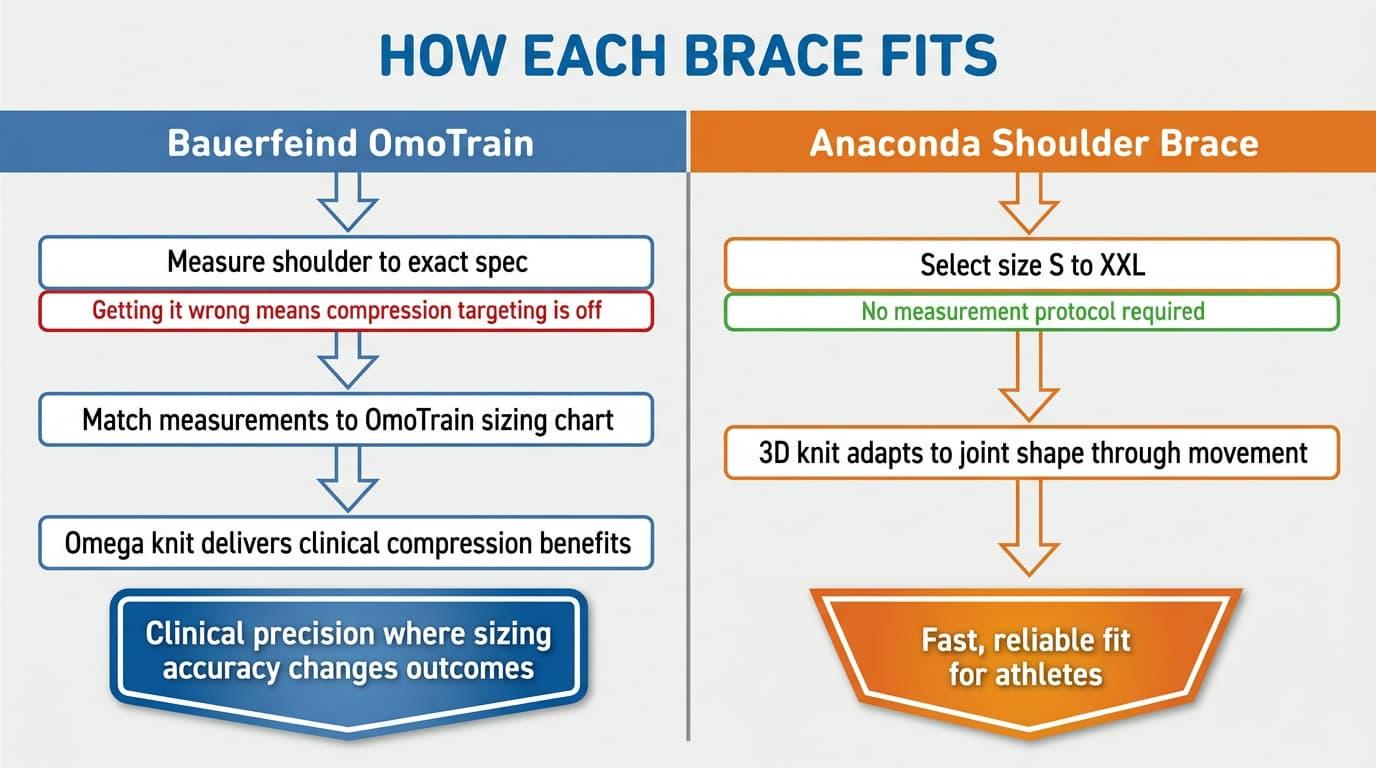
Bauerfeind's OmoTrain requires careful sizing. The omega knit only delivers its clinical compression benefits when the fit is correctly matched to the athlete's measurements.
Getting it wrong doesn’t just mean mild discomfort. This means the compression targeting is off, and the brace's clinical intent is partially lost. The OmoTrain is wearable on either side, but it’s not a brace you purchase casually.
The Anaconda brace works differently. Universal fit, ambidextrous design, sizes from S to XXL. The 3D knit adapts to the joint's shape through movement rather than requiring precise pre-calibration.
Knowing how to set strap tension correctly for grappling vs. lifting is what makes the difference between a brace that holds through a full round and one that drifts by the second exchange, but the sizing decision itself is straightforward.
For a combat athlete who needs support in place before the next session, that simplicity is a genuine advantage.
Bauerfeind wins for clinical precision where sizing accuracy changes outcomes. Anaconda wins for athletes who need a fast, reliable fit without a measurement protocol.
On the Mat: Where One Brace Belongs, and One Doesn’t
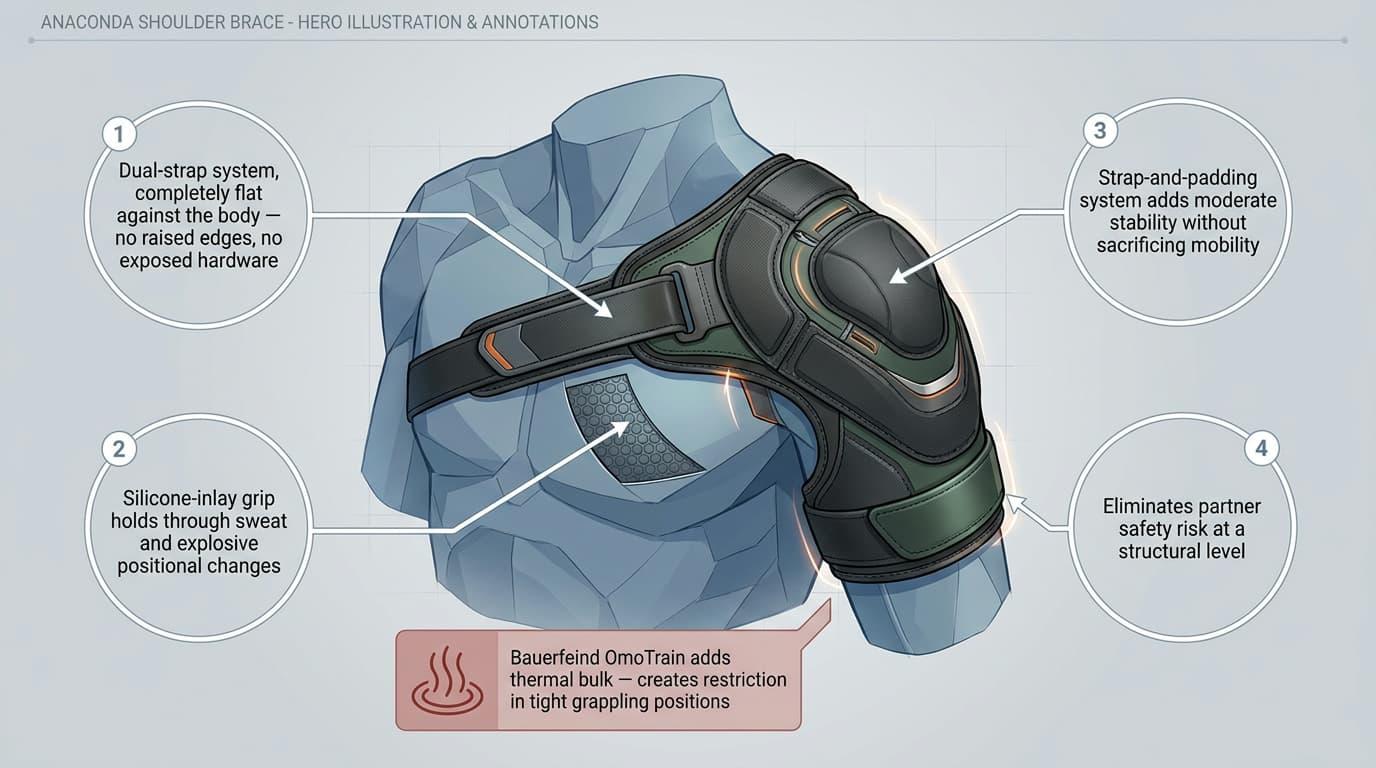
This section is the most direct in the article because the performance gap here is not subtle.
The Anaconda was designed around a specific failure mode: shoulder braces that feel fine during warm-up and fall apart the moment training gets physical, while still serving as a budget-friendly option for dynamic athletes who need impact cushioning.
The dual-strap system sits completely flat against the body, with no raised edges, no exposed hardware, nothing that catches on GI fabric or digs into a training partner during a close roll. The silicone-inlay grip holds the sleeve against the skin through sweat and explosive positional changes, and the strap-and-padding system adds moderate stability without sacrificing mobility during active training.
Partner safety is a real concern on the mat, and the Anaconda’s profile eliminates that problem at a structural level.
Bauerfeind’s OmoTrain adds thermal bulk from the medical-grade knit.
Heat builds under a GI faster than with athletic compression, the profile creates noticeable restriction in tight grappling positions, and the construction was simply never tested against the friction, sweat load, and positional demands of live BJJ. It does what it was built to do, and it does so excellently. The issue is that it was designed for clinical recovery support, not the realities of live grappling.
It’s a frustration we’ve heard from over 400,000 athletes who came to us after spending significantly more on clinical braces that were excellent products in the wrong context.
Anaconda wins for mat-based training without qualification, and that same balance also makes it a practical pick for weightlifters. Bauerfeind should not be evaluated in this context because it wasn’t designed for it.
Care and Durability: Daily Training Volume vs. Recovery Phase Use
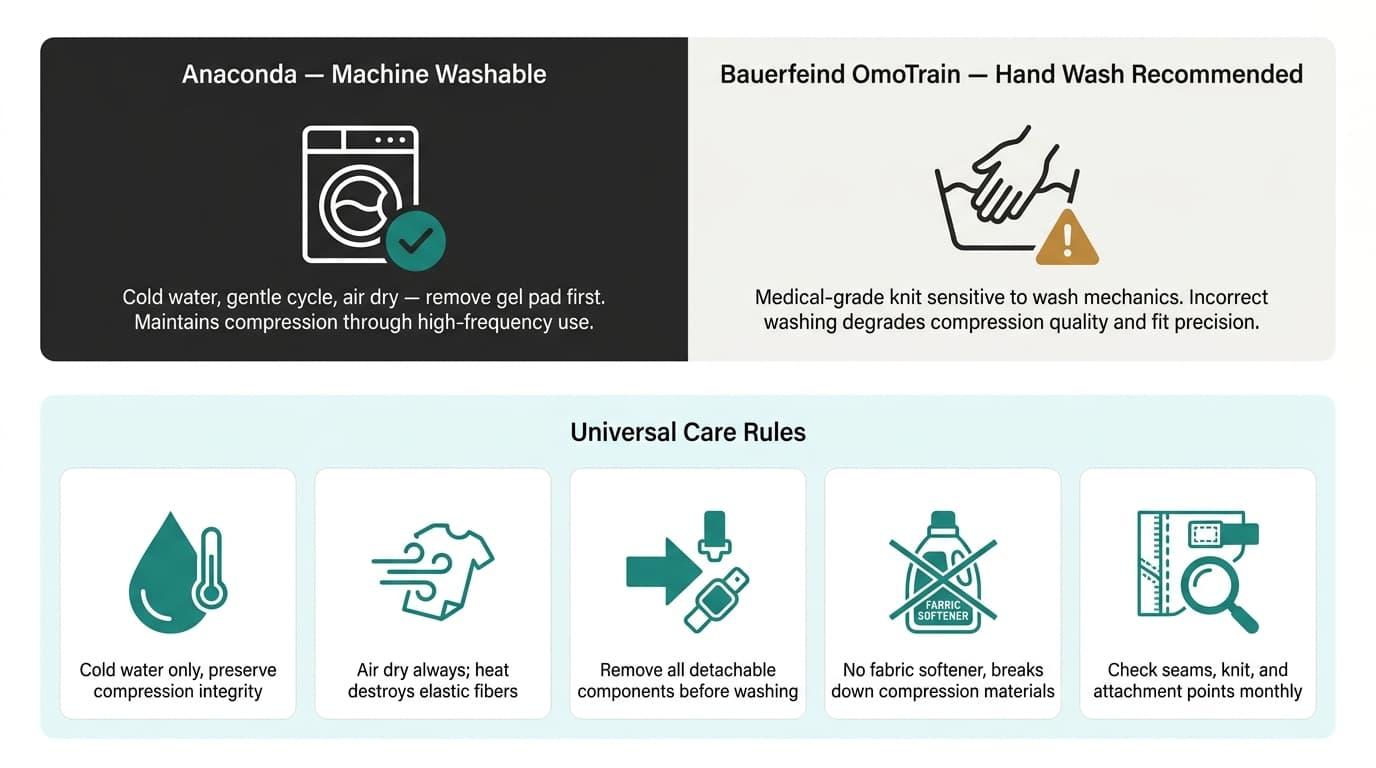
The Anaconda shoulder brace is machine washable. For an athlete washing gear three or four times a week, the routine is simple: Cold water, gentle cycle, air dry, and remove the gel pad first. The 3D knit maintains compression tension through that frequency without elastic degradation.
Bauerfeind recommends hand washing for the OmoTrain. The medical-grade knit is sensitive to wash mechanics, and incorrect washing degrades both compression quality and fit precision.
For an athlete using the brace two or three times a week during a recovery phase, hand washing is manageable. For someone running it through daily GI sessions and post-training showers, on the other hand, it becomes a genuine operational barrier that shortens the product's useful life.
Both braces benefit from the same general care principles:
-
Cold water only, preserve compression integrity
-
Air dry always; heat destroys elastic fibers
-
Remove all detachable components before washing
-
No fabric softener, it breaks down compression materials
-
Check seams, knit, and attachment points monthly
Anaconda wins for high-frequency athletic use. Bauerfeind is appropriate for the recovery phase, where wash frequency is naturally lower.
Price and Value: What $130 Actually Buys You
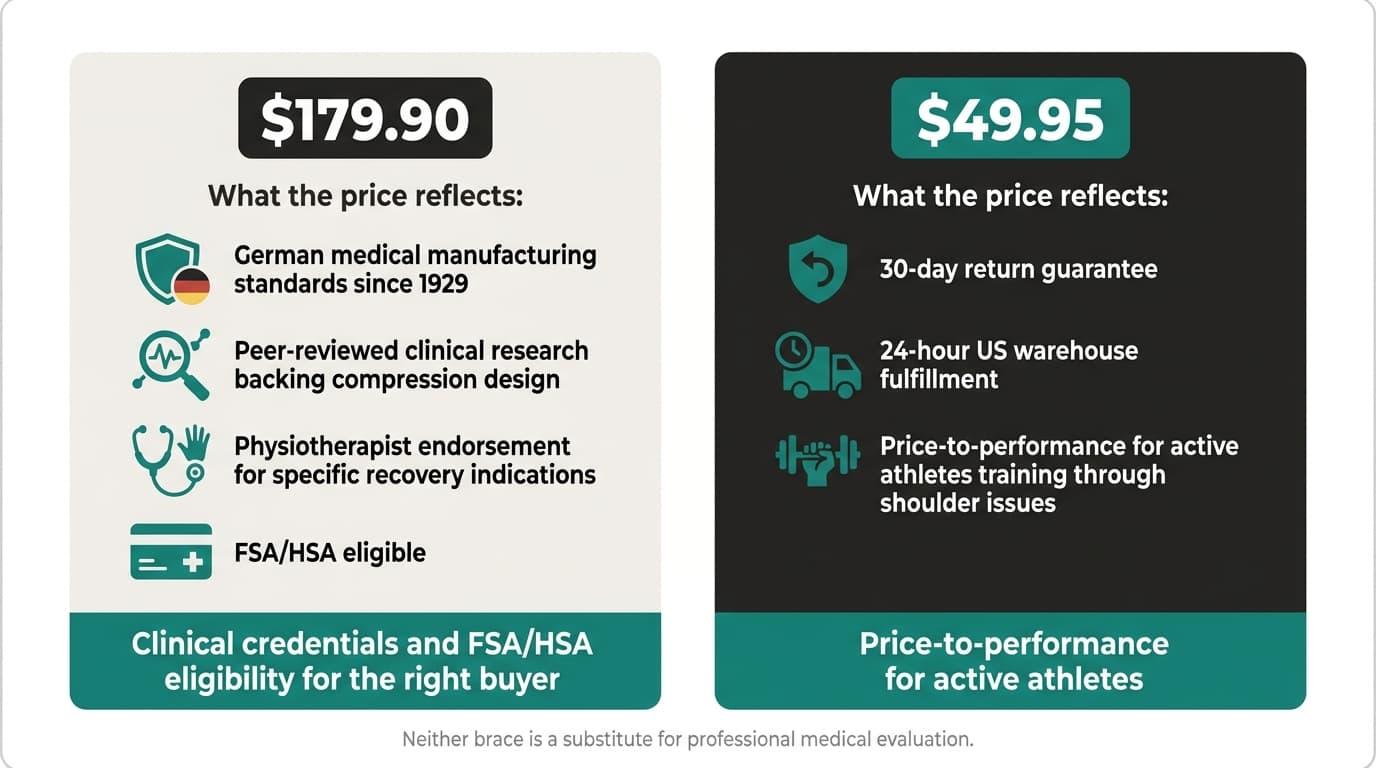
At $179.90, the Bauerfeind OmoTrain is expensive by athletic brace standards. At $49.95, the Anaconda Shoulder Brace is mid-range. That $130 difference is something worth caring about, and it reflects real differences in what you’re getting.
Bauerfeind’s price reflects German medical manufacturing standards maintained since 1929, peer-reviewed clinical research backing the compression design, physiotherapist endorsement for specific recovery indications, and FSA/HSA eligibility that allows eligible athletes to offset the cost through health spending accounts. The OmoTrain S also delivers medical-grade stabilization and structural quality, making it a better fit for post-injury rehabilitation, arthritis, and controlled daily movement.
For athletes in the clinical situations the OmoTrain was designed for, that price is justified.
For a combat athlete using a brace through a full competitive season of mat training, however, paying $179.90 for a hand-wash-only clinical tool that was never designed for live grappling is one of the most common buyer mistakes in this category.
Anaconda’s 30-day return guarantee and 24-hour US warehouse fulfillment also mean lower purchasing risk if you’re not certain.
Neither brace can or should act as a substitute for professional medical evaluation. Acute structural injuries, post-surgical instability, and full-thickness rotator cuff tears require clinical assessment, not just a better brace, and for severe injuries or full dislocations, a doctor should determine whether restricting shoulder movement is appropriate during healing.
Bauerfeind wins on clinical credentials and FSA/HSA eligibility for the right buyer, while Anaconda wins on price-to-performance for active athletes training through shoulder issues.
Final Words
Bauerfeind has built something excellent for clinical recovery. If your physiotherapist has recommended medical-grade shoulder support during the post-surgical phase, for an acute AC joint separation, or for early labrum rehabilitation, the OmoTrain belongs in that conversation. The research backs it. The price reflects it. Respect it for what it is.
The Anaconda shoulder brace was built for the athlete who has been cleared to train, or who is pushing through shoulder irritation and needs something that holds up through the round. Low profile, machine washable, $49.95, and built specifically for the friction, sweat, and contact that define mat training. That’s a different product for a different moment in the same athlete's journey.
Frequently Asked Questions
Explore quick answers to the most common questions athletes and recovering users ask before choosing between these two shoulder brace products.
Is the Anaconda Shoulder Brace designed for a specific shoulder side?
No, the Anaconda Shoulder Brace is designed for both left and right shoulders. Its ambidextrous design allows you to use the same brace on either side without needing a separate version. The strap system adjusts easily to whichever shoulder needs support. The Bauerfeind OmoTrain also works on both sides, but sizing accuracy is more important because of its medical-grade compression fit.
Is Bauerfeind a good brand?
Yes, Bauerfeind is considered one of the most respected medical support brands in the industry. The company has been producing orthopedic braces and rehabilitation supports in Germany since 1929. Their products are widely used in physical therapy and clinical recovery settings because of their research-backed design. The main difference is that Bauerfeind focuses more on rehabilitation, while Anaconda is built more for active athletic performance.
Is the Bauerfeind OmoTrain FSA/HSA eligible?
Yes, the Bauerfeind OmoTrain is FSA/HSA eligible. This makes it easier to purchase through health savings or flexible spending accounts. The Anaconda Shoulder Brace is currently not eligible for FSA/HSA reimbursement. If healthcare spending eligibility matters to you, Bauerfeind has the advantage here.
When should I switch from Bauerfeind to Anaconda?
You should consider switching from Bauerfeind to Anaconda once you are cleared for active training and return-to-sport movement. The OmoTrain works well during structured recovery and rehabilitation phases. The Bauerfeind OmoTrain S offers structural guidance for post-surgical healing, labrum instability, and more severe cases such as a torn rotator cuff before return to active training. Once you return to lifting, grappling, drilling, or live sparring, a performance-focused brace like Anaconda becomes more practical. It is designed to handle movement, sweat, and athletic demands more comfortably.
Can I use the Anaconda Shoulder Brace for weightlifting or shoulder injuries?
Yes, the Anaconda Shoulder Brace can be used for weightlifting and strength training. Its 3D knit construction allows natural shoulder movement during pressing, pulling, and overhead exercises. Many athletes use it to manage shoulder irritation while continuing to train. It provides added support without heavily restricting the range of motion.


