


Sitting out of workouts with a knee injury is one of the most frustrating places an athlete can land. The barbell is right there. The mat is waiting. And every day you spend on the sideline feels like a step backward from everything you’ve built.
The problem isn’t the injury; it’s the comeback. Most athletes return to the gym based on how much time has passed, not whether the knee is actually ready. That gap between a calendar-based return and a criterion-based return is exactly where re-injuries happen.
At Anaconda, we built our knee brace line for athletes who refuse to stop moving. Whether you’re coming back from an ACL tear, a meniscus injury, or a nagging patellar issue, our braces are designed to support the joint through every phase of recovery, not just the easy parts.
Key Takeaways
-
Recovery is a progression, not a countdown. Tissue readiness matters more than time elapsed.
-
Objective benchmarks like strength symmetry, full range of motion, and zero swelling determine when you advance.
-
Different injuries (ACL, meniscus, patellofemoral) have different entry points; there is no universal week-one plan.
-
A four-phase framework takes you from mobility work all the way back to sport-specific training.
-
Warning signs at every phase tell you when to stop. Knowing them is just as important as knowing when to push.
-
The mental side of recovery matters. Unresolved fear of re-injury is an independent risk factor, separate from physical readiness.
Are You Actually Ready? The Readiness Criteria That Matter
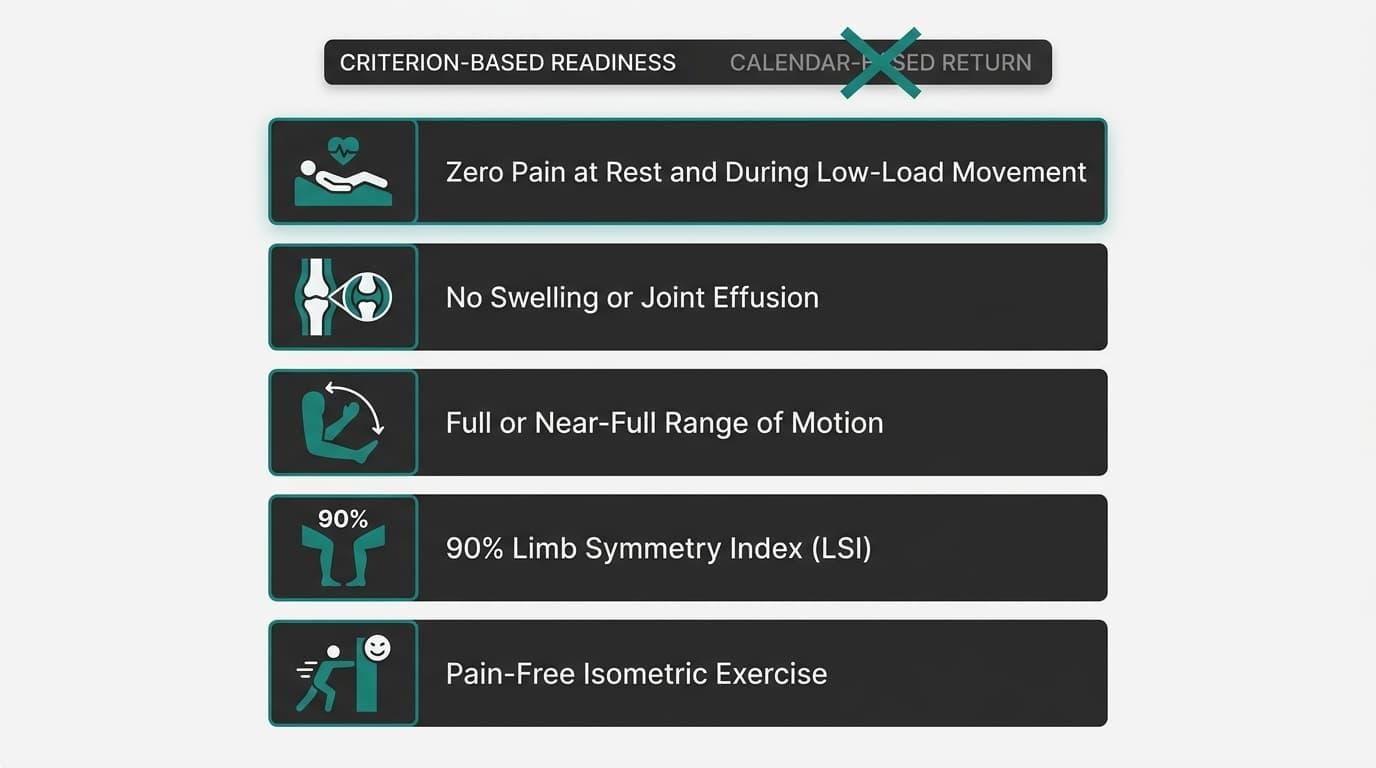
Time is not a readiness marker. Tissue is. The most consistent mistake athletes make after a knee injury is treating the six-week mark like a clearance form.
Pain feels manageable, the joint seems okay, and they load it before it’s actually prepared for that stress. That’s how re-injuries happen.
Criterion-based progression changes that logic entirely. Instead of counting days, you measure the knee against specific, objective benchmarks before advancing to the next training phase.
The scientific framework behind this is Physical Stress Theory: tissue adapts positively to graded mechanical load and breaks down when load exceeds its current capacity.
Objective Benchmarks That Signal Real Readiness
Before returning to any loaded gym work, the knee needs to clear five non-negotiable checkboxes:
-
Zero pain at rest and during low-load movement. Discomfort under load is a signal that the tissue isn’t ready, not a hurdle to grind through.
-
No swelling or joint effusion. Persistent fluid in the knee signals ongoing inflammation that heavier training will only aggravate.
-
Full or near-full range of motion compared to the uninjured side. Restricted motion under load compounds mechanical stress on surrounding structures.
-
Quadriceps and hamstring strength symmetry. Return-to-sport research after ACL reconstruction identifies a 90% limb symmetry index (LSI) as the threshold before returning to sport-specific loading.
-
Ability to perform isometric exercises without pain. Isometric work is the entry point for reloading the quad without joint shear. Pain here means the tissue isn’t ready for dynamic demands.
Return-to-sport criteria following knee injury consistently reinforce that quadriceps strengthening symmetry and functional movement quality are stronger predictors of safe return than time elapsed.
A physical therapist adds the external checkpoint that self-assessment simply cannot. Objective testing, not feeling, confirms readiness.
Knee Injuries That Make Athletes Go Back Too Soon
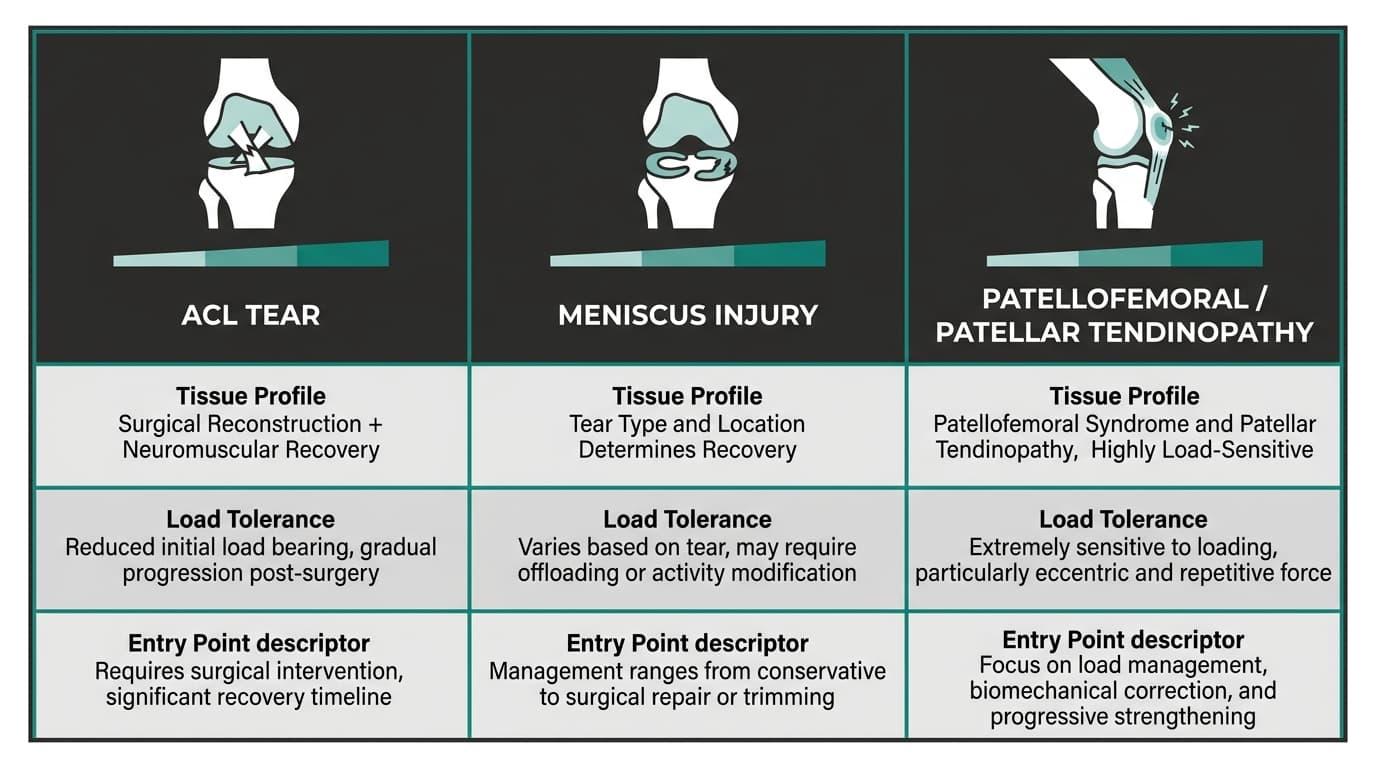
Not all knee injuries are created equal.
Treating them as interchangeable is one of the fastest ways to end up back on the sideline.
ACL Tears, Meniscus Damage, and Patellar Issues: What Makes Them Different
Here’s a brief breakdown of the most common gym-relevant knee injuries and why they demand different starting points:
-
ACL tear: Often requires surgical reconstruction, followed by an extended neuromuscular recovery period. Re-injury risk stays elevated until strength symmetry between both legs is confirmed. Time alone does not restore neuromuscular control.
-
Meniscus injury: Recovery depends heavily on tear type and location. Partial tears in well-vascularized zones may allow earlier return to low-impact work. Full tears or complex patterns typically require a more conservative progression.
-
Patellofemoral syndrome and patellar tendinopathy: Both are highly load-sensitive. Squats, leg press, and stair work are common aggravators. Returning to these movements too soon, even at reduced weight, can set recovery back significantly.
This isn’t diagnostic guidance. Identifying your specific injury type is the job of a physical therapist who has assessed your individual presentation.
The point is that your injury type determines where you start, which is exactly why the phased framework below is built around progression criteria, not fixed timelines.
The Four-Phase Comeback Framework: From Mobility to Full Training and Expected Return
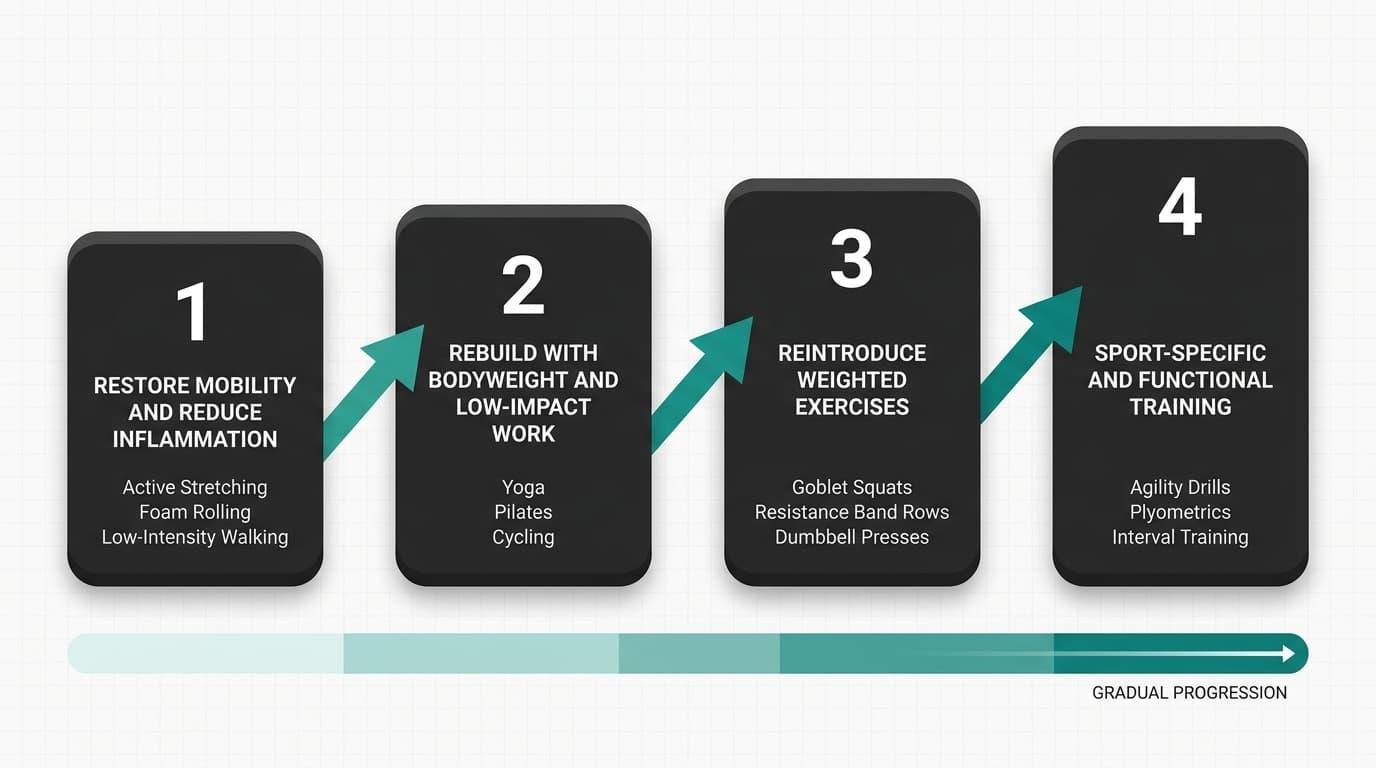
Physical Stress Theory is the backbone of this entire framework.
The goal isn’t to rush; it’s to apply the right stress at the right time so the knee builds tolerance instead of breaking down.
Gradual progression is the non-negotiable rule across all four phases.
One good day does not mean you should skip ahead.
Phase 1: Restore Mobility and Reduce Inflammation
The entry point is about range of motion and pain control. In Phase 1, the priority is calming the joint down and restoring basic movement without aggravating inflamed tissue.
Heel slides and isometric quad sets are the workhorses here. Isometric exercises allow quadriceps activation without joint shear, making them the safest way to reawaken the quad when the knee is still reactive.
A stationary bike at zero resistance is one of the most underrated tools at this stage; it drives a gentle range of motion through a controlled arc, promotes circulation, and keeps you moving without compressive load. Ice and compression between sessions help manage swelling.
A brace at this stage serves one role: joint support and swelling management. Not performance.
Phase 2: Rebuild With Bodyweight and Low-Impact Work
Once the range of motion is restored and swelling is consistently absent, controlled loading begins. Phase 2 introduces bodyweight squats to a comfortable depth, step-ups, wall sits, and straight-leg raises. These low-impact movements rebuild the foundational strength patterns the knee needs before any external load is added.
Pool walking or swimming works well here for athletes who need cardiovascular work without joint compression. The brace shifts roles in this phase; it’s no longer just managing swelling, it’s providing proprioceptive feedback and giving the nervous system constant sensory input about joint position during movement. That feedback rebuilds confidence in the knee before the loads get serious.
Phase 3: Reintroduce Weighted Exercises
This is where the real rebuild happens, and where most athletes either get it right or undo weeks of progress. Phase 3 introduces goblet squats, Romanian deadlifts, eccentric leg presses, and hamstring curls. Eccentric strengthening is particularly important here. Controlled lengthening under load builds the tissue resilience that protects the knee during deceleration and direction changes.
Balance training and proprioception drills, single-leg stands, and wobble board work are added alongside targeted strength exercises to rebuild neuromuscular control.
The Anaconda Knee Brace was built for exactly this phase. Using 3D knit compression in a 1–2mm profile, it transitions from structural support to a neuromuscular cue as strength returns, moving with you rather than fighting you. At just $49.95, it’s built for athletes coming back from serious injuries, not for spectators.
Phase 4: Sport-Specific and Functional Training
Phase 4 is where gym work reconnects with athletic performance. Lateral agility drills, plyometrics, and a return to barbell lifts mark this stage.
The movements become sport-specific, and the demands on the knee reflect what it will actually face in training. For grapplers and combat athletes, this means rotational loading, level changes, and explosive hip extension.
The brace here is a training tool, not a crutch. Re-injury prevention at this stage depends on the knee being strong enough to handle the demand, and on the athlete trusting it enough to move without hesitation.
Over 400,000 athletes have come to Anaconda looking for exactly that: A brace that holds up under real gym loads and doesn’t get in the way of how they move.
Warning Signs and Riskier Investments in Re-Injury Risks to Watch at Every Phase
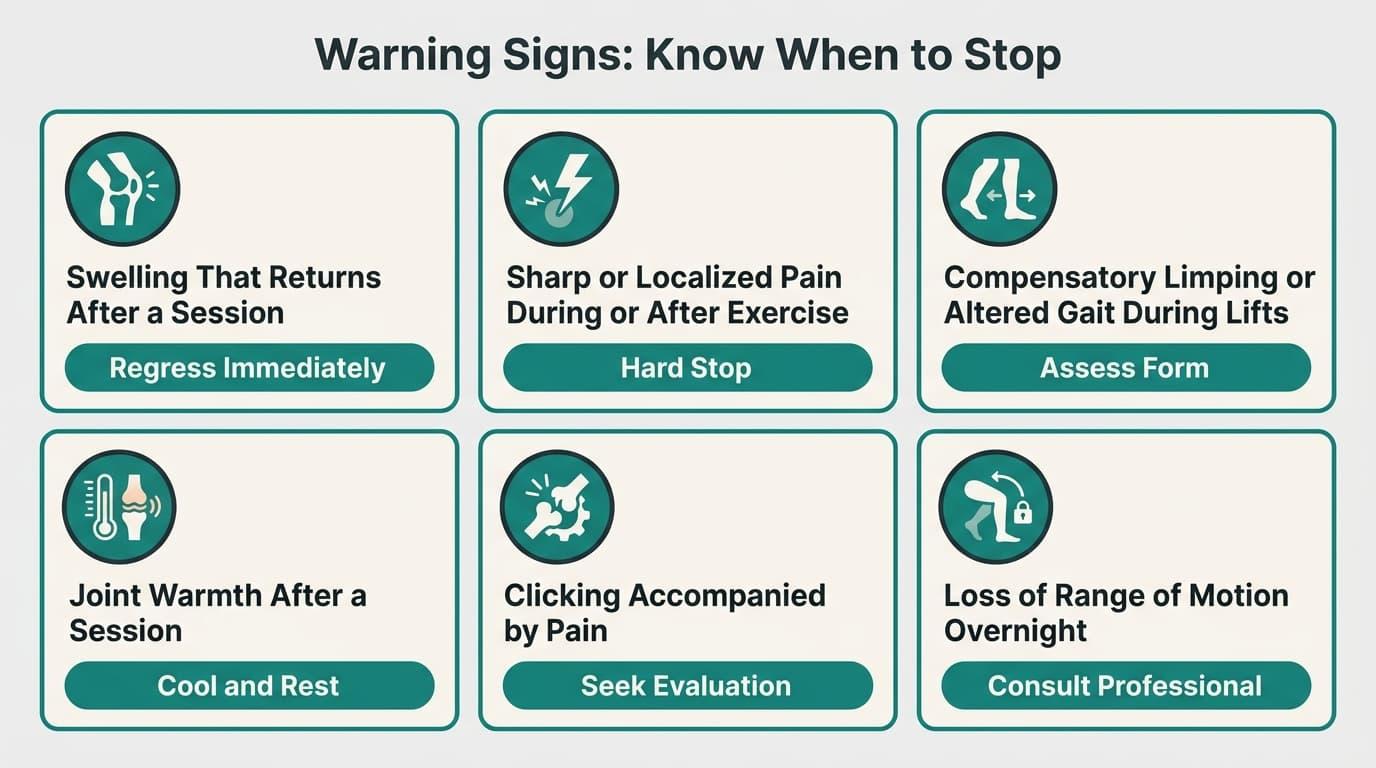
Progress isn’t always linear, which means knowing when to stop is just as important as knowing when to push.
The readiness criteria from earlier apply throughout the entire comeback, not just at the start.
Here are the specific warning signs to monitor across every phase:
-
Swelling that returns after a session: This is a hard stop, not a “push through it” moment. Post-session joint effusion means the tissue is not tolerating the current load.
-
Sharp or localized pain during or after exercise: Regress to the previous phase immediately. Don’t wait to see if it settles.
-
Compensatory limping or altered gait during lifts: If your body is rerouting movement to protect the knee, the surrounding muscles aren’t strong enough yet. Adding load at this point increases risk across the entire kinetic chain.
-
Joint warmth after a session: This is a warm joint signal that ongoing inflammation needs to be addressed before your next session.
-
Clicking accompanied by pain: Clicking alone isn’t always a concern, but clicking paired with pain warrants a step back.
-
Loss of range of motion overnight compared to the day before: This is a reliable early indicator that the tissue is being overloaded.
The biggest re-injury risk across all phases is progressing on feel-good days rather than objective return-to-play criteria.
One strong session doesn’t confirm readiness. And here’s a long-term note most comeback guides skip: Quadriceps and hamstring strength deficits can persist five to ten years post-injury.
Maintenance training after return isn’t optional, and gradual progression doesn’t end when you hit the gym again.
The Mental Side of Coming Back: Fear, Confidence, and What to Do About It
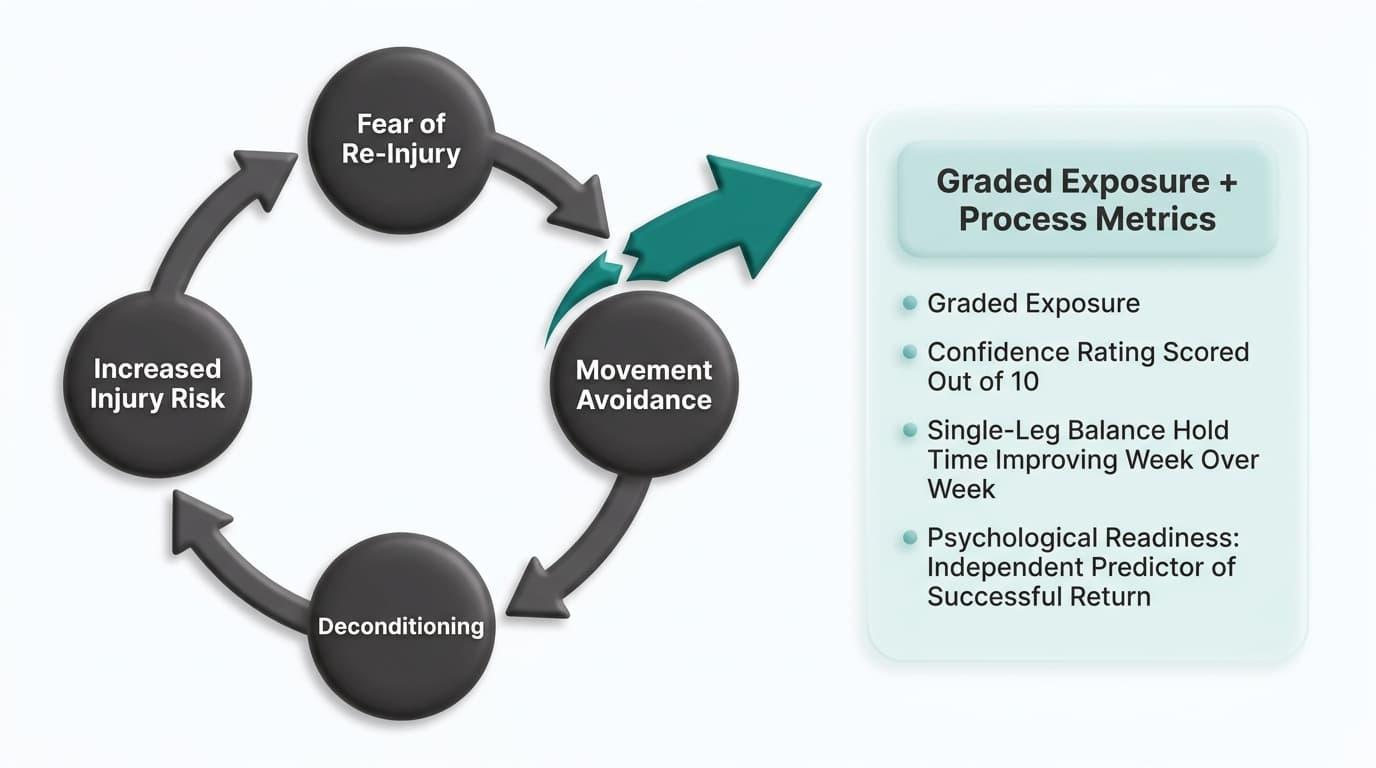
Fear of re-injury is not a weakness. Research identifies psychological readiness as an independent predictor of successful return to sport, separate from physical benchmarks entirely. Athletes who clear every physical criterion but carry unresolved fear are still at elevated risk of setback.
Kinesiophobia, the fear of movement due to anticipated pain or re-injury, creates a damaging loop.
Fear leads to movement avoidance. Avoidance leads to deconditioning. Deconditioning increases actual injury risk. The very outcome you’re trying to prevent becomes more likely because of the fear itself.
Breaking that loop starts with shifting what you measure. Instead of chasing pre-injury PRs, track process metrics:
-
Sets completed at the target depth
-
Single-leg balance hold time is improving week over week
-
Range of motion closing the gap with the uninjured side
-
Confidence rating during a specific movement, scored out of 10
Graded exposure applies the same logic as Physical Stress Theory to your mindset.
Do the feared movement first at a reduced load. Build tolerance to the stimulus before increasing demand.
A physical therapist or sports psychologist can structure this process if fear is actively limiting your training sessions.
Proprioception plays a direct role here, too. A well-fitted brace provides constant sensory feedback to the nervous system during loaded movement, which reduces the fear signal the brain generates around an injured knee.
Confidence and physical support aren’t separate tools in knee injury recovery. They reinforce each other.
Final Words
The difference between a clean comeback and a re-injury isn’t luck. It’s readiness criteria, phased progression, and the discipline to earn every step before taking it. Athletes who follow that process return stronger. Athletes who skip it come back twice.
At Anaconda, we engineered our knee brace because our founder lived this exact journey after tearing his ACL and MCL.
We know what knee injury recovery actually demands, and we built a brace designed for the comeback, not the sideline. Orders ship within 24 hours and come backed by our 30-day return guarantee. Your knee has more left in it. Let’s keep it that way.
Frequently Asked Questions: The Official Report
Concerned about knee injuries, recovery timelines, or returning to training safely? Here are quick answers to the most common questions athletes ask about knee health and rehabilitation.
What is the number one mistake that makes knee injuries worse?
The biggest mistake is returning to full training before the knee is fully ready. Many athletes base their return on how the knee feels rather than measurable strength and stability benchmarks. Reduced pain does not always mean the tissue has recovered completely. Progressing too quickly often leads to setbacks and reinjury.
Can an old knee injury come back years later?
Yes, old knee injuries can return years after the original injury. Lingering strength deficits, scar tissue, and movement compensations can become problematic when training intensity or volume increases. This is especially common when athletes stop doing maintenance strength work. Long-term knee health requires ongoing attention even after recovery.
What are three signs of a meniscus injury in the knee?
Three common signs of a meniscus injury are joint line pain, swelling after activity, and a locking or catching sensation during movement. Some people also experience stiffness when bending or straightening the knee. These symptoms often become more noticeable during squats, pivots, or changes in direction. Professional evaluation is recommended if they persist.
Does a knee injury ever fully heal?
Yes, many knee injuries heal well enough for a full return to sport and training. Recovery depends on the type of injury, rehabilitation quality, and long-term strength maintenance. Some injuries may leave minor differences in stability or movement that require ongoing management. Even after recovery, consistent strength training remains important for preventing future issues.
Can a knee injury heal in 2 weeks?
Some minor knee irritations or soft tissue strains can improve within two weeks with proper rest and load management. More serious injuries, such as ACL tears, ligament damage, or meniscus tears, require much longer recovery timelines. Pain relief alone does not mean the knee is ready for full training. Always assess recovery based on function, strength, and stability rather than symptoms alone.


