


Knee pain after squats is one of the most common complaints in any training environment, but it's rarely one single problem that’s causing it.
Where it hurts, when it starts, and what makes it worse are all diagnostic signals that point to very different causes and very different fixes.
The mistake most athletes make is treating all knee pain the same. They back off for a week, feel okay, and repeat the same loading pattern that got them here. The cycle continues.
Understanding what's actually driving the discomfort, whether it's a tracking issue at the kneecap, a muscle imbalance at the hip, or a mobility restriction at the ankle, is the only way to break it.
At Anaconda, we built our knee support range for athletes who refuse to sit out. Whether you're managing an ongoing issue or trying to prevent one, our braces are designed to keep you training smart, not sideline you.
Key Takeaways
-
Pain location is your first diagnostic signal, front, outer, back, and inner knee, each point to different causes
-
Weak glutes and restricted ankle mobility are the two most overlooked drivers of squat-related knee pain
-
Knee valgus (knees caving inward) is the most common and most damaging squat form error
-
Peak patellofemoral stress occurs between 60 and 90 degrees of flexion, the exact range most squats pass through
-
Most cases of squat-related knee pain are fixable with corrective exercise, load management, and form adjustments
-
Some symptoms, such as swelling, locking, and sharp pain during the lift, require professional evaluation, not more mobility work
Where Does It Hurt? A Location-First Triage Guide
Not all knee pain after squats is due to the same problem. The location of your discomfort is the fastest way to narrow down what's actually going on.
Use the table below as your starting point, then read through the sections that match your experience. These patterns can also reflect common knee injuries affecting the knee joint, including front-of-knee irritation, meniscus-related pain, and collateral ligament stress that show up among sports-related knee injuries.
|
Pain Location |
Most Likely Cause |
Key Signal |
|---|---|---|
|
Anterior (Front) |
Patellofemoral syndrome, Patellar tendinitis |
Pain under or around the kneecap during or after squats |
|
Lateral (Outer) |
IT band syndrome |
Sharp or burning pain along the outer knee edge gets worse with volume |
|
Posterior (Back) |
Hamstring strain, Baker's cyst |
Deep ache or pressure behind the knee at full flexion |
|
Medial (Inner) |
Meniscus tear, MCL stress |
Pain along the inner joint line, often with swelling or locking |
Anterior (Front of the Knee)
Front-of-knee pain is the most common complaint after squatting. It often involves the patellofemoral joint and can show up as kneecap pain during squats.
-
Patellofemoral syndrome: Occurs when the kneecap tracks poorly under load, creating friction against the femur.
-
Patellar tendinitis: Involves the tendon just below the kneecap. In some athletes, irritation can also affect the quadriceps tendon above the kneecap. It typically presents as a sharp, localized ache that worsens with heavy or high-rep sessions.
Both conditions respond well to corrective work when caught early.
Lateral (Outer Knee)
Outer knee pain almost always signals IT band syndrome, sometimes called runner's knee.
The iliotibial band tightens and compresses the lateral knee under repeated flexion. Pain outside of the knee can also reflect lateral collateral ligament irritation, not just iliotibial band issues. High squat volume, especially when combined with distance running, accelerates this pattern quickly.
Posterior (Back of the Knee) and Medial (Inner Knee)
Posterior pain typically suggests a hamstring strain or a Baker's cyst, both of which worsen at deep flexion angles. Medial pain is a higher-stakes signal.
A meniscus tears or medial collateral ligament stress often presents with joint-line tenderness; meniscal tears may follow trauma or age-related degeneration, and torn cartilage or cartilage injury here can trigger swelling, pain, and locking during squats. These warrant professional evaluation sooner rather than later. Don't wait for them to resolve on their own.
What Actually Causes Knee Pain When You Squat
Knee pain during squats rarely comes from a single mistake. It usually comes from a mechanical chain that breaks down under load, and the breakdown usually starts well before the knee itself.
The location-based triage above tells you where it hurts; this section explains why.
The 60–90 Degree Flexion Zone
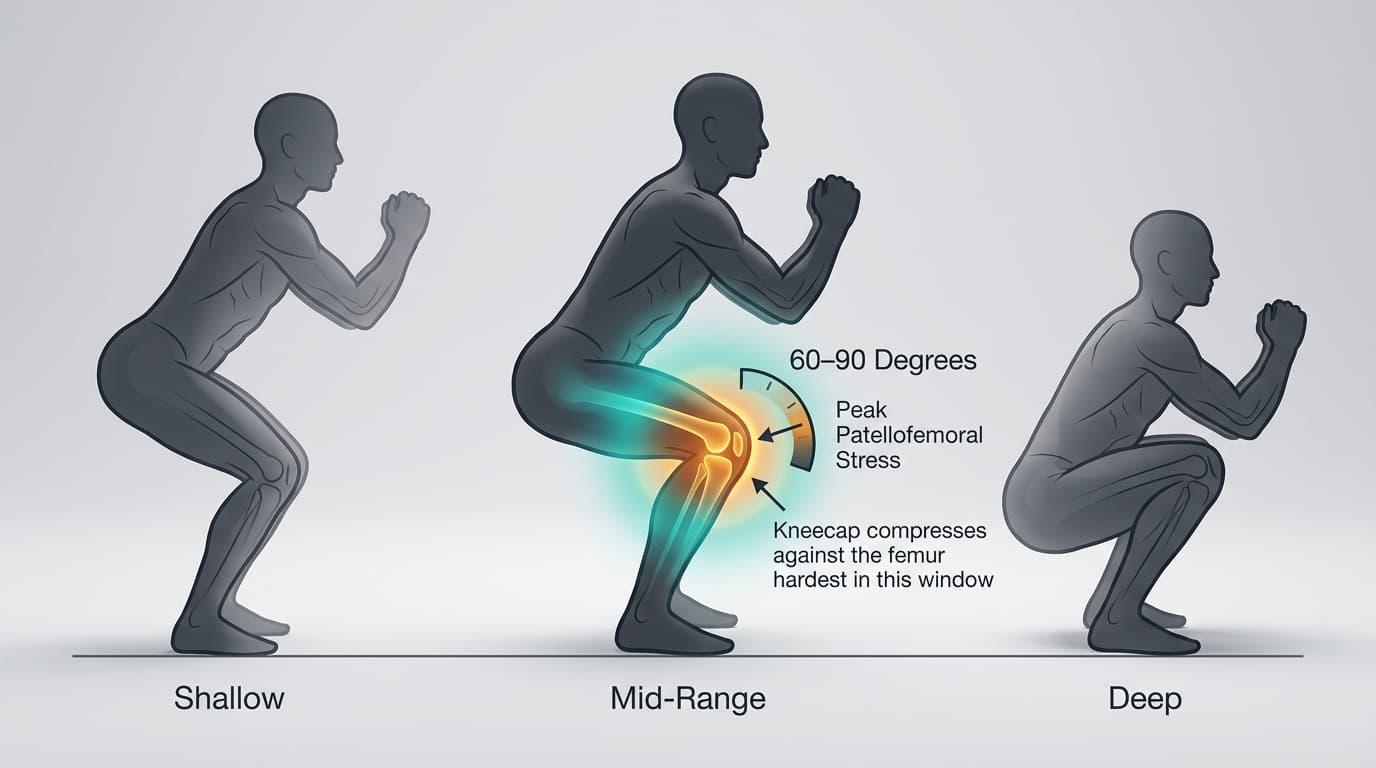
Research links patellofemoral pain syndrome risk directly to the mid-range of knee flexion. Peak patellofemoral stress occurs between 60 and 90 degrees, which is exactly the range most athletes pass through on every single rep.
The kneecap compresses against the femur hardest in this window, and more volume, more load, or poor mechanics through this range accelerates tissue irritation fast. This also explains why deep squats often feel worse than shallow ones. The longer you spend in that compression window, the more cumulative stress the joint absorbs.
Muscle Imbalances: Glutes, Hips, and Quads
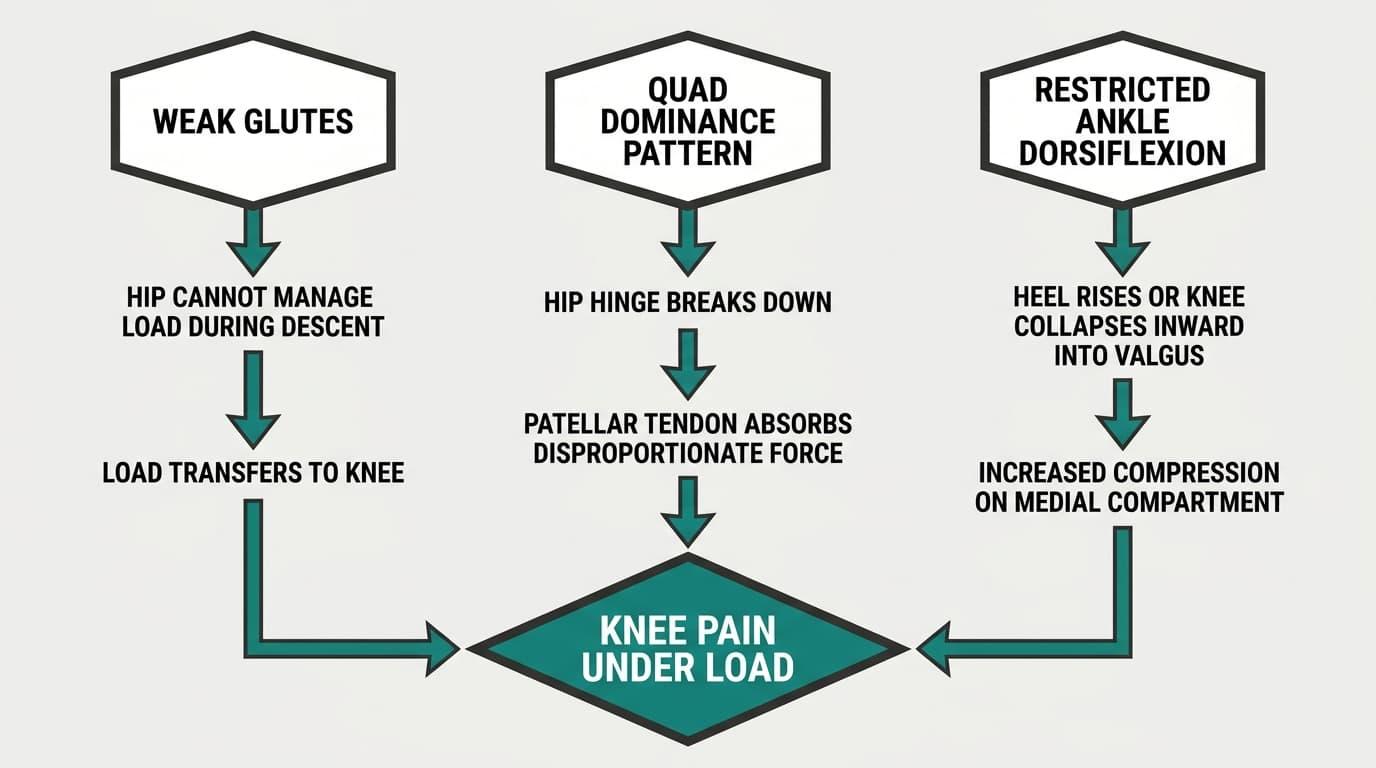
Weak glutes are one of the most common and most overlooked drivers of knee pain in squatting athletes.
When glute strength is insufficient, the hip can’t manage its share of the load during the descent, and that load transfers directly to the knee, increasing patellofemoral stress beyond what the joint is built to handle repeatedly.
Weak hip muscles, glute muscles, and thigh muscles reduce load sharing, while stronger leg muscles improve knee health by stabilizing the knee joint and absorbing force.
Quad dominance compounds the problem. When the quadriceps drive the movement without adequate posterior chain contribution, the patellar tendon absorbs disproportionate force, and the knee muscles have to work with the hips to keep the knees healthy under load.
The hip hinge pattern breaks down, the torso tips forward, and the knee tracks over the toes without control.
The result is a muscle imbalance that punishes the knee for a problem that started at the hip.
Ankle Mobility Limitations
Restricted ankle dorsiflexion is a direct mechanical contributor that most athletes ignore until the damage is done.
When the ankle cannot flex adequately, the heel rises, or the knee collapses inward into valgus. Both compensations increase compression on the medial compartment and shift load onto structures that were never designed to absorb it.
The deeper the squat, the more dorsiflexion the ankle needs, and without it, the body finds a workaround at the knee's expense.
DOMS vs. Injury Pain: Know the Difference
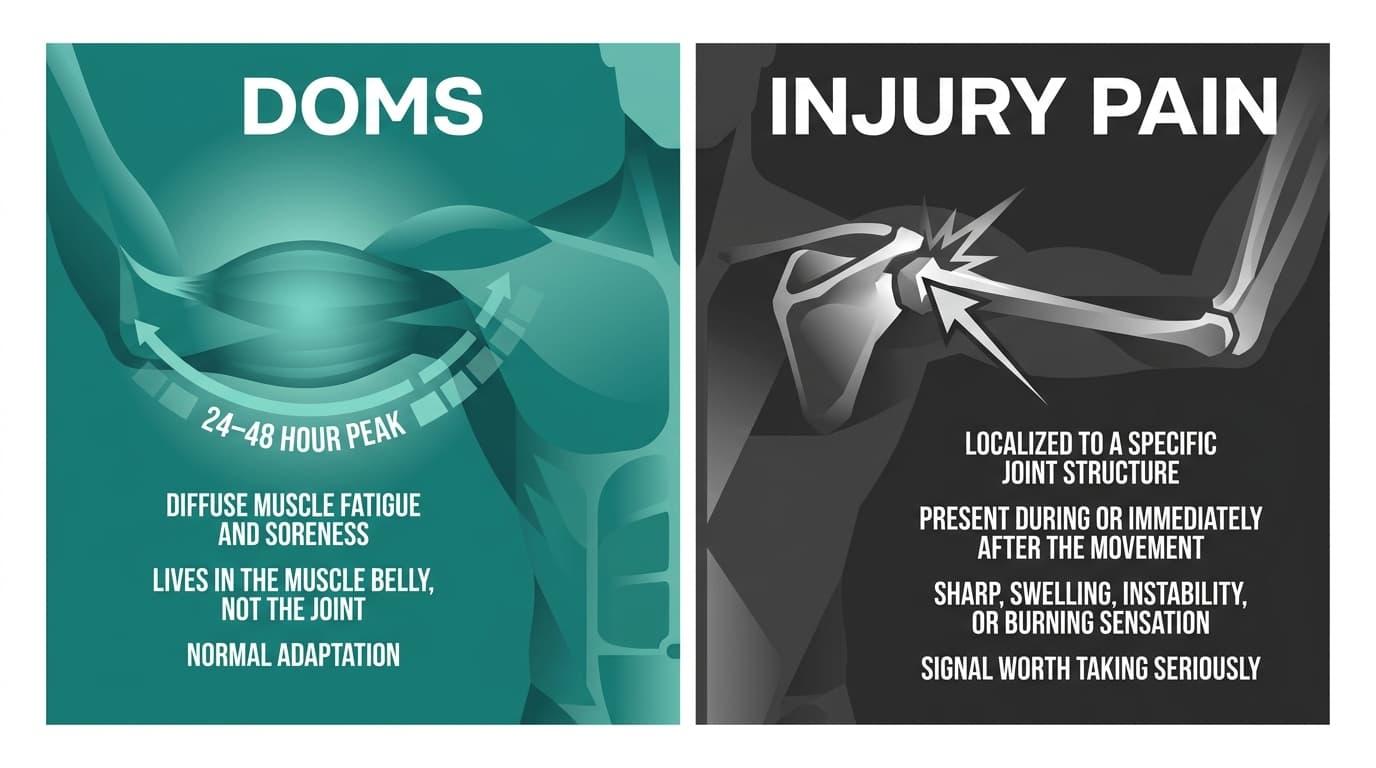
Not all post-squat discomfort is an injury signal.
Understanding the difference between normal adaptation and genuine structural stress can save you from unnecessary worry or from ignoring something that actually needs attention.
-
DOMS (Delayed Onset Muscle Soreness) presents as diffuse muscle fatigue and soreness, typically peaking 24–48 hours after training and living in the muscle belly, not the joint
-
Injury pain is localized to a specific joint structure, often sharp, and present during or immediately after the movement; some acute knee injuries may also bring swelling, instability, or a burning sensation rather than ordinary soreness
-
If the soreness is in the muscle and fades within two days, that's normal adaptation. If it sits in the joint and lingers, that's a signal worth taking seriously.
Squat Form Errors That Put Your Knees at Risk
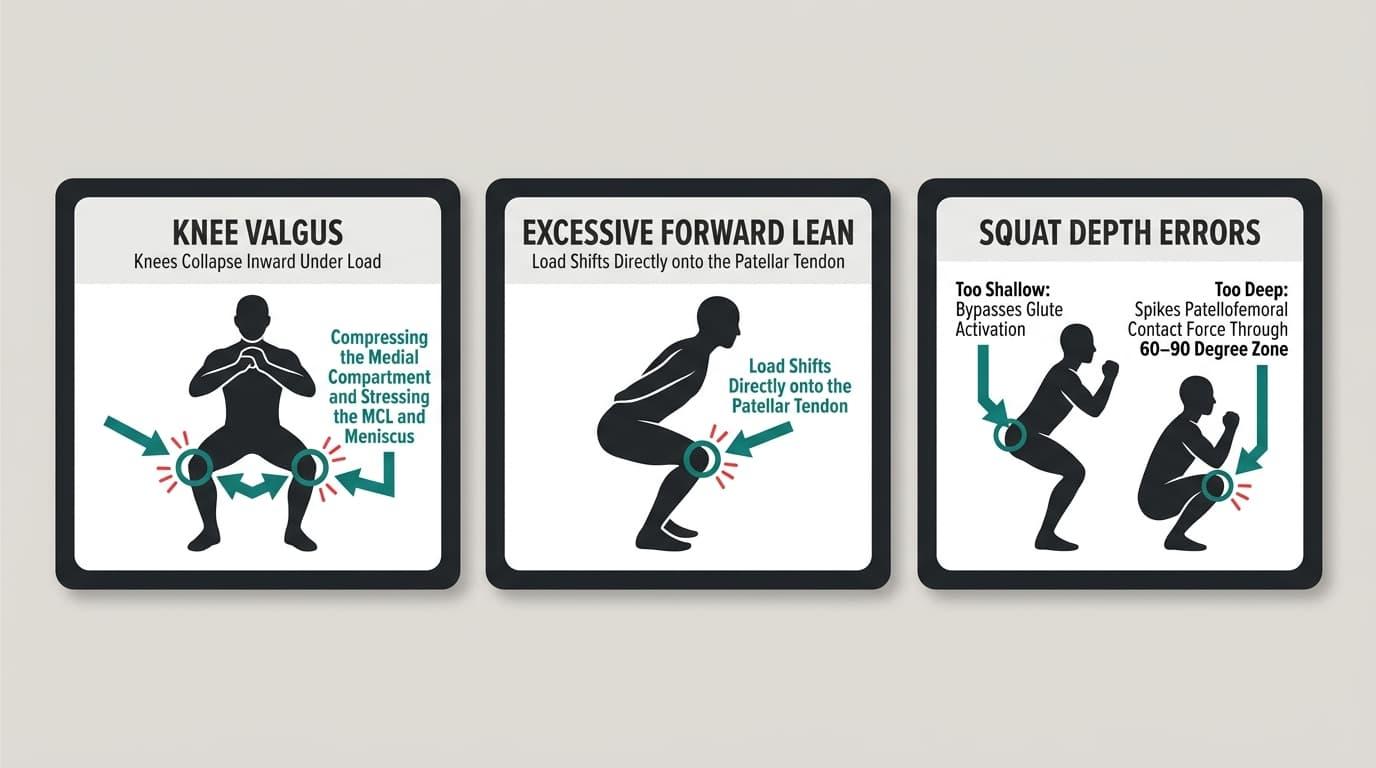
Bad squat form doesn't just look sloppy; it redirects force onto structures that were never designed to absorb it.
The knee is almost always the first to break down. Once you understand the mechanical causes covered above, these form errors become much easier to spot in your own training.
Here are the three primary form errors and what they cost you:
-
Knee valgus: The knees collapse inward under load, compressing the medial compartment and stressing the MCL and meniscus on every rep
-
Excessive forward lean: The torso tips too far forward, shifting load off the glutes and hamstrings and placing it directly on the patellar tendon
-
Squat depth errors: Too shallow bypasses glute activation; too deep without adequate mobility spikes patellofemoral contact force through the 60–90 degree zone
Knee Valgus (Knees Caving Inward)
Knee valgus is the most common and most damaging squat error.
When the knees track inward during the descent or drive phase, the medial compartment absorbs compression that it cannot handle repeatedly.
The MCL, a collateral ligament, stretches under lateral stress, and the meniscus gets caught between the femur and tibia in a position it was never built for. This pattern commonly affects the inner knee because valgus compresses the medial side repeatedly.
Weak glutes and limited ankle dorsiflexion are the two most frequent causes, which means fixing the hip and ankle first usually corrects the valgus on its own.
Poor Hip Hinge and Excessive Forward Lean
A proper squat is a hip-dominant movement. When the hip hinge breaks down, it creates a knee-dominant pattern that can cause pain at the front of the knee as the torso pitches forward and the knees take over a job the hips should be doing.
That forward lean increases the moment arm at the knee, loading the patellar tendon far beyond its intended range. Athletes with tight hip flexors or underdeveloped posterior chains are most vulnerable to this pattern.
Squat Depth Errors
Depth errors cut both ways. Squatting too shallow keeps the glutes disengaged, forcing the quads and patellar tendon to carry the full load without posterior chain support. Squatting too deeply without adequate hip and ankle mobility drives peak patellofemoral stress higher than the joint can manage under load.
Depth control is one of the most actionable variables you can adjust immediately, and it costs nothing to change on your next session.
Red-Flag Symptoms That Need a Professional Eye
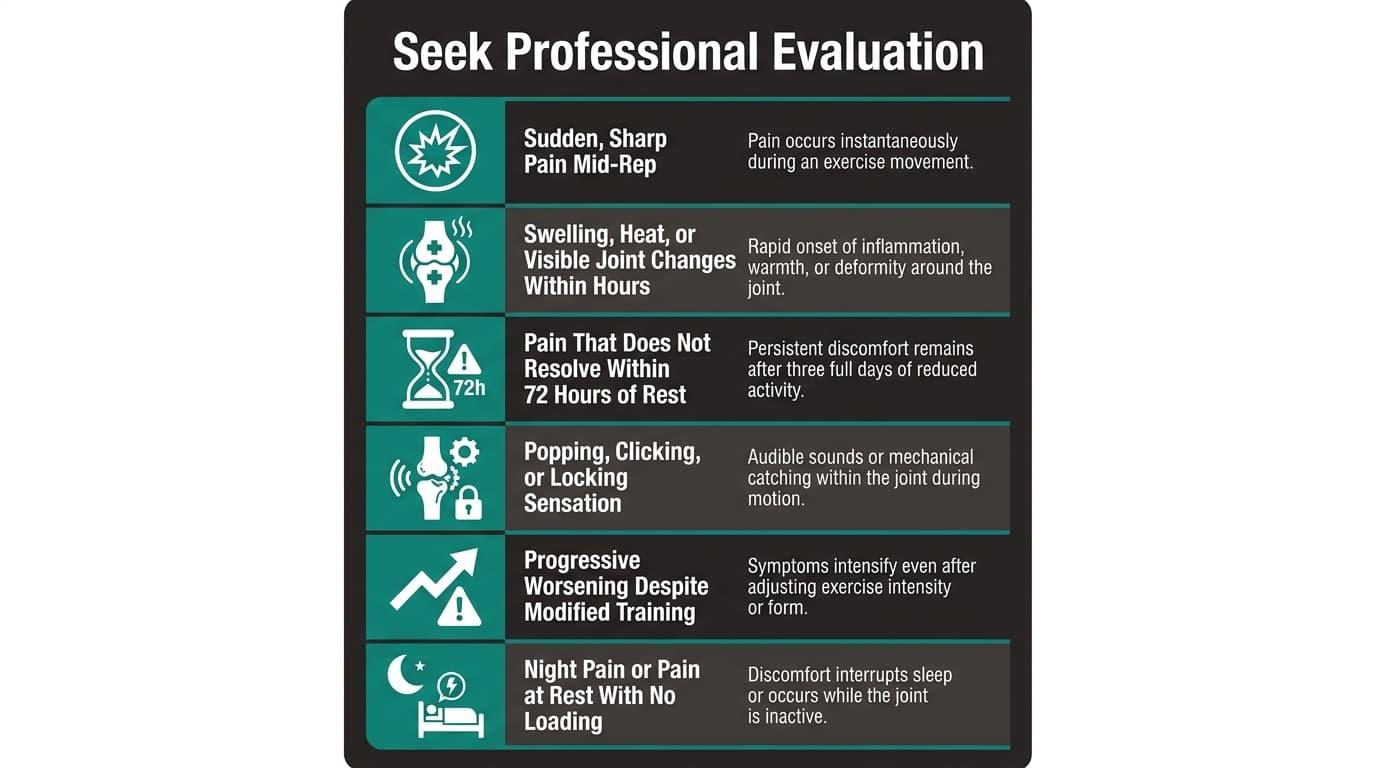
Most knee discomfort after squats is manageable, but some symptoms cross a line that rest and form corrections cannot fix. Knowing the difference keeps a minor issue from becoming a serious one.
Short-term pain relief with over-the-counter options like ibuprofen or acetaminophen may help reduce swelling and discomfort during recovery.
The following signals warrant professional evaluation don't try to train through them:
-
Sudden, sharp pain during a squat that stops the movement mid-rep. Pain that hits during the lift, not after, suggests acute tissue failure rather than accumulated fatigue.
-
Swelling, heat, or visible joint changes within hours of training. Rapid inflammatory responses indicate the joint is reacting to something beyond normal loading stress.
-
Pain that doesn't resolve within 72 hours of rest. Soreness from training fades. Structural irritation does not follow that timeline.
-
A popping, clicking, or locking sensation in the knee. These mechanical symptoms can indicate a meniscus tear, and some cases may point to other knee injuries such as acl injuries involving the anterior cruciate ligament acl, the most commonly injured ligament in the knee, especially after a twisting mechanism, so they merit proper evaluation rather than self-diagnosis.
-
Progressive worsening across multiple sessions despite modified training. If you've already reduced load and adjusted depth and the pain keeps climbing, that's pathology, not a technique problem.
-
Night pain or pain at rest with no loading involved. Pain that appears without a mechanical trigger is a systemic red flag that requires medical evaluation, not more mobility work.
None of these symptoms resembles DOMS. Muscle soreness is diffuse, peaks at 24–48 hours, and lives in the tissue, not the joint. If the pain is sharp, localized, and joint-specific, it belongs in a different category entirely.
How to Fix Knee Pain After Squats: Corrective Exercises and Strengthening
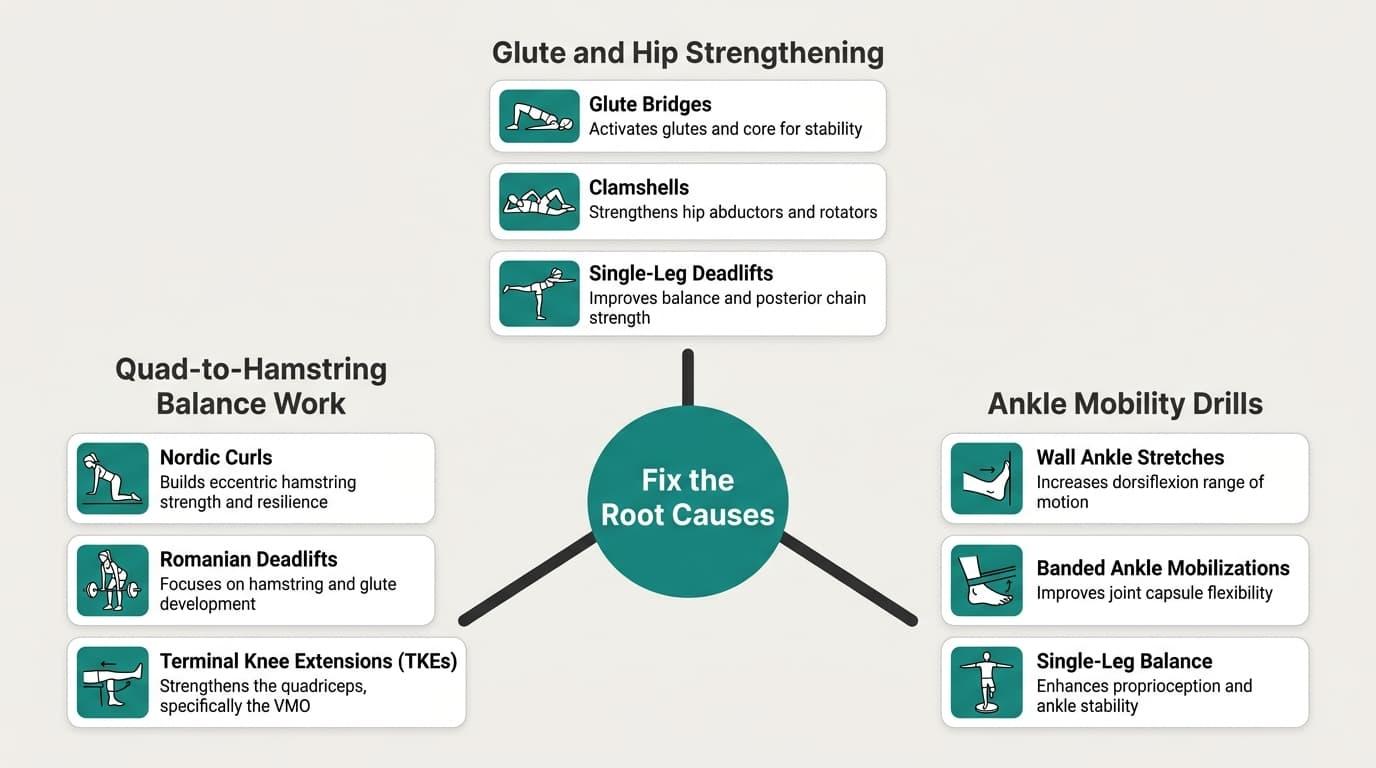
Before starting corrective work, if the knee is acutely inflamed, apply the RICE method: rest, ice, compression, elevation to calm the tissue first.
Once the acute phase settles, the real work begins. Most squat-related knee pain traces back to three fixable problems: weak glutes, a quad-to-hamstring imbalance, and restricted ankle mobility.
Address those three, and the knee usually follows.
Glute and Hip Strengthening
Weak glute strength is the most common upstream driver of knee pain in squatting athletes. These exercises rebuild the hip's ability to absorb load before it reaches the knee, and strengthening exercises guided by a physical therapist or through formal physical therapy can help restore hip control and reduce recurrent pain:
-
Glute bridges: Train hip extension under control, directly reducing patellofemoral stress during the squat descent.
-
Clamshells: Target the gluteus medius, the muscle most responsible for preventing knee valgus collapse.
-
Single-leg deadlifts: Build unilateral hip stability and expose side-to-side muscle imbalance that bilateral squats tend to mask.
Quad-to-Hamstring Balance Work
Quad dominance overloads the patellar tendon on every rep. These exercises restore posterior chain contribution and bring the anterior chain back into balance:
-
Nordic curls: Eccentrically load the hamstrings under high tension, directly countering anterior chain dominance.
-
Romanian deadlifts: Reinforce the hip hinge pattern and build hamstring length and strength simultaneously.
-
Terminal knee extensions (TKEs): Isolate the VMO, the inner quad muscle most responsible for patellar tracking and kneecap alignment.
Ankle Mobility Drills
Restricted dorsiflexion forces the knee into valgus. Fix the ankle, and the knee stops compensating. Start with these two drills before every squat session:
-
Wall ankle stretches: Improve dorsiflexion range directly, reducing heel rise during the squat.
-
Banded ankle mobilizations: Address joint capsule restriction that static stretching alone cannot reach.
Once mobility improves, reduce squat depth and load, rebuild mechanics cleanly, then gradually increase volume.
Load Management and Prevention: Training Through Knee Pain Safely
Corrective exercises address the root causes, but how you structure your training around those corrections determines how quickly you recover and whether the problem comes back. Consistent load management, mobility, and strength work over time help prevent knee pain from returning by improving mechanics and keeping the surrounding muscles strong.
Progressive Loading and Warm-Up Protocols
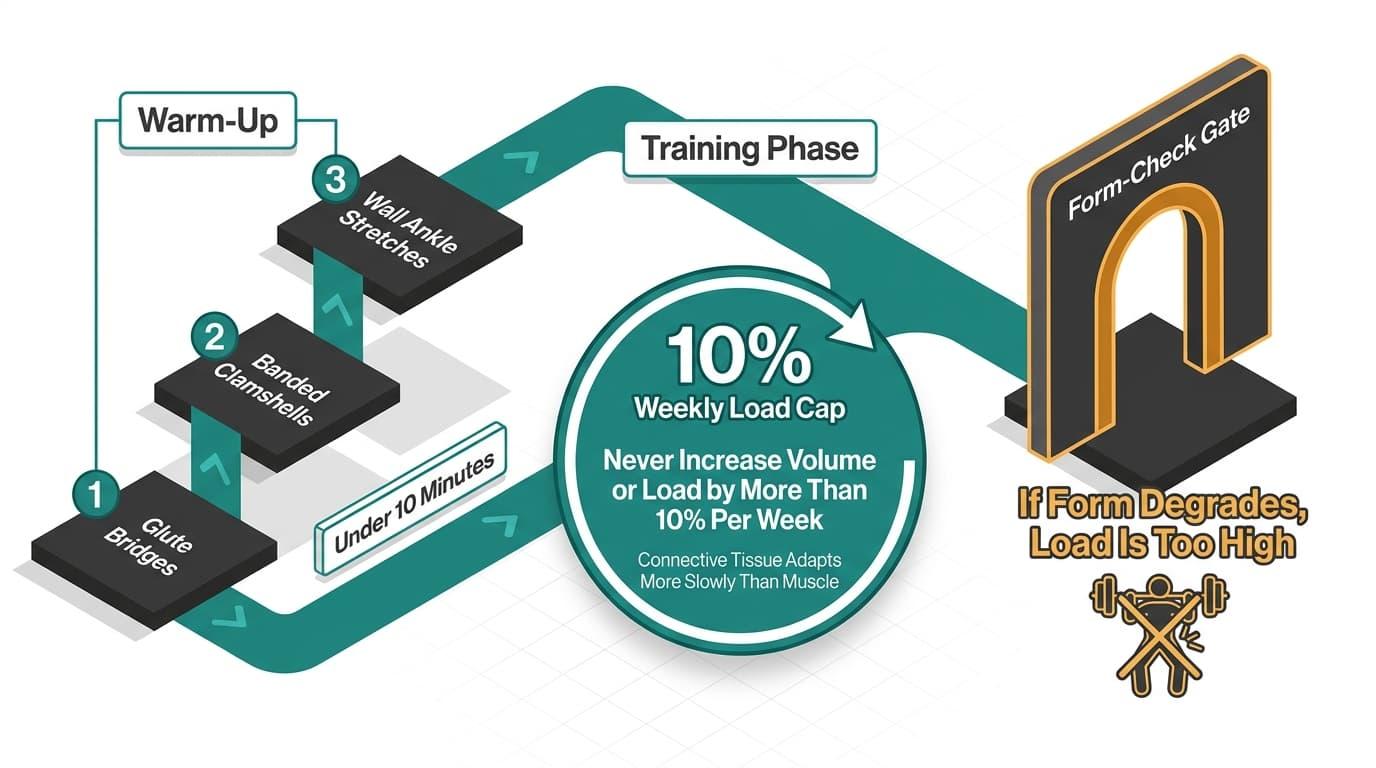
A proper warm-up does more than raise your heart rate.
Before loading the squat pattern, activating the glutes and mobilizing the ankle reduces patellofemoral stress from the first rep.
Glute bridges, banded clamshells, and wall ankle stretches take under 10 minutes and meaningfully change how the knee tracks through the 60–90 degree flexion zone.
Repetitive stress from squats and climbing stairs can aggravate an overuse injury pattern when volume rises too quickly.
Never increase squat volume or load by more than 10% per week.
That ceiling exists because connective tissue adapts more slowly than muscle, and pushing past it is how IT band syndrome and patellofemoral syndrome develop from training that felt manageable until it suddenly wasn't. Squat depth should also be earned progressively, not assumed.
If form degrades as load increases, the load is too high for where you currently are.
Knee Bracing as an Active Load-Management Tool
Bracing during squats isn't about immobilization; it's about proprioception. A compression sleeve worn during training sends continuous sensory feedback to the nervous system, helping the knee track correctly under load. That feedback matters most when fatigue sets in, and squat form starts to drift.
The Anaconda Knee Brace is built specifically for this role. Its Tri-Weave construction distributes compressive force across the joint rather than concentrating it, and the Zero-Slip design keeps it positioned correctly through every rep.
At just 1–2mm thick and weighing between 220–300g depending on size, it moves with you, not against you. For athletes managing knee pain while staying in training, wearing a knee brace during squats is a load-management decision, not a concession.
Conclusion
Knee pain after squats is almost always fixable. Localize it, identify the driver, correct the mechanics, and manage the load. You don't have to stop training; you just have to train smarter.
Pain is information, not a stop sign. The athletes who treat it that way come back stronger. At Anaconda, we built our knee support range for exactly that kind of athlete: the ones who refuse to quit, but are smart enough to know when to adjust.
Frequently Asked Questions
Experiencing knee pain during squats or wondering if you should keep training through it? Here are quick answers to the most common questions lifters ask about squat-related knee pain and recovery.
Should I skip squats entirely if my knees hurt?
No, you don’t always need to stop squatting completely if your knees hurt. In many cases, reducing the weight, adjusting your technique, or limiting squat depth can help manage symptoms while staying active. Complete rest is not always the best solution for mild overuse-related knee pain. However, severe pain, swelling, or a diagnosed injury should be professionally evaluated before continuing.
What is the most common injury from squats?
Patellofemoral pain syndrome is one of the most common knee issues associated with squatting. It occurs when the kneecap does not move smoothly through its normal tracking pattern under load, while patellar tendinitis is another frequent problem, especially in athletes who train with high volume; in older adults, osteoarthritis is also a common source of knee hurt because wear in the knee cartilage, including the articular cartilage, can inflame the joint. Both conditions are often linked to training load, movement mechanics, and muscle imbalances.
What is the number one mistake that makes bad knees worse?
The biggest mistake is continuing to train through knee pain without addressing the underlying cause. Ignoring mobility limitations, muscle imbalances, or poor technique allows irritation to build over time and can turn a short-term issue into chronic pain. Many athletes focus on pushing harder instead of fixing the issue driving the pain. Early correction is usually much easier than dealing with chronic knee pain later.
How long does knee pain from squats usually last?
Mild knee pain from squats often improves within one to three weeks when training load is adjusted appropriately. More persistent conditions like patellofemoral pain syndrome or patellar tendinitis can take several weeks or months to fully improve. Recovery depends on the severity of the issue and how quickly corrective measures are implemented. If symptoms continue beyond a few weeks, professional assessment is recommended.
What is the hardest exercise on the knees?
Deep squats and lunges performed with poor mechanics are often among the most demanding exercises on the knees. Very painful deep squats can also flare meniscal tears, especially sports-related cases, while severe trauma-based problems such as knee dislocation, damage to the cruciate ligaments, a posterior cruciate ligament injury, or other of the most common knee injuries seen by orthopaedic surgeons are different situations that need medical care rather than training tweaks. Jumping and landing movements can also place significant stress on the joint when control is lacking. However, the exercise itself is rarely the problem. Poor movement quality, excessive load, and insufficient strength are usually the factors that increase injury risk.


